
Forklift Battery Maintenance Checklist for Fleet Managers provides the structured, frequency-based protocols required to maximize battery life, minimize unplanned downtime, and maintain OSHA compliance in electric forklift fleets. In 2026 multi-shift warehouses and distribution centers, battery-related failures remain one of the leading causes of lost productivity. A documented checklist reduces those failures, extends service life, and supports consistent total cost of ownership (TCO) performance across both lead-acid and lithium iron phosphate (LiFePO₄ / LFP) packs.
This technical briefing supplies the metrics, differentiated procedures, and decision criteria fleet managers need to implement and audit an effective maintenance program.
Why Structured Battery Maintenance Determines Fleet Performance
Battery health directly controls truck availability, energy cost, and safety exposure. Industry data consistently show:
- Improper watering is the single largest cause of premature lead-acid failure.
- Lead-acid packs typically deliver 1,200–1,500 cycles under good care; poor maintenance can cut that figure by half.
- Quality industrial LFP packs rated ≥3,500 cycles at 80 % depth of discharge (DoD) routinely achieve 7–10+ years of multi-shift service when SOC is kept above the 20–30 % floor and opportunity charging is applied correctly.
- Battery-related downtime in multi-shift operations frequently exceeds $100–$300 per hour in lost throughput plus overtime.
- Cable and connector wear on frequently used lithium packs has become a leading practical failure mode once watering is eliminated.
A formal Forklift Battery Maintenance Checklist for Fleet Managers converts these risks into controllable variables.
Lead-Acid vs Lithium: Maintenance Burden Comparison
| Task / Requirement | Lead-Acid (Flooded) | LFP Lithium (Industrial) |
|---|---|---|
| Daily visual & SOC check | Required | Required |
| Electrolyte watering | Every 5–10 cycles (after full charge only) | Not required |
| Equalization charge | Weekly to monthly | Not required (BMS manages balancing) |
| Terminal / case cleaning | Monthly | Quarterly or as needed |
| Specific-gravity testing | Monthly / quarterly | Not applicable |
| BMS / fault-code review | N/A | Daily / weekly |
| Recharge d'opportunité | Not recommended | Supported (15–40 % capacity top-ups) |
| Typical cycle life (80 % DoD) | 1,200–1,500 | ≥3,500–5,000 |
| Labor hours per battery per year | 20–40+ | <5 |
Lithium packs certified to UL 2580 and IEC 62619 eliminate the highest-labor tasks while shifting attention to connector integrity, thermal monitoring, and charging discipline.
Core Forklift Battery Maintenance Checklist for Fleet Managers
Daily (Pre-Shift / Operator Level)
All chemistries
- Visual inspection of case, tray, and compartment for cracks, bulges, leaks, deformation, or foreign objects.
- Confirm connector pins are clean, undamaged, and fully seated; check cables for fraying or exposed conductors.
- Verify state of charge is adequate for the planned shift. Do not start a shift below the manufacturer’s recommended floor (commonly 20–30 % SOC for lithium; avoid deep discharge on lead-acid).
- Confirm no active BMS fault or warning codes (lithium).
- Ensure charging area and truck bay are free of metal tools or conductive debris on the battery top.
Lead-acid additional
- Quick visual confirmation that vent caps are present and seated.
Every 5–10 Charge Cycles or Weekly
Lead-acid
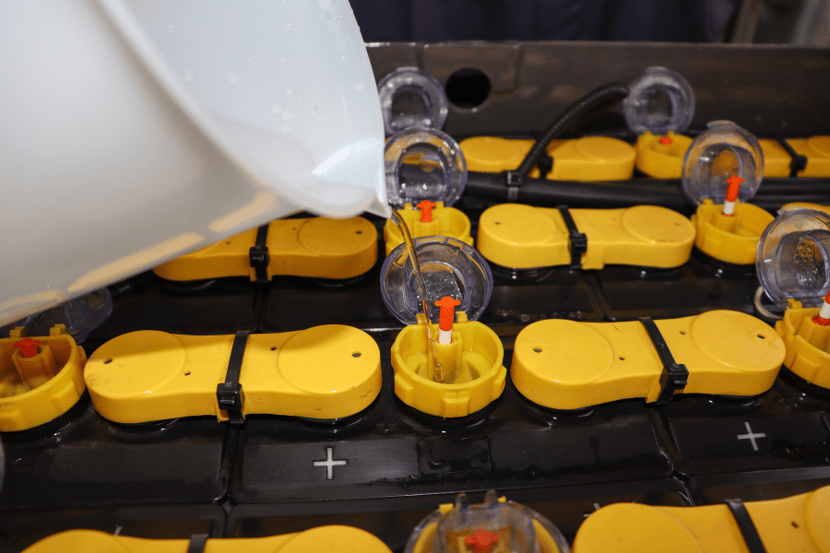
- Water cells with distilled or deionized water after a complete charge cycle only. Fill to the manufacturer’s mark (typically just above the plates / element protector). Never water before charging.
- Perform or schedule an equalization charge if specific-gravity variation across cells exceeds 0.030 or per OEM schedule.
- Check for acid residue on case top and neutralize with baking-soda solution if present.
Lithium
- Inspect charging cable and truck-side connector for wear, insulation damage, or bent contacts.
- Confirm BMS is logging cycles and temperatures correctly (via display or telematics).
- Clean connector contacts with a dry cloth or approved contact cleaner if contamination is visible.
Monthly
Both chemistries
- Torque terminal bolts / connectors to manufacturer specification.
- Detailed inspection of intercell connectors, cables, and tray mounting.
- Clean battery top surface and compartment of dust, debris, or residue.
- Review charge/discharge logs or telematics data for abnormal temperature events, deep discharges, or incomplete charges.
Lead-acid additional
- Measure specific gravity on a representative set of cells after a full charge (target typically 1.275–1.300 corrected for temperature).
- Clean terminals and apply protective spray if corrosion is present.
Lithium additional
- Optional calibration discharge/charge cycle if SOC gauge drift is reported (follow OEM guidance; many modern BMS units self-calibrate).
Quarterly / Every 500 Operating Hours
- Professional capacity test or load test to verify remaining capacity relative to nameplate.
- Thorough cleaning of battery compartment and charger area.
- Verification of charger output voltage and current against battery specifications.
- Review of entire fleet maintenance records for patterns (high water consumption, repeated BMS alerts, connector failures).
Semi-Annual / Annual
- Full visual and mechanical inspection by trained technician.
- For lead-acid: comprehensive equalization and specific-gravity survey.
- For lithium: BMS firmware / software status check and connector contact resistance measurement if recommended by OEM.
- Update residual-value and replacement planning based on measured capacity and cycle count.
Charging Discipline That Protects Cycle Life
Charging practices have equal or greater impact than mechanical inspection.
- Lead-acid: Charge only when SOC approaches 20–30 %. Complete the full charge cycle without interruption. Allow adequate cool-down before return to service. Avoid routine opportunity charging.
- LFP lithium: Opportunity charge freely during breaks or shift changes. Short top-ups of 15–40 % capacity are beneficial and do not count as full cycles against the warranty or cycle-life rating when performed within temperature and current limits. Keep average SOC above the 20–30 % floor recommended by most industrial BMS designs. Avoid prolonged storage at 100 % SOC. Place chargers at advantageous locations around the facility so operators can top up without returning to a central battery room.
Always match charger voltage, current, and profile to the battery chemistry and Ah rating. Mismatched chargers are a frequent cause of accelerated degradation.
Safety and Regulatory Requirements
OSHA 29 CFR 1910.178(g) governs changing and charging of storage batteries. Key compliance points for fleet managers include:
- Designated charging areas with adequate ventilation to keep hydrogen concentrations below explosive limits (lead-acid).
- Immediate access to eyewash and body-flushing facilities where electrolyte is present.
- Appropriate PPE (chemical goggles / face shield, acid-resistant gloves and apron) for lead-acid servicing.
- No open flames, sparks, or metal tools across cell tops during charging or maintenance.
- Operator training that covers battery-specific hazards and procedures.
- Lockout/tagout where required for maintenance work.
Lithium packs certified to UL 2580 (Batteries for Use in Electric Vehicles) and IEC 62619 (safety requirements for secondary lithium cells and batteries for industrial applications, explicitly including forklift trucks) reduce electrolyte and hydrogen hazards but introduce the need for BMS-aware procedures and thermal-runaway response planning.
Implementation Guidance for Fleet Managers
- Convert the checklist above into a printed or digital form that operators and technicians sign off daily/weekly.
- Integrate battery inspection items into the existing forklift pre-shift inspection process required under OSHA.
- Use telematics or BMS data export to flag high-temperature events, deep discharges, or cycle anomalies automatically.
- Track water consumption (lead-acid) and connector service intervals as leading indicators of charger or usage problems.
- Schedule professional capacity testing on a calendar or hour-based interval so residual life is known before failure occurs.
- Maintain records that demonstrate compliance and support warranty claims.
- For hybrid fleets, maintain separate procedures and training for each chemistry.
A living Forklift Battery Maintenance Checklist for Fleet Managers that is audited quarterly produces measurable reductions in emergency replacements and unplanned downtime.
Foire aux questions
How often should lead-acid forklift batteries be watered? After every 5–10 full charge cycles under normal duty, or more frequently in high-temperature or multi-shift environments. Always water after charging is complete, using only distilled or deionized water.
Do lithium forklift batteries require equalization or watering? No. Sealed LFP cells do not lose water and the BMS performs cell balancing automatically. Forced equalization is neither required nor recommended.
What is the most common cause of premature battery failure? For lead-acid: insufficient or incorrect watering and chronic deep discharge. For lithium: repeated operation below the recommended SOC floor, exposure to temperatures outside the BMS limits, or damaged connectors that create high resistance and heat.
How does opportunity charging affect lithium battery life? When limited to partial top-ups (typically 15–40 % capacity) and performed within temperature and current limits, opportunity charging reduces average depth of discharge and supports longer calendar and cycle life. Position chargers near work zones so top-ups become part of normal workflow.
Which standards should be specified for new lithium packs? UL 2580 and IEC 62619 are the primary industrial references used by OEMs and large fleets in 2026. Confirm current certificates and that the BMS includes the required protective functions.
Decision Framework
When establishing or updating a Forklift Battery Maintenance Checklist for Fleet Managers, prioritize in this order:
- Chemistry-specific procedures (lead-acid watering/equalization vs lithium BMS/connector focus).
- Measurable SOC and temperature limits that protect cycle life (≥3,500 cycles at 80 % DoD for LFP).
- Documented daily and weekly operator checks integrated with pre-shift inspections.
- OSHA 29 CFR 1910.178(g) compliance for charging areas, PPE, and training.
- Data capture (logs, telematics, capacity tests) that enables proactive replacement planning.
- Charger compatibility and opportunity-charging rules matched to chemistry, including strategic placement of lithium charging stations.
Forklift Battery Maintenance Checklist for Fleet Managers is not a one-time document. It is an operating system. When executed consistently, it converts battery assets from a source of random downtime into a predictable, high-utilization component of the material-handling fleet. In 2026 the combination of disciplined lead-acid care and the near-maintenance-free nature of certified LFP lithium packs gives fleet managers clear levers to reduce cost per hour and raise equipment availability.
Authoritative References
- OSHA 29 CFR 1910.178 – Powered Industrial Trucks (Changing and charging storage batteries): https://www.osha.gov/laws-regs/regulations/standardnumber/1910/1910.178
- OSHA Powered Industrial Trucks – Vehicle Maintenance guidance: https://www.osha.gov/powered-industrial-trucks/vehicle-maintenance
- OSHA eTool – Electric Power Sources and Battery Charging: https://www.osha.gov/etools/powered-industrial-trucks/types-fundamentals/power-sources/electrical
- IEC 62619:2022 – Secondary cells and batteries containing alkaline or other non-acid electrolytes – Safety requirements for secondary lithium cells and batteries for use in industrial applications (explicitly covers forklift trucks): https://webstore.iec.ch/en/publication/64073
- Modern Materials Handling – Big ideas for lift truck batteries (August 2026): https://www.mmh.com/article/big_ideas_for_lift_truck_batteries
- Modern Materials Handling – Hawker Powersource obtains UL 2580 listing for lithium-ion batteries: https://www.mmh.com/article/hawker_powersource_obtains_ul_safety_listing_for_its_lithium_ion_batteries
- Modern Materials Handling – Special Supplement: Lithium-ion is transforming motive power into a strategic asset (2026): https://www.mmh.com/article/special_supplement_lithium_ion_is_transforming_motive_power_into_a_strategic_asset