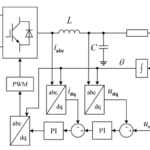


In the event of a major power system fault or prolonged power outage, the energy storage converter must switch to islanded operation mode to ensure continuous power supply to critical loads. In this mode, the converter needs to precisely regulate output power parameters, including voltage amplitude, frequency, and phase angle, to meet the power supply requirements of the load equipment. Therefore, islanded operation mode typically employs a voltage source control strategy. Basic islanding control methods mainly include: constant voltage-frequency (V/f) control strategy and droop control method based on power distribution. The following figures show the system structure block diagrams for these two control strategies.

The V/f control architecture achieves dynamic adjustment through a voltage-current dual closed-loop system: the outer loop maintains stable output amplitude through voltage feedback, while the inner loop utilizes current feedback to improve response speed. It is worth noting that the d-q axis coupling effect of its inner current loop can limit control performance.
Traditional droop control maps active/reactive signals to frequency/voltage regulation quantities respectively through a power calculation module, but its effectiveness is limited by the assumption of inductive impedance in the line. To address the issue of variable impedance characteristics in practical systems, this paper proposes an impedance-robust control scheme: while retaining the dual closed-loop framework, a virtual impedance compensation algorithm is used to eliminate the influence of line parameters. This strategy improves power allocation accuracy in islanded mode and is particularly suitable for mixed impedance network environments.