
What Pack Design Means for a Manufacturer
The customer buys kilowatt-hours. The OEM and the insurer buy evidence that a cell fault, a dropped wrench, or a mast strike does not become a warehouse fire or a tip-over.
Treat the pack as four coupled systems:
- Electrochemical. Cell chemistry, format, series-parallel map, and the cycle condition that will be published.
- Electrical. Busbars, fusing, contactors, pre-charge, isolation monitoring, connector, and charger protocol.
- Mechanical-thermal. Case, ballast, vibration isolation, IP rating, cell spacing, barriers, vents, heaters.
- Control and compliance. BMS functional safety, system lock, telematics, UL 2580 / IEC 62619 / UN 38.3 / EN 1175 interfaces, and the factory quality plan those standards assume.
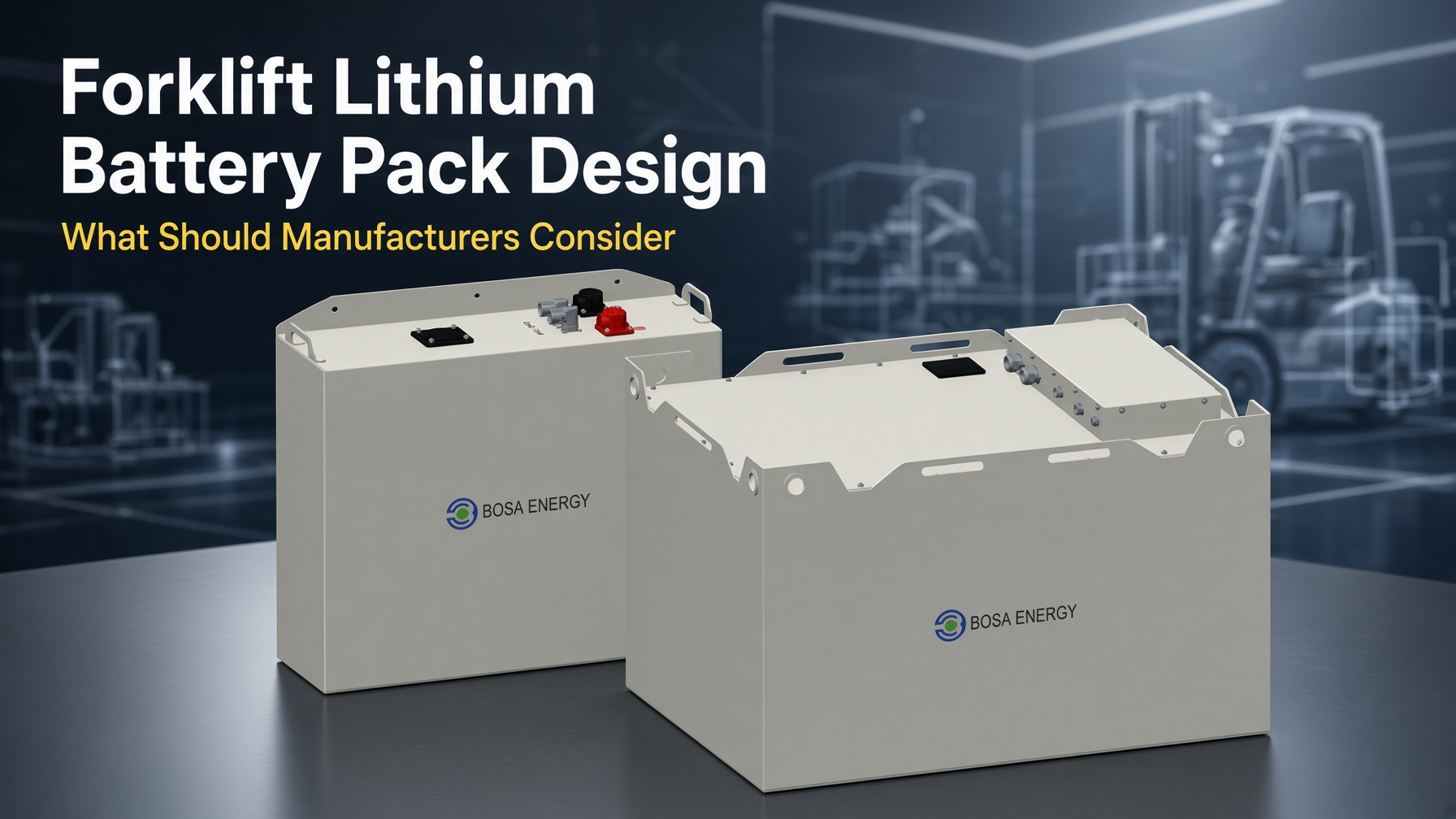
Forklift Lithium Battery Pack Design: What Should Manufacturers Consider? starts here because a pack that is excellent on item 1 and silent on items 3 and 4 will fail the truck listing or the first insurance review.
In 2026 the commercial pressure is the same as the technical one. Hyster’s May 2026 lithium power launch is built around a factory-validated battery–charger–truck ecosystem, modular LFP service, and a charge interlock that stops the truck while plugged in. Raymond’s April 2026 4260 stand-up counterbalance is designed the same way: factory-installed Raymond Lithium packs that exchange energy data with the truck and iWAREHOUSE telematics. Third-party pack makers who cannot hand the OEM a matching protocol, a ballast drawing, and a surveillance file will not make those bills of materials.
Cell Chemistry and Form Factor
Industrial forklift traction in 2026 is overwhelmingly LFP, not high-nickel automotive NMC. LFP’s higher thermal-runaway onset temperature and lower specific energy release give the pack designer more time and a smaller heat load. Specified industrial LFP also publishes the cycle figures multi-shift fleets actually use: ≥3,500–5,000 cycles at 80% DoD to about 80% remaining capacity.
Do not write “lithium-ion” on a datasheet. Write LFP, the cell manufacturer, the format, the cycle test condition, and the date of the cell certificate. Bobcat’s Class I line states LFP explicitly and lists UL 2580 together with IEC 62619, ISO 12405, EMC and UN 38.3. That is the language an OEM purchasing file expects.
Format choices that matter on a forklift:
- Prismatic LFP is the default for 24–80 V traction packs. Large flat faces simplify module compression, face cooling or barrier placement, and steel-case packing density.
- Cylindrical cells appear in some high-rate or modular designs. They need defined spacing, base or side thermal paths, and a fixture that survives vibration without can deformation.
- Pouch cells are a poor default for a compartment that takes fork strikes. Tab strain, swell management, and crush response are harder to prove under UL 2580 mechanical abuse.
Cell incoming inspection is a design control. Lot traceability, incoming IR and capacity sample, and a hold procedure for out-of-family cells belong in the quality plan IEC 62619 expects, not in a later CAPA.
Electrical Architecture and Voltage Platforms
Match the truck platform first. Common industrial voltages in 2026 remain 24 V and 36 V for Class II/III warehouse trucks, 48 V for the bulk of Class I counterbalance fleets, and 80 V (often 80–83.2 V nominal on LFP strings) for higher-capacity riders.
Bobcat’s February 2026 Class I launch, shown at MODEX 2026, is a current dual-platform example: 48 V and 80 V packs at 400 Ah and 600 Ah, UL 2580 on the battery, and a corresponding UL 583 update on the truck when the pack is installed. That pairing—pack listing plus truck listing—is the design target, not an afterthought.
Architecture rules that keep current density and fault energy under control:
- Series groups first. Every series group needs voltage sense. Pack-level voltage is telemetry, not protection.
- Parallel strings only with a reason. Unbalanced parallel paths hide a weak cell until the BMS can no longer explain the current split.
- Busbar and weld design for vibration. Laser-welded or bolted interconnects must survive the UL 2580 vibration profile. A soldered tab that works on a bench will fatigue on a mast. Bobcat’s Class I pack publishes laser-welded connections and a reinforced structure rated to 5G vibration—that is the mechanical language an OEM drawing package now expects.
- Layered overcurrent path. BMS current limit, then a hardware fuse or pyro/contactor sized for the external-short test, then terminal covers that make the short harder to create.
- Pre-charge. Protect the contactor after transport at reduced SOC or after a long idle.
- Isolation and marking. At 60 Vdc and above, UL 2580 notes orange cable/sleeving rules. Insulation monitoring belongs on 48 V and 80 V packs that live in wet or dusty compartments.
- Connector as a designed part. Strain relief, keying, interlock, and a current rating above peak lift current. Connector wear is a 2026 field failure mode; it is not a consumable the pack designer can ignore.
Opportunity charging at 15–40% of capacity is an electrical-design load, not a marketing claim. Size the charge path, the thermal path, and the BMS current table for repeated mid-shift top-ups, not only for an overnight 0–100% profile. Hyster’s purpose-built chargers put the port on the truck, lock motion while plugged in, and use a proprietary handshake—the published FAQ states that only Hyster chargers currently work with Hyster lithium packs, and a lead-acid charger is refused. That interlock and protocol are pack-and-vehicle design items, not dealer accessories.
Mechanical Design, Ballast, and Compartment Fit
On a counterbalance truck the battery is also a weight. OEM data plates publish a minimum—and often a maximum—battery mass. A 48 V / 600 Ah flooded lead-acid jar commonly sits near 900–1,100 kg. A comparable bare LFP pack often lands near 350–550 kg. Installing the light pack without engineered ballast changes the stability triangle and the rated capacity chart.
Design rules:
- Lock ballast inside the case or to designed lifting points. Loose plates in the tray are not an engineering control.
- Meet the compartment envelope without forcing the lid, the retainer, or the cable route. A pack that only fits with the connector standing proud will fail strain relief in a month.
- Design lifting points so a hoist cannot rack the case. OSHA 29 CFR 1910.178(g)(4) still requires a conveyor, overhead hoist, or equivalent when packs are changed.
- Prove crush, drop, and vibration to UL 2580 on the finished assembly, including ballast. Ballast that shifts and shears a cell wall is a self-inflicted short.
- Specify IP for the electronics and connector. Wash-down and cold-store fleets should not receive an open BMS board. IP65 is now a published target on several 2026 OEM packs, including Bobcat’s Class I line, which is specified for indoor, outdoor, and mixed-use compartments.
- Isolate the inner module frame from the outer steel case where vibration and shock would otherwise go straight into cell cans.
A lighter pack reduces handling injury risk. It does not reduce the need for a case that survives a mast strike. After any impact the pack is out of service until a technician clears it.
Thermal Management and Propagation Control
A temperature sensor is telemetry. Thermal design is what happens after one cell fails.
Specify, then test:
- Cell-to-cell or module-to-module barriers that slow conduction.
- Vent paths that send gas away from the operator and away from adjacent cells. Hot vent gas is often the faster propagation path.
- Charge inhibit below a published cell temperature. Cold-soaked LFP must not take a high-rate opportunity charge.
- Derating tables as temperature rises, before a hard cutoff.
- Heaters for cold-store SKUs. Bobcat publishes an automatic cold-weather heat pad and anti-condensation design intended to support operation near −20 °C. Passive cooling is acceptable on many 24–48 V warehouse packs; it is not a universal answer at 80 V, high C-rate, or sub-zero charging.
- A published operating band that matches the UL 2580 thermal-abuse window the report actually used—industry briefings commonly cite swings on the order of −20 °C to 70 °C plus single-cell failure tolerance.
MHL News coverage of certification practice is the right buyer-facing summary of the abuse set: thermal swings, crush and impact, rollover, BMS shutdown under overcharge or short, and fire-propagation control. Manufacturers should treat that list as the design validation matrix, not as a brochure footnote.
BMS, Functional Safety, and Vehicle Communication
IEC 62619:2022 requires independent control and protection methods and a system lock when cells leave the safe operating region. Hawker’s FLEX Li3 program is a current industrial example of pairing a UL 2580 listing with a BMS developed against automotive functional-safety practice (ISO 26262 ASIL C language appears in that product’s published claims). ROYPOW’s 24/48/80 V UL 2580 platform also publicly notes a UL 60730 functional-safety review of the BMS.
Minimum architecture:
- Voltage sense on every series group.
- Multi-point temperature sense at the hottest cells under lift current and at the connector or contactor.
- Pack current measurement on charge and discharge.
- Hardware disconnect that opens if software is late or dead.
- Non-resettable system lock after an operating-region violation. A key cycle must not clear it.
- Charger handshake. The pack refuses a lead-acid profile.
- Controlled power-down. MHI’s lift-truck lithium standards briefing records the OEM concern: an abrupt cut at low SOC can stop a moving truck hard enough to eject the operator. Design the derate, then the open.
- Vehicle and charger communication (CAN or the OEM’s specified protocol) so SOC, temperature, lockout, and charge enable are visible to the truck and to fleet telematics. Hyster Tracker-style integration is the 2026 OEM expectation, not a premium extra.
- EMC robustness. IEC 62619:2022 added EMC expectations; a warehouse is a noisy electrical environment.
Write the SOC floor (20–30%) and the opportunity-charge window (15–40%) into the BMS tables. Operators will run to empty if the pack lets them.
Manufacturing Quality and Change Control
IEC 62619 expects a quality plan. Manufacturers should treat the line as part of the safety case.
Controls that belong in the process FMEA:
- Incoming cell and electronics inspection with lot hold points.
- Weld or bolted-joint process capability, pull tests, and traceability to module serial numbers.
- End-of-line electrical test: isolation, contactor function, sense-wire continuity, BMS boot, charge handshake with the approved charger SKU.
- Pack-level leak or IP sample where the rating is claimed.
- Serialised as-built record: cell lots, BMS firmware hash, ballast mass, measured weight, and test results.
- Firmware configuration management. A field update that changes cutoff voltage is a design change.
- Repair standard. Who may open the case, which parts are field-replaceable, and when a pack is scrap. Hyster’s modular LFP architecture—service the module, not the whole pack—is the design pattern OEMs now ask third parties to match. Operator-facing controls (sleep mode, wake, side-panel status) belong in the same drawing set; they are how a fleet avoids leaving a pack at a deep SOC over a weekend.
A 3,500-cycle rating is meaningless if the first year of production used a different cell tab weld.
Serviceability, Telematics, and End of Life
Design for the technician who will see the pack after a connector burn or a fork strike.
- External diagnostics: SOC, SOH, highest cell temperature, lockout reason, cycle count.
- Connector and cable as service parts with a published replacement interval under high-cycle opportunity charging.
- Documented isolation and LOTO procedure before the lid comes off.
- A damaged-pack path: quarantine area, no charge, OEM or qualified teardown.
- End-of-life: state of health threshold, transport SOC, and a recycler who will accept the chemistry and the case. Second-life claims need a remaining-capacity test, not a brochure sentence.
Telematics is how the manufacturer learns whether the 15–40% opportunity-charge assumption matches the fleet. If trucks sit at 8% SOC every weekend, the BMS table—not the operator manual—has to change.
Design Decision Comparison
Use the table as the internal gate before a design freeze. A blank cell is an unmade decision.
| Design decision | Industrial baseline in 2026 | Failure mode if skipped |
|---|---|---|
| Chimie | Named LFP; ≥3,500 cycles at 80% DoD | Thermal and cycle claims that will not survive a multi-shift fleet |
| Cell format | Prismatic LFP unless a tested cylindrical architecture exists | Crush and vibration failures on pouch leftovers |
| Voltage platform | 24 / 36 / 48 / 80 V matched to the truck, not to leftover cells | OEM rejection; illegal retrofit |
| Ballast / min. weight | Engineered mass to the data-plate minimum | Reduced rated capacity and tip-over risk |
| Sense map | Every series group; multi-point temperature; pack current | Hidden cell faults |
| Independent protection | Hardware contactor or fuse plus BMS limits | Software-only cutoff |
| System lock | Non-resettable after operating-region violation | Damaged pack returned to the charger |
| Thermal architecture | Barriers, vent path, heaters where required, charge inhibit, tested band | Single-cell event becomes a pack event |
| Listings | UL 2580 assembly + IEC 62619 cells/system + UN 38.3; UL 583 / EN 1175 on the truck | No North American OEM or insurer path |
| Charge design | Handshake; 15–40% opportunity-charge thermal path; motion interlock where the OEM requires it | Overcharge or connector melt on mid-shift top-ups |
| Change control | Impact assessment on cell, firmware, structure | Silent loss of the listing |