
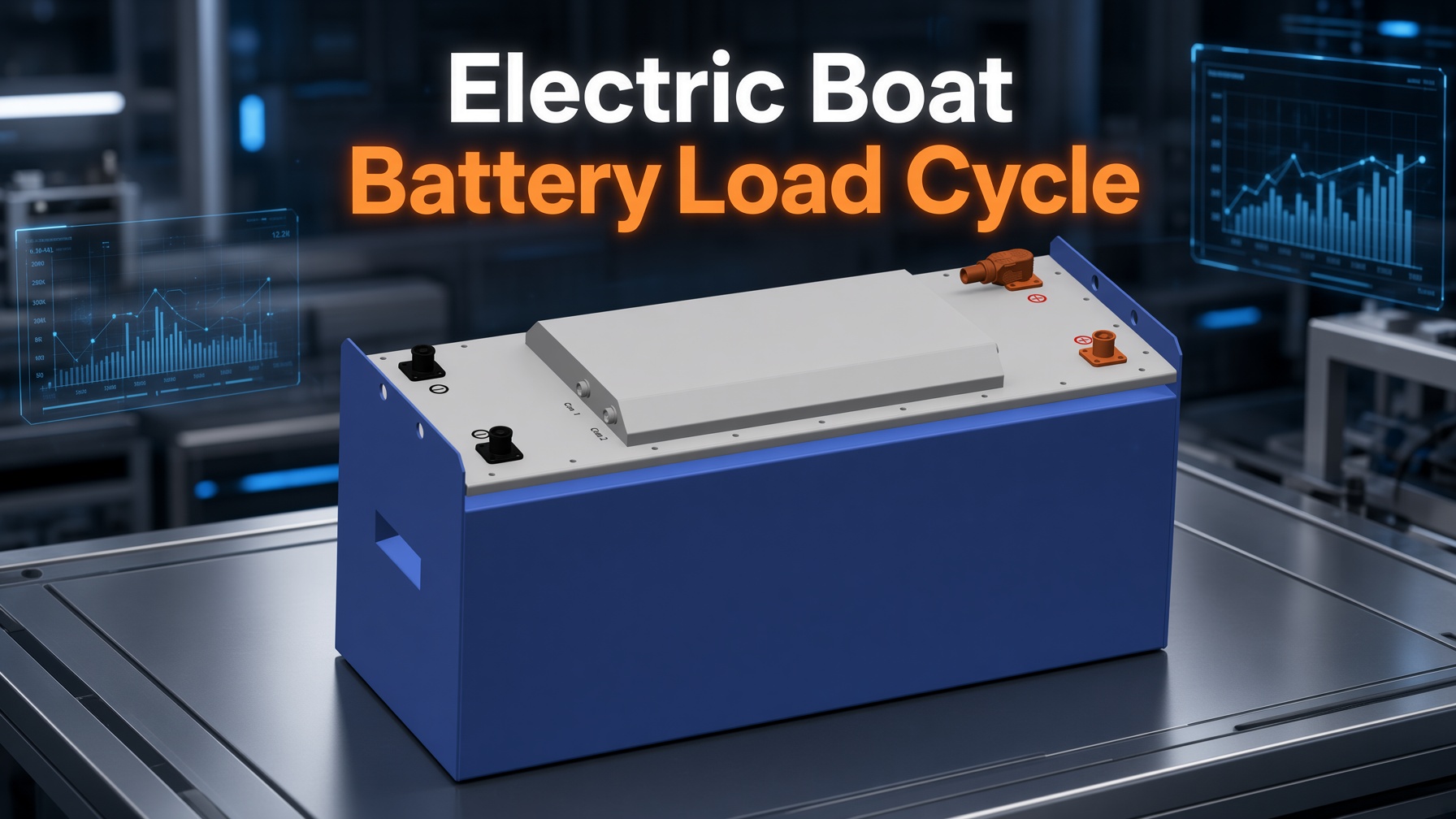
The electric boat battery load cycle defines the real-world power demand profile a lithium battery experiences during operation. It includes acceleration, steady cruising, wave-induced load spikes, docking maneuvers, and idle periods. Accurate understanding of this cycle determines usable range, thermal stress, cycle life, and long-term ownership cost.
In 2026 marine applications, operators who map and manage the electric boat battery load cycle achieve higher reliability and lower total cost of ownership than those who rely on nameplate capacity alone.
What Constitutes an Electric Boat Battery Load Cycle
A load cycle is the time-series pattern of current (C-rate), power, and depth of discharge the battery pack sees over a typical outing or shift. Key elements include:
- Peak power events (planing acceleration or foil takeoff)
- Sustained cruise power
- Transient loads from waves, wind, or passenger movement
- Regenerative opportunities (limited on most displacement or foil craft)
- Rest or opportunity-charge windows
Unlike steady laboratory constant-current tests, real marine profiles are highly dynamic. Research published in Nature Energy demonstrates that realistic dynamic discharge profiles can extend equivalent full cycles by up to 38 % compared with constant-current testing at the same average C-rate, provided the average rate stays in the 0.3–0.5 C window where time-induced and cycling ageing are balanced.
For electric boats the typical daily equivalent full cycle (EFC) count is low—often 0.03–0.3 EFC—yet individual cycles can be deep or high-power, making chemistry and thermal design decisive.
Impact of Load Cycle Severity on Battery Performance
Load intensity directly governs heat generation, lithium plating risk, and capacity fade.
| Duty Class | Typical Peak C-Rate | Average Power Share | Expected Effect on LFP Cycle Life | Example Use |
|---|---|---|---|---|
| Light | <0.5 C | Mostly cruise <30 % rated power | ≥4,000–5,000 cycles @ 80 % DoD | Day-sail, low-speed tender |
| Medium | 0.5–1 C | Mixed cruise + occasional high power | ≥3,500–4,000 cycles @ 80 % DoD | Coastal cruiser, water taxi |
| Lourd | >1 C sustained or frequent peaks | Continuous high-power or rapid cycling | 2,500–3,500 cycles @ 80 % DoD | Fast ferry, commercial workboat |
High-power segments raise cell temperature. Each 10 °C rise above 25 °C roughly doubles calendar ageing rate. Deep discharges below 20 % SOC and prolonged time at >90 % SOC accelerate both calendar and cycle fade. Opportunity charging that restores 15–40 % of capacity during short dock periods keeps the pack in the preferred mid-SOC band and reduces average DoD.

Preferred Chemistry for Marine Load Cycles
Lithium iron phosphate (LFP / LiFePO₄) remains the dominant chemistry for most electric boat battery load cycle applications in 2026. Advantages include:
- Intrinsic thermal stability and higher onset temperature for thermal runaway
- Flat voltage curve that simplifies power delivery under varying loads
- Cycle life of ≥3,500–4,000 cycles at 80 % DoD under typical marine conditions
- Lower raw-material risk and cost compared with high-nickel NMC
Torqeedo’s Deep Blue Battery 80 (79.2 kWh nominal, LFP, cell-to-pack) is rated for at least 3,750 cycles at 80 % DoD or 4,000 cycles at 75 % DoD (25 °C). Continuous discharge capability reaches 79 kW with short peaks higher, matching medium-to-heavy commercial profiles while retaining a 10-year capacity warranty.
NMC packs retain a role where extreme energy density or peak power is required (high-speed planing craft), but they demand more aggressive thermal management and tighter SOC windows to approach comparable calendar life.
Managing the Electric Boat Battery Load Cycle in Practice
Effective management rests on four measurable controls:
- SOC window – Keep daily operation between 20 % and 80–90 % SOC. Avoid routine deep discharges below 20 % and prolonged storage above 90 %.
- Recharge d'opportunité – Use short dock or layover windows to restore 15–40 % capacity. This reduces average DoD and keeps the pack cooler.
- Thermal limits – Maintain cell temperature 15–35 °C where possible. Active liquid cooling or immersion systems become essential for heavy-duty continuous profiles.
- BMS telemetry – Monitor real-time C-rate, cell voltage deviation, and temperature. Modern systems enforce power limits automatically when safe operating limits are approached.
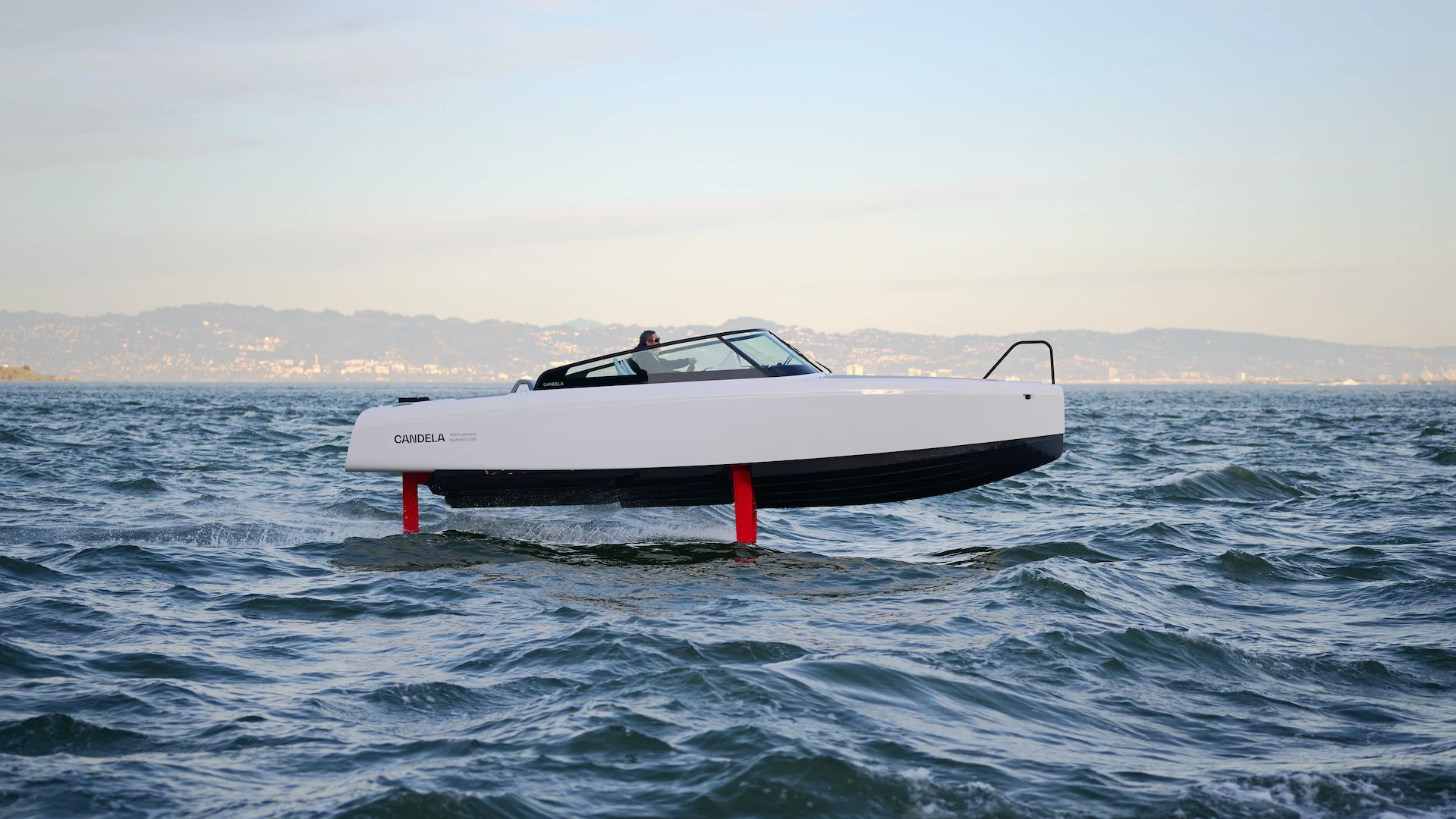
Candela’s C-8 (69 kWh Polestar-derived pack) illustrates efficient load-cycle design: foil-borne cruise at 22 kn consumes approximately 0.9 kWh/nm, delivering 57 nm range while the BMS and software keep the pack inside recommended SOC and temperature bands.
Standards and Certification Requirements
Any battery intended for propulsion or large house loads must satisfy:
- ISO 23625:2025 – Small craft lithium-ion batteries (selection, installation, manufacturer safety information, safe operating limits)
- ABYC E-13 – Lithium-ion battery installation, mandatory BMS with output disconnect, over-current and thermal protection
- IEC 62619 / IEC 62620 – Safety and performance for industrial secondary lithium cells and batteries
- UN 38.3 – Transport testing
Compliance ensures the battery and its BMS can survive the intended electric boat battery load cycle without cascading failures.

Selection Checklist for Operators
- Map the actual power profile (log peak and average C-rate over representative trips)
- Specify usable energy at the expected DoD and temperature (not just nameplate kWh)
- Prefer LFP for cycle life and safety unless weight or peak power absolute constraints force NMC
- Verify continuous and peak discharge ratings match the heaviest expected load segment
- Confirm active thermal management if average power exceeds ~0.5 C for extended periods
- Require IP67 or higher enclosure rating and marine-grade corrosion protection
- Demand BMS data logging and remote monitoring capability
- Calculate TCO using realistic cycle life under the mapped load profile, not laboratory ideal figures
FAQ
How many full cycles does a typical electric boat battery experience per year? Most leisure craft accumulate 50–150 equivalent full cycles annually. Commercial vessels may reach 200–400. Actual calendar life is often limited more by time and temperature than pure cycle count.
Does a more dynamic load cycle always shorten battery life? Not necessarily. Controlled dynamic profiles with rest periods and moderate average C-rates can extend life relative to constant high-current discharge. Extreme peaks and high average temperatures remain the primary stressors.
Should I size the battery for full-throttle continuous operation? No. Size for the realistic duty cycle plus a 15–20 % reserve. Over-sizing purely for peak power increases cost and weight without proportional range benefit.
What is the practical SOC range for daily operation? 20–80 % or 20–90 % depending on manufacturer guidance. This window maximises both cycle life and usable energy.
Decision Framework
- Log or model the vessel’s actual power-time profile under representative conditions.
- Classify the load cycle (light / medium / heavy) and select chemistry accordingly (LFP preferred for most cases).
- Size usable capacity so that average daily DoD stays ≤70–80 % with opportunity charging available.
- Verify thermal system capacity against the highest sustained power segment.
- Confirm certification to ISO 23625:2025, ABYC E-13 and IEC 62619.
- Evaluate 8–10 year TCO using the projected cycle life under the mapped profile rather than optimistic laboratory numbers.
Operators who treat the electric boat battery load cycle as a primary design input rather than an afterthought obtain longer service life, higher availability, and lower lifetime energy cost.
Authoritative References
- ISO 23625:2025 – Small craft — Lithium-ion batteries. International Organization for Standardization. https://www.iso.org/standard/85220.html
- Torqeedo Deep Blue Battery 80 technical data (LFP, cycle life ≥3,750 @ 80 % DoD). https://www.torqeedo.com/us/en-us/green-propulsion/battery-technology-com.html
- Nature Energy (2024): “Dynamic cycling enhances battery lifetime” – quantitative comparison of dynamic vs constant-current profiles. https://www.nature.com/articles/s41560-024-01675-8
- ABYC E-13 – Lithium Ion Batteries (installation and BMS requirements). American Boat & Yacht Council. https://abycinc.org
- Candela C-8 official specifications (69 kWh pack, 57 NM @ 22 kn). https://candela.com/leisure-boats/candela-c-8/
- IEC 62619:2022 – Secondary cells and batteries containing alkaline or other non-acid electrolytes – Safety requirements for secondary lithium cells and batteries for use in industrial applications. https://webstore.iec.ch/publication/66309