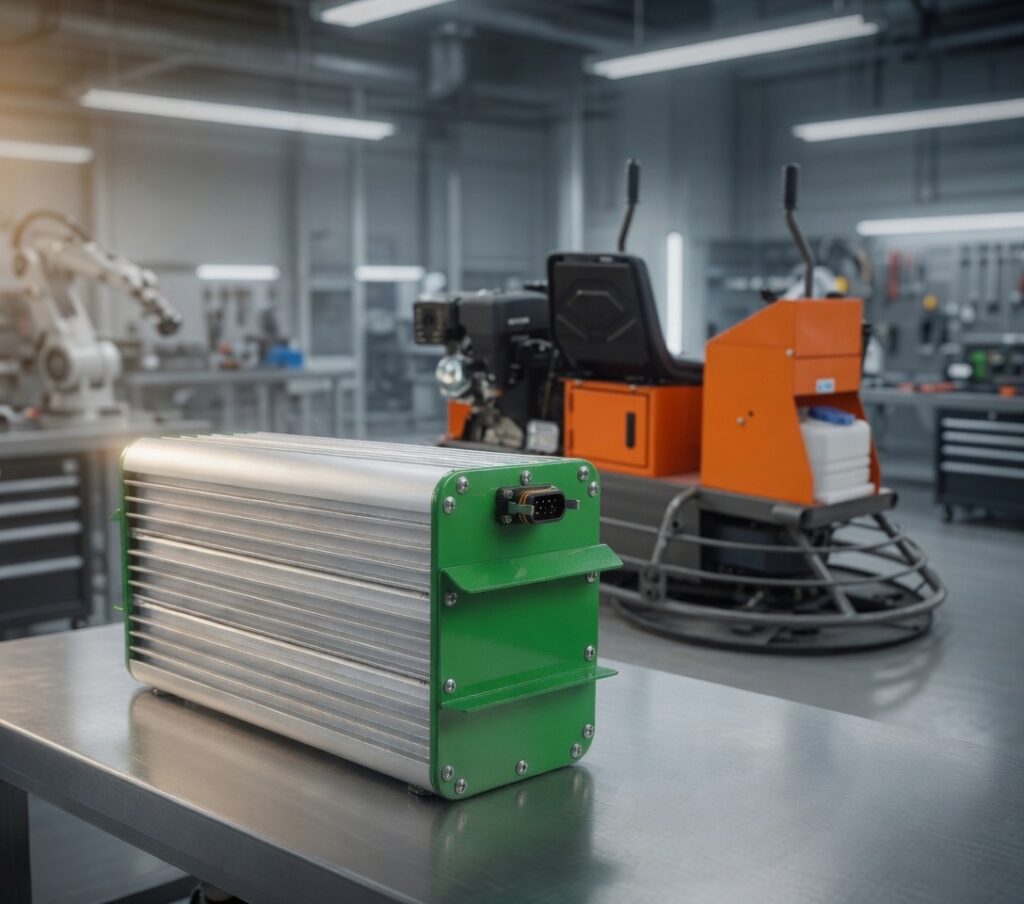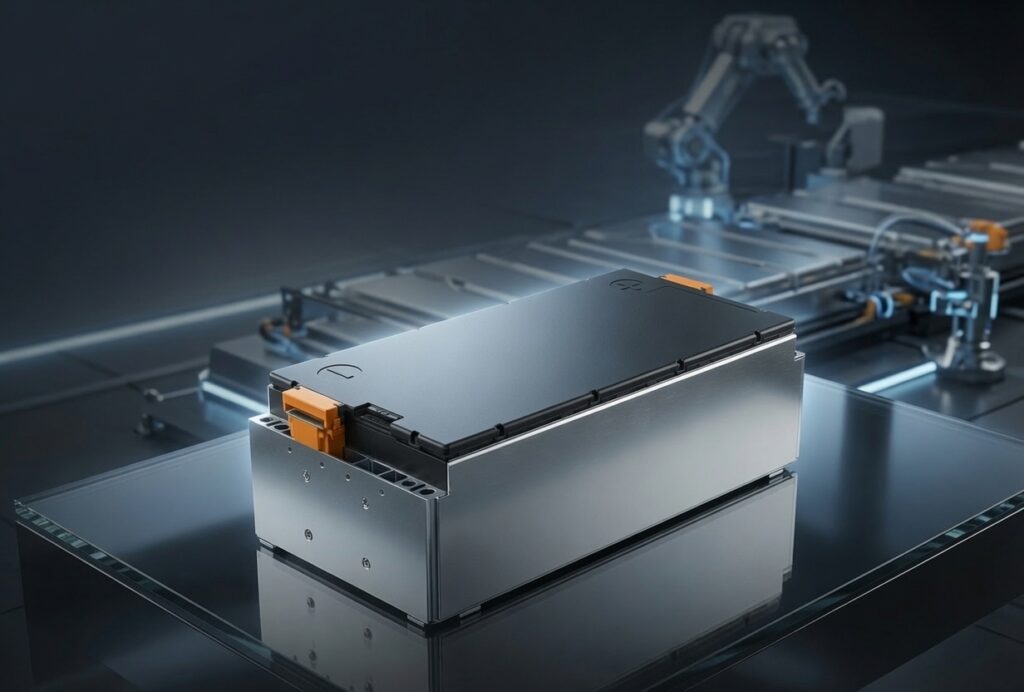

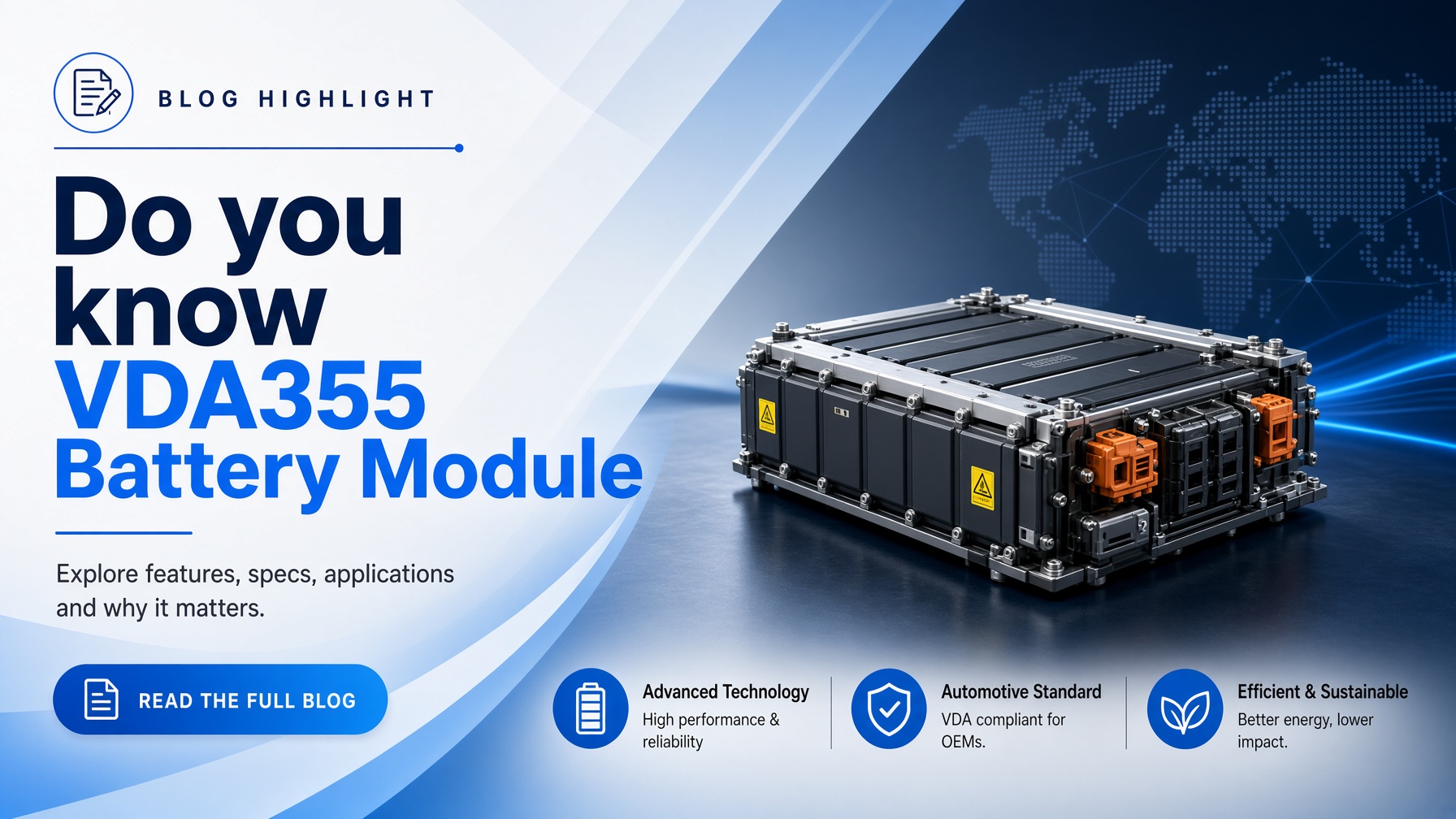
Do you know VDA355 Battery Module? If you specify packs for passenger EVs, light commercial vehicles, forklifts, AGVs, workboats or modular energy-storage racks, the answer should be yes. The VDA355 Battery Module is not one catalog SKU. It is a prismatic lithium-ion envelope of about 355 × 151 × 108 mm that the German Association of the Automotive Industry (VDA) popularized so cell makers, pack designers and service networks can interchange modules without redesigning the tray.
In 2026 the format still sits between a raw cell and a finished pack. LiFePO₄ (LFP) builds typically deliver ≥3,500–5,000 cycles at 80 % depth of discharge, accept 15–40 % opportunity charges, and keep a usable state-of-charge (SOC) floor of 20–30 %. Nickel-rich NCM builds trade cycle life for higher energy density. Both families need a pack-level BMS and duty-matched certification: IEC 62619 for industrial and stationary systems, UL 2580 for electric-vehicle and industrial-truck packs, and UN 38.3 for transport.
Table of Contents
- What the Name Actually Means
- Mechanical Envelope and Internal Build
- Electrical Configurations Used in 2026
- LFP Versus NCM in the Same Box
- Safety, BMS and Certification
- Where Integrators Use the Format
- How to Specify Before You Buy
- Practical Checklist
- FAQ
- Decision Framework
- Authoritative References
What the Name Actually Means
VDA stands for Verband der Automobilindustrie, the German Association of the Automotive Industry. “355” is the nominal module length in millimetres. The association publishes electromobility, battery-safety and quality-management documents; the 355 mm footprint itself is an industry dimensional convention that grew out of Volkswagen-era platforms around 2012 and later became a high-volume interface in Europe and China.
Typical production envelope:
| Axis | Typical value | Common tolerance |
|---|---|---|
| Length | 355 mm | ±1 mm |
| Width | 151–152 mm | ±1 mm |
| Height | 108–109 mm | ±1 mm |
| Mass | 11.0–12.2 kg | chemistry- and hardware-dependent |
Related envelopes exist. VDA390 and the later MEB590 / VDA590 class hold more energy per block. They do not replace the 355 mm length in compact floor pans, industrial trays or modular racks, where that length still packs efficiently.
A VDA355 Battery Module is therefore a packaging decision, not a chemistry decision. The same drawing can hold twelve thin prismatic cells, six thicker cells or four still-thicker cells. That is why a 1P12S 50–58 Ah NCM module, a 2P6S 100–122 Ah module and a 3P4S 150–177 Ah module share one mechanical interface.
Mechanical Envelope and Internal Build
A production module is a small structure, not a loose stack of cells.
- Aluminum alloy end plates and side plates carry compression and crash load.
- Laser-welded or bolted busbars connect cell terminals.
- Two or more temperature sensors sit on the busbar or between cells.
- An FPC or wire harness samples cell voltage; a fuse on the sense line is common.
- Optional CAN, QR traceability and customized high-voltage leads are offered on most OEM/ODM lines.
- Natural cooling is the default. Liquid-cooling plates or gap-filler glue are added when the pack thermal model requires them.
Housing stiffness matters because prismatic cells swell with cycle life. The frame must keep compression inside the cell maker’s window or impedance rises and capacity fade accelerates. Glue-fill and polyurethane foam between cells reduce vibration and improve heat spreading. Some 2026 suppliers use extruded-aluminum “barrel” housings to cut weld count and leave a defined coolant channel on the base.
Operating bands reported across current datasheets:
| Condition | Typical range |
|---|---|
| Charge | −20 to 55 °C (LFP often 0 to 55 °C without a heater) |
| Décharge | −30 to 55 °C |
| Storage | −30 to 55 °C at mid-SOC, not 100 % |
| Module DCR | ≤3–4.5 mΩ on many NCM 1P4S / 3P4S builds |
| Coulombic efficiency | ≥95 % |
| Module self-discharge | ≤3 % per month at 25 °C when the BMS is asleep |
These numbers are planning bands. Acceptance belongs on a rest-voltage and capacity protocol at a stated temperature, not on a brochure.
Electrical Configurations Used in 2026
The same box supports several series-parallel maps. Representative production figures:
| Configuration | Chimie | Tension nominale | Typical capacity | Énergie nominale | Approx. mass |
|---|---|---|---|---|---|
| 1P4S | LFP | 12.8 V | 135 Ah | ~1.73 kWh | ~11.6 kg |
| 1P8S | LFP | 25,6 V | ~50 Ah | ~1.28 kWh | ~11 kg |
| 1P4S | NCM | 14.6–14.8 V | 150–177 Ah | ~2.2–2.59 kWh | 11.6–11.9 kg |
| 3P4S | NCM | 14.7 V | 153–174 Ah | ~2.3–2.55 kWh | 12.0–12.2 kg |
| 1P6S / 2P6S | NCM | 22.2 V | 100–122 Ah | ~2.2–2.7 kWh | 11–12 kg |
| 1P12S | NCM | 44.4 V | 50–58 Ah | ~2.2–2.55 kWh | ~11 kg |
| 4P3S | NCM | ~11.1 V | 200–232 Ah | ~2.2–2.6 kWh | ~11–12 kg |
Module energy density is not pack energy density. Busbars, BMS, cooling plates, enclosure and connectors cut the figure by 15–35 % once the modules sit in a tray. The International Energy Agency’s Global EV Outlook 2026 places latest-generation LFP cells near 205 Wh/kg and NMC cells near 265 Wh/kg. In 2025 LFP packs were more than 40 % cheaper per kWh than NMC on average, accounted for more than 55 % of EV batteries deployed that year, and covered more than 90 % of stationary storage installations. Those cell and pack figures are the right context for a 150–230 Wh/kg module.
Continuous and pulse ratings vary with cell and cooling:
- LFP 1P4S 135 Ah: continuous charge ~187 A, continuous discharge ~270 A, 10 s pulse discharge ~405 A at SOC ≥30 %.
- NCM 1P6S 102 Ah: continuous charge ~102–120 A, continuous discharge ~102–150 A, 10 s pulse discharge ~306 A.
- NCM 1P4S 177 Ah: continuous discharge up to ~348 A, 10 s pulse discharge ~465 A at SOC ≥30 %.
Do not size a traction inverter from the pulse number. Size it from continuous current at the lowest planned coolant temperature, then confirm the 10 s pulse covers lift-off or hill-start.
LFP Versus NCM in the Same Box
Chemistry, not the nickname, decides duty fit.
| Criterion | LFP VDA355 | NCM VDA355 |
|---|---|---|
| Typical module energy | ~1.3–1.8 kWh | ~2.2–2.7 kWh |
| Cycle life at ~80 % DoD | ≥3,500–5,000 (industrial LFP) | Often 800–2,000 at 25 °C; shorter at 45 °C |
| Thermal-runaway onset | Typically ~270 °C | Lower than LFP |
| Cold-charge window | Often needs a heater below 0 °C | Broader charge window on many cells |
| Cost per kWh (IEA 2025–2026) | >40 % cheaper than NMC at pack level | Higher nickel and cobalt exposure |
| Best fit | Forklifts, AGVs, sweepers, marine house banks, C&I storage | Range-constrained passenger EVs and some light commercials |
LFP is the industrial default because cycle life and thermal margin dominate warehouse, marina and BESS duty. NCM remains the passenger-car default when the pack must deliver more kilowatt-hours inside a floor pan that cannot grow. Mixing chemistries inside one series string is not a specification; it is a failure mode.
Daily use rules do not change with the envelope:
- Keep in-service SOC above 20–30 %.
- Use 15–40 % opportunity charges on breaks instead of deep daily discharges.
- Store spare modules at mid-SOC in a cool room. Full-SOC storage in a hot warehouse is calendar fade, not readiness.
Safety, BMS and Certification
A module is only as safe as the pack BMS that owns it. Typical module-level hardware includes voltage sense, two temperature points and an optional sense-line fuse. Pack-level hardware must add cell balancing, isolation monitoring, temperature-aware current limits, contactor and pre-charge control, thermal-runaway detection and telematics that report SOC, SOH and fault codes.
Write the standard into the purchase order.
| Standard | What it covers | When it applies |
|---|---|---|
| IEC 62619:2022 | Safety of secondary lithium cells and batteries in industrial and stationary use | Forklift, AGV, marine motive, ESS, UPS trays |
| UL 2580 | Batteries for use in electric vehicles, including modules and industrial-truck assemblies | EV and industrial-truck packs sold into North America |
| UL 1973 | Stationary batteries | Rack BESS |
| UN 38.3 | Transport tests | Any module that ships by air, sea or land |
| GB/T 31484 / 31485 / 31486 | Cycle life, safety and electrical performance (China) | Modules built for the CN market |
| ISO 23625:2025 / ABYC E-13 | Marine lithium installation | Workboats and house-bank packs |
| UN GTR No. 22 | In-vehicle battery durability; State of Certified Energy (SOCE) | Light-duty EVs. Euro 7 makes SOCE disclosure mandatory for new vehicle types from 29 November 2026 |
VDA’s own battery-safety pages emphasize crash, shock, intrusion and fire testing at cell, module and system level. In November 2025 the association also published cross-industry recommendations for recovering and storing damaged electric vehicles after crash, fire or flood. Those association requirements sit on top of IEC and UL; they do not replace them.
Where Integrators Use the Format
Passenger EVs and PHEVs. Still the original market. Compact and mid-size platforms that standardized on the 355 mm length continue to use 1P12S, 2P6S and 3P4S NCM builds. Cell-to-pack architectures take share on new platforms, but the installed base and many cost-down refreshes remain module-based.
Light commercial vehicles. The same envelope stacks into higher-voltage strings. Fast-charge windows of ≤45 minutes appear on several NCM datasheets; confirm coolant flow before treating that figure as a route plan.
Industrial motive power. Forklifts, reach trucks, AGVs, ride-on sweepers and compact mining auxiliaries use LFP 1P4S / 1P8S modules in 24 V, 48 V and 80 V trays. Opportunity charging of 15–40 % during breaks and an SOC floor of 20–30 % turn one pack into a multi-shift asset.
Marine and off-highway. Integrators drop LFP modules into IP67 lockers for workboats, tourist vessels and auxiliary mining loads. Saltwater duty adds ISO 23625:2025 sealing and ABYC E-13 wiring rules.
Stationary energy storage. Commercial and industrial racks use the format because palletized modules are easy to service and because LFP cycle life matches daily solar and peak-shave cycling. The IEA notes that LFP accounted for more than 90 % of stationary storage deployments in 2025.
Second-life and DIY builds exist on the secondary market. Treat them as uncertified cells in a familiar box until the BMS, weld quality and residual capacity are measured. A VDA footprint is not a safety certificate.
How to Specify Before You Buy
Ask for four numbers on the same drawing:
- External dimensions and mass, including connectors.
- Usable kWh at the planned DoD — not 100 % nameplate.
- Continuous and 10 s pulse current at the lowest planned temperature.
- Cycle life to 80 % SOH at a stated C-rate, temperature and DoD.
Then lock chemistry, cooling method, sense-interface pin-out, end-use certifications, cell-lot traceability and shipment SOC (commonly 30–70 % or 50 % ±5 %).
A worked industrial example: a 48 V forklift tray built from four 1P8S LFP modules (~25.6 V / 50 Ah each, series-stacked and paralleled to the 51.2 V class) yields on the order of 5 kWh usable if SOC is held between 20–30 % and 90 %. Fifteen to forty percent opportunity charges during breaks keep the tray inside that window without a second battery.
Do you know VDA355 Battery Module? At the specification stage that question is answered by those four numbers, not by a nickname on a brochure.
Practical Checklist
- Confirm the envelope is 355 × 151–152 × 108–109 mm, not a look-alike 390 or 590 module.
- Record chemistry, configuration, usable kWh and mass on one line.
- Require IEC 62619 for industrial/stationary duty or UL 2580 for EV / industrial-truck duty.
- Require UN 38.3 test reports before any air or sea shipment.
- Specify ≥3,500 cycles at 80 % DoD for LFP industrial modules.
- Write the SOC operating band (keep above 20–30 %) and the opportunity-charge window (15–40 %) into the operating procedure.
- Match charger voltage and communication to the pack BMS, not to a generic “lithium” profile.
- Inspect terminal torque, sense-harness strain relief and corrosion on every incoming lot.
- Store unused modules at mid-SOC in a cool, dry room.
- Plan module replacement as a unit. Do not rebuild a failed string with mixed-age cells.
FAQ
Is VDA355 an official numbered VDA standard like VDA 6.3? No. It is an industry dimensional convention associated with VDA-era automotive platforms. Quality systems (VDA 6.x), electromobility standardization and battery-safety positions are separate VDA publications. Buy the module against IEC, UL and UN documents, not against the nickname.
Can I mix LFP and NCM modules in one pack? No. Voltage curves, charge endpoints and thermal limits differ. A mixed string will hit BMS limits early and age unevenly.
How many modules make a useful forklift or AGV pack? It depends on voltage. A 24 V class pack may use two 1P4S LFP modules in series. A 48 V class pack typically uses four. Energy then scales with parallel strings. Size to daily kWh plus a 1.1–1.2× margin, not to a round Ah number.
Do these modules support fast charge? Some NCM builds list ≤45 minute module fast-charge times. That figure assumes the pack cooling and charger can hold the cell inside its temperature and current window. LFP industrial trays are usually specified around 1C continuous with 15–40 % opportunity charges, not with a 10-minute DC-fast-charge claim.
What replaces this format on new passenger platforms? Cell-to-pack and larger MEB590 / VDA590 modules take share where energy per floor pan is the constraint. The 355 mm format remains the practical choice for compact packs, industrial trays and modular BESS.
Decision Framework
Use this sequence.
- Duty first. Multi-shift industrial, marine or storage duty → LFP. Range-constrained passenger EV designed around NCM → NCM.
- Envelope second. If the tray, crash structure or spare-parts catalog is already VDA355, stay on that footprint. Do not force a 390 or 590 module into a 355 cavity.
- Energy third. Calculate usable kWh at the planned DoD. Hold SOC above 20–30 % and plan 15–40 % opportunity charges before you add parallel strings.
- Certification fourth. IEC 62619 and/or UL 2580 plus UN 38.3. Add ISO 23625:2025 for saltwater. Add UL 1973 for stationary racks.
- Thermal fifth. Natural cooling is acceptable only if the pack model stays inside the cell temperature window at peak C-rate. Otherwise specify liquid plates or glue-fill and prove it.
- Service last. Identical modules, documented torque, QR traceability and a mid-SOC storage rule keep the pack repairable for the life of the asset.
Follow that order and Do you know VDA355 Battery Module? becomes a purchase specification instead of a catalog slogan.
Do you know VDA355 Battery Module? You should: it is a 355 mm prismatic block of roughly 1.3–2.7 kWh that is interchangeable across suppliers, chemistry-selectable for the duty, and certifiable to IEC 62619, UL 2580 and UN 38.3 when the pack around it is designed to those same rules.
Authoritative References
- VDA – Technical safety of vehicle batteries
- VDA – Standardization for electromobility
- VDA – Recommendations for safe handling of damaged electric vehicles (30 Nov 2025)
- VDA official website
- IEC 62619:2022 – Safety requirements for secondary lithium cells and batteries for industrial applications
- UL Solutions – EV battery testing and UL 2580
- IEA Global EV Outlook 2026
- IEA – Electric vehicle batteries (Global EV Outlook 2026 chapter)
- IEA – Global battery markets and LFP cost advantage
- UNECE – UN GTR No. 22, in-vehicle battery durability
- Battery Design – Prismatic cells and module architecture