
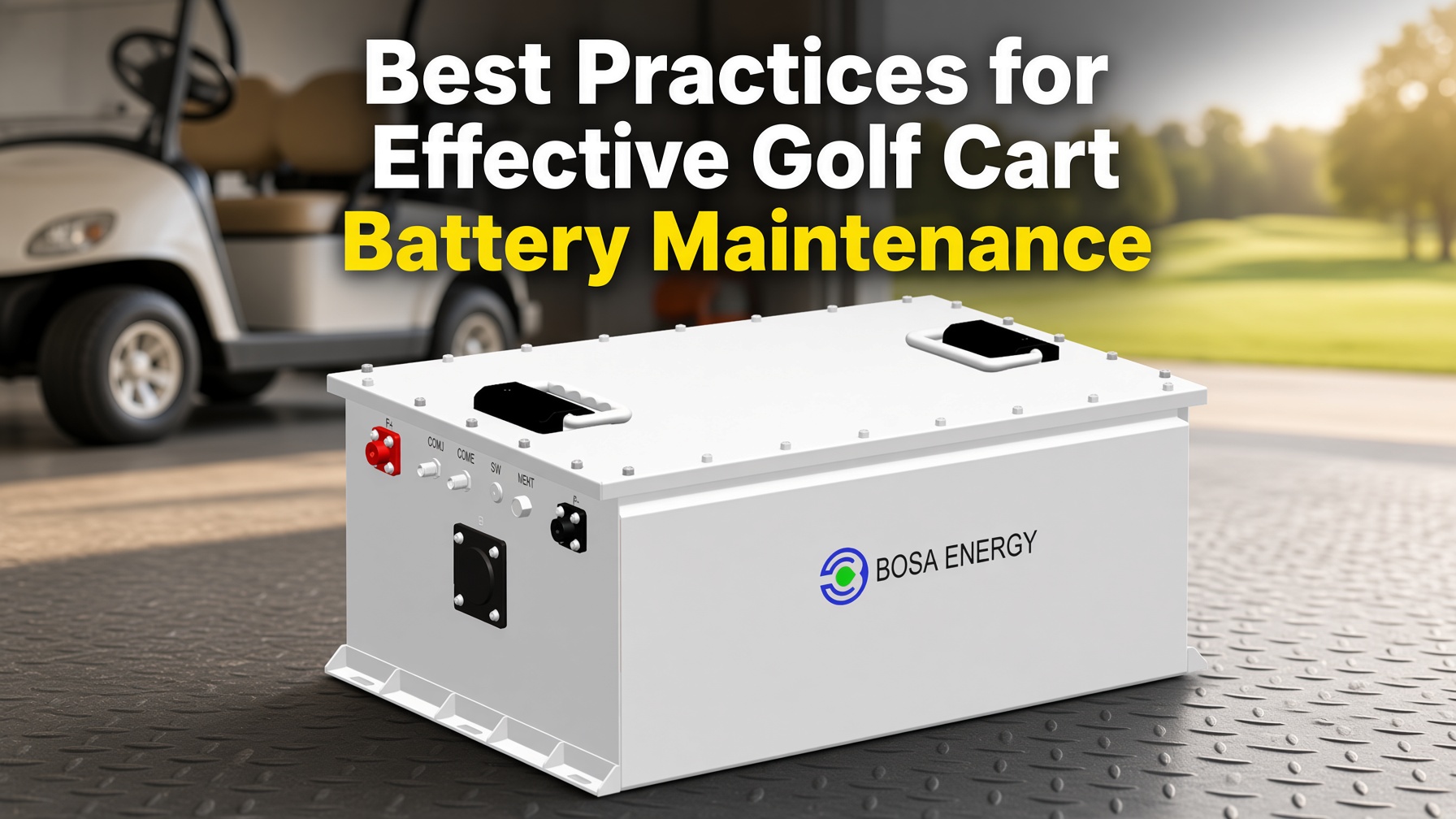
Golf-cart packs fail from routine, not mystery. Flooded lead-acid strings die from dry plates, sulfation, and terminal heat. LiFePO₄ (LFP) packs die from the wrong charger, chronic deep discharge, heat, and storage at the wrong state of charge (SOC). Best Practices for Effective Golf Cart Battery Maintenance are therefore chemistry-specific: water and equalize flooded batteries; protect the Battery Management System (BMS), charge window, and temperature envelope on lithium.
This briefing consolidates 2026 field practice from Trojan flooded and OnePack lithium guides, Battery University aging rules, ANSI/CAN/UL/ULC 2271:2023 pack-safety requirements for light electric vehicles, and current LFP golf-cart ratings of ≥3,500–5,000 cycles at 80% depth of discharge (DoD). Opportunity charging that recovers 15–40% capacity and keeping daily SOC above 20–30% are the two highest-ROI lithium habits. Follow the pack manufacturer’s manual when it conflicts with generic advice.
Table of Contents
- Identify Chemistry Before You Touch the Pack
- Flooded Lead-Acid Maintenance
- Lithium (LiFePO₄) Maintenance
- Charging Rules That Protect Capacity
- Temperature Limits
- Storage and Seasonal Layup
- Inspection Cadence
- Lead-Acid vs Lithium Comparison
- Practical Checklist
- Foire aux questions
- Decision Framework
- Authoritative References
Identify Chemistry Before You Touch the Pack
Do not water a sealed lithium monoblock. Do not apply a lead-acid equalization profile to an LFP charger. Do not treat a 48 V / 51.2 V lithium pack as six 8 V flooded batteries.
| Chimie | Typical 36 V / 48 V layout | Watering | Equalize | Valid charger | Storage SOC |
|---|---|---|---|---|---|
| Flooded lead-acid | 6×6 V (36 V) or 6×8 V / 4×12 V / 8×6 V (48 V) | Distilled water after a full charge | Periodic, flooded only | Lead-acid 3-stage | 100%, then monthly top-up |
| AGM / gel | Same voltage strings, sealed | Never | Never (or OEM-only if specified) | AGM profile | 100% |
| LiFePO₄ lithium | Single 36 V / 48 V / 51.2 V monoblock (or series modules) | Never | Never — BMS balances | LFP CC/CV; follow OEM voltage | OEM first; general LFP mid-SOC |
Confirm labels, vent caps, and whether a Bluetooth, CAN, or LED BMS interface is present before connecting tools. A mismatched charger after a DIY conversion remains the most common lithium “failure” shops diagnose in 2026.
Flooded Lead-Acid Maintenance
Watering is still the number-one cause of premature flooded-pack failure. Plates exposed to air sulfate permanently; overfilling dumps acid onto the tray and concrete.
- Charge first, then add distilled or deionized water only. Filling before charge lets electrolyte expand and overflow.
- Target level on Trojan standard deep-cycle cells: 1/8 in (3 mm) below the bottom of the vent well after a full charge. If plates are exposed on a discharged pack, add only enough water to cover them, charge, then top off. Never use tap water. Never add acid.
- Frequency: check monthly after installation to set the schedule; typically monthly in warm months and every 4–6 weeks in cooler weather. Older packs consume more water.
- Clean tops and terminals with a baking-soda solution (about 1 cup / 150 g per gallon / 1 L of water), rinse, and dry. Corrosion raises resistance and creates heat at the posts.
- Equalize flooded batteries only — never AGM or gel. Trojan guidance is to equalize when specific gravity stays below ~1.235 or cell-to-cell spread exceeds ~0.030 after a full charge. Cadence ranges from monthly to once or twice per year depending on evidence; many fleet chargers run a controlled overcharge every 30 days or 10–15 cycles.
- Rest at least 6 hours, preferably 24 hours, before using open-circuit voltage as an SOC reading. Surface charge inflates voltage and hides a weak jar. Investigate a spread greater than about 0.15 V among 6 V batteries or 0.22 V among 12 V batteries after a full charge and rest.
Trojan published open-circuit voltages (corrected to 80 °F / 27 °C) after a 6–24 h rest: 6.37 V / 8.49 V / 50.93 V at 100% SOC for 6 V, 8 V, and 48 V strings; 6.25 V / 8.33 V / 49.99 V at 80% SOC.
Lithium (LiFePO₄) Maintenance
“Maintenance-free” on a Trojan or other LFP pack means no watering, no equalization, and no routine terminal acid-cleaning. It does not mean zero attention. Visual inspection, correct charging, and SOC discipline remain required.
Quality LFP golf-cart packs in 2026 are typically rated ≥3,500–5,000 cycles at 80% DoD and 8–12 years of calendar life when heat and charge voltage stay inside spec. Trojan OnePack datasheets publish 4,000 cycles at 25 °C, C/2, 80% DoD to 80% of initial capacity (TR-48-170-M class), a registered 10-year limited warranty on the marketing line, and a separate FAQ statement of 4,000 cycles to 70% DoD. U.S. Battery Essential Li US48V105 and peer UL 2271 monoblocks occupy the same duty class. In August 2026, Intertek also certified additional aftermarket 36 V / 48 V / 51.2 V LiFePO₄ golf-cart packs to ANSI/CAN/UL 2271:2023.
Apply these Best Practices for Effective Golf Cart Battery Maintenance on lithium:
- Keep daily SOC above 20–30%. Repeated trips into the BMS low-voltage cutoff add wear and strand the cart on a hill.
- Use opportunity charging of 15–40% between nines, between resort turns, or during lunch. Partial top-ups do not count as full equivalent cycles.
- Allow a complete charge to 100% every 30–60 cycles (or monthly) so the BMS can balance cells.
- Use only an LFP-profile charger matched to that pack. Generic 16S LFP absorption is ≈3.65 V/cell (about 58.4 V). Trojan OnePack 48 V packs specify a recommended charging voltage of 54.7–56.0 V, with a 58.4 V charge-voltage cutoff. A leftover lead-acid algorithm overcharges cells and trips or damages the BMS.
- Inspect terminals, lugs, and cable jackets. Lithium chemistry itself does not accelerate corrosion; salt mist, wash-down water, and non-stainless hardware still do.
- Review BMS data monthly: cell-voltage spread, temperature history, cycle count, and fault flags. Persistent spread after a full balance charge is a replace-or-service signal.
- Isolate parasitic loads. The May 2026 Trojan OnePack user’s guide notes that lights, USB chargers, voltage reducers, GPS units, and similar accessories left connected can drive a low-voltage fault faster than the chemistry’s self-discharge (typically 1–3% per month at pack level). Use storage mode or Tow when the cart sits.
- Specify a complete-pack UL 2271 listing, not cell-only UL 1642. UL 2271 is a safety evaluation of the assembly; it does not certify cycle life.
Trojan OnePack hardware notes that matter in the field: M8-1.25 female terminals. The May 2026 OnePack user’s guide specifies a dry terminal torque of 88.5–106.0 in-lb (10–12 Nm) and the same range on the mounting-bracket hardware. Current 48 V datasheets and the June 2025 48 V Quick Start Guide still print 50–60 in-lb (5.7–6.8 Nm). Use the torque printed in the manual that shipped with that pack; over-tightening can snap the terminal and a loose stack can melt it. Never place a washer between the terminal face and the cable lug. A washer in that stack creates high resistance and can overheat the connection.
Charging Rules That Protect Capacity
Charging is maintenance. The wrong profile destroys both chemistries faster than mileage does.
| Rule | Flooded / AGM | LiFePO₄ |
|---|---|---|
| After every use | Yes — sulfation starts on a partial charge | Flexible; opportunity charging preferred |
| Overnight on charger | Acceptable with a smart lead-acid charger that finishes and floats correctly | Acceptable with a matched LFP charger that tapers to low or zero current |
| Opportunity / partial charge | Poor — leave sulfation risk | Excellent — recover 15–40% whenever the cart is parked |
| Equalize | Flooded only, on a schedule | Never |
| Cold charge | Reduced current, still possible | Most BMS units lock out charge below 0 °C / 32 °F |
| Incompatible charger | Under/overcharge, heat, dry-out | Overvoltage, imbalance, BMS shutdown |
Confirm the exact setpoint in the pack manual. Generic LFP 16S packs absorb near 58.4 V; Trojan OnePack 48 V packs are specified at 54.7–56.0 V. At temperatures below 20 °C / 68 °F, Trojan lithium packs automatically limit charge current. Charging is disabled below 0 °C / 32 °F and is reduced or locked out above 45 °C / 113 °F (zero charge above 55 °C / 131 °F on current OnePack current-vs-temperature tables).
Temperature Limits
Heat is the largest calendar-aging driver. Battery University treats dwelling above 30 °C / 86 °F as elevated temperature; combined high SOC and high temperature accelerates solid-electrolyte interphase growth.
Practical golf-cart envelope for LFP:
- Charge: 0 °C to 45 °C (32 °F to 113 °F) for most packs, including Trojan OnePack recommended band; current-limited up to 55 °C / 131 °F on some OnePack tables.
- Discharge: typically restored between −10 °C and 55 °C (14 °F to 131 °F); Trojan disables charge and discharge below −20 °C / −4 °F or above 60 °C / 140 °F.
- Parking: shade, ventilation around the compartment, and a delay before plugging in after a hot afternoon round.
- Cold start: warm the pack above freezing before connecting a charger. Drive the cart or move it indoors; do not force charge a locked-out BMS.
Flooded packs lose available capacity in the cold but are not damaged by charging near freezing the way lithium is. They are damaged by heat plus under-watering.
Storage and Seasonal Layup
Storage rules diverge by chemistry and, on lithium, by OEM.
Flooded lead-acid. Charge to 100% before storage, disconnect parasitic loads, store cool and dry, and recharge every 30–60 days. A discharged flooded pack sulfates in weeks.
General LFP (Battery University BU-702 / BU-808). Store near 40–60% SOC in a cool, dry location. Full-SOC storage at elevated temperature is more stressful than moderate cycling. Check every 3–6 months and recharge if SOC falls toward 20–30%.
Trojan OnePack / GC2 lithium (follow the user guide when you own that pack). Do not place the pack into prolonged storage (>1 month) below 30% SOC. The published FAQ allows storage for up to six months in storage mode above 25% SOC. The May 2026 OnePack user’s guide states a fully charged pack can be stored up to 12 months in climate-controlled conditions while in storage mode, with SOC checks every 4–6 months. Temperatures above 25 °C / 77 °F shorten that window. Trojan’s winterization guidance is to charge to 100% before long-term storage, use storage mode, set the cart to Tow if the pack stays installed, disconnect the charger after it finishes, and keep storage between 32 °F and 80 °F when possible.
When OEM and generic LFP guidance conflict, the pack manual wins for warranty. The physics still favors avoiding months at 100% SOC in a hot cart barn.
Inspection Cadence
| Task | Flooded lead-acid | LiFePO₄ lithium |
|---|---|---|
| Electrolyte level | Monthly in season | Never |
| Terminals, cables, hold-downs | Monthly | Monthly to quarterly |
| Equalize | Per OEM / specific-gravity spread | Never |
| Resting voltage / specific gravity | After 6–24 h rest | Pack voltage only; use BMS cell data |
| BMS / app / LED review | Aucun | Monthly |
| Case, seals, water ingress | Monthly | Monthly |
| Torque check | Semi-annually | Semi-annually (follow the pack manual: May 2026 OnePack UG 88.5–106.0 in-lb / 10–12 Nm; some 48 V datasheets still list 50–60 in-lb / 5.7–6.8 Nm) |
| Seasonal storage check | Every 30–60 days at 100% | Every 3–6 months; follow OEM SOC |
Clean, dry, and tight connections prevent more “dead battery” calls than any additive.
Lead-Acid vs Lithium Comparison
| Aspect | Flooded lead-acid | LiFePO₄ lithium |
|---|---|---|
| Typical service life | 4–6 years | 8 à 12 ans |
| Rated cycles | 500–1,000 | ≥3,500–5,000 at 80% DoD |
| Labor | High (water, clean, equalize) | Low (inspect + BMS) |
| Charge time | 8–12 h | 2–5 h typical |
| Recharge d'opportunité | Poor | 15–40% top-ups preferred |
| Usable DoD | ~50% recommended | 80–90% |
| Weight (48 V ~100–105 Ah class) | 250–400 lb | 90–150 lb monoblock |
| Round-trip efficiency | 70–85% | ≥95% |
| Safety listing to specify | — | UL 2271 complete pack |
Labor reduction is real only when lithium charging and storage rules are followed. A converted cart left on the original lead-acid charger is not a low-maintenance asset.
Practical Checklist
- Identify chemistry and voltage before any service step.
- Flooded: charge, then water with distilled water only; equalize on evidence or OEM cadence; clean terminals monthly.
- Lithium: matched LFP charger only; never equalize; never water. Confirm OEM charge voltage (OnePack 54.7–56.0 V, not a generic 58.4 V lead-in).
- Keep daily lithium SOC above 20–30%; use 15–40% opportunity charges.
- Never charge LFP below 0 °C; never leave either chemistry in a sealed, unventilated hot compartment after a peak-load day.
- Store flooded packs at 100% with periodic top-ups; store generic LFP at 40–60% unless the OEM (for example Trojan OnePack) specifies a full-charge storage-mode procedure.
- Inspect terminals, torque, cables, and case on a written schedule. Apply the torque printed in the pack manual (May 2026 OnePack UG: 88.5–106.0 in-lb / 10–12 Nm). Disconnect accessories or use Tow / storage mode when the cart sits.
- Prefer UL 2271-listed lithium packs for golf-cart and other light-electric-vehicle duty.
- Log deep-discharge events, high-temperature charges, and BMS faults for warranty and replacement timing.
- Re-test remaining range on a fixed loop each quarter rather than trusting a single resting-voltage reading.
These items are the operational core of Best Practices for Effective Golf Cart Battery Maintenance for both private carts and commercial fleets.
Foire aux questions
Do lithium golf-cart batteries need watering? No. Sealed LFP construction has no free electrolyte to replenish. Adding water voids the pack and creates a shock hazard.
Can I leave the cart on the charger overnight? Yes, if the charger matches the chemistry and terminates correctly. Do not leave a lithium pack at 100% SOC for weeks in a hot barn.
How often should I equalize? Flooded batteries only, when specific gravity or voltage spread justifies it, typically every 30 days or 10–15 cycles. Never equalize AGM, gel, or lithium.
What SOC should I use for winter storage? Flooded: 100%, then recharge periodically. Generic LFP: 40–60%. Trojan OnePack: follow the user guide — do not store below 30% for more than a month; charge to 100% before long-term storage, use storage mode, and check the BMS app on the OEM interval.
Does opportunity charging hurt lithium cycle life? No. Short 15–40% top-ups reduce equivalent full cycles and keep the pack out of the high-stress empty and full-soak zones.
Is UL 2271 required? It is the accepted pack-level safety standard for batteries in light electric vehicles, including golf carts. Many insurers, resorts, and dealers treat the listing as a purchase minimum. It does not guarantee cycle life. Intertek UL 2271 listings published in August 2026 underscore that the standard now covers a wider aftermarket 36/48/51.2 V golf-cart class.
When should I replace the pack? When remaining capacity no longer covers the required daily range with a 20–30% reserve, or when persistent imbalance, case damage, or BMS faults interrupt duty. Flooded strings often fail one jar at a time; replace the weak unit promptly or the rest follow.
Decision Framework
- Record chemistry, voltage, daily rounds, hills, passenger load, and barn temperature.
- If flooded, lock a watering-after-charge and equalization calendar; measure individual-jar voltage after a 6–24 h rest.
- If lithium, lock a matched LFP charger at the OEM voltage, a 20–30% SOC floor, and 15–40% opportunity charging.
- Apply OEM storage rules for that exact pack; default generic LFP to 40–60% SOC in a cool, dry space.
- Require UL 2271 on any new or conversion lithium pack and confirm terminal torque and lug stack against the manual that shipped with that pack.
- Review BMS or hydrometer data monthly; replace when the duty cycle is no longer covered with reserve.
Best Practices for Effective Golf Cart Battery Maintenance are not a single checklist. They are a chemistry split: water and equalize flooded batteries, then get out of the lithium pack’s way except for charger match, SOC window, heat, and inspection. Applied consistently, those controls are what convert a 4–6 year flooded string or an 8–12 year LFP rating into delivered service life.
Authoritative References
- Trojan Battery, Battery Maintenance (watering, equalization, resting-voltage table) — https://www.trojanbattery.com/resources/battery-maintenance
- Trojan Battery, Lithium-Ion Battery Resources & FAQs (maintenance-free definition, storage mode, temperature cutoffs, 4,000-cycle / 70% DoD note) — https://www.trojanbattery.com/technology/trojan-lithium-batteries/lithium-ion-battery-resources
- Trojan Battery, How to winterize lithium golf cart batteries — https://www.trojanbattery.com/blog/2025/how-to-winterize-lithium-golf-cart-batteries
- Trojan Battery, How long do lithium golf cart batteries last? (OnePack 4,000-cycle / 30% DoD method and 10-year limited warranty) — https://www.trojanbattery.com/resources/white-papers-and-articles/how-long-do-lithium-golf-cart-batteries-last
- Trojan Battery, OnePack family specifications — https://www.trojanbattery.com/technology/trojan-lithium-batteries/meet-the-onepack-family
- Trojan Battery, OnePack Lithium-Ion Battery User’s Guide (May 2026): storage mode, 12-month climate-controlled storage, parasitic-load warning — https://assets.ctfassets.net/nh2mdhlonj7m/1B1RbqawOOkYd4LmNmfi23/61a75afc466e11c8ff4a9f516268560d/20260505-OnePack-Users-Guide.pdf
Technical briefing for owners, dealers, and fleet managers. Metrics reflect published 2026 OEM ratings and independent test practice. Always follow the specific pack manual for voltage, torque, temperature, and storage limits.