
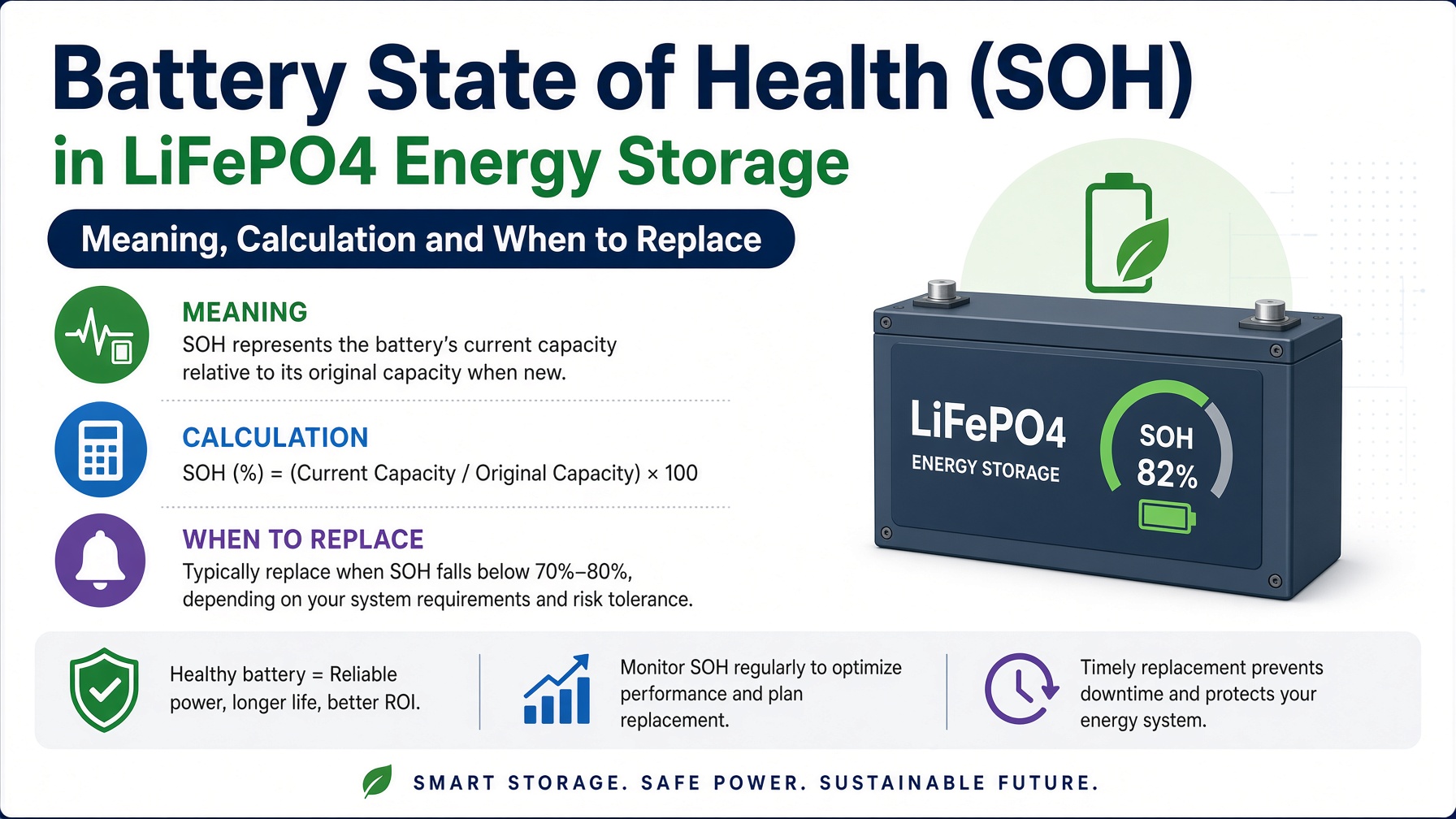
Understanding the health of a lithium iron phosphate battery is essential for anyone operating a residential, commercial, or utility-scale energy storage system. Battery State of Health (SOH) in LiFePO4 Energy Storage: Meaning, Calculation and When to Replace provides the framework for assessing how much usable capacity remains after years of cycling and calendar aging. Unlike state of charge, which simply indicates how full the battery is at any moment, SOH measures the irreversible loss of capacity and power capability relative to the original specification. Accurate tracking of this metric allows system owners to forecast remaining useful life, maintain energy guarantees, and plan capital expenditure without unexpected downtime.
What SOH Means for LiFePO4 Chemistry
In LiFePO4 energy storage the primary definition of SOH is the ratio of the current maximum available capacity to the original rated capacity, expressed as a percentage. A new 100 Ah module that can still deliver 85 Ah under the same test conditions therefore has an SOH of 85 percent. Because the olivine cathode structure of lithium iron phosphate is inherently stable, capacity fade is gradual and highly predictable compared with nickel-manganese-cobalt chemistries. Secondary indicators include the rise in internal resistance and the associated reduction in power capability. Most manufacturers and system integrators treat 70–80 percent SOH as the conventional end-of-life threshold, although many LiFePO4 packs continue to operate safely well below this point for second-life or lower-duty applications.
The distinction between capacity-based SOH and resistance-based SOH matters in practice. Capacity fade directly reduces the energy that can be stored and delivered during a discharge event, while resistance growth limits the maximum current the battery can accept or supply without excessive voltage drop or heat generation. In residential solar-plus-storage systems the capacity metric usually dominates decision-making; in high-power grid-support or commercial peak-shaving applications both metrics must be monitored.
Practical Methods for LiFePO4 battery state of health calculation
The most accurate method remains a controlled full-cycle capacity test. The pack or module is charged at a low rate (typically 0.1 C to 0.2 C) to the upper voltage limit, rested for at least two hours to eliminate polarization, then discharged at a moderate rate (0.2 C–0.5 C) while ampere-hours are integrated. SOH is then calculated as:
$$
\text{SOH} = \frac{Q_{\text{measured}}}{Q_{\text{nominal}}} \times 100\%
$$
Modern battery management systems rarely rely on full cycles alone. They combine coulomb counting with periodic voltage-based corrections, incremental capacity analysis (ICA), differential voltage analysis (DVA), and internal-resistance tracking obtained from short current pulses. These algorithms continuously update the estimated capacity and resistance, achieving typical errors of 2–5 percent when temperature and cell balance are well controlled. Advanced systems may also incorporate electrochemical impedance spectroscopy or machine-learning models trained on large field datasets.
For field technicians the simplest reliable check is still a partial or full discharge under known conditions, followed by comparison against the manufacturer’s original capacity rating. Periodic verification every 6–12 months, especially after the first three years of service, prevents cumulative estimation drift.
Key Factors Driving Capacity Fade
Several operating conditions accelerate the loss of active lithium and electrode surface area. Elevated temperature is the strongest driver: every 10 °C above 25 °C can roughly double the rate of solid-electrolyte-interface growth and calendar aging. Sustained high state of charge (above 90 percent) and frequent deep discharges beyond 80 percent depth of discharge also increase mechanical stress and side reactions. High C-rates generate localized heat and promote lithium plating if charging occurs near or below 0 °C. Even when the battery sits idle, calendar aging continues, albeit more slowly at moderate temperature and mid-range state of charge.
Because LiFePO4 exhibits a relatively flat voltage curve, small errors in voltage sensing can produce large errors in state-of-charge estimation, which in turn degrades the accuracy of coulomb-counting-based SOH algorithms. Proper cell balancing and high-quality current sensors are therefore prerequisites for trustworthy long-term health tracking.
When to Replace a LiFePO4 Energy Storage Battery
When to replace LiFePO4 energy storage battery is determined by both technical thresholds and application requirements. Most manufacturers warrant their products to at least 60–70 percent residual capacity after a stated number of cycles or calendar years under defined conditions. In practice, many system owners begin planning replacement when SOH falls to the 70–80 percent range, because this is the point at which the remaining capacity may no longer meet the original energy-throughput or autonomy targets. Below 60 percent, power capability often declines noticeably, cell-to-cell imbalance tends to increase, and some warranties no longer cover capacity claims.
Replacement decisions should also consider safety margins and economic factors. Although LiFePO4 chemistry has an excellent thermal-runaway safety record, continued operation of a severely degraded pack can still raise the risk of localized overheating if one or more cells reach end-of-life first. From an economic standpoint, the levelized cost of energy often favors replacement once the battery can no longer deliver the contracted energy or backup duration, even if it remains technically functional. Second-life opportunities—such as relocating modules to lower-duty backup or off-grid sites—can extend value beyond the primary application.
Monitoring Best Practices and Long-Term Reliability
Effective SOH management begins with a high-quality BMS that logs capacity, resistance, temperature extremes, and cycle counts. Regular review of these data, combined with occasional independent capacity tests, provides the evidence needed for warranty claims and residual-value assessments. Keeping average operating temperature near 25 °C, limiting daily depth of discharge to 80 percent or less, and avoiding prolonged storage at 100 percent state of charge are the most effective ways to slow degradation.
Measuring SOH in lithium iron phosphate batteries also supports predictive maintenance. When fade accelerates beyond the expected 2–3 percent per year under normal conditions, operators can investigate root causes such as cooling-system failure, excessive C-rates, or cell imbalance before irreversible damage occurs. BMS based SOH estimation for LiFePO4 has matured to the point that many commercial systems now deliver real-time health dashboards accessible via cloud platforms, enabling fleet-level analysis across multiple installations.
LiFePO4 battery capacity fade factors are well understood, and adherence to manufacturer guidelines routinely yields 10–15 years of useful service or 4,000–7,000 full equivalent cycles. The combination of inherent chemical stability, robust BMS algorithms, and disciplined operating practices makes LiFePO4 the preferred chemistry for stationary energy storage worldwide.
In summary, Battery State of Health (SOH) in LiFePO4 Energy Storage: Meaning, Calculation and When to Replace is not merely a technical specification; it is the central metric that governs system performance, safety margins, warranty eligibility, and long-term economics. By combining accurate capacity testing with continuous BMS estimation and disciplined thermal and cycling management, owners can extract maximum value from their investment and schedule replacement at the optimal moment.
Related Resources
- Understanding Depth of Discharge and Cycle Life in LiFePO4 Batteries
- Best Practices for Battery Management System Configuration in Energy Storage
- Temperature Effects on Lithium Iron Phosphate Calendar Aging
- Second-Life Applications for Retired LiFePO4 Modules
- Warranty Terms and Capacity Retention Guarantees for Stationary Storage