
The best battery for a golf cart in 2026 is not the pack with the largest brochure amp-hour number. It is the pack that matches the cart’s voltage window, charger profile, tray geometry, and daily route so the vehicle finishes the day above a safe state of charge without watering labor or a mid-life swap.
This Best Battery for Golf Cart – Comprehensive Guide 2026 ranks that decision with current factory ratings, drop-in LiFePO₄ integrations, and the charging rules that actually determine range. Three paths remain open: keep flooded lead-acid and accept watering plus a 4–6 year replacement; retrofit a platform-matched lithium pack onto a sound chassis; or specify a factory lithium car (E-Z-GO ELiTE, Club Car Tempo / Onward Li-Ion, Yamaha Drive2 PowerTech Li).
Readers who need a single decision document can treat this Best Battery for Golf Cart – Comprehensive Guide 2026 as the working spec: chemistry first, platform match second, charger third.
Key takeaways
- Specify LiFePO₄ packs rated at least 3,500 cycles at 80% depth of discharge (DoD), with UL 2271 (or equivalent light-EV pack certification) and a documented battery management system (BMS).
- 2026 factory anchors: E-Z-GO RXV ELiTE 2.2 at 56.7 V max / ~60 Ah with the Light World Charger; Club Car Tempo Li-Ion at ~3.8 kWh stored energy with a 6-year / 2.8 MWh base lithium warranty; Trojan OnePack XR at 51.2 V / 171 Ah and 4,000 cycles.
- Opportunity charges of 15–40% of pack capacity between turns are acceptable on lithium. Keep operating state of charge (SOC) above 20–30%.
- Platform match beats peak amps. IEEE Spectrum’s 30 May 2026 review of drop-in motive packs put the rule in one sentence: design the lithium system around the electrical reality of the legacy platform, not the other way around.
Table of Contents
- What “best” actually means in 2026
- Chemistry comparison: flooded, AGM, LiFePO₄
- Voltage systems: 36 V, 48 V, and 72 V
- 2026 factory lithium platforms
- Drop-in lithium packs worth specifying
- How to size capacity and range
- Stay flooded, retrofit, or buy factory
- Charging infrastructure and operating rules
- Safety and certification floor
- Procurement checklist
- FAQ
- Decision framework
- Authoritative references
What “best” actually means in 2026
A weekend owner optimizes for range and install simplicity. A course superintendent optimizes for first-tee availability, turf mass, barn labor, and the cost of a mid-season pack failure. Both scorecards use the same four metrics.
- Usable energy versus route demand. Convert amp-hours × nominal volts to kilowatt-hours. An 18-hole loop with hills, GPS, coolers, and four adults is not the same load as a flat executive course. Size usable kWh so a normal day ends above 20–30% SOC after accessory drain.
- Charge-window fit. Most garages and cart barns have 6–10 overnight hours and short midday gaps. Lithium’s value is opportunity charging without an 8-hour cool-down, not a theoretical 75-mile range.
- Integration risk. A pack that forces a controller swap, kills limp-mode logic, or blanks the OEM state-of-charge gauge creates service tickets. Voltage window and communications matter more than pulse amps.
- Labor and mid-life cost. Flooded packs demand watering, equalization, and a replacement set every 4–6 years in high-cycle use. Lithium removes watering and usually spans one vehicle life when duty cycle is respected.
Darren Brittain, Trojan’s vice president of lithium commercial strategy for motive applications, stated the engineering filter in IEEE Spectrum on 30 May 2026: design the lithium system around the electrical reality of the legacy platform, rather than asking the vehicle to adapt to the battery. Apply that filter to every SKU on a bid sheet or a shopping cart.
Factory lithium platforms are now a standard specification on new course cars, not a premium option reserved for resort fleets.
Chemistry comparison: flooded, AGM, LiFePO₄
| Criterion | Flooded lead-acid | AGM / sealed lead | LiFePO₄ lithium |
|---|---|---|---|
| Typical cycle life | 1,000–1,500 cycles | 800–1,200 cycles | ≥3,500–4,000 at 80% DoD |
| Usable DoD | ~50% without shortening life | ~50–60% | 80% is the published rating point |
| Daily labor | Watering, equalization, terminal service | Terminal and case inspection | Connector and SOH check |
| Recharge d'opportunité | Damages life if abused | Limited | 15–40% top-ups are normal |
| Weight for equivalent usable energy | Highest | High | Typically 40–60% lower |
| Cold-weather charge | Possible with reduced current | Possible with reduced current | Charge cut-off commonly 0 °C unless heated |
| Best fit | Low-cycle, capital-constrained carts | Spill-sensitive storage, modest duty | Daily use, fleets, hills, accessories |
AGM is not a lithium substitute. It removes watering but keeps lead-acid cycle life and charge discipline. For a cart that runs most days of the week, LiFePO₄ is the chemistry that belongs in the tray. Nickel-rich automotive cells do not; thermal stability and cycle life at golf-cart C-rates favor iron phosphate.
Voltage systems: 36 V, 48 V, and 72 V
Match the pack to the drivetrain you already have unless you are rebuilding the controller, motor, and charger as a set.
- 36 V remains common on older Club Car DS and some refurbished fleets. Trojan’s OnePack 36 V 105 Ah (38.4 V nominal) is the 2026 drop-in example that stays inside a legacy 36 V window. Do not series-stack 12 V lithium modules unless the vendor publishes a series-ready BMS and a matched charger.
- 48 V is the default on current E-Z-GO RXV / TXT, Club Car Precedent / Tempo / Onward, and Yamaha Drive2 platforms. Nominal lithium voltage is typically 51.2 V with a working window near 40.5–58.4 V. That window is why OnePack and several Gen3 aftermarket packs can talk to a 48 V AC controller without a swap.
- 72 V appears on lifted personal-transport vehicles and some high-speed LSVs. It is a system voltage, not a performance upgrade you can drop into a 48 V chassis. If the controller, motor insulation, and charger are 48 V, stay at 48 V and buy continuous-current headroom (OnePack HP at 300 A continuous is the documented 48 V high-output path).
A voltage mismatch is the most expensive “upgrade” a buyer can make. Confirm the controller rating, charger algorithm, and gauge scale before the pack ships.
2026 factory lithium platforms
E-Z-GO RXV ELiTE 2.2
2026 dealer specifications list the RXV ELiTE 2.2 as a single 56.7 V max lithium pack at approximately 60 Ah, paired with the Light World Charger (56.7 V, 10 ft DC cord). Electrical architecture remains a 48 V AC drivetrain with a 4.4 hp (3.3 kW) continuous motor. Curb weight with the 2.2 pack is listed at 662 lb (300 kg). Samsung SDI cells and an eight-year battery warranty appear on current U.S. dealer sheets.
The 2.2 pack is smaller than earlier ELiTE offerings. For a flat 18-hole course with midday plug-in time, that is a feature: less mass on turf and faster overnight recovery. Hilly 36-hole days, four-seat shuttle duty, and heavy accessory loads need a measured loop before you standardize on 60 Ah.
Club Car Tempo Li-Ion and Onward Li-Ion
Club Car positions Tempo Li-Ion as a fleet range leader among factory lithium cars, with stored energy in current literature at approximately 3.8 kWh and a 4.7 hp AC motor. The official warranty page states base lithium coverage as the earlier of 6 years or 2.8 MWh of cumulative discharge; extended-range lithium is the earlier of 6 years or 4.9 MWh. Transfer into a second-life golf fleet application is capped at 5 years or 3.6 MWh.
The pack sits in a sealed, IP67-rated steel case. A vehicle control module supports remote diagnostics and over-the-air updates. For a private Onward buyer the same 6-year / 2.8 MWh base term is the number to model, not a one-time range claim.
Yamaha Drive2 PowerTech Li
Yamaha’s 2026 Drive2 PowerTech Li fleet and PTV lines use a factory 48 V lithium pack with an AC induction motor (4.4 hp / 3.3 kW on current PTV listings) and independent rear suspension as standard on lithium models. Published service-life guidance is in the eight-year band. If the existing barn or garage is already Yamaha-heavy, stay on Yamaha chargers. Mixing three lithium charge algorithms in one building is a preventable failure mode.
Drop-in lithium packs worth specifying
Not every owner can capital-replace the cart. 2026 aftermarket activity is concentrated on packs that talk to the OEM controller instead of replacing it.
Trojan OnePack and OnePack XR
Trojan’s 15 April 2026 announcement added drop-in compatibility for E-Z-GO RXV Gen 1 ELiTE cars: no motor or controller replacement. The 48 V OnePack (TR-48-110-M class, 105 Ah) and OnePack XR (TR-48-170-M, 51.2 V nominal, 171 Ah, 8,755 Wh) are LiFePO₄ packs with a working window of 40.48–58.40 V—inside the tolerance of many legacy 48 V platforms.
The May 2026 XR datasheet rates cycle life at 4,000 cycles at 25 °C, C/2. Continuous discharge on the XR datasheet is 180 A, with 300 A for 30 seconds. Ingress protection is IP65. Charge current falls to 0 A below 0 °C. Trojan states an expected life of at least ten years or 4,000 cycles and backs the family with a 10-year warranty when registered. Opportunity charging is explicitly supported.
That voltage-window discipline is why the IEEE Spectrum piece treated OnePack as a case study rather than a generic “more Ah” upgrade.
Bolt factory integrations (May 2026)
On 18 May 2026 Bolt Lithium announced plug-and-play factory integrations for Club Car and E-Z-GO, using the vehicle’s existing motor controllers and wiring harnesses, including Club Car Vanguard and LG platforms. Pre-orders opened 1 June 2026. The commercial claim is a 12-year transferable warranty and the elimination of controller swaps on supported SKUs. Confirm the exact generation (TXT vs RXV, Vanguard vs LG) before the kit ships.
Eco Battery Gen3 TXT / RXV adapter (June 2026)
Eco Battery’s June 2026 Factory Lithium Conversion Bundles target E-Z-GO TXT and RXV Gen 1 and Gen 2 cars that already carry small OEM Samsung packs. The bundle pairs a Gen3 BMS with E-Z-GO-specific firmware and a factory lithium conversion adapter so dash, gauges, and OEM safety logic remain intact. Golf Car Options carried the same launch on 14 September 2026. Capacities in the current catalog run 105–160 Ah depending on tray (skinny vs thru-hole) and generation. Factory 60 Ah Samsung packs are the units these kits are sized to replace.
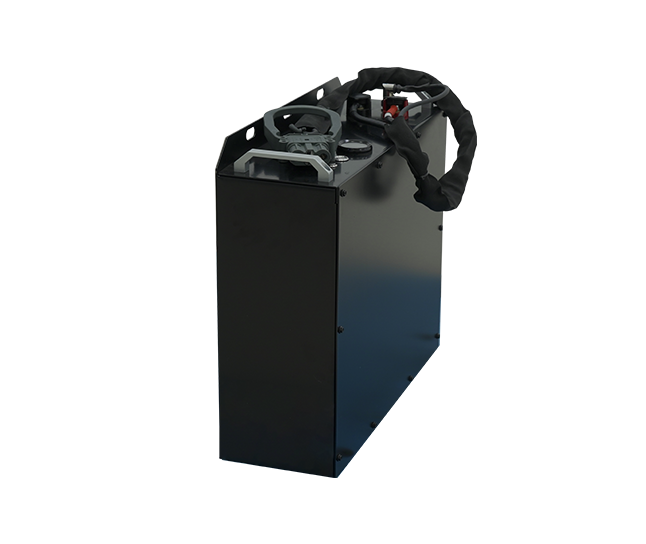
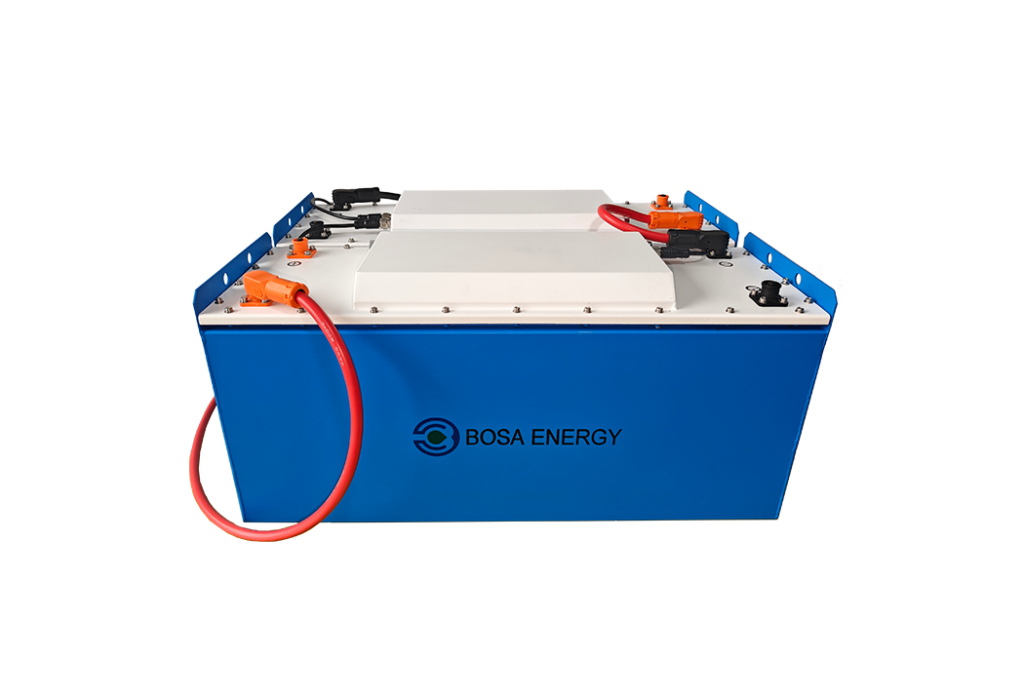
A single sealed LiFePO₄ pack replaces a six-battery flooded tray and removes watering from the weekly checklist.
How to size capacity and range
Ignore “up to 75 miles” unless the vendor states load, speed, and terrain. Size from energy.
Usable kWh ≈ Ah × nominal V ÷ 1,000. A 51.2 V / 105 Ah pack is about 5.4 kWh. A 51.2 V / 171 Ah XR pack is 8.8 kWh. A factory ELiTE 2.2 at ~60 Ah and 56.7 V max is a much smaller energy tank—treat it as an 18-hole pack with reserve, not an all-day community cruiser.
Then apply three adjustments:
- Measure or estimate kWh per 18-hole loop on ton routing. Hills, four adults, oversized tires, and a stereo change the number more than cell brand.
- Apply a 1.1–1.2× buffer for wind, accessories, and a hot afternoon.
- Keep the planned day-end SOC above 20–30%. Do not size the pack so every round ends at 10%.
Continuous discharge is the other sizing axis. A four-passenger climb off the first tee is a continuous-current event, not a 2-second pulse. XR-class 180 A continuous and HP-class 300 A continuous are different machines from a 60 Ah factory pack on a flat 18.
Stay flooded, retrofit, or buy factory
| Criterion | Stay flooded | Retrofit LiFePO₄ drop-in | Factory lithium (new car) |
|---|---|---|---|
| Typical cycle life | 1,000–1,500 cycles | ≥3,500–4,000 at 80% DoD (LFP) | OEM-warranted 6–8 years or MWh cap |
| Daily labor | Watering, equalization, terminal service | Connector and SOH check | Connector and SOH check |
| Mid-life pack swap | Yes, often year 4–6 | Usually no, if duty cycle is respected | Usually no |
| Recharge d'opportunité | Damages life if abused | 15–40% top-ups are normal | Designed in |
| Vehicle integration | Native | Must match voltage window and CAN / gauge logic | Native |
| Turf / curb mass | Highest | Lower than flooded; varies by Ah | Lowest on current 2.2-class packs |
| Charger | Existing flooded chargers | Lithium-profile charger required | OEM lithium charger |
| Best fit | Low-cycle, capital-constrained carts | Sound chassis, 4–8 years of life left | New fleet buys and personal-use replacements |
Use the table as a filter. A cracked 2014 TXT frame is not a retrofit candidate. A 2023 RXV ELiTE with a healthy chassis and a worn 2.2 pack is. In other words, the right pack is the option that still has a viable chassis and a charger behind it.
Charging infrastructure and operating rules
A lithium pack that cannot plug in is an inventory problem, whether the building is a two-car garage or a 60-stall barn.
Golf Course Industry’s 3 February 2026 busway brief and the Butler Country Club case make the fleet constraint explicit. Butler, an 18-hole private club in western Pennsylvania, could not charge its 60-cart electric fleet simultaneously on the legacy barn wiring. The club installed three 50-foot runs of 100-amp T3 Starline Track Busway with plug-in units carrying four 20-amp breakers and receptacles, plus custom brackets for E-Z-GO chargers. The busway was hung and energized in two days.
Private owners face a smaller version of the same rule: one lithium-profile charger on a dedicated circuit, not a leftover flooded charger on a shared garage outlet.
Operating rules that protect cycle life:
- Keep daily operating SOC above 20–30%. Deep daily dumps to 10% buy range today and sell cycles tomorrow.
- Use opportunity charging for 15–40% of pack capacity during lunch, nine-hole turns, and weather holds. Do not treat every plug-in as a requirement to hit 100%.
- Charge above 0 °C unless the pack has a certified heater. Trojan’s OnePack charge cut-off at 0 °C is typical LFP behavior, not a defect.
- Store long-idle winter carts in a climate-controlled space at a manufacturer-stated storage SOC (commonly around a 30% floor, not empty and not 100%).
- Inspect connectors, charge ports, and tray fasteners on the same interval you used to water cells. Connector wear is the lithium failure mode that flooded-era checklists miss.
- Log SOH from the BMS or OEM telematics quarterly. Replace on SOH and energy-throughput, not on a calendar alone.
Butler Country Club’s 100-amp T3 busway is the operational half of a lithium fleet specification: every stall must have a lithium-profile charger.
Safety and certification floor
LiFePO₄ is the chemistry that belongs under a golf-cart seat. The phosphate cathode is thermally more stable than nickel-rich automotive cells, and the BMS—not the cell—is the component that prevents the event operators fear.
Minimum pack requirements:
- UL 2271 (batteries for light electric vehicles) or a documented equivalent pack-level abuse test.
- UN 38.3 for shipping and replacement logistics.
- Cell- and pack-level over-voltage, under-voltage, over-current, short-circuit, and temperature cut-offs, with redundant disconnects.
- Ingress rating of IP65 or better if carts are washed, stored in open-sided barns, or run coastal humidity.
- Charger and pack tested as a pair. A flooded charger on an LFP pack is an uncertified system.
UL 2271 abuse testing covers overcharge, short circuit, crush, and thermal conditions that a garage or barn will eventually produce through a damaged cable or a misplaced jack. It is a specification line, not optional marketing.
Procurement checklist
- Duty cycle recorded: holes or miles per day, hills, passenger load, GPS and accessory draw, winter storage months.
- Measured or estimated kWh per 18-hole loop or community loop on ton routing.
- Decision path chosen: stay flooded / retrofit / factory lithium, with chassis age documented.
- Voltage window, charger profile, and gauge / limp-mode behavior confirmed in writing.
- LiFePO₄ chemistry, ≥3,500-cycle rating at 80% DoD or OEM MWh cap on the order form.
- UL 2271 (or equivalent) certificate and UN 38.3 report on file.
- IP65–IP67 enclosure if wash-down or coastal exposure applies.
- Lithium-profile charger included or specified; flooded charger retired.
- Opportunity-charge policy written: 15–40% top-ups allowed; SOC floor 20–30%.
- Warranty expressed in years et throughput; fleet-transfer exclusions read.
- Dealer response time and spare-pack policy attached to the purchase order.
- Pilot of one cart (private) or 3–5 cars (fleet) for 30–60 days before a full conversion.
FAQ
Is lithium always the right answer? No. A cart that runs 20 rounds a year and already has a healthy flooded set can stay flooded until that set dies. Daily use, hills, accessories, and fleet duty flip the answer to LiFePO₄.
How many holes should a factory lithium course car complete on one charge? OEM fleet cars are designed around 18 holes with reserve, and Club Car publishes 36-plus-hole claims on Tempo Li-Ion under its test conditions. Confirm with a loaded loop on your property. Hills, four adults, and GPS change the number.
Is a 60 Ah ELiTE 2.2 pack enough? Often yes on a flat 18-hole course with midday opportunity charging. Often no on a hilly 36-hole day or a loaded four-seat shuttle. Measure day-end SOC before you standardize.
Can a 171 Ah XR pack drop into every RXV? Only on supported generations. Trojan’s April 2026 drop-in is specified for RXV Gen 1 ELiTE without a controller swap. Gen 2 factory-lithium cars and TXT platforms need their own adapter path (Eco Battery Gen1/Gen2 kits are the 2026 example).
Do lithium golf cart batteries need watering? No. They need connector inspections, firmware or app checks where supplied, and storage-SOC discipline. Watering belongs to the flooded fleet you are leaving.
Will lithium save money in year one? Usually not on a one-year cash view. The saving appears when you remove watering labor, avoid a mid-life flooded replacement, and stop parking the cart for eight-hour cool-down charges. Model five years, not one season.
What charger is required? A lithium-profile charger matched to the pack voltage and CAN or algorithm. The E-Z-GO Light World Charger is the factory answer on 2026 ELiTE 2.2 cars. Retrofits require the vendor’s charger or a documented reflash. Do not use a leftover flooded charger.
Decision framework
Use this Best Battery for Golf Cart – Comprehensive Guide 2026 as a four-question filter, in order.
- Is the chassis worth another pack life? If the frame, wiring harness, and motor have fewer than four clean years left, buy a factory lithium car. Do not put a 10-year pack in a 3-year body.
- Does a factory SKU already cover the duty cycle? If an ELiTE 2.2, Tempo Li-Ion, or Drive2 PowerTech Li finishes your measured loop above 20–30% SOC, specify that OEM pack and spend the rest of the budget on a matched charger.
- If you retrofit, is the pack designed for this platform? Require a published working-voltage window, an adapter or CAN kit for that generation, limp-mode preservation, and UL 2271. Trojan OnePack on RXV Gen 1 ELiTE, Bolt’s May 2026 Club Car / E-Z-GO integrations, and Eco Battery’s TXT/RXV Gen3 adapter are the 2026 examples that meet the platform-first test.
- Can the cart charge tonight? If the answer is no, fix the circuit and charger before you issue a battery purchase order. Butler’s 100-amp T3 install is the fleet template; a dedicated lithium-profile outlet is the private-owner template.
Apply those four filters and the “best” pack is the one that is still moving at the end of the day—not the one with the loudest cycle-life headline.
This Best Battery for Golf Cart – Comprehensive Guide 2026 closes on one system decision: LiFePO₄ chemistry, platform-matched voltage and communications, a lithium-profile charger, and an operating policy that keeps SOC out of the bottom fifth of the gauge. Specify that system once. Then stop watering.
Authoritative references
- IEEE Spectrum, “A Better Way to Swap Lead-Acid With Lithium Batteries,” 30 May 2026 (Darren Brittain / Trojan platform-match interview): https://spectrum.ieee.org/lithium-batteries-lead-acid-ev
- Trojan Battery, “Trojan Battery Unveils Lithium Solution for E-Z-GO RXV Gen 1 ELiTE Golf Carts,” 15 April 2026: https://www.prnewswire.com/news-releases/trojan-battery-unveils-lithium-solution-for-e-z-go-rxv-gen-1-elite-golf-carts-302743635.html
- Trojan Battery, OnePack now drop-in compatible with E-Z-GO RXV Gen 1 ELiTE: https://www.trojanbattery.com/blog/2026/onepack-now-drop-in-compatible-with-e-z-go-rxv-gen-1-elite
- Trojan OnePack XR datasheet (TR-48-170-M, 4,000 cycles, 51.2 V / 171 Ah): https://assets.ctfassets.net/nh2mdhlonj7m/X1vG1fgNYKHOnw4RUNYFw/2e8d8892a9c9939265a33fc97f95777b/202605-OnePack-XR-Datasheet.pdf
- Club Car official warranty (base lithium: 6 years or 2.8 MWh): https://www.clubcar.com/en-us/warranty
- Golf Course Industry, “Solution to a charged situation” (busway charging, February 2026): https://www.golfcourseindustry.com/news/busway-charging-system-golf-carts-vehicles/
- Starline / Legrand, Butler Country Club 100-amp T3 busway case: https://starlinepower.com/resources/case-studies/teeing-up-flexible-power