
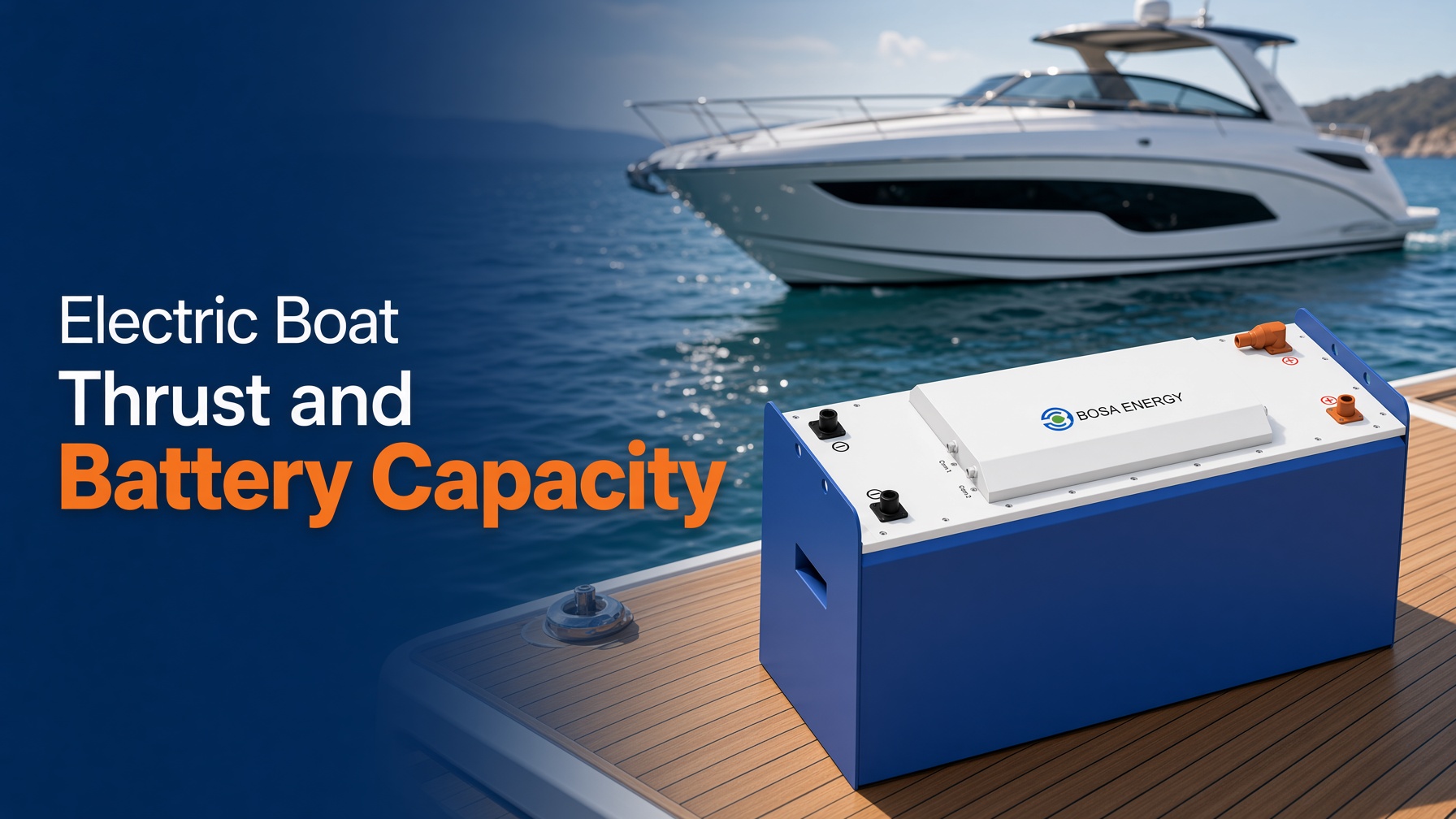
Electric boat thrust and battery capacity** determine whether a vessel can deliver the required push while maintaining usable runtime. Thrust is a function of motor power, propeller design and system voltage. Battery capacity (kWh) governs how long that thrust can be sustained. Confusing the two leads to undersized packs that force early power reduction or oversized systems that add unnecessary weight and cost.
This technical briefing explains the quantitative relationship between electric boat thrust and battery capacity, provides sizing formulas used in 2026 marine practice, compares real-world systems, and sets clear selection criteria for recreational and light commercial applications.
Table of Contents
- Thrust vs Power: The Core Relationship
- Battery Capacity Determines Runtime, Not Peak Thrust
- Practical Sizing Formulas
- Real-World System Examples
- Chemistry, Cycle Life and Operating Windows
- Standards and Safety Requirements
- Selection Checklist
- Decision Framework
- FAQ
- Authoritative References
Thrust vs Power: The Core Relationship
Static thrust is measured in pounds (lbs) or newtons (N). Power is measured in kilowatts (kW) or horsepower (HP). Approximate conversion used across the industry:
- 72–75 lbs of thrust ≈ 1 HP ≈ 746 W of electrical input under typical propeller efficiency.
Higher system voltage reduces current for the same power, lowering cable losses and heat. A 48 V or 96 V architecture is preferred once continuous power exceeds ~3–6 kW. Peak thrust is set by the motor’s continuous and peak ratings plus propeller matching. Battery capacity has almost no effect on maximum available thrust provided the pack can deliver the required continuous and peak current without voltage sag.
Rule of thumb for displacement and semi-displacement hulls (fully loaded):
- Minimum 2 lbs of thrust per 100 lbs of boat weight for calm-water operation.
- 2.5–3 lbs per 100 lbs when wind, current or frequent docking maneuvers are expected.
Battery Capacity Determines Runtime, Not Peak Thrust
Battery energy is expressed in kilowatt-hours (kWh). Runtime at a given power draw is:
$$
\text{Runtime (h)} = \frac{\text{Usable battery energy (kWh)}}{\text{Average motor power (kW)}}
$$
Usable energy is typically 80–90 % of nominal capacity for marine LiFePO₄ packs to preserve cycle life and leave reserve. Capacity therefore sets endurance; it does not increase the motor’s maximum thrust.
Example: a 6 kW continuous motor drawing an average of 3 kW at cruise speed with a 24 kWh usable pack yields approximately 8 hours of operation. Doubling the pack to 48 kWh doubles runtime but leaves peak thrust unchanged.
Practical Sizing Formulas
Gross battery capacity estimate
$$
\text{Gross kWh} = \frac{\text{Motor continuous kW} \times \text{Target runtime (h)}}{\text{Usable depth of discharge}}
$$
Typical usable DoD for marine LiFePO₄: 0.80–0.85. Add 15–25 % margin for hotel loads, waves, wind and aging.
Energy from Ah rating
$$
\text{kWh} = \frac{\text{Voltage (V)} \times \text{Ah}}{1000}
$$
Opportunity charging guidance (2026 practice)
Short opportunity charges of 15–40 % of capacity between legs are preferred over deep discharges. Maintain state of charge (SOC) above 20–30 % during normal operation to maximize cycle life.
Real-World System Examples
| System | Continuous Power | Approx. Static Thrust | Capacité de la batterie | Typical Runtime / Range | Notes |
|---|---|---|---|---|---|
| Trolling motor (55 lb class) | 0.6–0.8 kW | 55 lbs | 12 V / 100–150 Ah LiFePO₄ (~1.2–1.8 kWh) | 4–6 h mixed use | 2 lbs thrust / 100 lbs boat weight rule |
| ePropulsion Navy 6.0 Evo | 6 kW | ~280 lbs | E163 8.3 kWh (48 V) | 1.5 h full power; 9 h at 1 kW | Direct-drive, hydrogeneration capable |
| Torqeedo Cruise 6.0 | 6 kW | 230 lbs | Power 48-5000 (5 kWh) | ~50–80 min full power | Scalable with multiple packs |
| Candela C-8 (foiling) | 45–50 kW | High effective thrust via foils | 69 kWh | 57 NM @ 22 kn | Foils cut drag ~80 %; power demand far lower than planing hull |
| Torqeedo Deep Blue 50/80 class | 25–55 kW continuous | Equivalent 40–80 HP propulsive | Deep Blue Battery 80: 79.2 kWh nominal / 77.6 kWh usable | Multi-hour displacement or 30–60 min planing | LFP, IP67, 4 000 cycles @ 75 % DoD |
These examples illustrate that electric boat thrust and battery capacity must be matched to hull type and duty cycle rather than treated as independent variables.
Chemistry, Cycle Life and Operating Windows
LiFePO₄ (LFP) remains the dominant chemistry for marine propulsion packs in 2026 because of thermal stability, long cycle life and cost. Representative metrics:
- Cycle life: ≥ 3 500–4 000 cycles at 80 % DoD (or 4 000 cycles at 75 % DoD for high-end packs such as Torqeedo Deep Blue Battery 80).
- Preferred operating SOC window: 20–30 % minimum during daily use; opportunity charging of 15–40 % capacity between operations.
- Temperature: active or passive thermal management required for continuous high-power discharge; most packs specify –20 °C to +50 °C cell operating range.
NMC packs appear in some high-energy-density applications but require more rigorous thermal and BMS safeguards.
Standards and Safety Requirements
- ISO 23625:2025 – Small craft — Lithium-ion batteries. Applies to systems > 500 Wh used for propulsion or house loads. Requires compliance with IEC 62619 / IEC 62620 cell and battery safety, proper installation guidance and manufacturer safety information.
- ABYC E-13 (latest edition) – Lithium-ion batteries. Mandates BMS with over-charge, over-discharge, over-current and temperature protection, remote disconnect capability, secure mounting, and appropriate over-current protection (Class-T fuses commonly specified for high AIC).
- IP67 rating is the practical minimum for external or bilge-adjacent packs.
Systems that meet both ISO 23625:2025 and ABYC E-13 provide the baseline for insurance acceptance and survey compliance in most markets.
Selection Checklist
- Calculate required static thrust from fully loaded displacement (2–3 lbs per 100 lbs).
- Convert thrust requirement to continuous motor power using 72–75 lbs ≈ 1 HP and apply a 1.2–1.5 safety factor for real-world conditions.
- Determine average cruise power (typically 30–60 % of continuous rating for mixed use).
- Size gross battery capacity with the formula above using 80–85 % usable DoD plus margin.
- Verify pack continuous and peak discharge current meet motor controller demands.
- Confirm LFP chemistry, ≥ 3 500-cycle rating at 80 % DoD, IP67 enclosure and BMS with marine communication (CAN / NMEA 2000 preferred).
- Validate compliance with ISO 23625:2025 and ABYC E-13.
- Plan opportunity charging infrastructure (15–40 % top-ups) and keep daily SOC above 20–30 %.
Decision Framework
Choose the smallest motor that reliably meets the thrust requirement for the heaviest expected load and worst-case conditions. Then size the battery pack for the desired daily energy throughput rather than for maximum theoretical range. Over-sizing the motor increases cost, weight and peak current demand; over-sizing the battery increases weight and capital cost with diminishing returns beyond the duty-cycle energy need. For planing or foiling hulls, prioritize system efficiency (propeller, foil design, voltage architecture) before simply adding kWh. For displacement vessels, prioritize usable energy and opportunity-charging capability.
Correct matching of electric boat thrust and battery capacity yields predictable runtime, lower total cost of ownership and compliance with current marine standards.
FAQ
Does a larger battery increase thrust?
No. Peak thrust is limited by motor continuous/peak power, voltage and propeller. Capacity only extends the time that thrust can be maintained.
How much battery capacity do I need for a 10 kW continuous motor?
For 2 hours at full continuous power and 80 % usable DoD: 10 × 2 / 0.8 = 25 kWh gross. Real-world mixed use at 40–50 % average power allows smaller packs or longer runtime.
What cycle life should I specify?
Specify LiFePO₄ packs rated ≥ 3 500 cycles at 80 % DoD (or equivalent manufacturer warranty such as 4 000 cycles at 75 % DoD). Maintain SOC above 20–30 % and use opportunity charging of 15–40 % to approach that life in service.
Are there official standards I must follow?
Yes. ISO 23625:2025 covers selection and installation of lithium-ion batteries on small craft. ABYC E-13 provides detailed installation and BMS requirements widely referenced by surveyors and insurers.
How does foiling change the calculation?
Foils can reduce drag by up to 80 %, so a 45–50 kW system with a 69 kWh pack (Candela C-8 class) can deliver 50+ NM at 22 kn—performance unattainable with the same energy on a conventional planing hull.
Authoritative References
- ISO 23625:2025 – Small craft — Lithium-ion batteries: https://www.iso.org/standard/85220.html
- Torqeedo Deep Blue Battery 80 technical data (79.2 kWh nominal, LFP, 4 000 cycles @ 75 % DoD, IP67, IEC 62619/62620): https://www.torqeedo.com
- Candela C-8 specifications (69 kWh, 57 NM @ 22 kn, 45/50 kW C-Pod): https://candela.com
- ePropulsion Navy 6.0 Evo and E-Series battery documentation: https://www.epropulsion.com
- BoatTEST electrical propulsion tutorial (thrust-to-power relationships and energy calculations): https://boattest.com
- Bonnen Battery Electric Boat Battery Sizing Guide (kWh formulas and DoD guidance): https://www.bonnenbatteries.com
Properly engineered electric boat thrust and battery capacity pairing remains the single most important determinant of usable performance and long-term ownership cost in 2026 marine electric propulsion.