
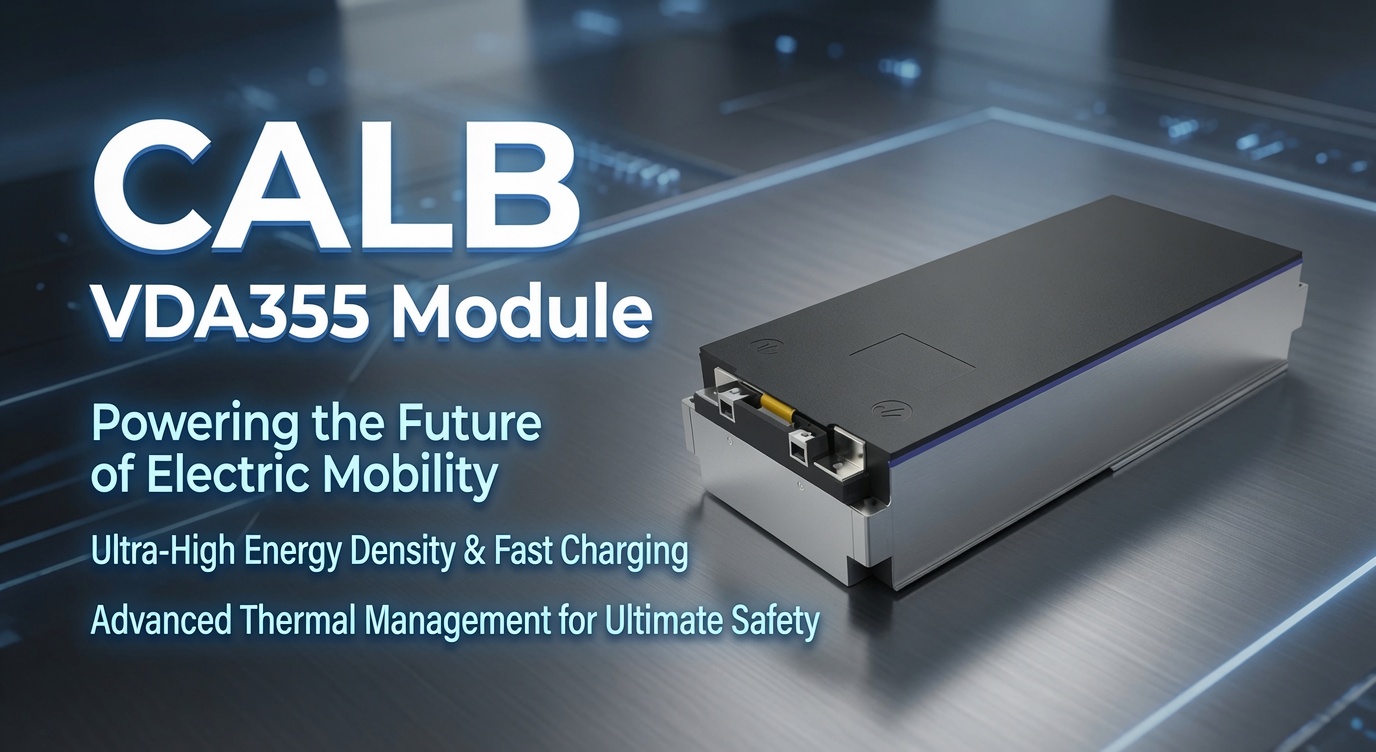
Le CALB VDA355 Module represents one of the most versatile and widely adopted standardized lithium-ion battery modules in the electric vehicle and energy storage industries. Manufactured by CALB (CALB Group Co., Ltd.), a leading global lithium battery producer, this module follows the VDA355 standard originally developed by the German Association of the Automotive Industry (VDA). Its compact dimensions, high energy density, and proven reliability make it a preferred choice for passenger EVs, commercial vehicles, custom battery conversions, and stationary storage systems.
Whether you are an EV enthusiast building a custom pack, an engineer designing scalable battery systems, or a buyer sourcing high-quality modules, understanding the CALB VDA355 Module helps you make informed decisions about performance, compatibility, and long-term value.
What is the CALB VDA355 Module?
The CALB VDA355 Module is a prismatic lithium-ion battery module built to the precise VDA355 dimensional standard (approximately 355 mm × 151 mm × 108 mm). CALB produces several configurations using high-performance NMC (Nickel Manganese Cobalt) cells, with the 3P4S 174Ah model (model D148N58-3P4S) being one of the most popular variants.
This module delivers a nominal voltage of 14.68 V and a capacity of 174 Ah, providing roughly 2.55 kWh of energy per module. Its standardized footprint allows seamless integration into battery packs designed around the VDA355 platform, reducing engineering time and improving pack density.
CALB brings decades of expertise in cell chemistry, module design, and safety engineering. As one of China’s top-tier battery manufacturers (historically ranked among the global top 10 EV battery suppliers), CALB emphasizes high energy density, long cycle life, and robust thermal performance.
The VDA355 Standard: Origins and Industry Importance
The VDA355 standard emerged from the German automotive industry’s push for battery module standardization. Introduced to improve interchangeability, manufacturing efficiency, and supply chain consistency, the format was first widely used in Volkswagen vehicles.
Key dimensions:
- Length: 355 ± 1 mm
- Width: 151.3 ± 1 mm
- Height: 108–108.5 mm
The “355” refers to the module’s length. Over time, cell thicknesses evolved (single, double, and triple), enabling different series-parallel configurations within the same outer dimensions:
- 1P12S — lower voltage, higher capacity per string
- 2P6S — balanced voltage and capacity
- 3P4S — the popular high-capacity configuration (e.g., CALB 174 Ah)
- 4P3S — even higher parallel current capability
Before 2018, VDA355 modules dominated many EV platforms. While larger formats like VDA590 (MEB platform) later appeared for higher-range vehicles, the compact VDA355 remains highly relevant for its flexibility, ease of packing, and cost-effectiveness in medium-sized packs.
Detailed Specifications of the CALB VDA355 3P4S 174Ah NMC Module
Here are the key parameters for the widely available CALB D148N58-3P4S module:
Electrical & Performance
- Nominal Capacity: 174 Ah
- Nominal Voltage: 14.68 V
- Energy: ≈ 2.55 kWh
- Internal Resistance: ≤ 4.5 mΩ
- Cycle Life: ≥ 800 cycles (45°C, fast charge, 80% SOH); ≥ 1,200 cycles (25°C); up to 2,000 cycles @ 80% DOD in optimized conditions
Physical
- Dimensions: 355 × 151.3 × 108.1 mm (±1 mm tolerance)
- Weight: ≤ 12.2 kg (typical ~12.0 kg)
- Configuration: 3P4S (3 parallel strings of 4 series-connected cells)
Operating Conditions
- Charge Temperature: -20°C to 55°C
- Discharge Temperature: -30°C to 55°C
- Storage Temperature: -40°C to 60°C
- Recommended SOC Window: Typically 5–95% or 5–97% depending on application
Certifications: CE, UN38.3, MSDS, and sea transportation compliance.
Other configurations (2P6S, 1P12S, etc.) are also available from CALB and compatible suppliers, allowing designers to tailor voltage and capacity while keeping the same mechanical footprint.
Key Features and Engineering Advantages
The CALB VDA355 Module stands out for several reasons:
- Standardized Form Factor — Simplifies mechanical design, busbar routing, and thermal management across different vehicle platforms.
- High Energy Density — NMC chemistry delivers excellent Wh/kg and Wh/L performance compared with many LFP alternatives in the same volume.
- Advanced Monitoring — Many versions incorporate FPC (Flexible Printed Circuit) solutions for precise cell voltage and temperature monitoring, improving safety and balancing efficiency.
- Robust Construction — Aluminum end plates, side plates, and structural elements provide mechanical integrity and vibration resistance suitable for automotive use.
- Thermal Management Ready — Designed for compatibility with liquid cooling plates, enabling high continuous power and fast charging.
- Évolutivité — Modules can be easily connected in series and parallel to achieve 48 V, 400 V, 800 V, or custom system voltages.
Real-World Applications
Véhicules électriques — Passenger cars and light commercial vehicles benefit from the module’s compact size and high energy density. Many Chinese OEMs and some international platforms have adopted VDA355-based packs.
DIY EV Conversions & Custom Builds — Popular among enthusiasts converting classic cars or building race/track vehicles. The standardized size makes packaging straightforward, and used/refurbished modules sometimes appear on secondary markets.
Stationary Energy Storage — Excellent for residential, commercial, or industrial BESS when configured into larger racks. Good cycle life and thermal stability support daily cycling.
Marine, Mining & Specialty Vehicles — Rugged construction and wide temperature tolerance suit ships, mining machinery, and off-highway equipment.
Aftermarket & Replacement Packs — Some suppliers offer modules compatible with platforms originally using similar VDA355 formats.
Performance, Safety & Reliability
CALB modules undergo rigorous testing for safety and durability. Key strengths include:
- Stable performance across a wide temperature range
- Low internal resistance for efficient high-power operation
- Strong calendar and cycle life when operated within recommended SOC and temperature windows
- Compliance with international transportation and safety standards (UN38.3, etc.)
Proper battery management system (BMS) integration, cell balancing, and thermal control are essential for maximizing lifespan and safety — especially in high-voltage series strings.
Practical Integration Tips for Battery Builders
When designing a pack with CALB VDA355 Modules:
- Mechanical — Use the standard mounting points and consider compression or structural frames for vibration resistance.
- Electrical — Calculate series/parallel combinations carefully. Example: 14 modules in series ≈ 205 V nominal; further paralleling increases capacity.
- Thermal — Liquid cooling plates are highly recommended for sustained high C-rates or fast charging.
- BMS — Choose a BMS with sufficient channels for cell monitoring and support for the module’s FPC or connector type.
- Enclosure — Account for module expansion, busbar routing, and IP rating requirements.
Many builders source custom busbars, end plates, and cooling solutions specifically designed for VDA355 modules.
Sourcing Authentic CALB VDA355 Modules
When purchasing, prioritize:
- Authorized distributors or direct factory channels
- Full traceability and original datasheets
- Recent production batches with proper certifications
- Clear warranty and technical support terms
Some suppliers maintain stock in regions like the United States for faster delivery. Always request the latest technical agreement or specification sheet, as minor parameter variations can exist between production runs or configurations.
Foire aux questions
What is the difference between 3P4S and 2P6S VDA355 modules? 3P4S offers higher capacity (174 Ah) at lower nominal voltage (~14.68 V). 2P6S provides higher voltage per module with lower capacity, which can reduce the number of series connections needed for higher system voltages.
Can CALB VDA355 modules be used for home solar storage? Yes, they are suitable when properly configured with an appropriate BMS, inverter, and thermal management. Many users build 48 V or higher voltage racks successfully.
How long do these modules typically last? Under normal EV or stationary use (25°C, moderate C-rates, 80% DOD), expect 1,200+ cycles to 80% SOH. Real-world lifespan depends heavily on temperature control, charging strategy, and depth of discharge.
Are liquid cooling plates necessary? For high-performance or fast-charging applications, yes. Passive or air cooling may suffice for lower-duty cycles but limits continuous power.
Is the VDA355 standard still relevant in 2025–2026? Absolutely. While larger modules exist for maximum range vehicles, VDA355 remains popular for its packing efficiency, cost-effectiveness, and widespread tooling/support in the supply chain.
Conclusion
Le CALB VDA355 Module combines proven standardization, high energy density, and reliable performance from a top-tier manufacturer. Its compact footprint and flexible configurations make it an outstanding building block for electric mobility and energy storage projects worldwide.
Whether you are scaling production battery packs or embarking on a custom EV conversion, the CALB VDA355 platform offers an excellent balance of performance, integration ease, and long-term value.
For the latest specifications, pricing, or technical support, consult authorized CALB distributors or experienced battery system integrators. As battery technology continues to advance, standardized modules like the VDA355 will remain a cornerstone of efficient, scalable energy solutions.
This article is for informational purposes. Always verify current specifications directly with the manufacturer or supplier before purchase or system design. Battery systems involve safety considerations — professional engineering review is strongly recommended.