
Meta-Beschreibung: 2026 technical briefing on forklift lithium battery safety protection features. Coverage of multi-layer BMS functions, thermal management, mechanical/IP protection, UL 2580 & IEC 62619 requirements, LiFePO₄ advantages, comparison table, selection checklist, FAQ and decision framework for industrial fleets.
Forklift lithium battery safety depends on engineered protection layers that keep cells, modules and complete packs inside safe electrical, thermal and mechanical limits under real warehouse duty cycles. In 2026 the combination of a properly designed Battery Management System, active or passive thermal controls, robust enclosures and third-party certification forms the practical baseline for reliable, low-risk operation.
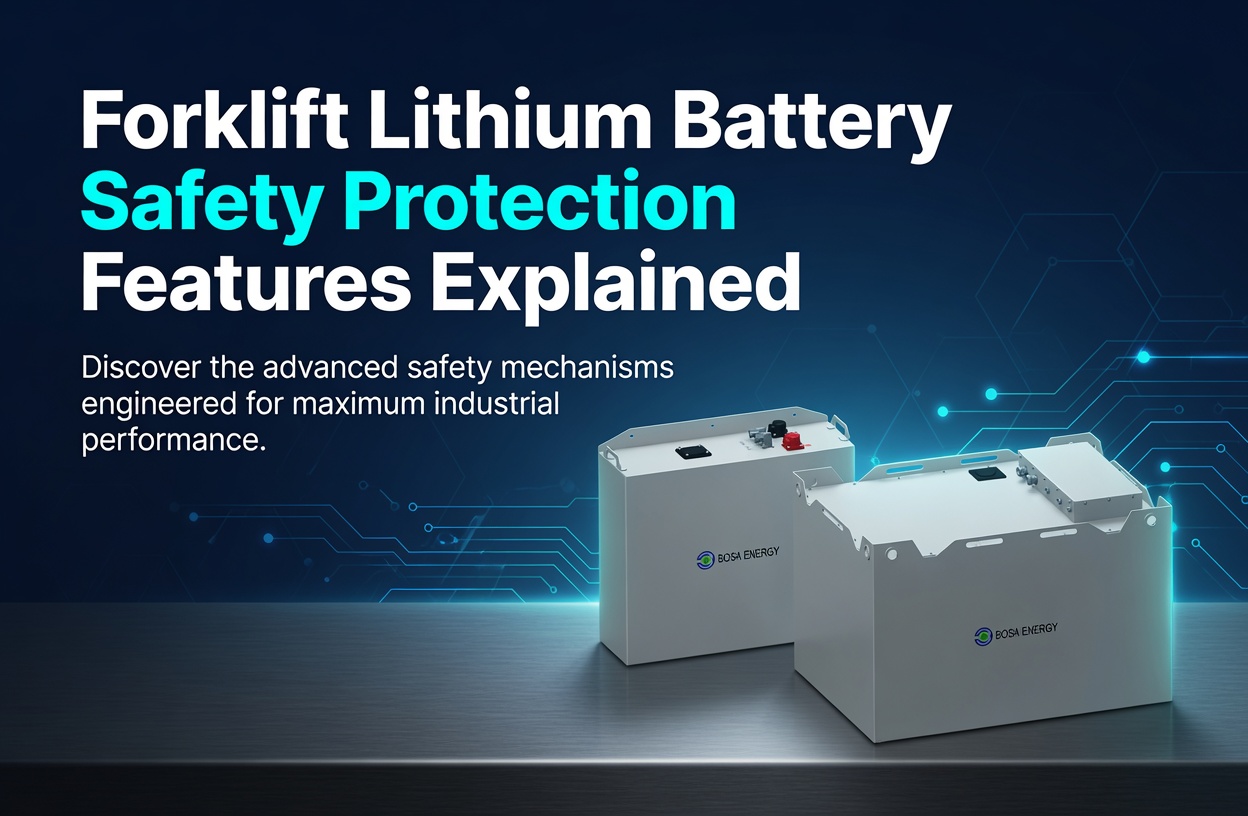
This briefing on Forklift Lithium Battery Safety: Protection Features Explained maps the core protection features that define modern forklift lithium packs, quantifies typical performance thresholds, and supplies prioritised selection criteria so facility and fleet managers can evaluate claims against measurable safety outcomes.
Table of Contents
- Why Multi-Layer Protection Matters
- Battery Management System (BMS) – The Primary Safety Controller
- Thermal Management and Temperature Safeguards
- Mechanical, Structural and Ingress Protection
- Electrical Isolation, Fusing and Emergency Controls
- Certification Requirements: UL 2580 and IEC 62619
- Comparison Table of Protection Layers
- Selection Checklist for Safe Forklift Lithium Packs
- Häufig gestellte Fragen
- Decision Framework: Specifying Protection Features
Why Multi-Layer Protection Matters
Lithium-ion packs used in Class I, II and III industrial trucks operate under high continuous currents, frequent opportunity charging, vibration and occasional impact. A single unprotected fault—over-voltage, cell imbalance, internal short or elevated temperature—can cascade into capacity loss, abrupt shutdown or, in extreme cases, thermal events.
Effective forklift lithium battery safety therefore relies on independent, overlapping safeguards rather than any single device. The Battery Management System provides real-time monitoring and protective disconnection; thermal systems keep cells inside the safe operating window; mechanical design contains energy and resists environmental intrusion; and certification verifies that the complete assembly survives defined abuse tests without fire, explosion or hazardous leakage.
LiFePO₄ (LFP) chemistry further reduces baseline risk through higher thermal-runaway onset temperature and minimal oxygen release compared with NMC formulations, which is why the majority of certified industrial forklift packs in 2026 use LFP cells.
Battery Management System (BMS) – The Primary Safety Controller
The BMS is the continuous safety brain of every modern lithium forklift battery. It samples individual cell voltages, pack current and multiple temperature points, then enforces hard limits and soft operating windows.
Core protective functions include:
- Over-charge protection that disconnects the charge path when any cell approaches its upper voltage limit (typically 3.65 V for LFP).
- Over-discharge protection that opens the discharge path before cells fall into irreversible low-voltage territory (commonly below 2.5 V).
- Over-current and short-circuit protection with response times measured in milliseconds to tens of milliseconds, often using both software thresholds and hardware comparators.
- Cell balancing (passive or active) that equalises state-of-charge across the series string and prevents progressive capacity divergence.
- State-of-charge (SOC) and state-of-health (SOH) estimation with diagnostic fault logging and CAN-bus communication to the forklift controller and charger.
Advanced industrial BMS designs add functional-safety analysis (aligned with IEC 61508 or ISO 26262 concepts), lock-out after critical trips, and EMC immunity so industrial electrical noise does not disable protection. In multi-shift operations the BMS also manages regenerative-braking current pulses without nuisance trips and supports opportunity charging by reporting available charge current in real time.
A weak or poorly specified BMS is repeatedly identified as the dominant root cause of lithium forklift battery problems; therefore the quality and certification status of the BMS should be treated as a primary selection criterion.
Thermal Management and Temperature Safeguards
Temperature is the second major control variable. Lithium cells deliver rated life and safety only inside a defined thermal window—typically 15–35 °C for optimal performance, with hard cut-offs near 0 °C (charging lock-out) and 55–65 °C (discharge or charge inhibition).
Protection features commonly include:
- Distributed NTC or equivalent temperature sensors across modules.
- Passive heat-spreading plates or phase-change materials that absorb short-term heat spikes.
- Active air or liquid cooling loops on higher-capacity packs (>200–300 Ah) that extract sustained heat loads.
- Self-heating or pre-heat circuits for cold-storage and outdoor winter operation so charging can begin only after cells reach the safe lower threshold.
These systems prevent both performance fade and the conditions that can initiate thermal runaway. Facilities further support thermal safety by locating chargers away from extreme airflow, maintaining clean high-current connectors, and ensuring operators respond promptly to temperature-related fault codes.
Mechanical, Structural and Ingress Protection
Forklift batteries experience continuous vibration, occasional drops during service, and exposure to dust, wash-down water or outdoor moisture. Structural protection therefore forms a third independent layer.
Typical design elements:
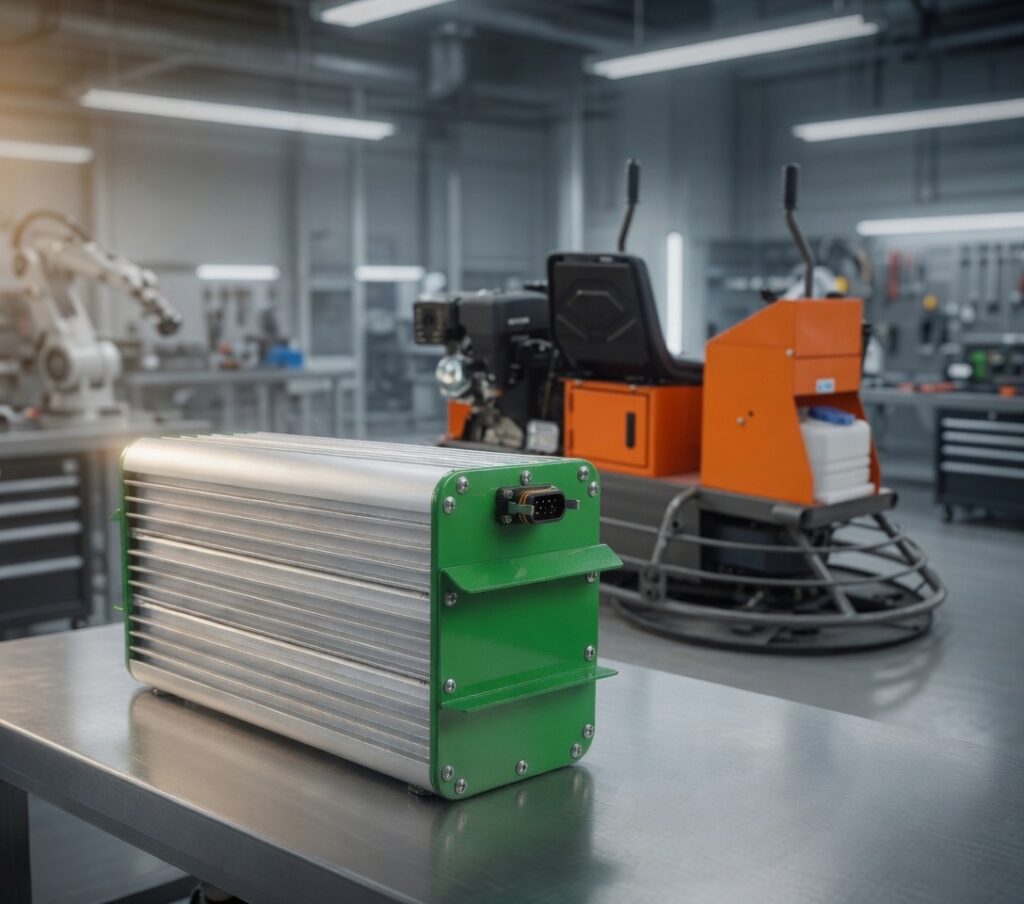
- Reinforced steel or aluminium enclosures with internal cell fixtures that resist 5–7 g vibration and drop-test loads.
- IP54 to IP65 (and occasionally higher) ingress protection that keeps dust and water jets away from terminals, busbars and electronics. IP65 is increasingly common for mixed indoor/outdoor and cold-chain fleets.
- Vibration-dampening mounts, nylon-coated or insulated busbars, and strain-relieved connectors that reduce arc-flash and mechanical fatigue risks.
- Modular architecture that isolates any single-module failure and simplifies field replacement.
These mechanical features work together with the BMS: even if a cell is mechanically compromised, the enclosure contains debris and the BMS detects the resulting voltage or temperature anomaly and isolates the pack.
Electrical Isolation, Fusing and Emergency Controls
Beyond the BMS software limits, hardware electrical safeguards provide an additional independent barrier:
- Contactors or solid-state power distribution units that open under fault conditions.
- Fast-acting fuses sized for the continuous and peak currents of the specific voltage platform (24 V, 36 V, 48 V or 80 V).
- Manual emergency power cut-off switches accessible to the operator.
- Proper high-voltage interlocks and insulation monitoring where required by the forklift OEM.
These elements ensure that a software fault or sensor failure cannot leave the pack fully energised under hazardous conditions.
Certification Requirements: UL 2580 and IEC 62619
Third-party certification converts design claims into verified performance. The two standards most relevant to forklift lithium packs are:
- UL 2580 – the primary North American standard for battery packs used in electric-powered industrial vehicles. It subjects complete assemblies to over-charge, external short-circuit, crush, impact, vibration, thermal abuse and other tests; the pack must not produce fire, explosion or personnel-exposure hazards.
- IEC 62619:2022 – the principal international industrial standard covering both motive (forklifts, AGVs) and stationary applications. It includes thermal-runaway propagation testing, formal BMS functional-safety analysis and enhanced EMC requirements.
Many global suppliers pursue dual certification. UN 38.3 transport testing remains mandatory for international shipment. Prefer packs whose certificates explicitly cover the exact voltage and capacity platform being purchased and that carry ongoing factory surveillance.
Comparison Table of Protection Layers
| Protection Layer | Primary Function | Typical Implementation | Key 2026 Performance Expectation |
|---|---|---|---|
| BMS (core) | Voltage, current, temperature monitoring & cut-off | Multi-cell AFE + MCU, CAN communication | ≤200 ms critical disconnection; functional-safety analysis |
| Cell Balancing | Prevent progressive imbalance | Passive or active (2–5 A) | Maintain ± few mV variance across string |
| Wärmemanagement | Keep cells inside safe window | NTC sensors + air/liquid/PCM | Charge lock-out <0 °C; inhibit >55–65 °C |
| Mechanical / IP | Contain energy, resist environment | Steel enclosure, IP54–IP65, vibration mounts | Survive drop/vibration tests; dust/water jet protection |
| Electrical Hardware | Independent isolation | Contactors, fuses, emergency switch | Hardware redundancy independent of BMS software |
| Certification | Third-party abuse validation | UL 2580 and/or IEC 62619 | Full suite of electrical, mechanical, thermal tests |
| Chemie | Intrinsic thermal stability | LiFePO₄ preferred | Higher runaway onset temperature vs NMC |
Selection Checklist for Safe Forklift Lithium Packs
When evaluating forklift lithium battery safety protection features in 2026, verify the following:
- Documented multi-layer BMS with over-charge, over-discharge, over-current, short-circuit and temperature protection.
- Explicit cell-balancing method and accuracy.
- Thermal sensors distributed across the pack plus defined charge/discharge temperature windows.
- Enclosure rating of at least IP54 (IP65 preferred for mixed or outdoor duty).
- Valid UL 2580 and/or IEC 62619 certificate covering the exact model and voltage platform.
- LiFePO₄ chemistry with published cycle life ≥3,500 cycles at 80 % DoD.
- Compatibility with opportunity charging (15–40 % capacity restoration) while the BMS keeps average SOC above 20–30 %.
- Clear fault codes, CAN communication and diagnostic access for technicians.
- Supplier evidence of factory surveillance and UN 38.3 transport compliance.
Häufig gestellte Fragen
What is the single most important protection feature in a forklift lithium battery? The BMS. Without continuous cell-level monitoring and protective disconnection, the other mechanical and thermal features cannot prevent electrical faults from escalating.
Do lithium forklift batteries require special fire-suppression systems? Product-level standards (UL 2580 / IEC 62619) address the battery itself. Facility-level fire protection is governed by local codes and NFPA 855. Certified LFP packs substantially reduce the probability and severity of thermal events, but site-specific risk assessment remains necessary.
Can opportunity charging compromise safety? No. When the BMS and charger communicate correctly, short opportunity charges of 15–40 % capacity are fully compatible with certified packs and actually reduce average depth of discharge, improving both life and thermal stability.
How does LFP chemistry improve forklift lithium battery safety? LFP cells exhibit higher thermal-runaway onset temperatures and release far less oxygen during failure than NMC chemistries, simplifying compliance with propagation tests and reducing fire intensity if a cell is compromised.
Is IP67 necessary for indoor warehouse forklifts? Usually not. IP54–IP65 provides adequate protection against dust and wash-down for the majority of indoor and mixed-use fleets. Higher ratings add cost and are justified mainly for outdoor, marine-adjacent or high-pressure cleaning environments.
Decision Framework: Specifying Protection Features
- Confirm the application duty cycle (single-shift, multi-shift, cold storage, outdoor) and required voltage platform.
- Require a multi-layer BMS with documented functional-safety analysis and CAN communication.
- Verify thermal management matches the ambient extremes of the site.
- Specify minimum IP54 (prefer IP65) and mechanical robustness validated by drop/vibration testing.
- Demand UL 2580 and/or IEC 62619 certification for the exact pack model.
- Prefer LiFePO₄ chemistry with ≥3,500-cycle rating at 80 % DoD.
- Ensure the pack supports opportunity charging while the BMS enforces SOC windows above 20–30 %.
- Integrate fault reporting into daily operator checks and maintenance routines.
A clear understanding of Forklift Lithium Battery Safety: Protection Features Explained allows fleet managers to move beyond marketing claims and select packs whose engineered safeguards align with both regulatory expectations and the realities of continuous industrial operation. When these layers are correctly specified and maintained, lithium technology delivers the uptime, cycle life and inherent safety advantages that justify the transition from lead-acid systems.
In summary, prioritising the multi-layer protections detailed in this guide to Forklift Lithium Battery Safety: Protection Features Explained remains the most reliable path to safe, high-uptime lithium forklift fleets in 2026.