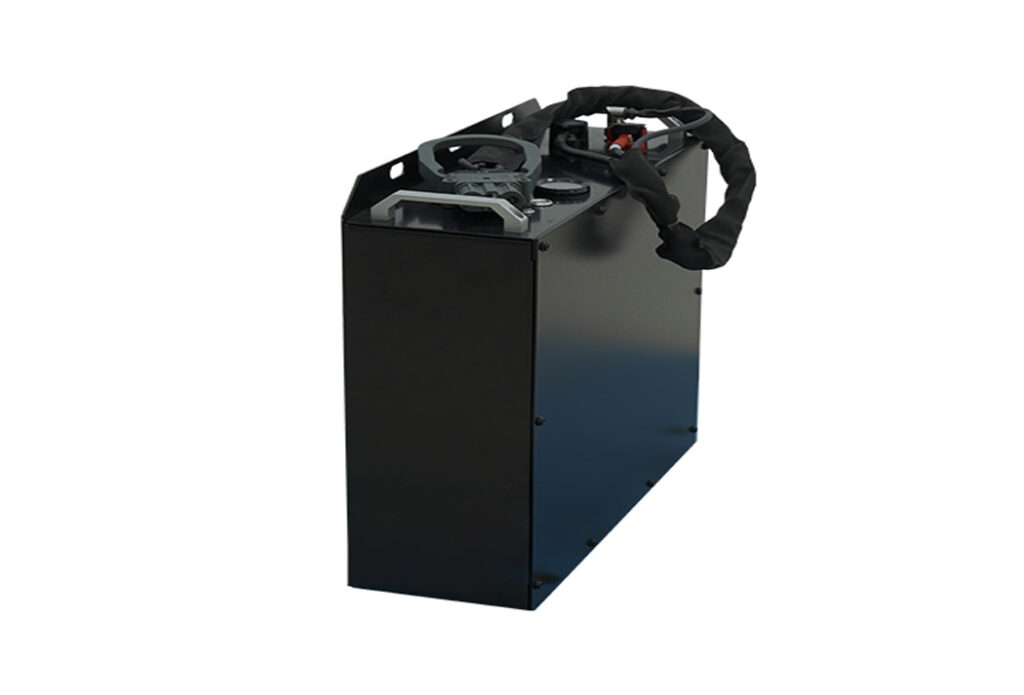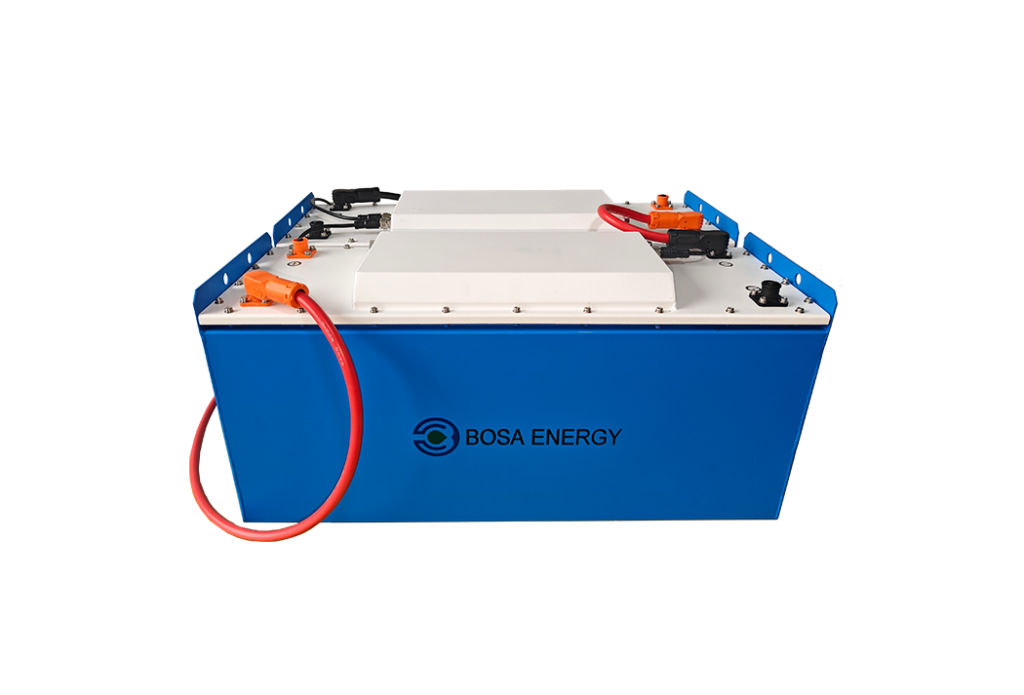

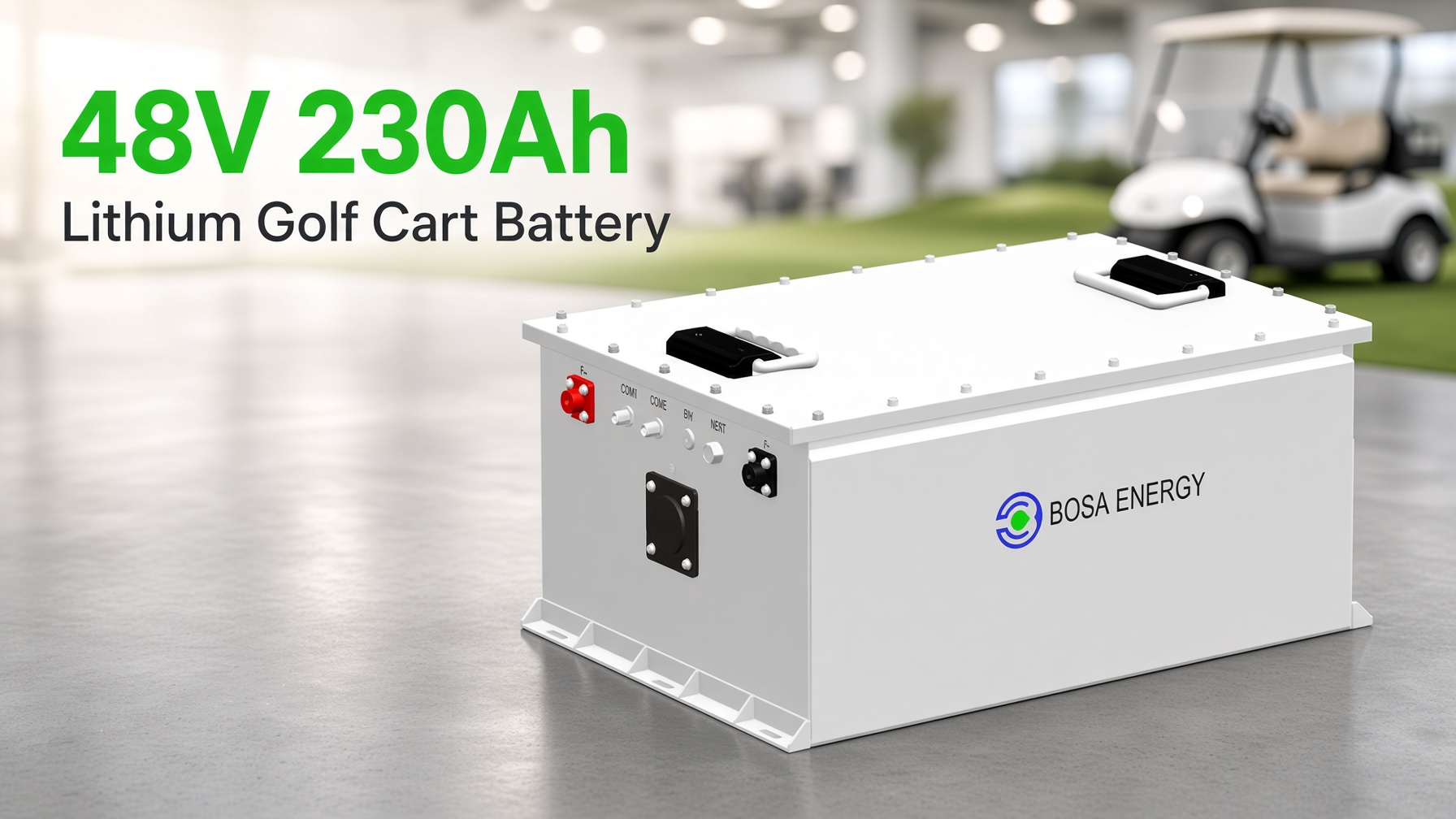
A 48V 230Ah Lithium Golf Cart Battery is a high-capacity LiFePO₄ pack, not a factory golf-car SKU. At 51.2 V nominal it stores about 11.78 kWh — roughly twice Trojan’s 171 Ah OnePack XR and nearly four times the ~3.8 kWh Club Car Tempo Li-Ion pack. Specify it only when the measured duty cycle, tray envelope, controller current, and charger circuit all justify that energy. Platform match still beats peak amp-hours.
Key takeaways
- Specify LiFePO₄ packs rated at least 3,500 cycles at 80% depth of discharge (DoD), with UL 2271 (or a documented equivalent light-EV pack certification), UN 38.3 shipping, and a published 40–58.4 V working window on a 48 V platform.
- 2026 factory anchors remain smaller than 230 Ah: E-Z-GO RXV ELiTE 2.2 at 56.7 V max / ~60 Ah with the Light World Charger; Club Car Tempo Li-Ion at ~3.8 kWh with a 6-year / 2.8 MWh base lithium warranty; Trojan OnePack XR at 51.2 V / 171 Ah / 8,755 Wh and 4,000 cycles (15 April 2026 RXV Gen 1 ELiTE drop-in).
- A 48V 230Ah Lithium Golf Cart Battery belongs on lifted PTVs, long resort loops, neighborhood LSVs, and utility carts that finish a 105–171 Ah day below 20–30% state of charge (SOC). It is oversized for a stock 18-hole rental fleet.
- Opportunity charges of 15–40% of pack capacity between turns are acceptable on lithium. Keep operating SOC above 20–30%. A 22 A kit charger on 230 Ah is only ~0.1C — size the charger to the barn circuit, not the nameplate.
- Platform match beats peak amps. IEEE Spectrum’s 30 May 2026 review of drop-in motive packs put the rule in one sentence: design the lithium system around the electrical reality of the legacy platform, not the other way around.
Table of Contents
- What a 230 Ah 48 V pack actually is
- 2026 factory lithium platforms set the baseline
- Who should specify 230 Ah — and who should not
- Stay-flooded vs 105 Ah vs 171 Ah XR vs 230 Ah
- Voltage window, current, and controller limits
- Tray fit, mass, and ballast
- Charging a 11.8 kWh golf-cart pack
- Safety and certification floor
- Install sequence
- Selection checklist
- Häufig gestellte Fragen
- Decision Framework
- Authoritative references
What a 230 Ah 48 V pack actually is
Nameplate “48 V” on a lithium golf-cart pack is a system class, not the cell string voltage. Production LiFePO₄ strings for this class are 16S. Nominal voltage is 51.2 V. Charge cutoff is 58.4 V. Discharge cutoff sits near 40 V. Energy is voltage × amp-hours:
51.2 V × 230 Ah = 11,776 Wh ≈ 11.78 kWh.
Usable energy at 80% DoD is about 9.4 kWh. That is the figure that should go into a range model, not the 230 Ah sticker.
Two 2026 aftermarket envelopes dominate the 230 Ah class:
| Pack | Energy / voltage window | Continuous / peak current | Envelope / mass | Cycle claim |
|---|---|---|---|---|
| Epoch LiMax BB51230A (kit) | 51.2 V, 230 Ah, 11.78 kWh; 40–58.4 V | 300 A cont.; 500 A / 15 s; 1,000 A / 2 s; 230 A charge | ~23.5 × 14.4 × 9.9 in; ~180–196 lb; IP67 | 4,000 cycles; 11-year limited warranty |
| BSLBATT B-LFP-48-230GC-A | 51.2 V, 230 Ah, 11,776 Wh | 205 A cont. discharge; 100 A charge | 27.76 × 16.54 × 10.04 in (705 × 420 × 255 mm); 227 lb; IP67 | >4,500 cycles (vendor) |
| Lithion 51.2 V 230 Ah (LEV / UTV / GSE class) | 11.78 kWh; 40–58.4 V | 230 A cont.; 460 A / 10 s; 700 A / 2 s | 34.65 × 12.60 × 9.69 in; 182 lb; IP67 | Industrial datasheet, not a golf-tray drop-in |
None of those three is an E-Z-GO, Club Car, or Yamaha factory pack. They are aftermarket or industrial 16S modules sold into golf-cart trays, PTVs, and utility vehicles. Parallel of two packs is listed on some Epoch sheets (up to 23.55 kWh). Series is not supported — the pack is native 48 V.
A six-battery flooded 48 V set (six 8 V GC2/GC8) typically stores 150–170 Ah nameplate and delivers about half of that before voltage sag and sulfation force a recharge. The lithium pack’s usable energy is therefore closer to 2–2.5× a healthy flooded tray, not 230 ÷ 150.
2026 factory lithium platforms set the baseline
Darren Brittain, Trojan’s vice president of lithium commercial strategy for motive applications, stated the engineering filter in IEEE Spectrum on 30 May 2026: design the lithium system around the electrical reality of the legacy platform, rather than asking the vehicle to adapt to the battery. A 230 Ah aftermarket box that ignores that filter is just a heavier, more expensive 105 Ah kit.
The 2026 factory and documented drop-in anchors:
E-Z-GO RXV ELiTE 2.2. Current dealer sheets list a single 56.7 V max lithium pack at approximately 60 Ah, paired with the Light World Charger (56.7 V, 10 ft DC cord). The drivetrain remains a 48 V AC architecture with a 4.4 hp (3.3 kW) continuous motor. Curb weight with the 2.2 pack is listed at 662 lb (300 kg). Samsung SDI cells and an eight-year battery warranty appear on U.S. dealer literature. The 2.2 pack is smaller than earlier ELiTE offerings. A 230 Ah aftermarket pack is not a plug-in replacement for that Samsung module.
Club Car Tempo Li-Ion. Club Car positions Tempo Li-Ion as a fleet range leader among factory lithium cars, with stored energy in current literature at approximately 3.8 kWh and a 4.7 hp AC motor. The official warranty page states base lithium coverage as the earlier of 6 years or 2.8 MWh of cumulative discharge; extended-range lithium is the earlier of 6 years or 4.9 MWh. Chargers on Tempo lithium configurations are 650 W standard with a 900 W option.
Trojan OnePack and OnePack XR. Trojan’s 15 April 2026 announcement added drop-in compatibility for E-Z-GO RXV Gen 1 ELiTE cars: no motor or controller replacement. The 48 V OnePack (105 Ah) and OnePack XR (TR-48-170-M, 51.2 V nominal, 171 Ah, 8,755 Wh) are LiFePO₄ packs with a working window of 40.48–58.40 V — inside the tolerance of many legacy 48 V platforms. The May 2026 XR datasheet rates cycle life at 4,000 cycles at 25 °C, C/2. Opportunity charging is explicitly supported. Range claims are up to 60 miles (105 Ah) and 75 miles (171 Ah), terrain-dependent.
Bolt factory integrations (18 May 2026). Bolt Lithium announced plug-and-play factory integrations for Club Car and E-Z-GO, using the vehicle’s existing motor controllers and wiring harnesses, including Club Car Vanguard and LG platforms. Pre-orders opened 1 June 2026. The commercial claim is a 12-year transferable warranty and the elimination of controller swaps on supported SKUs. Confirm generation (TXT vs RXV, Vanguard vs LG) before the kit ships.
Eco Battery Gen3 TXT / RXV adapter (June 2026). Eco Battery’s Factory Lithium Conversion Bundles target E-Z-GO TXT and RXV Gen 1 and Gen 2 cars that already carry small OEM Samsung packs. The bundle pairs a Gen3 BMS with E-Z-GO-specific firmware and a factory lithium conversion adapter so dash, gauges, and OEM safety logic remain intact. Golf Car Options carried the same launch on 14 September 2026. Catalog capacities run 105–160 Ah depending on tray (skinny vs thru-hole) and generation. Factory 60 Ah Samsung packs are the units these kits are sized to replace.
Those SKUs define the market the 230 Ah class sits above. If an ELiTE 2.2, Tempo Li-Ion, OnePack XR, Bolt factory kit, or Eco Gen3 160 Ah finishes the measured loop above 20–30% SOC, do not buy 230 Ah for its own sake.
Who should specify 230 Ah — and who should not
Specify 230 Ah when at least two of the following are true:
- The cart is lifted, enclosed, or loaded (rear seat, cargo box, extra passengers) and a 105–171 Ah lithium pack already finishes the longest day near 20% SOC.
- Daily energy use, logged from a SOC gauge or BMS app over a full week, exceeds ~7–8 kWh usable.
- The route is hilly, sandy, or stop-start utility work rather than a flat 18-hole loop.
- Opportunity charging between turns is unreliable (no barn mid-day, no 15–40% top-up).
- The tray physically accepts the published envelope and the controller continuous rating is ≥200 A.
Do not specify 230 Ah when:
- The cart is a stock rental or member fleet car that already completes 36 holes on a 105 Ah or factory lithium pack.
- The tray is a skinny RXV metal tray or a compact TXT box that will not accept a 23.5–27.8 in pack without cutting or stacking.
- The only available charger circuit is a shared 15 A garage outlet and the kit charger is 22 A at 58.4 V (~1.3 kW). That circuit will trip or starve the pack.
- The buyer’s goal is “more Ah” on a car whose controller, motor, and tires cannot use the extra energy.
Range estimates published by aftermarket vendors (90–100 miles on 230 Ah) assume flat terrain, stock tires, one or two occupants, and a moderate speed. Hills cut range 20–50%. A 230 Ah pack does not repeal that physics; it only delays the SOC floor.
Stay-flooded vs 105 Ah vs 171 Ah XR vs 230 Ah
| Criterion | Stay flooded (6 × 8 V) | 48 V 105 Ah LFP | Trojan OnePack XR 171 Ah | 48 V 230 Ah LFP |
|---|---|---|---|---|
| Nameplate energy | ~7–8 kWh (poorly usable) | ~5.4 kWh | 8.76 kWh | 11.78 kWh |
| Usable energy at prudent DoD | ~3.5–4.5 kWh | ~4.3 kWh | ~7.0 kWh | ~9.4 kWh |
| Typical pack mass | 350–450 lb | ~90–120 lb | 170 lb (77 kg) | 180–227 lb |
| Lebenszyklus | 400–800 | ≥3,500 at 80% DoD | 4,000 (Trojan XR) | 4,000+ (Epoch / vendor) |
| Charge time, matched charger | 8–10 h | 3–5 h | 4–6 h | 5–12 h (depends on charger amps) |
| Watering / equalization | Weekly / monthly | Keiner | Keiner | Keiner |
| Platform integration | Native | Adapter or drop-in | Documented RXV Gen 1 ELiTE drop-in | Measure tray; confirm controller |
| Best use | Low-hour private carts | Stock 18-hole / light PTV | Long-range stock and RXV ELiTE upgrade | Lifted, utility, multi-loop, LSV |
The mass column matters. A 230 Ah lithium pack is lighter than a flooded tray but heavier than a 105 Ah lithium pack by 60–130 lb. That mass sits in the same well the chassis was designed around. Do not assume “lithium is always lighter” when moving from 105 Ah lithium to 230 Ah lithium.
Voltage window, current, and controller limits
A 48 V AC golf-cart controller expects a working window near 40–58 V. That is why OnePack XR (40.48–58.40 V) and the Epoch / BSLBATT 230 Ah packs (40–58.4 V) can talk to many legacy 48 V platforms without a controller swap — provided the BMS does not collapse voltage under load into the controller’s undervoltage lockout.
Current is the second filter:
- Stock E-Z-GO / Club Car AC controllers on member cars are often in the 275–450 A class. A pack rated 300 A continuous with 1,000 A / 2 s peak will not be the bottleneck on a stock motor.
- Aftermarket high-current controllers (Navitas and similar) can demand more than a 205 A-limited pack will give. Match pack continuous current to controller continuous current, not to marketing peak.
- Regenerative braking on AC cars returns current into the pack. Confirm the BMS accepts regen (Epoch lists 500 A / 15 s peak charge/regen). A pack that opens on regen will throw a fault on every downhill.
A voltage mismatch is the most expensive “upgrade” a buyer can make. Confirm the controller rating, charger algorithm, and gauge scale before the pack ships. Factory lithium cars (ELiTE 2.2, Tempo Li-Ion, some Onward / Vanguard) use CAN or a proprietary wake line. A generic 230 Ah “Big Box” without the platform adapter will leave the dash dark or the charger locked out.
Tray fit, mass, and ballast
Measure the tray before the order. Published 230 Ah envelopes are not interchangeable:
- Epoch LiMax class: ~23.5 × 14.4 × 9.9 in. Fits many TXT “big box” trays and some Club Car Precedent / Tempo wells with the vendor bracket. Confirm height under the seat pan.
- BSLBATT 230GC: 27.76 × 16.54 × 10.04 in. Longer and wider. Will not drop into a skinny RXV metal tray.
- Lithion 230 Ah industrial: 34.65 in long. Treat as a UTV / GSE / custom-box pack, not a golf-seat drop-in.
Flooded-to-lithium conversions remove 150–250 lb from a six-battery tray. Going the other way — from a 105 Ah lithium pack to 230 Ah — puts 60–130 lb back. On a lifted PTV that already runs large tires and a rear seat, that mass is useful ballast. On a stock RXV it changes ride height and braking feel. Re-torque hold-downs after the first week. Do not rely on the flooded J-bolts if the new pack uses a different footprint.
IP67 is the right ingress target for carts that are washed, stored in open-sided barns, or run coastal humidity. IP65 is the floor. An unsealed “DIY cell box” is not a golf-cart battery.
Charging a 11.8 kWh golf-cart pack
A 48V 230Ah Lithium Golf Cart Battery does not charge like a 105 Ah kit. Energy in is ~11.8 kWh plus losses. Charge time is pack kWh ÷ charger kW, not a marketing “2-hour” claim copied from a smaller pack.
| Charger | Approximate power at 58.4 V | 20–80% on 230 Ah | Empty-to-full (rough) |
|---|---|---|---|
| Kit 22 A lithium charger (common Epoch kit) | ~1.3 kW | ~5–6 h | ~10–12 h |
| 15 A waterproof kit charger | ~0.9 kW | ~7–8 h | ~13–15 h |
| 25–30 A / ~1.5 kW lithium charger | ~1.5–1.8 kW | ~4–5 h | ~7–9 h |
| Opportunity charge, 20–40 min at 22–30 A | 15–40% of capacity | Use between loops | Do not wait for empty |
Rules that do not change with amp-hours:
- Use the vendor’s lithium-profile charger or a documented reflash (Lester Summit II lithium algorithm, Delta-Q lithium profile). A flooded PowerWise or un-flashed QuiQ will over-volt or under-charge an LFP pack.
- Opportunity charges of 15–40% of pack capacity between turns are acceptable. Keep operating SOC above 20–30%.
- Charge temperature floor is 0 °C / 32 °F on most LiFePO₄ BMS maps. Do not charge a frozen pack; wait for the heat pad or ambient recovery.
- Storage: 30–50% SOC in a climate-controlled space if the cart sits more than 30 days. Trojan’s May 2026 OnePack user’s guide still uses a 12-month climate-controlled storage rule and a 0 °C charge cut-off — apply the same discipline to a 230 Ah aftermarket pack.
Fleet barns hit a different limit: circuit count. Butler Country Club, an 18-hole private club in western Pennsylvania, could not charge its 60-cart electric fleet simultaneously on legacy barn wiring. The club installed three 50-foot runs of 100-amp T3 Starline Track Busway with plug-in units carrying four 20-amp breakers and receptacles, plus custom brackets for E-Z-GO chargers. Golf Course Industry’s February 2026 busway brief and the Starline case make the constraint explicit. A 230 Ah pack with a 22 A charger draws more than a 105 Ah pack on the same stall. Count breakers before you count amp-hours.
Safety and certification floor
LiFePO₄ is the chemistry that belongs under a golf-cart seat. The phosphate cathode is thermally more stable than nickel-rich automotive cells, and the BMS — not the cell — is the component that prevents the event operators fear.
Minimum pack requirements:
- UL 2271 (batteries for light electric vehicles) or a documented equivalent pack-level abuse test. UL 2271 covers overcharge, short circuit, crush, vibration, and thermal conditions that a garage or barn will eventually produce through a damaged cable or a misplaced jack. “UL 1642 cells inside” is not the same as a UL 2271 pack.
- UN 38.3 for shipping and replacement logistics.
- Cell- and pack-level over-voltage, under-voltage, over-current, short-circuit, and temperature cut-offs, with redundant disconnects.
- Ingress rating of IP65 or better; IP67 preferred.
- Charger and pack tested as a pair.
IEEE Spectrum’s 30 May 2026 piece treated Trojan’s OnePack as a case study because the pack stays inside the legacy voltage window and the BMS enforces thermal and current limits without asking the cart to change. Apply that same test to any 230 Ah SKU: four levels of protection and five temperature sensors (Trojan’s published OnePack architecture) are the class of BMS a buyer should demand, not a single low-voltage cutoff.
Install sequence
- Identify the platform. TXT vs RXV vs Precedent vs Tempo vs Drive2; flooded vs factory Samsung / Vanguard / LG lithium; controller brand and continuous amp rating; existing charger model.
- Measure the tray. Length, width, height under the seat, cable-exit side, and hold-down pattern. Compare to the published 230 Ah envelope.
- Confirm the voltage window. Pack 40–58.4 V must sit inside the controller and charger tolerance. Factory ELiTE 2.2 cars at 56.7 V max need the OEM path or a documented adapter, not a generic Big Box.
- Size energy from a logged week, not a brochure mile claim. If a 171 Ah pack already finishes above 30% SOC, stop.
- Specify the charger first. Dedicated circuit, lithium algorithm, and current that can add 15–40% in a lunch window if the duty cycle needs it.
- Pull the old pack. Isolate the key, chock the wheels, support the seat. On Club Car IQ / OBC cars, use the documented bypass only if the new pack requires it.
- Set the new pack, torque terminals to the datasheet (typically 50–60 in-lb on many golf-cart M8 posts; follow the vendor sheet), fit the 12 V converter if accessories are 12 V, and mount the SOC gauge.
- First charge to 100% on the matched charger before the first loaded loop. Update BMS firmware if the vendor ships OTA (Epoch lists Bluetooth OTA).
- Pilot one cart for two weeks. Log SOC at the start and end of each day, peak current, and any limp-mode events. Copy the spec only after the pilot stays above 20–30% SOC with margin.
Selection checklist
- Chemistry is LiFePO₄, ≥3,500 cycles at 80% DoD (4,000 on current Epoch / Trojan XR class).
- Pack-level UL 2271 (or documented equivalent) and UN 38.3.
- Published working window 40–58.4 V (or the OEM window for that platform).
- Continuous discharge ≥ controller continuous rating.
- Regen / charge current accepted by the BMS.
- Envelope measured against the actual tray, not a “fits all carts” headline.
- Matched lithium charger on a dedicated circuit; opportunity charging 15–40% planned.
- Operating SOC policy: stay above 20–30%.
- 12 V accessory path (converter or DC-DC) documented.
- IP65 minimum, IP67 preferred.
- Warranty in writing (years and/or MWh), with the same coverage on the charger.
- Pilot cart before a fleet buy.
Häufig gestellte Fragen
Is 230 Ah too large for a normal golf cart? For a stock 18-hole member or rental car, yes. Factory 2026 packs sit at ~60 Ah (ELiTE 2.2) to ~171 Ah (OnePack XR). Use 230 Ah when logged energy use, hills, lift kits, or utility duty empty a 105–171 Ah pack.
Will a 230 Ah 48 V lithium pack drop into an E-Z-GO RXV ELiTE 2.2? Not as a silent swap. The 2.2 car uses a ~60 Ah pack at 56.7 V max and the Light World Charger. Aftermarket 230 Ah kits target flooded 48 V trays and some factory-lithium cars only when the vendor supplies the generation-specific adapter (Trojan OnePack on RXV Gen 1 ELiTE; Bolt May 2026 Club Car / E-Z-GO integrations; Eco Battery Gen3 TXT/RXV adapter). Measure first.
How far will 230 Ah go? Vendor sheets quote 90–100 miles on flat ground. Treat that as a ceiling. A loaded, lifted PTV on hills will look more like 40–70 miles. Model from 9.4 kWh usable and your measured Wh/mile, not the brochure.
Do I need a new charger? Yes. The flooded charger stays on the shelf. Kit 22 A chargers will fill 230 Ah overnight. If the cart must turn twice in one day with no mid-day plug, specify a higher-current lithium charger and confirm the barn circuit.
Can I parallel two 230 Ah packs? Some Epoch sheets allow two in parallel (23.55 kWh). Series is not supported. Parallel only with identical packs, identical firmware, and the vendor’s parallel harness. Most golf trays cannot physically hold two 230 Ah boxes.
What cycle life should I write into a bid? LFP ≥3,500 cycles at 80% DoD is the floor used across this briefing series. Epoch lists 4,000 on the 230 Ah LiMax; Trojan lists 4,000 on the XR. Calendar life is still 8–12 years if SOC and temperature are respected.
Decision Framework
- Log the duty cycle for one week. Start-of-day SOC, end-of-day SOC, payload, and whether a mid-day plug exists. If a 105–171 Ah lithium pack finishes above 20–30% SOC, do not buy 230 Ah.
- Does a factory SKU already cover the duty cycle? If an ELiTE 2.2, Tempo Li-Ion, or Drive2 PowerTech Li finishes the measured loop with margin, specify that OEM pack and spend the rest of the budget on a matched charger.
- If you retrofit, is the pack designed for this platform? Require a published working-voltage window, an adapter or CAN kit for that generation, limp-mode preservation, and UL 2271. Trojan OnePack on RXV Gen 1 ELiTE, Bolt’s May 2026 Club Car / E-Z-GO integrations, and Eco Battery’s TXT/RXV Gen3 adapter are the 2026 examples that meet the platform-first test. A generic 230 Ah box is acceptable only on flooded 48 V trays after the envelope and controller checks pass.
- Size the charger and the stall before the pack. A 48V 230Ah Lithium Golf Cart Battery on a 22 A kit charger needs a dedicated circuit and an overnight window. Fleet barns should look at Butler Country Club’s 100-amp T3 busway logic: every stall must have a lithium-profile charger it can actually power.
- Pilot, then copy. One cart, two weeks, SOC log. Specify that system once. Then stop watering.
Authoritative references
- IEEE Spectrum, “A Better Way to Swap Lead-Acid With Lithium Batteries,” 30 May 2026 (Darren Brittain / Trojan platform-match interview): https://spectrum.ieee.org/lithium-batteries-lead-acid-ev
- Trojan Battery, “Trojan Battery Unveils Lithium Solution for E-Z-GO RXV Gen 1 ELiTE Golf Carts,” 15 April 2026: https://www.prnewswire.com/news-releases/trojan-battery-unveils-lithium-solution-for-e-z-go-rxv-gen-1-elite-golf-carts-302743635.html
- Trojan Battery, OnePack Extended Range XR 48V 171Ah product page: https://www.trojanbattery.com/products/onepack-extended-range-xr-48v-171ah-lithium-battery-pack
- Trojan Battery, RXV OnePack compatibility brochure (Rev. 08/10/26): https://assets.ctfassets.net/nh2mdhlonj7m/1uAy7YjI3JznT2JhPXdANG/6f59d059d39c313e090b2b5f193817f1/20260812-OnePack-E-Z-GO-RXV-Compatibility-Brochure.pdf
- Club Car lithium-ion vehicle page (Tempo / Onward / Carryall): https://www.clubcar.com/en-ca/lithium-ion
- Bolt Lithium, factory integrations for Club Car and E-Z-GO, 18 May 2026: https://golfcarting.com/bolt-lithium-batteries-unveils-industry-first-factory-integrations-for-club-car-and-e-z-go-golf-carts/
- Eco Battery, Factory Lithium Conversion Bundles for E-Z-GO TXT and RXV, June 2026: https://golfcarting.com/eco-battery-introduces-factory-lithium-conversion-bundles-2/
- Starline / Legrand, Butler Country Club 100-amp T3 busway case: https://starlinepower.com/resources/case-studies/teeing-up-flexible-power
- NGCOA, “Modernized Golf Cart Charging with Starline Busway”: https://www.ngcoa.org/golf-business-weekly/2025/november/week-2/modernized-golf-cart-charging
- UL Standards, UL 2271 — Batteries for Use in Light Electric Vehicle (LEV) Applications: https://www.batterydesign.net/legislation-rules-and-regulations/ul-2271/
- Golf Car Advisor, “UL Certification on Lithium Golf Car Batteries,” 27 February 2025: https://golfcaradvisor.com/2025/02/27/ul-certification-on-lithium-golf-car-batteries/