
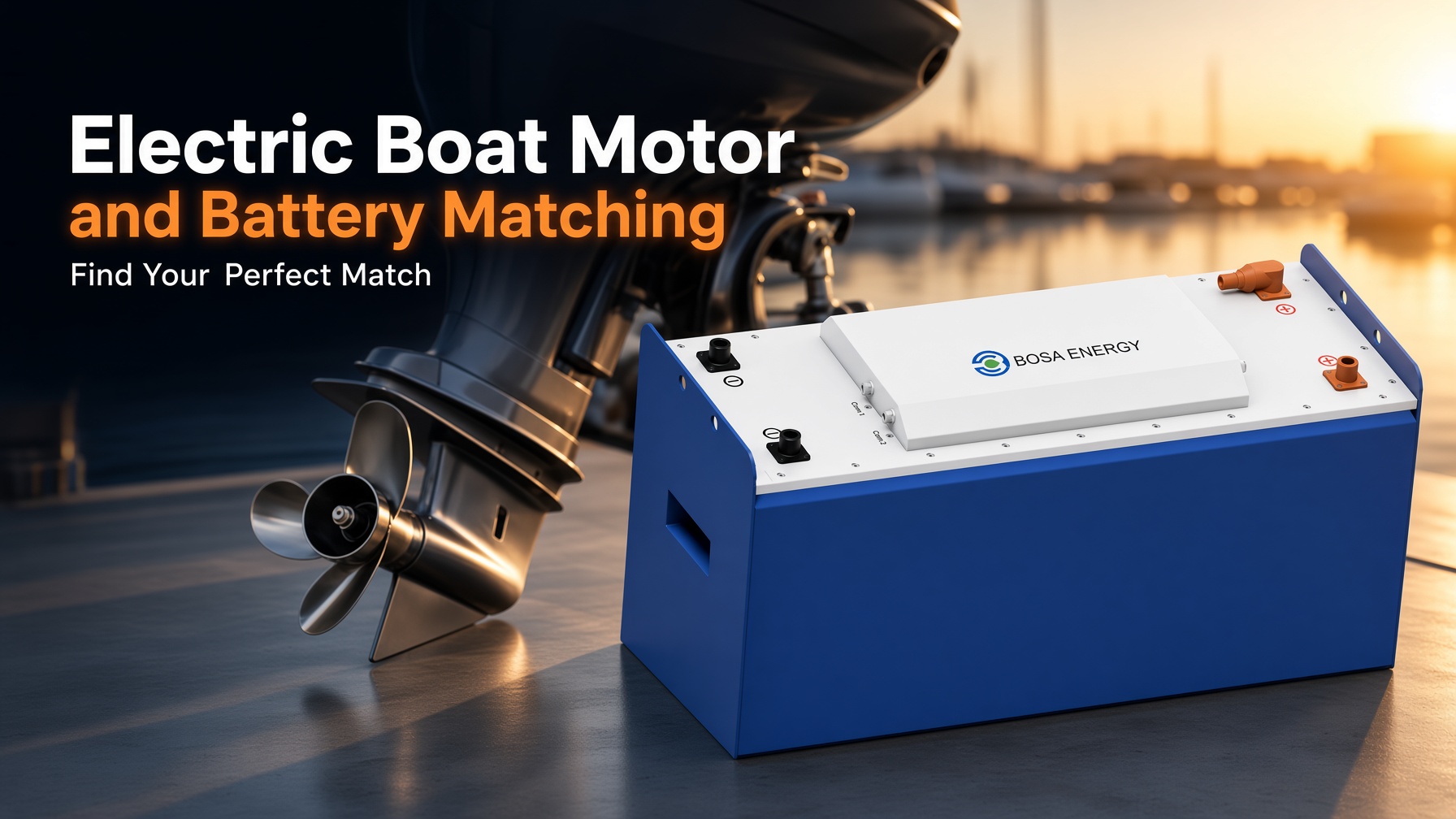
Correct electric boat motor and battery matching determines whether an electric propulsion system delivers rated power, usable range and long-term reliability or suffers chronic under-performance, BMS cut-outs and premature component failure. In 2026 the process of electric boat motor and battery matching is quantitative: voltage, continuous current, energy capacity and communication protocol must align within defined tolerances before any other specification is considered.
LiFePO₄ chemistry remains the default for the majority of new marine installations because of its cycle life (≥3,500–5,000 cycles at 80 % depth of discharge), thermal stability and high usable capacity. Matching decisions must also satisfy ISO 23625:2025 and ABYC E-13 requirements for batteries above 500 Wh.
Core Matching Parameters
1. Voltage Compatibility (Non-Negotiable)
The battery nominal voltage must equal the motor controller’s design voltage. Common 2026 classes are:
| System Voltage | Typical Motor Power Range | Example Platforms |
|---|---|---|
| 12 V / 24 V / 36 V | < 2 kW | Trolling motors, small auxiliaries |
| 48 V | 3–15 kW | ePropulsion Navy 3.0/6.0 Evo, Torqeedo Cruise series |
| 72–96 V | 15–40 kW | Higher-power outboards and mid-size inboards |
| ~350 V | 40–100+ kW | Candela C-8 (Polestar-sourced pack), Torqeedo Deep Blue high-voltage |
A 48 V motor on a 36 V bank will never reach rated power; a higher-voltage pack on a lower-voltage controller risks immediate damage or BMS lock-out. Series connection of lower-voltage modules is permitted only when the manufacturer documents a single master BMS and the installation complies with ABYC E-13.
2. Continuous and Peak Current
Calculate motor continuous current as:
I (A) = P (W) ÷ V (V)
The battery continuous discharge rating (and its BMS continuous limit) must exceed the motor’s maximum continuous current by a 20–25 % margin. Peak rating must cover acceleration and planing transitions.
Example: a Navy 6.0 Evo (6 kW continuous) on a 48 V system draws ≈125 A. The matched battery must sustain ≥150 A continuous. Undersized continuous current remains the single most common cause of mid-run shutdowns in the field.
3. Energy Capacity (kWh, Not Only Ah)
Runtime is governed by usable energy:
Required kWh = (Average continuous power in kW × desired hours) ÷ usable DoD
Add 20–25 % reserve for wind, current, hotel loads and aging. LFP packs typically deliver 80–100 % usable capacity. Convert kWh to Ah by dividing by system voltage when comparing nameplate ratings.
Industry guidance for 6–8 hours of mixed operation points to roughly 4–5 × continuous motor power in kWh as a practical starting figure. Shorter duty cycles scale linearly.
4. BMS Communication and Protocol
Many OEM motors (ePropulsion E-Series, Torqeedo Deep Blue, Candela) exchange SOC, temperature and fault data with the battery via CAN or proprietary links. Third-party batteries without matching protocol still function on voltage and current alone, but lose accurate remaining-range display and adaptive power limiting. ABYC E-13 prohibits any electrical path that bypasses the BMS.
5. Environmental and Mechanical Fit
- IP67 (preferred) or minimum IP65 enclosure
- Vibration and shock resistance suitable for marine use
- Low-temperature charge cut-off (typically 0 °C)
- Secure mounting that prevents movement under wave impact
ISO 23625:2025 requires batteries >500 Wh to meet IEC 62619 / IEC 62620 construction requirements and to incorporate a functional BMS capable of disconnecting the pack under hazardous conditions.
Practical Matching Examples (2026)
| Motor | Nennspannung | Continuous Power | Minimum Continuous Battery Current | Typical Matched Capacity | Anmerkungen |
|---|---|---|---|---|---|
| ePropulsion Navy 3.0 Evo | 48 V (39–60 V) | 3 kW | ≥62.5 A | 3–8 kWh (E60 / E80 / E163) | Third-party LFP allowed if current rating met |
| ePropulsion Navy 6.0 Evo | 48 V (39–60 V) | 6 kW | ≥125 A | 6–17 kWh (E163 / parallel E-series) | Parallel packs common for all-day use |
| Torqeedo Cruise 6.0 / 10.0 | 48 V | 6–10 kW | 125–210 A | 5–20 kWh | Power 48-series or equivalent |
| Torqeedo Deep Blue 25/50 | ~348–352 V | 25–50 kW | System-level | Deep Blue Battery 40 (38 kWh) or Battery 80 (79.2 kWh) | High-voltage LFP/NMC modules; ≥3,750 cycles @80 % DoD on Battery 80 |
| Candela C-Pod | ~350 V | 45–50 kW | System-level | 69 kWh | Integrated Polestar pack; 57 NM @ 22 kn |
These pairings illustrate the practical outcome of disciplined electric boat motor and battery matching at both low- and high-voltage ends of the market.
Opportunity Charging and SOC Discipline
Keep daily operating SOC above 20–30 %. Short opportunity charges of 15–40 % capacity during lunch stops or marina waits are both safe and beneficial for LFP longevity. Store packs at 50–60 % SOC for extended periods. These practices, combined with correct current matching, routinely achieve the upper end of the 3,500–5,000 cycle rating.
Selection Checklist for Electric Boat Motor and Battery Matching
- Motor nominal voltage confirmed and battery voltage matched exactly
- Continuous BMS discharge rating ≥ motor continuous current + 20–25 % margin
- Peak current rating covers acceleration and planing
- Usable kWh calculated with 20–25 % reserve for real-world conditions
- LFP chemistry selected unless extreme energy density is mandatory
- IP67 (or higher) enclosure and marine vibration rating
- BMS provides full protection suite and cannot be bypassed
- Documentation of ISO 23625:2025 / ABYC E-13 / IEC 62619 compliance
- Compatible lithium-specific charger and correct cable gauge / Class-T fusing
- Weight, dimensions and centre-of-gravity impact verified against hull design
Decision Framework
- Establish the duty cycle (cruise power, peak power, daily hours, sea state).
- Fix system voltage that keeps continuous current practical and cable sizes manageable.
- Calculate required usable energy and continuous current with reserve.
- Select LFP packs whose BMS continuous rating and protocol match the motor.
- Verify environmental protection, mounting and standards compliance.
- Size the charger for both overnight recovery and opportunity charging of 15–40 %.
- Validate total cost of ownership; correctly matched LFP systems typically deliver 30–50 % lower operating cost over 8–10 years versus lead-acid baselines.
Following this sequence produces a reliable electric boat motor and battery matching outcome that meets performance targets and current marine safety standards.
Häufig gestellte Fragen
Can I use a third-party battery with an ePropulsion Navy motor? Yes, provided the pack is 48 V nominal, continuous discharge current meets or exceeds 62.5 A (Navy 3.0) or 125 A (Navy 6.0), and the installation follows ABYC E-13. Communication features will be limited.
How much capacity do I need for a 3-hour cruise at 4 kW average? At 80 % usable DoD and 25 % reserve: (4 kW × 3 h) ÷ 0.8 × 1.25 ≈ 18.75 kWh installed.
Is higher voltage always better? Higher voltage reduces current and cable size for a given power, but only if the motor and controller are designed for that voltage. Matching remains mandatory.
Does ISO 23625:2025 apply to high-voltage systems? The base standard covers batteries >500 Wh. Systems operating at ≥60 V carry additional manufacturer and installation requirements that must also be followed.
What cycle life can I realistically expect from a properly matched LFP system? When continuous current is correctly sized, SOC is kept above 20–30 %, and opportunity charging of 15–40 % is used, most marine LFP packs deliver ≥3,500–5,000 cycles at 80 % DoD, equating to 8–12+ years of typical recreational use.
Authoritative References
- ISO 23625:2025 – Small craft — Lithium-ion batteries https://www.iso.org/standard/85220.html
- ABYC E-13 – Lithium Ion Batteries (2025/2026 edition) https://abycinc.org/
- ePropulsion Navy Series technical documentation and third-party battery guidelines https://www.epropulsion.com/products/electric-outboards/navy-evo
- Torqeedo Deep Blue system and Battery 80 technical data (79.2 kWh LFP, ≥3,750 cycles @80 % DoD) https://www.torqeedo.com/us/en-us/green-propulsion/battery-technology-com.html
- Candela C-8 technical specifications (69 kWh / ~350 V platform, 57 NM @ 22 kn) https://candela.com/leisure-boats/candela-c-8/
- West Marine – Electric and Hybrid Propulsion Systems guidance https://www.westmarine.com/west-advisor/Electric-And-Hybrid-Propulsion-Systems.html
Correct electric boat motor and battery matching is the foundation of safe, efficient and durable electric propulsion. Apply the voltage, current and energy rules above, confirm standards compliance, and the system will perform as designed for the life of the vessel.