
The marine industry is undergoing a quiet revolution. As boaters, yacht owners, and commercial operators seek quieter, cleaner, and more efficient propulsion, electric boats are moving from niche to mainstream. At the heart of many high-performance electric marine systems lies a proven, standardized component: the VDA355 Battery Module.
Originally developed for the automotive sector under the German Association of the Automotive Industry (VDA) standard, the VDA355 has become one of the most versatile marine battery modules available. Its compact footprint, exceptional energy density, and modular architecture make it an outstanding choice for electric boat battery modules and complete VDA355 marine battery systems.
Whether you are powering a small tender, a sailboat auxiliary system, a full-electric center console, or a commercial workboat, the VDA355 delivers automotive-grade reliability in a marine-optimized package.
What Is the VDA355 Battery Module?
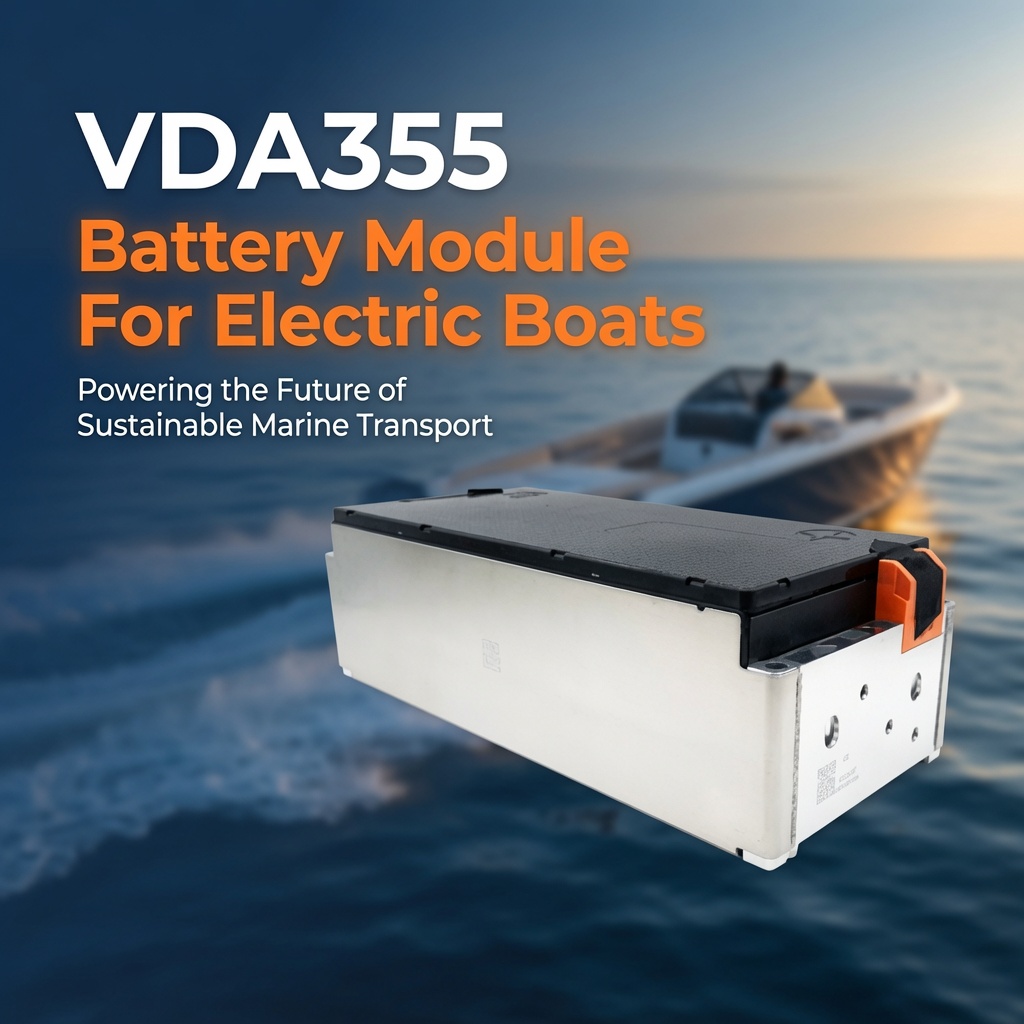
The VDA355 is a standardized prismatic lithium-ion battery module measuring approximately 355 mm × 151–152 mm × 108–108.5 mm. It was created by the VDA to promote interchangeability across vehicle platforms, reduce development costs, and accelerate production scaling.
Today, leading manufacturers (including CALB, Sunwoda, and others) produce VDA355 modules in both LFP (LiFePO4) Und NMC chemistries. Common configurations include 1P4S (≈12.8–14.8 V) and various parallel/series arrangements that allow system designers to build anything from 24 V to 800 V+ marine battery packs.
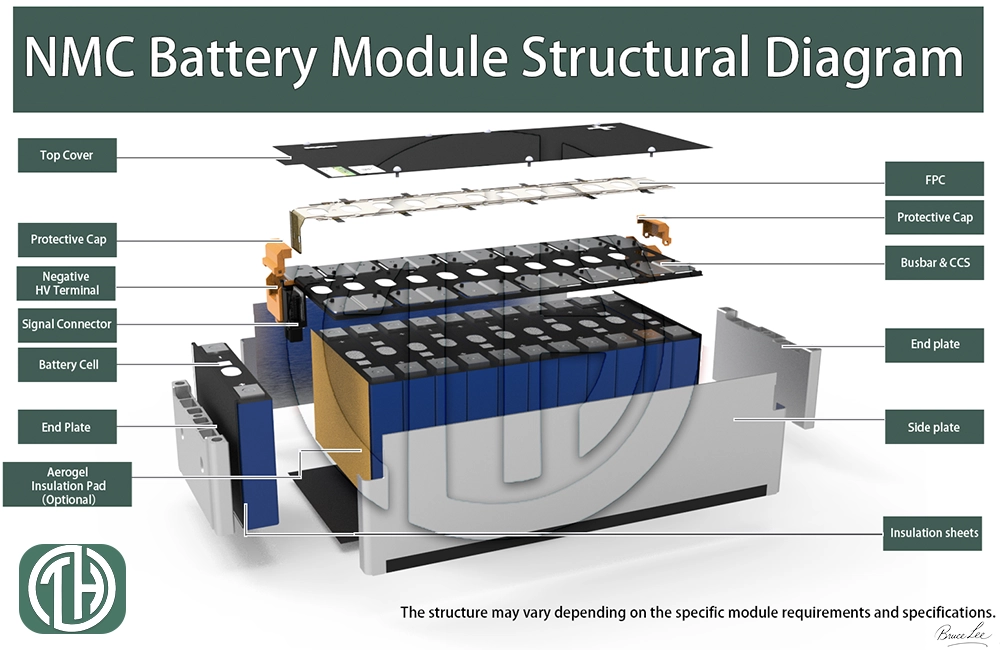
D148N58-2P6S VDA355 Battery Module – 58Ah (2P6S) | LYTH
Key advantages of the standardized format:
- Interchangeable across suppliers
- Simplified pack design and thermal management
- Easier maintenance and module replacement
- Proven high-volume manufacturing quality
Why the VDA355 Is Ideal for Electric Boats and Marine Applications
Marine environments demand more than just high energy density. Batteries must withstand vibration, humidity, temperature swings, and high-discharge events from electric motors. The VDA355 excels here because it inherits rigorous automotive validation (vibration, thermal, and safety testing) while offering the flexibility marine integrators need.
Primary benefits for electric boats:
- Lightweight design — At roughly 11.6–11.9 kg per module, a VDA355-based pack is 60–70% lighter than equivalent lead-acid capacity, improving boat speed, range, handling, and payload.
- High energy density — Modules deliver 1.7–2.6 kWh each, enabling compact packs that fit tight hull spaces.
- High continuous and pulse power — Supports the instant torque and high-current demands of electric outboards and inboards.
- Long cycle life — 2,000–5,000+ cycles depending on chemistry and depth of discharge, dramatically reducing lifetime ownership cost.
- Schnellladen — Many configurations accept 1C+ charge rates, perfect for shore power or solar top-ups between trips.
- Modular scalability — Build exactly the capacity and voltage your vessel requires without custom cell engineering.
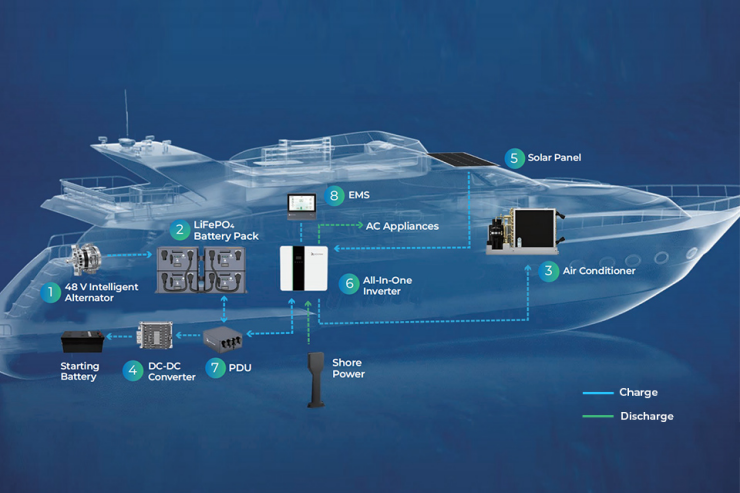
Set Sail with ROYPOW Marine Battery Systems
VDA355 Marine Battery Technical Specifications
Specifications vary slightly by manufacturer and cell type. Below are representative values for popular configurations.
Typical LFP VDA355 Module (1P4S, 135 Ah)
| Parameter | Spezifikation |
|---|---|
| Nennspannung | 12.8 V |
| Nominal Capacity | 135 Ah |
| Nominal Energy | 1.728 kWh |
| Dimensions (L × W × H) | 355 × 152 × 108.5 mm |
| Gewicht | 11.6 kg |
| Maximale Dauerentladung | 270 A |
| Maximale Dauerladung | 187 A |
| Betriebstemperatur (Entladung) | -20 °C to +55 °C |
| Betriebstemperatur (Ladung) | 0 °C to +55 °C |
| Lebenszyklus | >2,000 cycles @ 80% DoD |
Typical NMC VDA355 Module (1P4S, 177 Ah)
| Parameter | Spezifikation |
|---|---|
| Nennspannung | 14.64 V |
| Nominal Capacity | 177 Ah |
| Nominal Energy | 2.59 kWh |
| Dimensions (L × W × H) | 355 × 152 × 108.5 mm |
| Gewicht | ≈11.9 kg |
| Maximale Dauerentladung | 348 A |
| Maximale Dauerladung | 211 A |
| Betriebstemperatur | -30 °C to +55 °C (discharge) |
| Lebenszyklus | >1,500–2,000 cycles |
Notiz: Always refer to the specific manufacturer’s datasheet. Modules typically include aluminum housings, cell monitoring, and temperature sensors. Full marine systems require an additional marine-grade BMS, IP67+ enclosure, and proper fusing.
Electric Boat Battery Module Integration Best Practices
Successful VDA355 marine battery projects follow these principles:
- System Architecture — Use series strings for voltage (e.g., 4× LFP modules = 51.2 V nominal) and parallel strings for capacity. Common marine voltages: 48 V, 96 V, and higher for larger vessels.
- Marine-Grade BMS — Essential for cell balancing, over/under voltage protection, current limiting, SOC/SOH reporting, and CAN-bus communication with displays, motor controllers, and chargers.
- Enclosure & Environmental Protection — House modules in sealed, shock-mounted, IP67 or better enclosures with proper venting or pressure equalization. Consider salt-spray resistance and fire-retardant materials.
- Wärmemanagement — Natural convection is often sufficient, but active cooling or heating may be added for extreme climates or very high-duty cycles.
- Charging Infrastructure — Compatible with marine battery chargers, DC-DC converters from alternators, and solar MPPT controllers.
- Safety & Certification — Individual modules often carry UN38.3 and MSDS. Full systems should meet relevant marine standards (ABYC, ISO, or class society rules for commercial vessels).
Professional system integrators can deliver turnkey VDA355-based packs optimized for your specific electric boat or outboard motor.
Maintenance and Safety for VDA355 Marine Batteries
VDA355 modules are low-maintenance compared with lead-acid, but best practices still apply:
- Monitor battery data regularly via the BMS display or app.
- Avoid prolonged exposure to temperatures above 45 °C or below -10 °C when possible.
- Use only compatible chargers and follow manufacturer charge profiles.
- Inspect connections, mounts, and enclosures annually.
- Keep modules at 30–50% SOC for long-term storage.
- Follow all local regulations for lithium battery transport and installation.
When properly integrated, these modules offer excellent safety margins, especially LFP variants which are inherently more thermally stable.
VDA355 vs Traditional Marine Batteries
| Besonderheit | VDA355 Li-ion (LFP/NMC) | Lead-Acid / AGM | Other Li-ion (non-standard) |
|---|---|---|---|
| Gewicht | Very Low | High | Niedrig |
| Energiedichte | High | Niedrig | High |
| Lebenszyklus | 2,000–5,000+ | 500–1,200 | 1,500–4,000 |
| Usable DoD | 80–90% | 50% | 80–90% |
| Charge Speed | Fast (1C+) | Slow | Fast |
| Wartung | Minimal | Regular watering/equalizing | Minimal |
| Standardization | Excellent | Good | Poor |
| Marine Integration | Excellent (with proper design) | Good | Variable |
The VDA355 combines the best attributes of standardized automotive modules with the flexibility required for custom marine packs.
Häufig gestellte Fragen
What is the typical energy capacity of one VDA355 module? Most common configurations deliver between 1.7 kWh and 2.6 kWh per module, depending on chemistry and cell configuration.
Can I use VDA355 modules for a full-electric boat or only hybrid systems? Both. Many recreational and commercial electric boats use VDA355-based packs as the primary energy source. Proper system design (BMS, contactors, thermal management) is critical for full-electric applications.
Is LFP or NMC better for marine use? LFP offers superior safety, longer cycle life, and better tolerance to partial state-of-charge operation — ideal for most recreational and workboat applications. NMC provides higher energy density when space or weight is extremely constrained.
Do VDA355 modules come with a BMS? Most include basic cell voltage and temperature monitoring. A full-featured marine BMS is usually added at the pack level.
What certifications should I look for? Modules: UN38.3, MSDS, and relevant GB/T or IEC standards. Complete systems: ABYC, ISO 16315, or class society approval depending on vessel type and region.
How many modules will my boat need? It depends on desired range, speed, and vessel size. A small electric tender might use 2–4 modules; a 25–30 ft full-electric day boat may require 20–40+ modules. A qualified marine electrician or battery integrator can perform an accurate energy audit.
Abschluss
Der VDA355 Battery Module represents a mature, standardized, and highly adaptable solution for the growing electric boat market. Its automotive heritage delivers proven reliability, while its compact modular design gives marine engineers the freedom to create optimized, lightweight, high-performance marine battery modules and complete VDA355 marine battery systems.
As the industry moves toward zero-emission propulsion, choosing a standardized platform like the VDA355 reduces risk, simplifies supply chains, and future-proofs your vessel.
Ready to power your next electric boat project with VDA355 technology? Consult with experienced marine battery integrators who understand both the modules and the unique demands of the marine environment. The future of boating is electric — and the VDA355 is ready to take you there.