
IP67 Definition and Test Limits
IEC 60529 defines the two-digit IP code:
- First digit 6 = dust-tight (no ingress of dust under prescribed test conditions).
- Second digit 7 = temporary immersion: 1 metre depth for 30 minutes with no harmful water ingress.
The rating applies to the complete enclosure, including seals, cable glands and connectors. A genuine IP67 pack must pass the immersion test with all interfaces in place. Marketing language that simply says “waterproof” without reference to the test protocol has no engineering value.
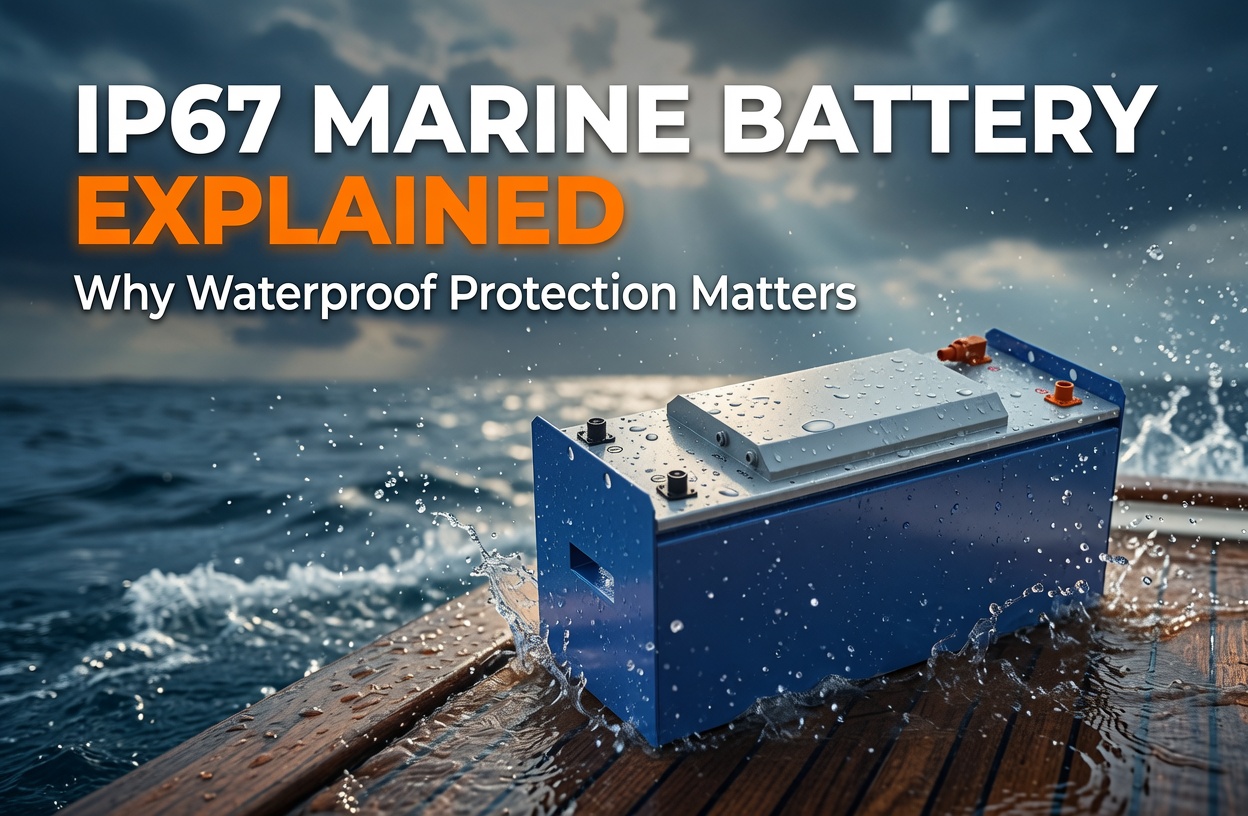
IP67 Marine Battery Explained: Why Waterproof Protection Matters starts with this measurable standard. It is the minimum verified level that keeps moisture and salt particles away from the electronics for the majority of recreational and light-commercial installations.
Marine-Specific Failure Drivers
Land-based enclosures face rain and occasional humidity. Marine environments add continuous multi-directional exposure:
- Conductive salt film forms on surfaces and activates with any moisture.
- Wave-induced vibration and shock fatigue gaskets and glands over time.
- Temperature cycling creates internal pressure differentials that draw moist air past imperfect seals.
- Bilge water, deck wash-downs and green-water events are routine, not exceptional.
LFP cells tolerate these conditions reasonably well. The BMS board, balance leads and power interconnects do not. Once salt bridges tracks or corrodes copper, the pack develops high resistance, false faults or complete shutdown. Repair is rarely economic; replacement follows.
Keeping average SOC above 20–30 % and using opportunity charging (15–40 % capacity restoration during short stops) maximises calendar life only if the electronics remain dry. Enclosure integrity is therefore a prerequisite for realising the 3,000–5,000 cycle life expected from quality marine LFP in 2026.
Protection Level Comparison (IP65–IP68)
| Rating | Dust | Liquid Protection | Typical Marine Fit | Design Notes |
|---|---|---|---|---|
| IP65 | Full | Low-pressure jets / rain | High, dry locations under hard covers | Minimum for sheltered outdoor use |
| IP66 | Full | Powerful water jets | Deck-adjacent spray zones | Suitable for wash-down exposure |
| IP67 | Full | Temporary immersion (1 m / 30 min) | House banks, propulsion packs in protected compartments | Current baseline for most electric boats |
| IP68 | Full | Continuous immersion (depth & duration defined by manufacturer) | eFoils, electric surfboards, submersible applications | Higher cost, tighter thermal management |
IP67 is the practical sweet spot for the majority of small-craft lithium installations. IP68 adds cost and complexity that are justified only when prolonged immersion is an intended operating condition.
Construction Requirements for True IP67 Performance
A compliant marine IP67 pack typically incorporates:
- Continuous dual-lip or compressed O-ring perimeter seals rated for the full immersion test.
- Pressure-equalisation membranes (e.g., expanded PTFE) that pass air molecules while blocking liquid water and salt particles. Completely sealed boxes without membranes will eventually fail under thermal cycling.
- Cable glands or moulded connectors whose mating interfaces also meet or exceed IP67.
- Conformal coating or selective potting on the BMS as a secondary barrier.
- Corrosion-resistant materials: marine-grade plastics or coatings, tinned or stainless hardware, and salt-fog validated finishes.
- Mechanical design that maintains seal compression under the vibration and shock spectrum of small craft.
These features separate a certified IP67 marine battery from a consumer pack placed inside a generic plastic box.
Failure Modes Prevented by Correct Sealing
Without adequate sealing the sequence is predictable:
- Moisture or salt reaches the BMS or interconnects.
- Corrosion raises contact resistance or creates leakage paths.
- Cell imbalance or false fault reports appear.
- Capacity drops or the pack shuts down.
- Early replacement is required, erasing the economic advantage of LFP.
IP67 does not eliminate the need for correct mounting (above the bilge waterline whenever practical). It supplies the necessary safety margin when conditions exceed the ideal. Under ISO 23625:2025 guidance for lithium systems on small craft, that margin is now expected.
Comparison Table: Rating vs Typical Application
| Application | Minimum Recommended Rating | Rationale |
|---|---|---|
| High, dry console or sealed locker | IP65 / IP66 | Spray and rain only |
| Standard house or propulsion bank | IP67 | Occasional flooding or heavy spray risk |
| Open-boat or high green-water exposure | IP67 (mount high) | Temporary immersion possible |
| eFoil, electric surfboard, thruster | IP68 | Intentional or prolonged immersion |
| Commercial workboat / ferry | IP67 minimum, often higher | Reliability and class requirements |
Selection and Installation Criteria
- Require documented IP67 (or higher) test data, not brochure language.
- Prefer LFP chemistry for thermal stability and cycle life; confirm BMS includes accurate SOC, temperature cut-offs and low-temperature charge inhibition.
- Verify that all cable glands and connectors maintain the enclosure rating when installed.
- Mount the pack as high and dry as the layout allows. IP67 is protection against accidental immersion, not permission for continuous wet mounting.
- Ensure pressure-equalisation is present if the design requires it.
- Align installation with ISO 23625:2025 recommendations for selection, safety information and system integration.
- Design the energy budget so the pack rarely operates below 20–30 % SOC; use opportunity charging to restore 15–40 % capacity during short stops.
- Retain manufacturer immersion, vibration and salt-fog test records for insurance and residual-value documentation.