
Why the Transition Is Accelerating
Three forces are converging:
- Regulatory and site constraints — Noise limits near livestock housing, zero-emission requirements for indoor or peri-urban work, and corporate Scope 1 targets are eliminating diesel from certain tasks.
- Energy-cost and maintenance differentials — Electricity is frequently cheaper than diesel on a per-kWh basis. Lithium packs eliminate oil changes, DEF, particulate filters and most engine-related services.
- OEM readiness — John Deere, AGCO/Fendt, CLAAS and others now offer commercial or near-commercial battery-electric machines with documented runtimes and charging performance.
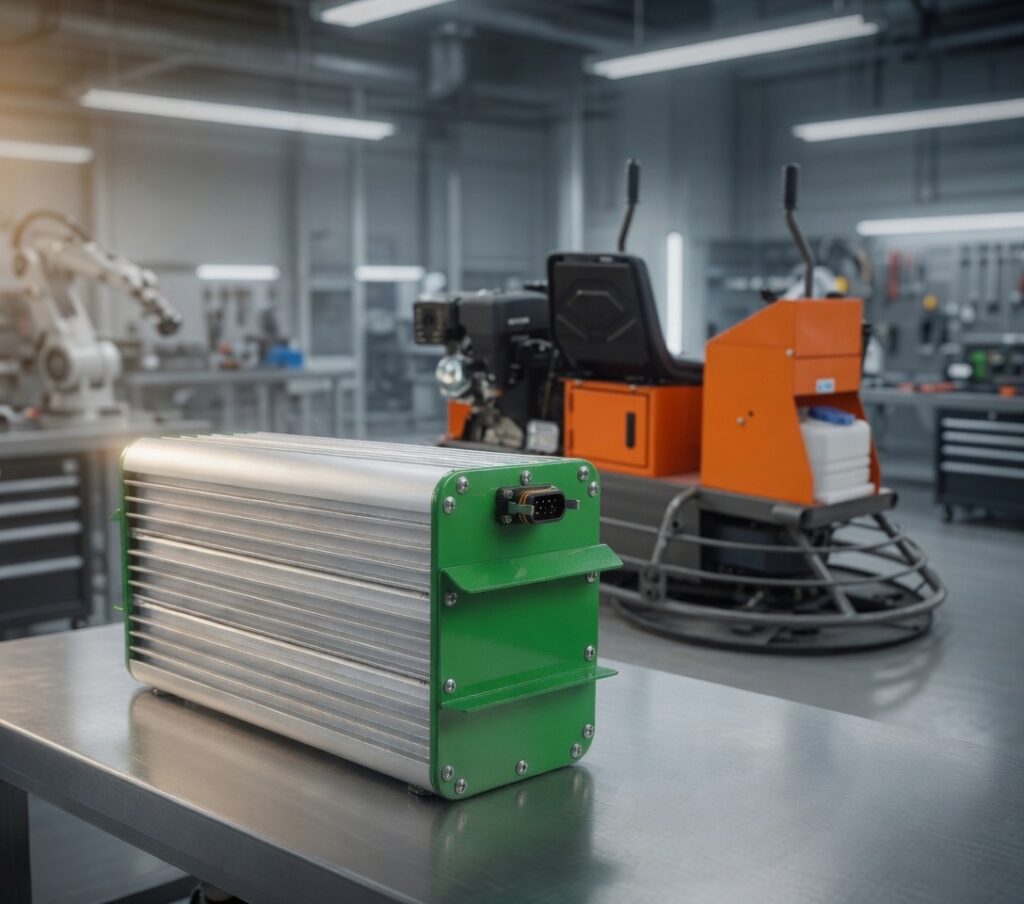
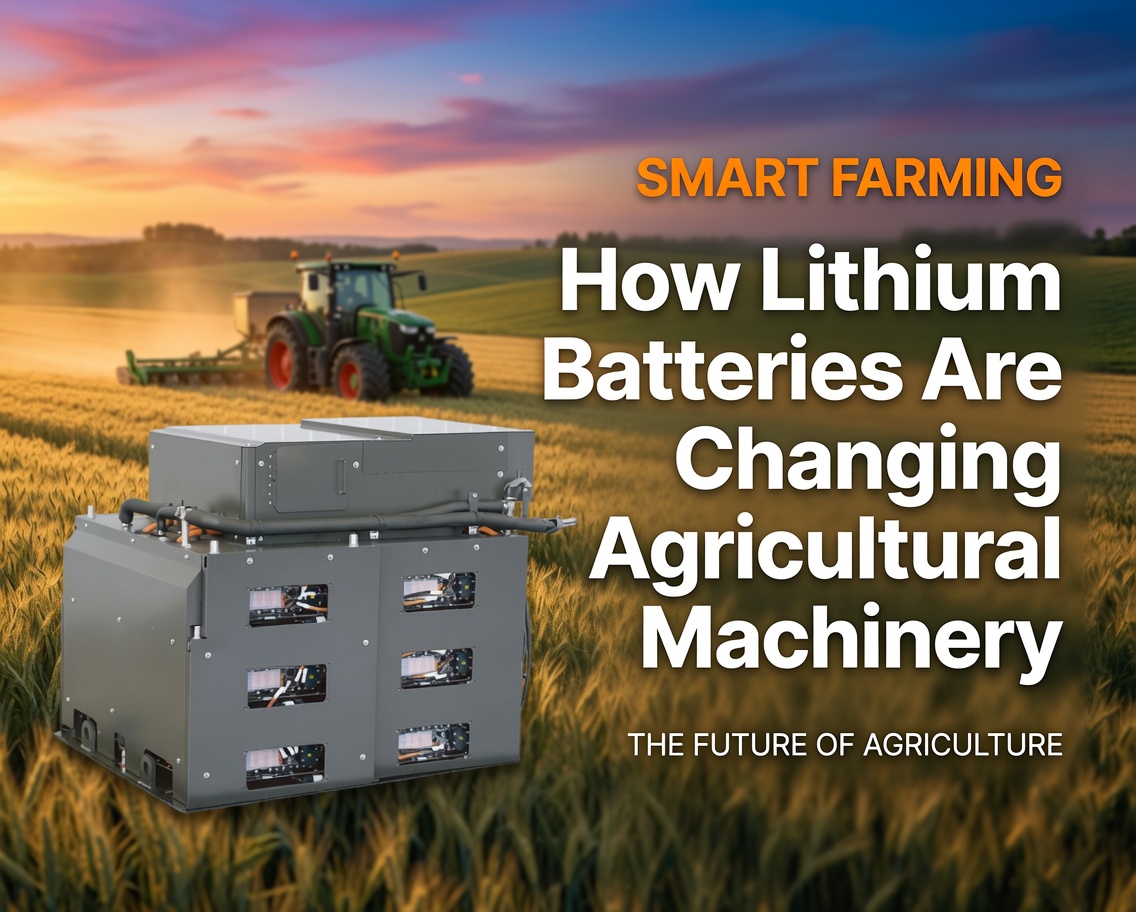
How Lithium Batteries Are Changing Agricultural Machinery is no longer theoretical. It is a calculated decision about uptime, animal welfare, local air quality and lifetime cost.
LFP Chemistry and Performance Metrics That Matter
Lithium iron phosphate (LFP / LiFePO₄) remains the dominant chemistry for agricultural traction packs because it balances safety, cycle life and cost under vibration, dust and temperature extremes.
Key field-relevant characteristics:
- Thermal runaway threshold typically above 250–270 °C
- Documented cycle life of 3,500–4,000+ full cycles at 80 % depth of discharge under industrial conditions
- Flat voltage curve that maintains torque delivery across most of the state-of-charge window
- Round-trip efficiency ≥ 95 %
- Wide operating temperature range when thermal management is properly engineered (commonly –20 °C to +55 °C or better with preconditioning)
- Near-zero maintenance beyond BMS-managed monitoring
NMC appears where maximum energy density is required for longer continuous high-load work. LTO offers extreme cycle life and charge rates but at higher cost and lower energy density. For the majority of compact and mid-size agricultural machines, LFP delivers the lowest risk and best value.
| Metric | LFP Lithium Pack | Diesel Powertrain | Advantage |
|---|---|---|---|
| Cycle / service life | 3,500–4,000+ @ 80 % DoD | Engine overhauls every few thousand hours | Lithium |
| Round-trip efficiency | ≥ 95 % | 30–40 % thermal | Lithium |
| Torque delivery | Instant from 0 rpm | RPM-dependent lag | Lithium |
| Onderhoud | BMS-managed, near-zero fluid work | Filters, fluids, emissions systems | Lithium |
| Point-of-use emissions / noise | Zero tailpipe, significantly quieter | High DPM, NOx, noise | Lithium |
| Opportuniteitsheffing | Fully supported | N/A | Lithium |
These figures reflect current industrial and OEM-reported data, not laboratory ideals.
Operational Changes on the Farm
How Lithium Batteries Are Changing Agricultural Machinery shows up most clearly in daily operations:
- Livestock environments — Dramatically lower noise reduces animal stress and improves operator comfort during feeding and barn work.
- Specialty crops and orchards — Zero emissions and quiet running allow early-morning or late-evening passes without neighbour complaints.
- Instant torque and precision — Electric motors deliver full torque at zero speed, improving control of implements and reducing wheel slip in sensitive soils.
- Regenerative braking — Energy recovery on downhill or deceleration phases improves effective range on undulating ground.
- Predictive health data — Integrated BMS and telematics report state of health, temperature and usage patterns, enabling planned rather than reactive maintenance.
- Exportable power — Many platforms offer 110/220 V or higher auxiliary outputs, turning the machine into a mobile power source for tools or temporary lighting.
These advantages are strongest in duty cycles with moderate continuous power demand and opportunities for midday or overnight charging.
Charging Strategy and Energy Management
Runtime is governed by pack capacity, load profile, temperature and charging opportunities. Best-practice guidance consistent with industrial lithium systems:
- Keep average state of charge above 20–30 % during the working day to maximise cycle life.
- Use opportunity charging (15–40 % capacity top-ups during breaks or between fields) to extend daily output without waiting for a full charge.
- Prefer overnight AC charging for single-shift operations; use DC fast charging only when the duty cycle requires rapid turnaround.
- Ensure thermal preconditioning in cold climates so the pack can accept charge and deliver full power immediately.
- Size the pack with a 1.1–1.2× margin relative to measured daily energy demand rather than relying on optimistic continuous-power ratings.
Farms with three-phase power or existing EV chargers can integrate tractor and loader charging with minimal additional infrastructure. Remote or pure field operations without grid access remain better served by diesel or hybrid solutions until mobile high-power charging or battery-swap systems mature.
Total Cost of Ownership Reality
Upfront purchase prices for battery-electric agricultural machines remain higher than equivalent diesel models. The gap is offset by:
- Lower energy cost per hour of work
- Elimination of diesel, DEF and most engine maintenance
- Longer powertrain life (LFP packs routinely rated for 3,500–4,000+ cycles)
- Potential residual-value advantages as emission regulations tighten
- Incentives available in some jurisdictions for zero-emission equipment
High-utilisation specialty and livestock operations often see payback inside 4–7 years. Low-hour or continuous high-load tillage fleets may not. Accurate TCO requires site-specific energy prices, annual hours and local incentives rather than generic claims.
Selection Criteria in Priority Order
- Duty-cycle energy demand — Measure actual kWh per shift under realistic implement loads before specifying pack size.
- Charging access — Overnight AC availability is the minimum; DC fast or opportunity charging expands usable applications.
- Noise and emission constraints — Livestock, orchards, greenhouses and urban-edge farms gain the largest operational benefit.
- Chemistry and cycle life — Prefer LFP with documented ≥ 3,500 cycles at 80 % DoD and robust BMS thermal management.