
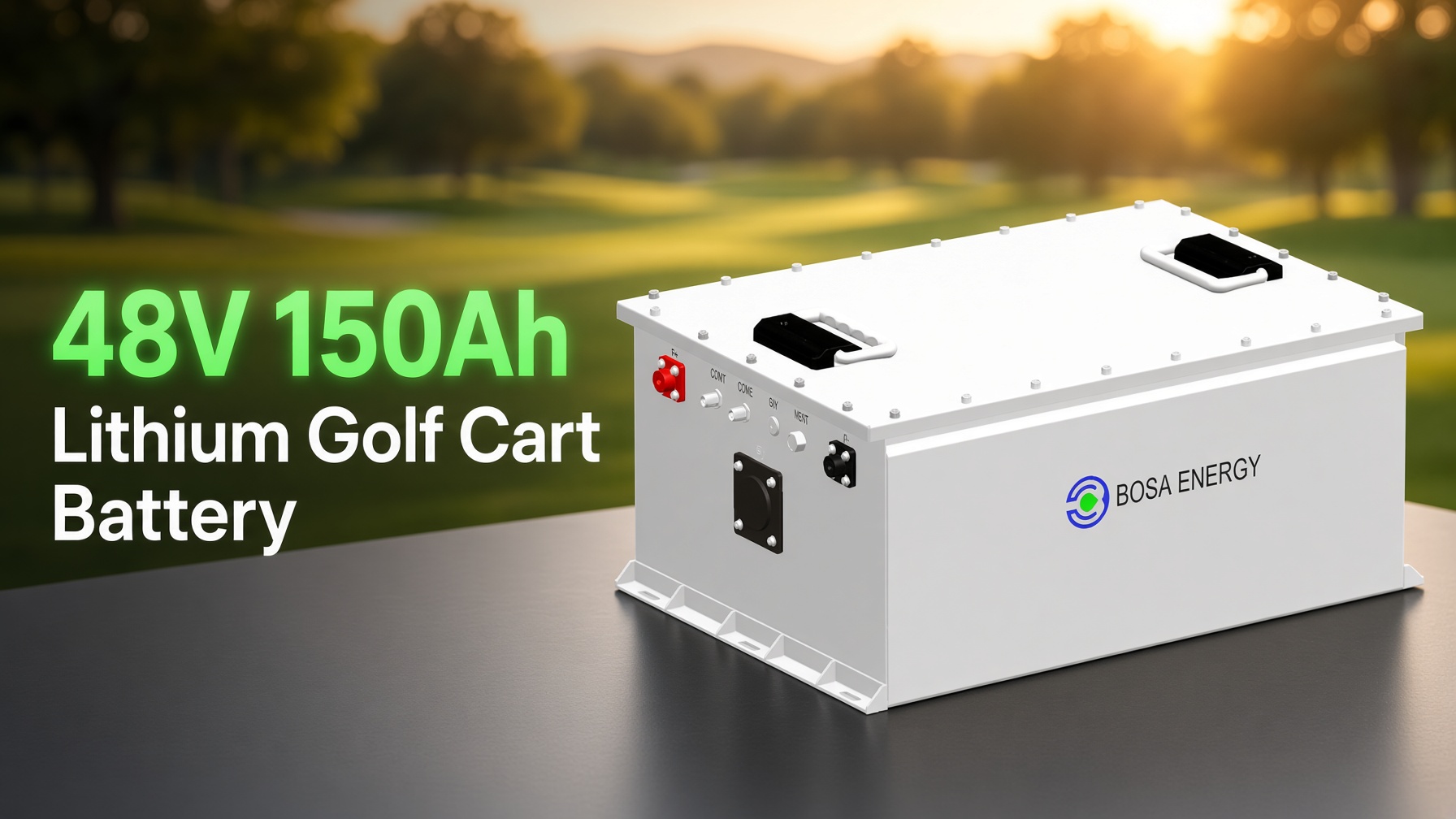
A 48 V golf cart does not need the largest amp-hour stamp that still fits under the seat. It needs a pack whose stored energy, voltage window, and charger profile match the loaded loop you actually drive. A 48V 150Ah Lithium Golf Cart Battery is therefore a platform-match briefing for the mid-to-extended class—not a catalog of brochure miles.
In 2026 the 150 Ah LiFePO₄ pack sits between the 105 Ah neighborhood default and the 171 Ah OnePack XR shuttle tank. It is the SKU when a factory ~60 Ah / 3.1–3.8 kWh pack or a 105 Ah commute pack finishes the day too close to empty, but a 171 Ah XR pack is more energy than the chassis will use. This briefing lists the published numbers, maps the duty cycles that justify them, and ranks the 150 Ah class against flooded six-packs, factory lithium, and the 105 / 160 / 171 Ah lithium rungs.
Key takeaways
- A 51.2 V / 150 Ah LiFePO₄ pack stores 7.68 kWh. At 80% depth of discharge (DoD) that is about 6.1 kWh usable—more usable energy than a flooded 150–170 Ah tray kept at 50% DoD to protect cycle life.
- Specify LiFePO₄ packs rated at least 3,500 cycles at 80% DoD, with UL 2271 (or equivalent light-EV pack certification) and a documented battery management system (BMS).
- 2026 150 Ah anchors: Eco Battery 48 V 150 Ah at 51.2 V / 7,680 Wh, 250 A continuous / 600 A for 5 s, IP67, 165 lb, 22.0 × 12.125 × 10.625 in; ROYPOW S51150P-AA at 7.68 kWh, 180 A continuous / 315 A peak, IP67; Epoch LiMax 48 V 150 Ah at 7.68 kWh, 300 A continuous, 135 lb. Trojan’s published ladder remains 105 Ah commute / 171 Ah XR shuttle—treat 150 Ah as the aftermarket rung between those two.
- Opportunity charges of 15–40% of pack capacity between loops are acceptable on lithium. Keep operating state of charge (SOC) above 20–30%.
- Platform match beats peak amps. IEEE Spectrum’s 30 May 2026 review of drop-in motive packs put the rule in one sentence: design the lithium system around the electrical reality of the legacy platform, not the other way around.
Table of Contents
- What a 48 V 150 Ah pack actually is
- Published specifications that belong on the bid sheet
- Convert 150 Ah into usable kilowatt-hours
- Voltage window comes before extra current
- 2026 reference packs in the 150 Ah class
- Where 150 Ah sits on the 48 V capacity ladder
- Applications the 150 Ah class is built for
- Applications that need a different pack
- 150 Ah versus flooded, factory, 105 Ah, and XR energy
- Charging time is part of the specification
- Operating rules that protect cycle life
- Safety and certification floor
- Procurement checklist
- Veelgestelde vragen
- Decision framework
- Authoritative references
What a 48 V 150 Ah pack actually is
A 48 V golf cart is defined by its electrical system, not by a single cell chemistry. Flooded trays use six 8 V batteries in series. Factory lithium cars keep a 48 V AC drivetrain while the pack itself sits higher—E-Z-GO lists the 2026 RXV ELiTE 2.2 as a 56.7 V max pack on a 48 VDC system. Aftermarket LiFePO₄ drop-ins in the 150 Ah class are typically 51.2 V nominal (16 series LFP cells, sometimes 2P16S) with a working window near 40–58.4 V.
The 150 Ah stamp on a quality LFP sheet is the same number at the 5-, 10-, and 20-hour rates because Peukert’s law is mild on LiFePO₄. Energy is 150 Ah × 51.2 V ÷ 1,000 = 7.68 kWh stored. That number, not “up to 70 miles,” is the specification.
Darren Brittain, Trojan’s vice president of lithium commercial strategy for motive applications, stated the engineering filter in IEEE Spectrum on 30 May 2026: design the lithium system around the electrical reality of the legacy platform, rather than asking the vehicle to adapt to the battery. Extra continuous amps that the controller cannot use, or that blank the OEM gauge, are not a specification upgrade. They are integration risk.
Factory 48 V lithium platforms are specified around a measured 18-hole loop with reserve. A 150 Ah drop-in is the aftermarket tank that covers that loop after a rear seat, hills, a 36-hole day, or LSV lighting are added.
Published specifications that belong on the bid sheet
Do not buy a 150 Ah pack from a single brochure line. Put these fields on the purchase order.
| Specificatie | Typical 2026 150 Ah LiFePO₄ drop-in | Why it matters |
|---|---|---|
| Nominale spanning | 51.2 V (16S LFP, some 2P16S) | Must sit inside the 48 V controller and charger envelope |
| Working window | ~40.0–58.4 V (Eco Battery published 43.2–58.4 V working / 48.0–57.0 V recommended) | Legacy gauges and limp-mode logic were written against this band |
| Nameplate capacity | 150 Ah at 0.5C or 5 / 10 / 20 h | Same Ah at every rate is a quality signal |
| Stored energy | 7.68 kWh | Compare packs in kWh, not in brochure miles |
| Usable energy at 80% DoD | ~6.1 kWh | Day-end SOC target is 20–30%, not 0% |
| Mass | ~135–165 lb / 61–75 kg for a sealed tray pack | Replaces a 400–600 lb flooded six-pack |
| Envelope | Eco Battery ~22.0 × 12.125 × 10.625 in; Epoch LiMax ~19.84 × 15.35 × 9.84 in; ROYPOW S51150P-AA ~31.50 × 14.19 × 8.78 in | Skinny TXT trays, thru-hole RXV trays, and long utility trays are not the same hole pattern |
| Continuous discharge | 180–300 A class | Hills and four adults are energy En current, not only Ah |
| Peak / pulse | 315–600 A for a few seconds on published sheets | Controller current, not pack pulse, sets acceleration |
| Levensduur van de cyclus | ≥3,500–4,000 at 80% DoD, 25 °C (some sheets claim 6,000) | Rating assumes SOC and temperature discipline |
| Ingress | IP65–IP67 | Wash-down, irrigation overspray, coastal air |
| Charge cut-off | 0 °C / 32 °F unless a heater path is specified | Unheated LFP will refuse a winter charge |
| Mededeling | Bluetooth app and/or CAN | Required if the OEM gauge must stay honest |
| Garantie | 8–12 years common; Club Car factory lithium is 6 yr or 2.8 MWh | Read years En throughput |
Treat those figures as the class template, then confirm the generation adapter for jouw chassis. A 150 Ah pack that does not fit the tray, or that the OEM gauge cannot read, is not a 150 Ah upgrade.
Convert 150 Ah into usable kilowatt-hours
Ignore “up to 60 miles” and “up to 70 miles” unless the vendor states load, speed, and terrain. Size from energy.
Stored kWh ≈ Ah × nominal V ÷ 1,000.
| Pack (48 V class) | Nominale spanning | Nameplate Ah | Stored energy | Typical usable energy at rated DoD |
|---|---|---|---|---|
| Flooded six-pack, 150–170 Ah | 48 V | 150–170 | 7.2–8.2 kWh | ~3.6–4.1 kWh at 50% DoD |
| Factory ELiTE 2.2 | 56.7 V max / 48 V system | ~60 | ~3.1–3.4 kWh | ~2.5–2.7 kWh at 80% DoD |
| Club Car Tempo Li-Ion | OEM lithium | — | ~3.8 kWh | OEM-warranted share; 6 yr or 2.8 MWh cap |
| Drop-in 105 Ah LiFePO₄ | 51,2 V | 105 | 5.376 kWh | ~4.3 kWh at 80% DoD |
| Drop-in 150 Ah LiFePO₄ | 51,2 V | 150 | 7.68 kWh | ~6.1 kWh at 80% DoD |
| Drop-in 160 Ah LiFePO₄ | 51,2 V | 160 | ~8.2 kWh | ~6.6 kWh at 80% DoD |
| OnePack XR / HP | 51,2 V | 171 | 8.76 kWh | ~7.0 kWh at 80% DoD |
Then apply three adjustments:
- Measure or estimate kWh per 18-hole loop or community loop on jouw routing. Hills, four adults, oversized tires, and a stereo change the number more than cell brand.
- Apply a 1.1–1.2× buffer for wind, accessories, and a hot afternoon.
- Keep planned day-end SOC above 20–30%. Do not size the pack so every round ends at 10%.
That conversion is the working method behind a 48V 150Ah Lithium Golf Cart Battery. Brochure range is a ceiling measured on a light cart on flat pavement. Your loop is the specification.
Voltage window comes before extra current
Flooded 48 V strings start near 50 V off the charger and sag into the low 40s. Controllers, gauges, and limp-mode logic on TXT, RXV, Precedent, Tempo, Onward, and Drive2 platforms were written against that curve. A lithium pack holds the mid-to-high 50s for most of the discharge and then drops sharply.
Trojan’s OnePack window of 40.48–58.40 V is the published example of staying inside that legacy envelope. Eco Battery’s published 150 Ah working band of 43.2–58.4 V (recommended 48.0–57.0 V) and Bolt’s 18 May 2026 Club Car / E-Z-GO factory integrations exist for the same reason. A cart that blanks the OEM SOC meter on the first loaded hill does not have a capacity problem. It has an integration problem.
Do not “add capacity” by stepping a 36 V car to 48 V unless the motor insulation, controller, charger, and harness are already specified for 48 V. That is a system conversion, not a battery upgrade.
Ask for three items in writing:
- Working-voltage window.
- How SOC is reported to the dash.
- Whether limp-mode and OEM safety logic remain intact.
If the vendor cannot answer the second question, the pack is not finished—regardless of amp-hours.
A sealed 150 Ah LiFePO₄ pack occupies the flooded tray as one object. Capacity only counts if that object stays inside the 48 V controller window.
2026 reference packs in the 150 Ah class
Trojan does not publish a 150 Ah OnePack SKU. The maroon ladder in 2026 is 105 Ah commute and 171 Ah XR / HP shuttle. The 150 Ah class is therefore an aftermarket and specialist-OEM rung. Use the sheets below as class examples, not as a shopping list.
Eco Battery 48 V 150 Ah
Eco Battery’s 48 V 150 Ah pack is the most fully documented 150 Ah golf-cart sheet in the current dealer channel. Published facts that survive a bid review:
- Nominal 51.2 V, 150 Ah, 7,680 Wh; reserve 360 minutes at 25 A.
- Cell configuration 2P16S; parallel connectable up to two matched packs; not series-connectable.
- Working voltage 43.2–58.4 V; recommended 48.0–57.0 V; bulk/absorb 57.0 V; BMS high-voltage cutoff 59.2 V.
- Max continuous discharge 250 A; 550 A for 10 s; 600 A for 5 s.
- Max continuous charge <52 A; charge freeze protection under 32 °F.
- IP67 powder-coated steel shell; Bluetooth, CAN, over-the-air updates.
- Mass 165 lb; envelope 22.0 × 12.125 × 10.625 in; M8 female terminals.
Confirm the generation adapter. Eco Battery’s June 2026 Factory Lithium Conversion Bundles and the Golf Car Options 14 September 2026 write-up cover 105–160 Ah TXT / RXV Gen3 kits; flooded TXT metal trays, factory-Samsung ELiTE cars, and Club Car Vanguard platforms still use different harnesses.
ROYPOW S51150P-AA
ROYPOW lists the S51150P-AA as a 48 V (51.2 V) / 150 Ah / 7.68 kWh pack aimed at multi-seaters and rough-terrain utility duty:
- Continuous charge / discharge 30 A / 180 A; maximum 40 A / 315 A.
- Envelope 31.50 × 14.19 × 8.78 in (800 × 360.4 × 223 mm)—longer than a standard under-seat tray.
- Mass 145.51 ± 6.61 lb (66 ± 3 kg) without counterweight.
- IP67 steel case; Bluetooth monitoring; published cycle floor 3,500+.
- Charge 0 °C–55 °C; discharge −20 °C–55 °C.
The long envelope is the first filter. A TXT skinny tray will not accept this SKU without a tray redesign. Treat it as a utility / stretched-chassis pack, not as a drop-in for every 48 V car.
Epoch LiMax 48 V 150 Ah
Epoch’s LiMax 48 V 150 Ah (7.68 kWh) kit is sold as a complete conversion set: pack, gauge, 48-to-12 V converter, and cart-specific brackets.
- 1P16S LiFePO₄; operating window 40–58.4 V; max charge voltage 58.4 V.
- Max continuous discharge 300 A; peak 500 A / 15 s and 1,000 A / 2 s.
- Max charge 150 A continuous.
- Parallel up to two packs.
- Mass 135 lb; envelope 19.84 × 15.35 × 9.84 in.
- Charge 0 °C–55 °C; discharge −20 °C–60 °C; published cycle claim up to 4,000 with an 11-year warranty on current kit language.
The 300 A continuous rating is an HP-adjacent current spec. Confirm the controller on the cart can use that current before you pay for it.
Other published 150 Ah sheets
JREPower’s JszG-LF27135 lists 51.2 V / 150 Ah / 7,680 Wh, 40–58.4 V, 200 A continuous, 300 A peak ≤3 s, IP65 steel, ~134.5 lb, 21.3 × 15.0 × 9.8 in. BSLBATT’s B-LFP-48-150GC lists 7,680 Wh, 250 A continuous, IP67, and a heavier ~178 lb envelope. Use them only after UL 2271 (or equivalent), UN 38.3, the voltage window, and the tray drawing are on the same page as the Ah stamp.
Factory and 171 Ah context, not 150 Ah SKUs
- E-Z-GO RXV ELiTE 2.2. 2026 dealer specifications list a single 56.7 V max lithium pack at approximately 60 Ah with the Light World Charger on a 48 V AC drivetrain (4.4 hp / 3.3 kW continuous, 235 A controller). Curb weight with the 2.2 pack is listed at 662 lb (300 kg). That is the factory short-loop tank a 150 Ah retrofit is sized to beat.
- Club Car Tempo Li-Ion. Official stored energy in current literature is approximately 3.8 kWh. Base lithium warranty is the earlier of 6 years or 2.8 MWh of cumulative discharge; extended-range lithium is the earlier of 6 years or 4.9 MWh.
- Trojan OnePack XR / HP. 51.2 V / 171 Ah / 8,755 Wh, 4,000 cycles at 25 °C C/2 on the May 2026 XR datasheet; 180 A continuous on XR and 300 A on HP. The 15 April 2026 PR Newswire drop-in covers RXV Gen 1 ELiTE without a motor or controller swap. If the duty is a six-to-eight-seat LSV community loop, XR—not 150 Ah—is the published Trojan answer.
- Bolt factory integrations, 18 May 2026. Plug-and-play kits for Club Car and E-Z-GO that keep the factory motor controller and harness, including Vanguard and LG platforms. Pre-orders opened 1 June 2026. Confirm whether the quoted kit is 105 Ah, 150 Ah, or 160 Ah before the crate ships.
Where 150 Ah sits on the 48 V capacity ladder
| Class | Energy band | Fits | Does not fit |
|---|---|---|---|
| Factory short-loop (~60 Ah / 3.1–3.8 kWh) | 3–4 kWh stored | Flat 18-hole course car, two riders, midday plug-in | Hilly 36-hole day, four-seat shuttle, lifted LSV |
| Neighborhood default (105 Ah) | ~5.4 kWh stored | Two- to four-seat neighborhood use, 18 holes with reserve, modest accessories | All-day resort shuttle, 23-inch tires plus hills |
| Extended mid-class (150 Ah) | 7.68 kWh stored | Hilly 18, 36-hole days with a lunch plug, four-seat community cruiser, modest lift kits | Short flat nine that already finishes on a factory pack; six-to-eight-seat all-day LSV with no plug |
| Extended (160 Ah) | ~8.2 kWh stored | Same duty as 150 Ah when the tray and current rating line up | Undersized only if duty is a short flat nine |
| XR / HP (171 Ah / 8.76 kWh) | 8.8 kWh stored | Heavy four- to six-seat shuttle, LSV communities, winter voltage-sag reserve | Overkill for a two-seat executive nine that already plugs in at lunch |
The 150 Ah class is the first pack that routinely covers a loaded 36-hole day without treating opportunity charging as a substitute for energy. It is not automatically “better” than 105 Ah. Extra kilowatt-hours that sit unused still cost tray space, charger time, and capital.
Applications the 150 Ah class is built for
| Application | Why 150 Ah / 7.68 kWh fits | Notities |
|---|---|---|
| Hilly 18 holes, four adults | Hills commonly cut range 20–50% versus a flat loop. ~6.1 kWh usable is the buffer a 105 Ah pack often lacks. | Measure one week of SOC on the current pack before you standardize. |
| 36-hole day with a lunch plug | Opportunity charges of 15–40% plus 7.68 kWh stored finish two loops above 20–30% SOC on most stock-height four-seaters. | A factory 3.1–3.8 kWh pack cannot do this without living on the charger. |
| Neighborhood / gated-community LSV | Lights, screen, and audio are continuous watts. 150 Ah absorbs accessory draw that a 105 Ah pack treats as range loss. | Street-legal lighting does not change the voltage window. Confirm FMVSS / local LSV rules separately. |
| Lifted cart with 23-inch tires | Extra rolling resistance and mass. 150 Ah is the first class that usually survives the first season after a lift kit. | Current rating matters as much as Ah on the first steep driveway. |
| Resort two-to-four-seat shuttle | Duty is hours, not holes. 7.68 kWh plus staged 15–40% top-ups covers a split shift. | Six-to-eight-seat people-movers still belong on 171 Ah XR. |
| Cold-morning first loop | LFP voltage holds better than flooded, but unheated packs will not charge below 0 °C. Size energy so the first loop does not need a frozen charge. | Specify a heater path if the barn sits below freezing. |
Applications that need a different pack
- Flat two-seat 18 with a midday plug. A factory ELiTE 2.2 or Tempo Li-Ion already finishes that loop. Buying 7.68 kWh to sit at 70% SOC every afternoon is capital you could spend on a charger circuit.
- Stock-height neighborhood cart with no lift and no four-adult load. 105 Ah / 5.376 kWh is the 2026 default class. Step to 150 Ah only after a measured week shows day-end SOC crowding 20%.
- Six-to-eight-seat LSV, no midday plug, hills. Trojan’s own map puts that duty on 171 Ah XR (8.76 kWh) or the HP current variant. 150 Ah is the wrong side of the line.
- Skinny TXT tray that cannot accept a 22-inch-deep, 12-inch-wide pack. Envelope first. A thin 105 Ah SKU that fits is more useful than a 150 Ah brick that does not.
- 36 V chassis. Do not “upgrade” by forcing a 51.2 V pack onto a 36 V controller. Convert the electrical system or stay on a 36 V lithium SKU.
150 Ah versus flooded, factory, 105 Ah, and XR energy
A flooded 48 V set stamped 150 Ah looks like a 1:1 swap for a 150 Ah lithium pack. It is not, once usable DoD and voltage sag are counted.
| Criterion | Flooded 48 V six-pack (150–170 Ah) | Factory lithium (~60 Ah / 3.1–3.8 kWh) | LiFePO₄ 105 Ah | LiFePO₄ 150 Ah | OnePack XR 171 Ah |
|---|---|---|---|---|---|
| Stored energy | 7.2–8.2 kWh | ~3.1–3.8 kWh | 5.376 kWh | 7.68 kWh | 8.76 kWh |
| Usable at rated DoD | ~3.6–4.1 kWh at 50% | ~2.5–3.0 kWh at 80% | ~4.3 kWh at 80% | ~6.1 kWh at 80% | ~7.0 kWh at 80% |
| Typical cycle life | 1,000–1,500 | OEM MWh cap (Club Car 6 yr / 2.8 MWh base) | ≥3,500–4,000 at 80% DoD | ≥3,500–4,000 at 80% DoD | 4,000 at 25 °C C/2 on May 2026 XR sheet |
| Voltage under load | Sags as SOC falls | OEM-managed | Flat through most of the discharge | Flat through most of the discharge | Flat; HP variant adds continuous current |
| Opportuniteitsheffing | Damages life if abused | OEM policy | 15–40% top-ups are normal | 15–40% top-ups are normal | Explicitly supported |
| Gewicht | 400–600 lb class | Lightest OEM pack | ~120 lb class | ~135–165 lb class | OnePack XR envelope on the family sheet |
| Mid-life tray swap | Often year 4–6 in daily use | No if the MWh cap is respected | Usually no if sized correctly | Usually no if sized correctly | Usually no if sized correctly |
AGM removes watering. It does not convert a flooded energy budget into a lithium energy budget. For daily 48 V duty that has outgrown 105 Ah, LiFePO₄ at 150 Ah is the chemistry that belongs in the tray.
Charging time is part of the specification
Energy without a charger is inventory. A 7.68 kWh pack on a 20 A lithium charger is a ~7–8 hour overnight job from a low SOC. The same pack on a 30–50 A matched charger finishes in a private-garage window. A leftover flooded charger is not a lithium charger.
Two planning rules follow:
- Overnight dwell of 6–10 hours covers a 150 Ah pack on a matched 25–40 A lithium charger in a private garage.
- Opportunity charges of 15–40% of pack capacity between loops are how a correctly sized pack covers a 36-hole day. They are not how an undersized 60 Ah pack pretends to be a 150 Ah pack.
Fleet barns scale the same math. Butler Country Club’s 60-cart barn used three 50-foot runs of 100-amp Starline T3 busway so every cart could plug at once. That is a charger-circuit specification, not a battery-brand specification. Fix the circuit before you issue a 150 Ah purchase order for twenty cars.
Operating rules that protect cycle life
Capacity fades when the operating policy fights the chemistry.
- Keep operating SOC above 20–30%. The last fifth of the gauge is reserve, not commute fuel.
- Opportunity-charge 15–40% during lunch, turn, or staging. Lithium does not need an 8-hour cool-down.
- Do not store the pack at 100% SOC in a hot barn, or empty over winter. Manufacturers commonly specify a storage floor near 30% SOC in a climate-controlled space.
- Respect the 0 °C charge cut-off on unheated LFP packs. Eco Battery’s 150 Ah sheet and Trojan’s OnePack family both refuse a sub-freezing charge unless a heater path is specified. That is typical LFP behavior, not a defect.
- Inspect connectors on the old watering interval. High-resistance terminals waste the amp-hours you paid for as heat.
Cycle-life ratings of ≥3,500–4,000 cycles at 80% DoD assume those rules. They are not a promise that a pack driven to empty twice a day on a lifted four-seater will last a decade.
Safety and certification floor
A 48 V golf-cart pack is a light-EV battery. Require:
- UL 2271 (or an equivalent light-EV pack certification) on the assembled pack, not only on the cells.
- UN 38.3 transport test report.
- A documented BMS with over-voltage, under-voltage, over-current, and temperature limits that cannot be bypassed.
- IP65 or better if the tray sees wash-down, irrigation overspray, or coastal air.
UL 2271 is the certification U.S. Battery cites on its 48 V Essential Li line. It is the floor a private owner should copy onto a 150 Ah bid. IEEE Spectrum’s 30 May 2026 drop-in review treated the BMS as the object that lets a legacy controller keep reading voltage and current while the pack enforces cell limits the vehicle never knew existed.
Procurement checklist
- Measured or estimated kWh per 18-hole loop or community loop on jouw routing, with payload noted.
- 150 Ah quote converted to 7.68 kWh stored and ~6.1 kWh usable; day-end SOC target set at 20–30%.
- Decision path chosen: stay flooded / 105 Ah retrofit / 150 Ah retrofit / factory lithium / 171 Ah XR step-up, with chassis generation documented.
- Voltage window, charger profile, and gauge / limp-mode behavior confirmed in writing.
- LiFePO₄ chemistry, ≥3,500-cycle rating at 80% DoD or OEM MWh cap on the order form.
- UL 2271 (or equivalent) certificate and UN 38.3 report on file.
- IP65–IP67 enclosure if wash-down or coastal exposure applies.
- Lithium-profile charger included or specified; flooded charger retired.
- Opportunity-charge policy written: 15–40% top-ups allowed; SOC floor 20–30%.
- Warranty expressed in years En throughput; transfer exclusions read.
- Tray envelope confirmed against the actual seat well (skinny TXT vs standard vs long utility).
- Continuous-current rating checked against the controller, not only against the brochure pulse figure.
- Pilot one cart for 30 days under loaded duty before a multi-cart purchase order.
Veelgestelde vragen
**Is a 150 Ah lithium pack equal to a 150 Ah flooded set?**On usable energy, the lithium pack is the upgrade. Flooded 150 Ah at 50% DoD is about 3.6 kWh usable. Lithium 150 Ah at 80% DoD is about 6.1 kWh usable, and it holds voltage on hills.
**How far will a 48 V 150 Ah pack actually go?**Vendor “up to 60–70 miles” figures are ceilings on light carts on flat pavement. Plan from ~6.1 kWh usable. A stock four-seat neighborhood loop often finishes with reserve. Hills, six adults, and 23-inch tires commonly cut that figure 20–50%. Measure one week of SOC before you copy the SKU across a fleet.
**Can I drop a 150 Ah pack into any 48 V cart?**Only if the tray, working-voltage window, charger, and generation adapter match. Flooded TXT metal trays, factory-Samsung ELiTE cars, and Club Car Vanguard platforms use different kits. A long-envelope utility pack will not drop into a skinny TXT well.
**Should I buy 150 Ah instead of 105 Ah or 171 Ah?**Buy 150 Ah when a measured 105 Ah day ends too close to 20% SOC and the cart is not yet a six-to-eight-seat all-day LSV. If the loop is a flat two-seat 18, stay on 105 Ah or the factory pack. If the loop is a no-plug shuttle with hills, step to 171 Ah XR.
**Will 150 Ah damage the motor?**Capacity (kWh) does not overspeed a motor. Voltage and controller current do. Stay inside the 48 V window. A 300 A continuous pack on a 235 A controller is unused current, not extra speed.
**Does a 150 Ah pack charge slower than a 105 Ah pack?**It stores more energy, so a same-amp charger takes longer. A matched 25–40 A lithium charger still finishes overnight. Do not recover 7.68 kWh with a leftover flooded charger.
**Do 150 Ah lithium packs need watering?**No. They need connector inspections, firmware or app checks where supplied, and storage-SOC discipline.
Decision framework
A 48V 150Ah Lithium Golf Cart Battery is the correct specification when four answers line up.
- How many usable kilowatt-hours does the loaded loop consume? Measure or estimate, apply a 1.1–1.2× buffer, and keep day-end SOC above 20–30%. If the loop is a flat two-seat 18 that a factory 3.1–3.8 kWh pack already finishes, stay on the OEM pack. If a 105 Ah / 5.376 kWh pack ends the day crowding 20% SOC, 7.68 kWh stored is the next 2026 class.
- Does the published specification match this chassis? Require a 51.2 V-class working window inside ~40–58.4 V, an adapter or CAN kit for that generation, limp-mode preservation, and UL 2271. Eco Battery’s 150 Ah sheet, Epoch LiMax 150 Ah kits, ROYPOW S51150P-AA where the long tray fits, and Bolt’s May 2026 Club Car / E-Z-GO integrations are the 2026 examples that meet the platform-first test. Trojan’s published answer one step up remains OnePack XR at 171 Ah.
- Is 150 Ah enough energy, or is it a 171 Ah day? If the cart is a six-to-eight-seat LSV, climbs all day with no midday plug, or needs HP-class continuous current, step up a class. Opportunity charging of 15–40% covers a second loop. It does not replace an undersized tank.
- Can the cart charge tonight? If the answer is no, fix the circuit and charger before you issue a battery purchase order. A dedicated lithium-profile outlet is the private-owner template; Butler’s 100-amp T3 install is the multi-cart template.
Apply those four filters and the right 150 Ah pack is the conservative part of the system: LiFePO₄ chemistry, a voltage window the controller already understands, 7.68 kWh stored sized to the loaded loop rather than to a two-seat test track, a charger at the stall, and an operating policy that keeps SOC out of the bottom fifth of the gauge.
A 48V 150Ah Lithium Golf Cart Battery succeeds when the bid sheet carries those numbers in writing. Specify that system once. Then stop watering.
Authoritative references
- IEEE Spectrum, “A Better Way to Swap Lead-Acid With Lithium Batteries,” 30 May 2026 (Darren Brittain / Trojan platform-match interview): https://spectrum.ieee.org/lithium-batteries-lead-acid-ev
- Trojan Battery, “Trojan Battery Unveils Lithium Solution for E-Z-GO RXV Gen 1 ELiTE Golf Carts,” 15 April 2026: https://www.prnewswire.com/news-releases/trojan-battery-unveils-lithium-solution-for-e-z-go-rxv-gen-1-elite-golf-carts-302743635.html
- Trojan Battery, OnePack family (48 V 105 Ah / XR 171 Ah / HP 171 Ah): https://www.trojanbattery.com/technology/trojan-lithium-batteries/meet-the-onepack-family
- Trojan OnePack XR context and 4,000-cycle rating via the May 2026 family datasheet path on Trojan’s site: https://www.trojanbattery.com/trojan-lithium-batteries
- E-Z-GO, 2026 RXV ELiTE specifications (ELiTE 2.2, 56.7 V max, Light World Charger): https://ezgo.txtsv.com/personal/models/rxv
- Club Car official warranty (base lithium: 6 years or 2.8 MWh): https://www.clubcar.com/en-us/warranty
- Golf Carting Magazine, Bolt Lithium factory integrations for Club Car and E-Z-GO, 18 May 2026 announcement: https://golfcarting.com/bolt-lithium-batteries-unveils-industry-first-factory-integrations-for-club-car-and-e-z-go-golf-carts/
- Golf Car Options, Eco Battery factory lithium conversion bundles, 14 September 2026: https://golfcaroptions.com/eco-battery-introduces-factory-lithium-conversion-bundles/
- ROYPOW, S51150P-AA 48V 150Ah lithium golf cart battery specifications: https://www.roypow.com/lifepo4-golf-cart-batteries-s51105p-n-product/
- Golf Course Industry, busway charging coverage (Butler Country Club / Starline T3): https://www.golfcourseindustry.com/news/busway-charging-system-golf-carts-vehicles/
- Starline / Legrand, Butler Country Club 100-amp T3 busway case: https://starlinepower.com/resources/case-studies/teeing-up-flexible-power
- NGCOA, “Modernized Golf Cart Charging with Starline Busway”: https://www.ngcoa.org/golf-business-weekly/2025/november/week-2/modernized-golf-cart-charging
- U.S. Battery on UL 2271 pack certification for the Essential Li line: https://www.usbattery.com/us48v105-added-to-the-essential-li-line-of-batteries-that-are-ul-2271-certified/
- ANSI/CAN/UL 2271 overview (batteries for light electric vehicles): https://www.batterydesign.net/legislation-rules-and-regulations/ul-2271/