
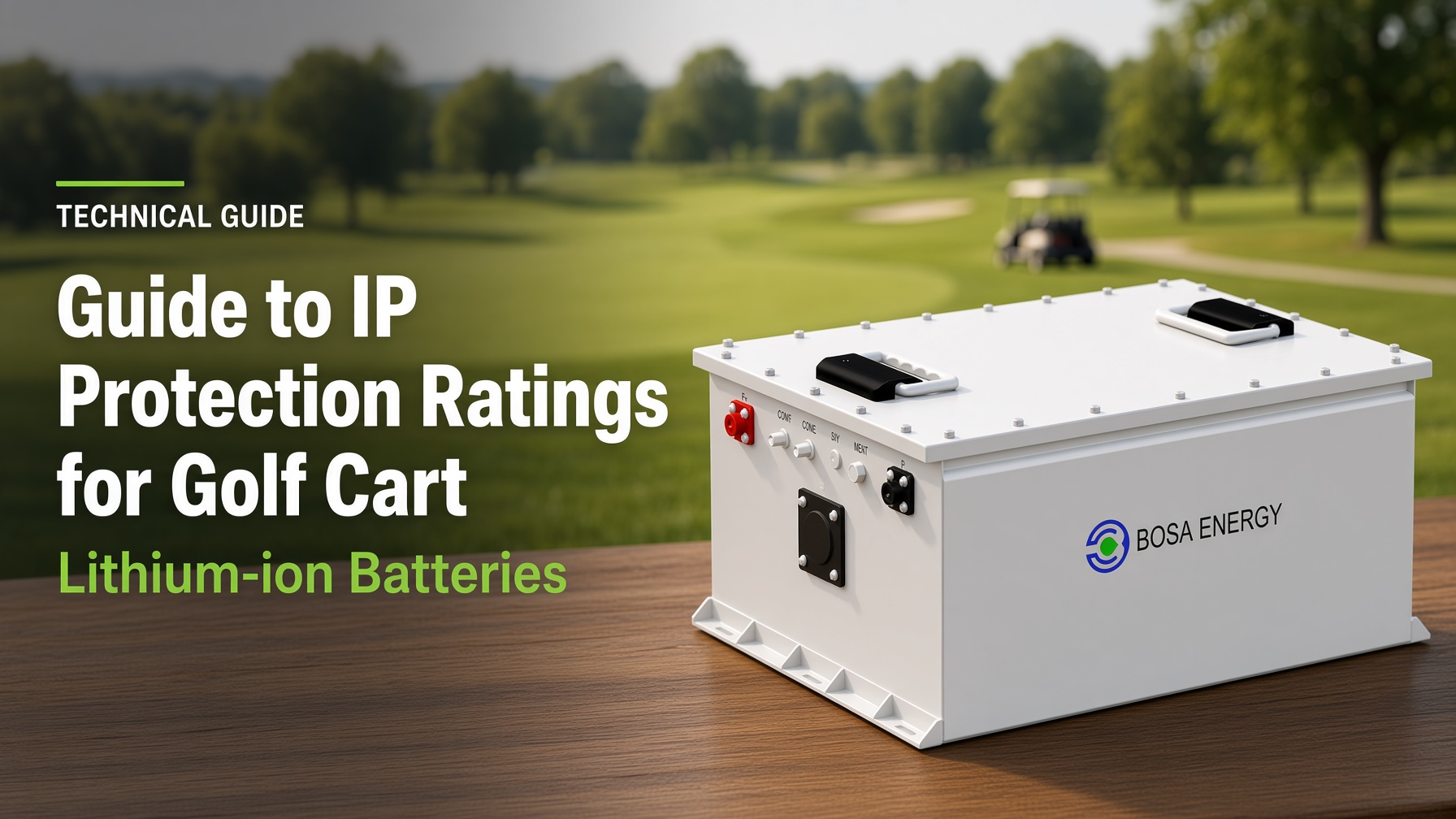
IP ratings define how well a battery enclosure resists dust and water. For golf cart lithium‑ion batteries operating outdoors on wet grass, dusty paths, and under irrigation systems, the correct Ingress Protection (IP) level is a core reliability and safety specification—not a marketing extra.
This Guide to IP Protection Ratings for Golf Cart Lithium‑ion Batteries explains the IEC 60529 IP code, the ratings most relevant to golf cart lithium‑ion batteries, how those ratings translate into real-world durability, and the decision criteria buyers should apply in 2026.
What the IP Code Means
The International Electrotechnical Commission standard IEC 60529 classifies degrees of protection provided by enclosures. The code is written as “IP” followed by two characteristic numerals:
- First digit (0–6): protection against solid foreign objects and dust.
- Second digit (0–9): protection against water.
A higher number indicates stronger protection. “X” is used when a digit is not specified or not tested.
| First Digit | Solids / Dust Protection | Second Digit | Water Protection |
|---|---|---|---|
| 0 | No protection | 0 | No protection |
| 1 | >50 mm objects | 1 | Vertically falling drops |
| 2 | >12.5 mm objects | 2 | Drops when tilted ≤15° |
| 3 | >2.5 mm objects | 3 | Spraying water |
| 4 | >1 mm objects | 4 | Splashing water from any direction |
| 5 | Limited dust ingress (no harmful deposit) | 5 | Low-pressure water jets (6.3 mm nozzle) |
| 6 | Dust-tight (no ingress) | 6 | Powerful water jets (12.5 mm nozzle) |
| — | — | 7 | Temporary immersion (1 m, 30 min) |
| — | — | 8 | Continuous immersion (manufacturer-specified depth/time) |
| — | — | 9 | High-pressure, high-temperature jets |
Source: IEC 60529.
Ratings Commonly Used for Golf Cart Lithium‑ion Batteries
Golf cart batteries see rain, dew, course irrigation, mud, and airborne dust. The ratings that appear most frequently on modern LiFePO₄ packs are IP54, IP65, and IP67.
| Rating | Dust | Water | Typical Golf Cart Suitability |
|---|---|---|---|
| IP54 | Limited dust ingress | Splashing from any direction | Basic outdoor use; limited against jets or standing water |
| IP65 | Dust-tight | Low-pressure water jets from any direction | Rain, hose-down, wet grass; not immersion |
| IP67 | Dust-tight | Temporary immersion up to 1 m for 30 min | Wet courses, temporary flooding, higher durability margin |
Many 2026-generation golf cart lithium‑ion batteries from established suppliers (including Trojan Trillium / OnePack platforms and multiple aftermarket LFP packs such as ROYPOW and BSLBATT) specify IP67. Lower-cost packs may claim only IP54 or IP65.
IP65 is water-resistant against jets; it is not waterproof under immersion. IP67 adds a defined immersion test and is therefore preferred when carts regularly encounter puddles, irrigation overspray, or high-humidity environments such as coastal or Florida courses.
Why IP Rating Matters for Golf Cart Lithium‑ion Batteries
Moisture and conductive dust are leading contributors to terminal corrosion, connector faults, and premature BMS or cell failures. An inadequate enclosure allows:
- Water bridging between terminals or into the BMS cavity.
- Dust accumulation that abrades seals or creates conductive paths.
- Accelerated corrosion of busbars and fasteners.
LiFePO₄ chemistry already offers high thermal stability and long cycle life (≥3,500–4,000 cycles at 80 % DoD for quality cells). That longevity is only realized if the pack remains sealed against the environment. An IP67 enclosure, combined with proper connector sealing and UL 2271 certification, reduces the risk of water-related downtime and extends service life under real outdoor duty cycles.
Opportunity charging (15–40 % capacity recovery during short stops) and maintaining state of charge above 20–30 % further support longevity; neither practice compensates for water or dust ingress.
This Guide to IP Protection Ratings for Golf Cart Lithium‑ion Batteries therefore treats the enclosure rating as a non-negotiable selection filter alongside capacity, voltage, and cycle-life claims.
Selection Criteria for Golf Cart Lithium‑ion Batteries
Prioritize the following measurable attributes when evaluating packs:
- Verified IP rating – Prefer IP67 (or documented IP65 as a minimum for moderate climates). Confirm the rating applies to the complete pack including connectors and any vents.
- UL 2271 certification – Required or strongly preferred for light electric vehicle (LEV) batteries in many jurisdictions. Covers abuse testing, BMS functional safety, and environmental exposure.
- LiFePO₄ cells with documented cycle life – Target ≥3,500 cycles at 80 % depth of discharge.
- Robust BMS – Over-voltage, under-voltage, over-current, short-circuit, and temperature protection with clear communication (Bluetooth or CAN where available).
- Connector and cable sealing – IP67-rated Anderson-style or equivalent connectors reduce a common failure point.
- Mechanical durability – Metal or high-strength composite cases with proper gasketing outperform thin plastic housings under vibration and impact.
- Manufacturer test documentation – Request the actual IEC 60529 test report or third-party certificate rather than marketing claims alone.
Practical Comparison: IP65 vs IP67 for Golf Cart Use
| Condition | IP65 Performance | IP67 Performance |
|---|---|---|
| Driving in rain | Pass | Pass |
| Hose wash-down | Pass | Pass |
| Standing water / temporary flooding | Risk of ingress | Designed for 1 m / 30 min |
| Dusty fairways / desert courses | Dust-tight | Dust-tight |
| Long-term humidity (coastal / Gulf Coast) | Adequate if seals remain intact | Higher margin against seal aging |
For fleet operators in wet or coastal regions, the incremental cost of IP67 is usually justified by lower corrosion-related failures and extended pack life.
Buyer Checklist
- Confirm the exact IP code on the product label or datasheet (IP67 preferred).
- Verify UL 2271 (or equivalent) listing for the specific model.
- Check that connectors and any service ports maintain the stated IP rating.
- Review cycle-life claim at defined DoD and temperature.
- Confirm operating temperature range covers local climate extremes (especially low-temperature charge limits).
- Request third-party test reports for IP and safety certifications.
- Evaluate total cost of ownership over 5–8 years rather than initial purchase price alone.
FAQ
What is the minimum recommended IP rating for a golf cart lithium‑ion battery? IP65 is acceptable for moderate climates with limited standing water. IP67 provides a clearer safety margin for wet grass, irrigation, and occasional immersion.
Does IP67 mean the battery can be submerged indefinitely? No. The standard test is temporary immersion (typically 1 m for 30 minutes). Continuous submersion requires IP68 with manufacturer-defined depth and duration.
Is UL 2271 the same as an IP rating? No. UL 2271 is a comprehensive safety standard for batteries in light electric vehicles. It includes environmental and water-exposure tests but is broader than the IEC 60529 IP code alone.
Do all lithium golf cart batteries carry an IP rating? Reputable manufacturers publish one. Absence of a stated rating or reliance on vague terms such as “waterproof” is a red flag.
How does IP rating interact with opportunity charging and SOC management? IP rating protects the physical pack. Opportunity charging (15–40 % recovery) and keeping SOC above 20–30 % protect the cells electrochemically. Both are required for maximum service life.
Decision Framework
- Map the operating environment (rainfall, irrigation frequency, dust, temperature extremes, coastal exposure).
- Set the minimum IP requirement (IP65 for dry/moderate sites; IP67 for wet or high-humidity sites).
- Require UL 2271 certification and documented LiFePO₄ cycle life ≥3,500 cycles at 80 % DoD.
- Inspect connector sealing and overall enclosure construction.
- Calculate 5–8 year total cost of ownership including replacement frequency and downtime.
- Select the pack that meets the environmental and safety criteria first; then optimize capacity and voltage for the specific cart and duty cycle.
A correctly rated enclosure is foundational. Pairing an IP67-rated, UL 2271-certified LiFePO₄ pack with disciplined charging practices delivers the reliability and low ownership cost expected from modern golf cart lithium‑ion batteries. This Guide to IP Protection Ratings for Golf Cart Lithium‑ion Batteries provides the measurable criteria needed to make that selection with confidence.
Authoritative References
- IEC 60529: Degrees of protection provided by enclosures (IP Code) – IEC Webstore
- UL 2271: Batteries for Use in Light Electric Vehicle (LEV) Applications – UL Standards
- Trojan Battery lithium product documentation (IP67 rating statements for Trillium / OnePack platforms) – Trojan Battery
- IEC 60529 overview – Wikipedia IP Code
- ROYPOW LiFePO₄ golf cart battery technical literature confirming IP67 enclosures (2026 product data)
- Industry guidance on lithium golf cart battery environmental protection and UL 2271 requirements (LEV safety literature, 2023–2026 editions)