
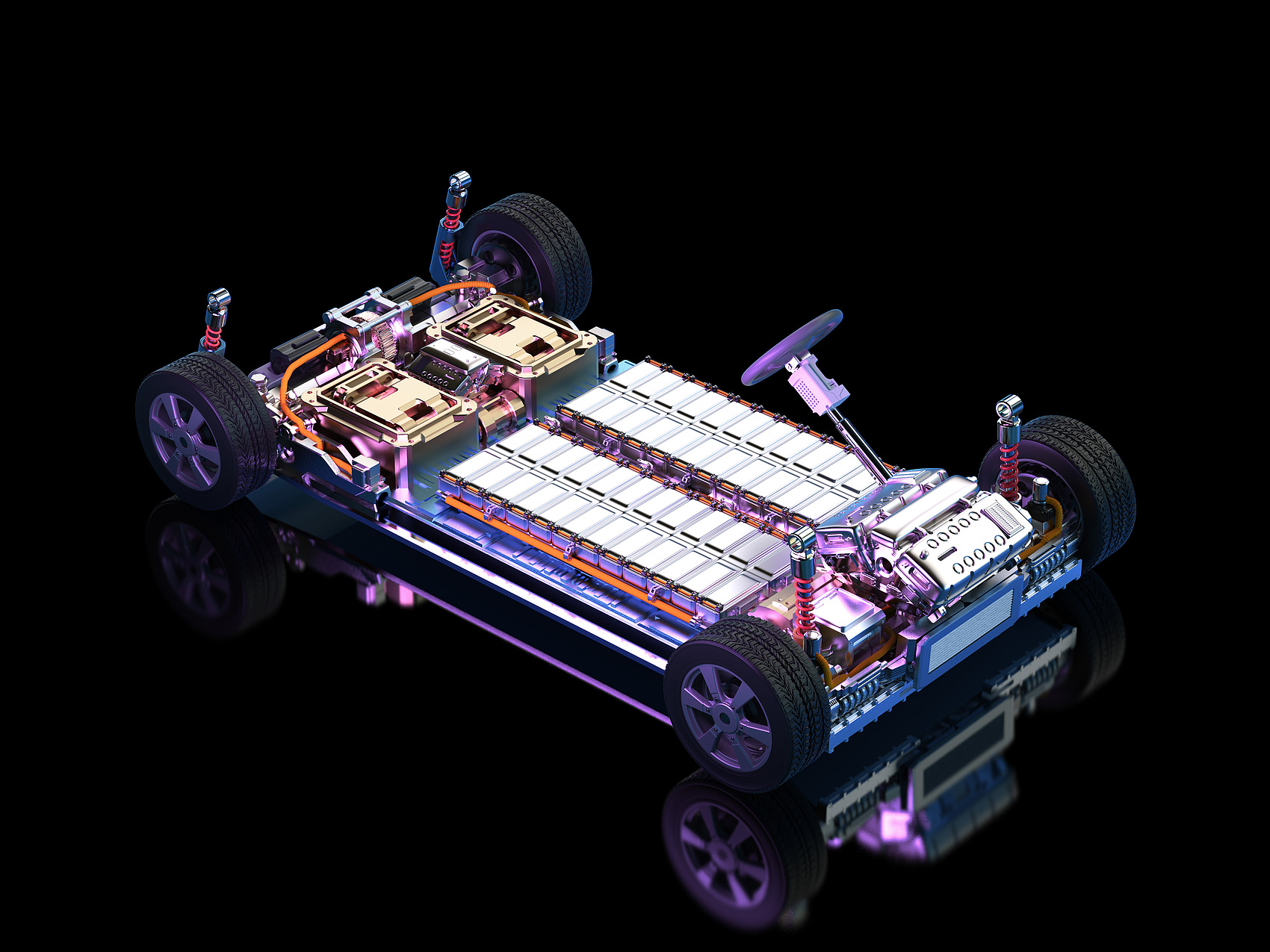
Integrated battery pack design can improve battery energy density and power density, enhance battery pack safety and stability, extend battery life, and improve manufacturing efficiency.
Currently, the main battery pack integration technologies include:
Cell To Module (CTM)
Cell To Pack (CTP)
Cell To Body (CTB)
Cell To Chassis (CTC)
1. CTM
This is the earliest battery pack integration technology. It involves connecting several battery cells in series or parallel, then combining them with end plates, side plates, and other components to form independent battery modules. These modules are then assembled into a battery box to form a battery pack. Finally, the battery pack is bolted to the vehicle chassis, as shown in the figure. Most new energy vehicles on the market currently use this typical integration technology.

This type of battery pack has advantages such as simple structure and easy assembly. Furthermore, because the battery modules operate relatively independently, a single battery module can be replaced if a cell fails. However, since each battery module has end plates, side plates, and a top cover, and there are gaps between each module, this type of battery pack can only accommodate a limited number of cells, has a larger overall weight, and lower space utilization.
2. CTP
This technology eliminates the battery module in CTM and directly integrates the battery cells into the battery pack, as shown in the figure.

Compared to CTM (Cell-to-Pack) technology, CTP (Cell-to-Pack) technology eliminates the module stage, thus reducing the number of components. This not only improves volume utilization but also increases overall energy density due to the reduced battery pack weight. The elimination of battery modules transforms cell fixing from mechanical to adhesive, using thermally conductive adhesive with superior adhesion and high thermal conductivity to bond the cells to the battery casing. This method eliminates the need for bolts, gaskets, and other fasteners found in CTM, reducing the space allocated to the fixing structure and increasing the space available for the cells.
CTP technology increases vehicle range. Within the same vehicle specifications, CTP technology offers improved energy density and volume utilization compared to CTM technology. In 2019, CATL pioneered the CTP battery pack in the industry. After years of iteration and technological updates, in June 2022, they launched their third-generation CTP battery pack, the Kirin battery pack, as shown in the figure. Its 72% volume utilization rate has garnered significant attention within the industry.
3. CTB
This technology integrates the battery pack crossbeams with the battery cover and the vehicle chassis floor, directly integrating the battery cells with the car chassis, as shown in the figure.

Sharing a single panel between the battery pack cover and the passenger compartment floor reduces the number of components at the vehicle level, thereby lowering overall vehicle weight and energy consumption. Since the battery pack retains its enclosure while integrating with the body’s sill and side beams, it forms a double layer of protection in the event of a collision, increasing vehicle safety. The main challenges of CTB technology lie in the sealing and load-bearing capacity between the cover and the floor. Additionally, battery thermal runaway is a critical issue for new energy vehicles; therefore, reducing the protective layer introduces certain safety risks for occupants. The reliability of CTB technology still needs further testing, and it is currently only being used as a technological experiment in the new energy vehicle industry.
5. CTC
The main difference is the elimination of the fixing structure of the battery cells under the battery pack, thus reducing the overall weight of the battery pack. The cells are integrated with the vehicle’s side beams and crossbeams. Similar to CTB technology, directly integrating the battery components into the vehicle’s chassis structure allows for more efficient use of vehicle space, reducing wasted chassis space and improving overall vehicle compactness and interior space utilization.
Compared to CTB technology, CTC technology further reduces the number of vehicle body parts. This means that the battery cells are no longer separate battery packs but are integrated into the vehicle body. This integration method changes the manufacturing, assembly, testing, and maintenance methods of new energy vehicles. When a battery fails, it can no longer be replaced individually, reducing maintainability. Therefore, although CTC technology has theoretically attractive advantages, it faces significant challenges in mechanical connections, electrical connections, thermal management, and its impact on the overall vehicle structure and performance. Therefore, at this stage, more research and experimental verification of the technology’s reliability are needed to meet the requirements for safe driving.