
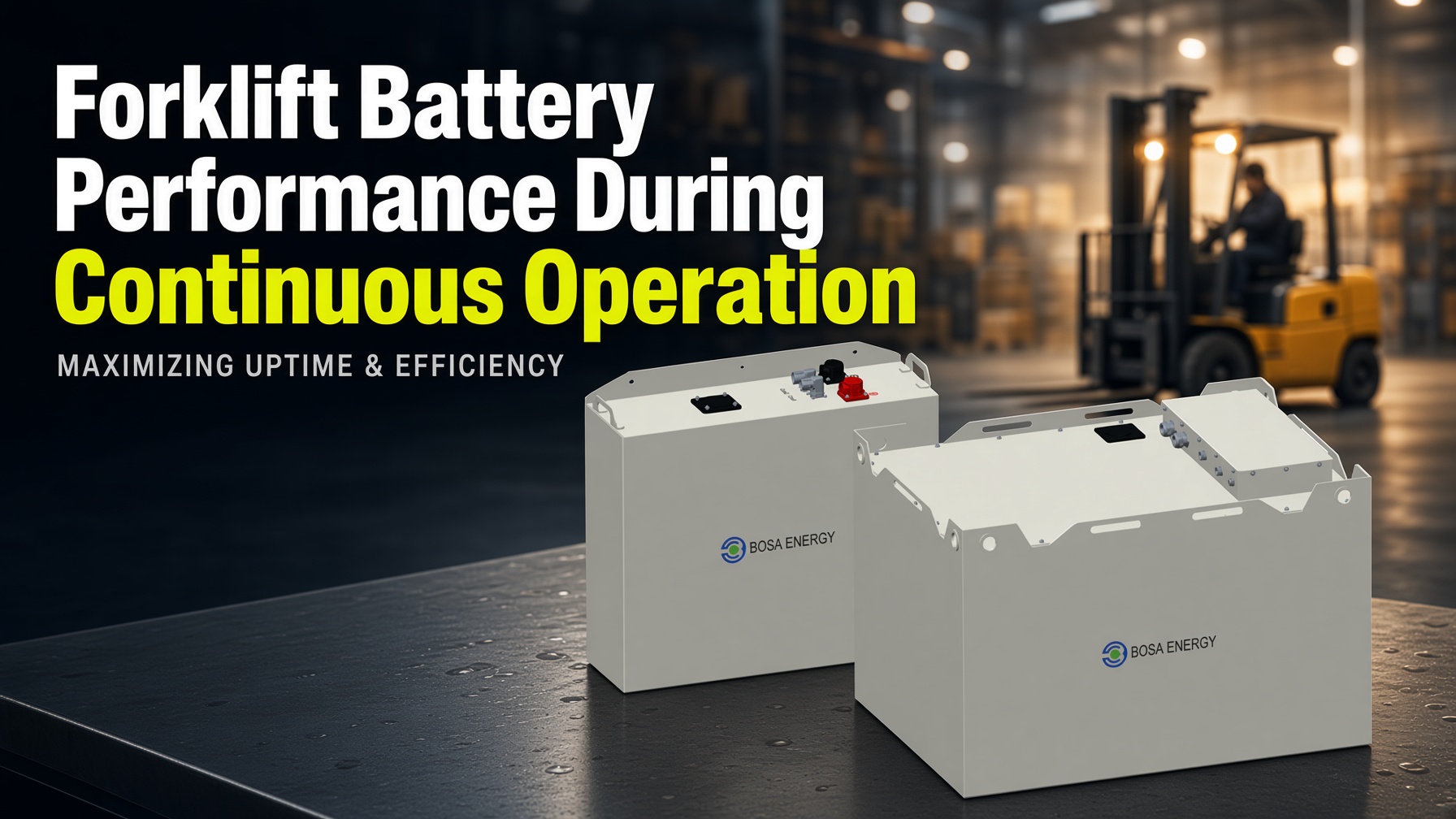
Continuous multi-shift and 24/7 warehouse operations place extreme demands on motive power systems. Voltage stability, charge acceptance, thermal behavior, and usable energy under sustained high duty cycles determine whether a forklift remains productive or becomes a bottleneck. Understanding forklift battery performance during continuous operation is essential for fleet managers evaluating total cost of ownership, uptime, and long-term reliability in 2026 industrial environments.
Lead-acid batteries struggle under these conditions because of voltage sag, mandatory cool-down periods, and the need for battery swaps. Lithium iron phosphate (LiFePO₄ / LFP) systems, by contrast, deliver consistent power, support frequent opportunity charging, and maintain high efficiency across full shifts. This guide examines the measurable factors that govern forklift battery performance during continuous operation, compares chemistries with current data, and provides decision criteria for high-utilization fleets.
Core Challenges of Continuous Duty Cycles
In continuous operation a forklift may run 16–24 hours per day with only short breaks. Key stressors include:
- Sustained high average current draw from lifting, traveling, and regenerative events.
- Limited windows for full recharge.
- Heat accumulation inside the battery compartment.
- Cumulative cycle counts that accelerate calendar aging if depth of discharge (DoD) is poorly managed.
- Operator and infrastructure constraints that prevent ideal charging discipline.
Lead-acid chemistry responds poorly: available capacity drops as state of charge (SOC) falls, internal resistance rises, and sulfation risk increases with partial-state-of-charge cycling. Lithium systems avoid most of these limitations when properly specified and managed.
Lithium vs Lead-Acid Performance Comparison
| Metric | Lead-Acid | Lithium (LFP) | Impact on Continuous Operation |
|---|---|---|---|
| Voltage curve | Declining (power fades late in shift) | Flat (consistent power to ~10–20% SOC) | Lithium maintains full lift and travel speeds |
| Full charge time | 8–10 h + 8 h cool-down | 1–2 h to 80–100% (no cool-down) | Lithium enables single-battery multi-shift use |
| Opportunity charging | Not recommended (shortens life) | Fully supported (15–40% capacity recovery in 15–45 min) | Enables true continuous availability |
| Round-trip efficiency | 70–85% | 95–98% | Lower energy cost and less heat |
| Cycle life (80% DoD) | 1,000–1,500 | ≥3,500 (often 4,000–5,000+) | Longer calendar life under high annual hours |
| Maintenance | Weekly watering, equalization, cleaning | Zero (BMS-managed) | Eliminates labor and battery-room overhead |
| Typical batteries per truck (3-shift) | 2–3 | 1 | Space, capital, and handling savings |
Data drawn from 2026 OEM and independent sources show that LFP packs routinely deliver 10–30% more usable runtime from the same nominal energy because of higher efficiency and deeper safe DoD.
Opportunity Charging and Runtime Extension
Opportunity charging is the primary enabler of forklift battery performance during continuous operation. Short top-ups during operator breaks, shift changes, or idle periods restore 15–40% of capacity without accelerating degradation.
Cat Lift Trucks notes that with appropriate charger sizing, a lithium pack can support continuous truck use without removal from service. A 30–45 minute opportunity charge on a 0.5–1C rate typically recovers enough energy for several additional hours of mixed duty. Because LFP has no memory effect and the BMS actively balances cells, partial cycles do not reduce the rated cycle life in the same way they damage lead-acid plates.
Best-practice SOC window for continuous fleets: keep daily operation between approximately 20–30% minimum and 80–90% maximum. Avoiding deep discharges below 20% SOC and prolonged storage at 100% maximizes both cycle and calendar life.
Voltage Stability, Thermal Behavior, and Power Delivery
Lead-acid voltage declines steadily with SOC, causing progressive loss of lift speed and acceleration in the second half of a shift. LFP maintains a nearly flat voltage curve until very low SOC, so truck performance remains consistent hour after hour.
Thermal management is equally critical. Continuous high-current operation generates heat. Modern industrial LFP packs incorporate BMS-controlled thermal monitoring and, in higher-end designs, active or passive cooling. Acceptable operating windows typically span –20 °C to +55 °C with derating at extremes. Proper compartment ventilation and avoidance of prolonged high-rate charging above 45 °C preserve both safety and longevity.
Real-world evidence confirms these advantages. A Linde E18 electric counterbalance forklift operating in continuous three-shift duty at a New Zealand dairy facility accumulated more than 32,000 operating hours (approximately 3,600 hours per year). The integrated lithium battery completed roughly 1,618 full cycles while retaining substantial remaining life against an expected rating near 4,000 cycles. This case illustrates reliable forklift battery performance during continuous operation over nearly a decade of high-intensity use.
Cycle Life Under Continuous Use
Rated cycle life for industrial LFP forklift batteries is commonly ≥3,500 cycles at 80% DoD, with premium packs reaching 4,000–5,000+ cycles. Under continuous multi-shift duty the annual cycle count rises, but the higher absolute rating still yields longer calendar life than lead-acid.
Factors that protect cycle life in continuous service:
- Opportunity charging that keeps average DoD moderate.
- BMS protection against over-charge, over-discharge, and temperature extremes.
- High-quality cells and robust mechanical packaging (UL 2580 and IEC 62619 certified).
- Telematics that allow fleet managers to monitor SOC, SOH, and charge events in real time.
Selection Criteria and Implementation Checklist
When specifying batteries for continuous operation, prioritize the following:
- Chemistry and certification — Prefer LiFePO₄ with UL 2580 (vehicle) and IEC 62619 (industrial) certification.
- Capacity sizing — Size for the expected daily energy throughput plus margin; opportunity charging reduces the need for oversized packs.
- Charge rate capability — Confirm 0.5–1C continuous charge acceptance and compatible high-power chargers.
- BMS and telemetry — Require SOC/SOH reporting, thermal protection, and data logging compatible with fleet management systems.
- Thermal design — Verify operating temperature range and any active cooling or heating features for the site climate.
- Mechanical fit and weight — Ensure compatibility with the truck’s battery compartment and weight distribution requirements.
- Supplier support — Demand clear cycle-life warranties (typically 5–10 years or fixed cycle counts) and local service capability.
Implementation checklist for continuous fleets
- Map actual duty cycles and available idle windows for opportunity charging.
- Confirm electrical infrastructure can support simultaneous multi-truck opportunity charging (or implement load management).
- Train operators on plug-in discipline during breaks.
- Integrate battery telematics into existing fleet software.
- Establish SOH monitoring thresholds and replacement planning based on remaining cycle life.
- Verify compliance with local electrical and safety codes for distributed charging points.
FAQ
How does continuous multi-shift use affect lithium forklift battery life? Higher annual hours increase cycle accumulation, but LFP’s ≥3,500-cycle rating and tolerance for opportunity charging typically still deliver 8–12 years of service—far longer than lead-acid under the same conditions.
Can a single lithium battery support true 24/7 operation? Yes, when opportunity charging is available during natural breaks. Cat and other OEMs confirm continuous operation is achievable without battery removal.
What SOC range maximizes performance and life in continuous duty? Maintain roughly 20–30% minimum SOC and avoid prolonged full charge. Short opportunity charges that restore 15–40% capacity keep the pack in its optimal window.
Do lithium batteries lose power as they discharge during long shifts? No. The flat voltage curve of LFP provides consistent lift and travel performance until very low SOC, unlike lead-acid.
What standards should continuous-operation batteries meet? UL 2580 for electric-vehicle battery safety and IEC 62619 for industrial lithium cells and systems are the primary references used by major OEMs and fleets in 2026.
Decision Framework
Choose lithium (LFP) when maximizing forklift battery performance during continuous operation is the priority:
- Annual utilization exceeds ~1,800–2,000 hours or the fleet runs two or more shifts.
- Opportunity charging windows of 15–45 minutes exist during the day.
- Labor cost of battery changing, watering, and battery-room management is material.
- Consistent truck performance across the full shift is required for throughput targets.
- Total cost of ownership over 5–10 years is the primary metric.
Lead-acid remains viable only for low-hour single-shift applications with existing infrastructure and tight capital constraints. For the majority of high-throughput warehouses and distribution centers in 2026, lithium delivers superior forklift battery performance during continuous operation, higher uptime, and lower long-term cost.
Authoritative References
- Cat Lift Trucks Li-ion Batteries brochure and technical documentation (opportunity charging for continuous operation): https://www.catlifttruck.com/sites/default/files/documents/cat-li-ion-batteries-brochure-oebc2661.pdf and https://www.catlifttruck.com/solutions/power-sources/li-ion-batteries
- Linde E18 real-world continuous three-shift case (>32,000 hours, ~1,618 cycles remaining life): https://mhdsupplychain.com.au/2026/04/16/linde-e18-forklift-surpasses-30000-hour-milestone/
- IEC 62619:2022 Safety requirements for secondary lithium cells and batteries for industrial applications: https://standards.iteh.ai/catalog/standards/iec/0257aa6b-b5d0-416f-9bff-191236d5ca43/iec-62619-2022
Article prepared for industrial fleet decision-makers. All quantitative claims reflect publicly available 2026 OEM and independent sources current as of publication.