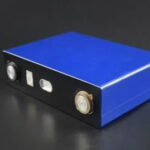

The constant current followed by constant voltage strategy in the lithium battery charging process is designed based on the physical characteristics and safety of the battery. This charging method not only ensures the safety of the battery, but also maximizes its capacity and prolongs its service life.
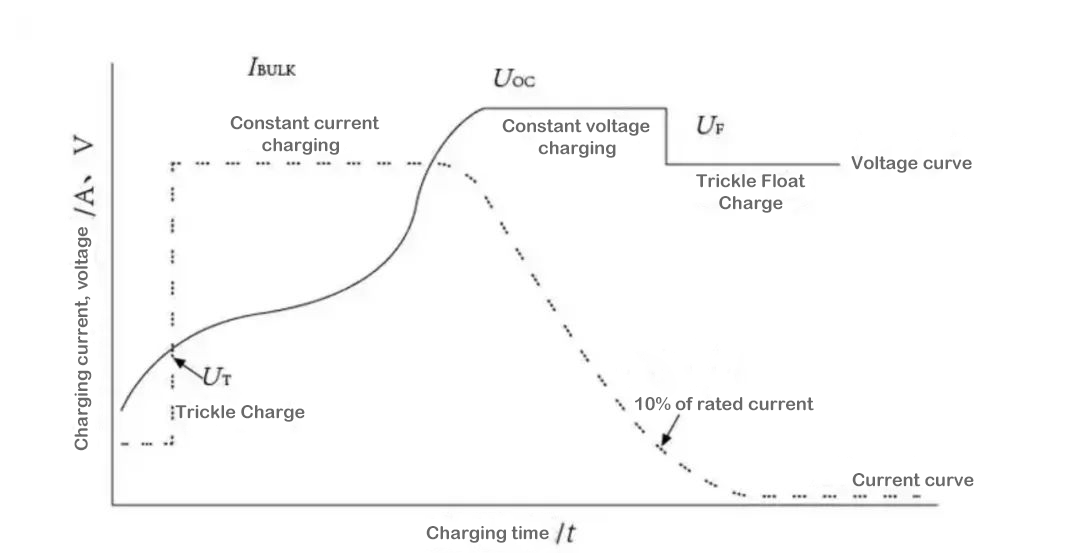
Constant Current Charging Stage
In the initial stage of lithium battery charging, the Constant Current (CC) mode is usually used. In this stage, the charger will provide a relatively stable current, which is generally set according to the design parameters of the battery.
For a battery with a nominal capacity of 100Ah, a charging rate of 0.5C means a charging current of 50A.
The main purpose of constant current charging is to quickly increase the battery voltage to a threshold close to the full charge state. This stage is effective because when the battery power is low, the internal resistance is small and can accept a larger charging current without causing overheating or damage.
In addition, since the polarization phenomenon is weak at this time, charging with a larger current will not significantly affect the performance of the battery.
Transition from constant current to constant voltage
When the battery voltage reaches the set cut-off voltage, the constant current charging phase ends and the system automatically switches to Constant Voltage, (CV) mode.
Continuing to charge at a constant high current may cause the battery voltage to rise rapidly, exceeding the safety limit, thereby damaging the battery structure and shortening its service life.
During the constant voltage charging phase, the charger keeps the output voltage unchanged, but the charging current naturally decreases as the battery is gradually filled. This is because as the number of lithium ions inside increases, it becomes more difficult to further embed into the negative electrode, causing the internal resistance of the battery to rise, thereby reducing the current even at the same external voltage.
Constant Voltage Charging Phase
During the constant voltage charging phase, the main goal is to gradually reduce the charging current until it reaches a predetermined low level, at which point the battery is considered fully charged.
Despite the reduced charging current, the battery terminal voltage remains constant, allowing the remaining energy to be charged efficiently into the battery while avoiding the risk of overcharging.
It should be noted that although the constant current charging phase can quickly increase the battery charge, it cannot complete the entire charging process alone. At the end of the constant current charging, there may be some polarization inside the battery, and the actual battery voltage may be lower than the measured voltage. Without subsequent constant voltage charging, the battery may not reach its maximum capacity, and long-term battery health may deteriorate.
Polarization and safety considerations
When choosing a constant current followed by a constant voltage charging method, the polarization effect inside the battery should also be considered. Polarization refers to the situation in which the actual voltage of the battery is higher than the equilibrium voltage under ideal conditions due to the limitation of the electrochemical reaction rate during the charging process.
The degree of polarization increases with the increase of charging current, which may cause the battery voltage to increase abnormally, or even trigger the protection mechanism to terminate charging prematurely. Introducing a constant voltage stage helps to make the ion concentration distribution inside the battery more uniform, reduce the polarization effect, and ensure that the battery can be fully charged without overheating or damage.
Energía Bosa
Bosa Energy, con una capacidad de 150 GWh y más de 400 000 aplicaciones en autobuses eléctricos y vehículos utilitarios, figura entre los 5 primeros puestos de la industria china de baterías. Colaboramos con Yutong, Geely, Damiller, entre otros.
También ofrecemos sistemas ESS en contenedores y entregamos 6 GWh en 2024 (equivalente a 75 000 unidades del Modelo 3 con batería de 80 kWh). En el mercado local, ofrecemos servicios OEM a Changan, CALB, National Grid, Ping Gao Electric, Xuji Electronics y Ruineng Electronics, nuestros principales proveedores de sistemas ESS en contenedores en China.
Somos el proveedor más profesional de baterías de litio marinas en China, y nuestro volumen de exportación de baterías marinas se sitúa constantemente entre los tres primeros de China; además, somos el principal exportador de módulos de baterías de litio en China, especializados en ofrecer diversas soluciones de módulos de baterías de litio.
Gracias a su excelente calidad y rendimiento, nuestros productos son populares en más de 30 países. Además, contamos con almacenes en Alemania y los Países Bajos para garantizar la disponibilidad y entrega puntual a nuestros clientes.
Personalizado y flexible
l Alta capacidad de entrega
Amplias aplicaciones
l Amplia experiencia en paquetes de baterías de litio