
The Core Requirement: Zero Emissions Without Sacrificing Throughput
Indoor air-quality rules, corporate ESG targets, and local regulations continue to restrict combustion equipment during occupied hours. California’s Small Off-Road Engine (SORE) rules and similar frameworks elsewhere have already limited new spark-ignition machines in many categories. Hospitals, schools, food-processing plants, and high-traffic retail sites increasingly prohibit propane or gasoline scrubbers while people are present.
Zero-emission lithium machines eliminate three constraints at once:
- No exhaust gases or combustion particulates
- No hydrogen generation during charging
- No requirement for dedicated ventilated battery rooms or on-site fuel storage
The result is higher machine utilization and simpler compliance documentation.
Lithium Batteries: The Technical Foundation
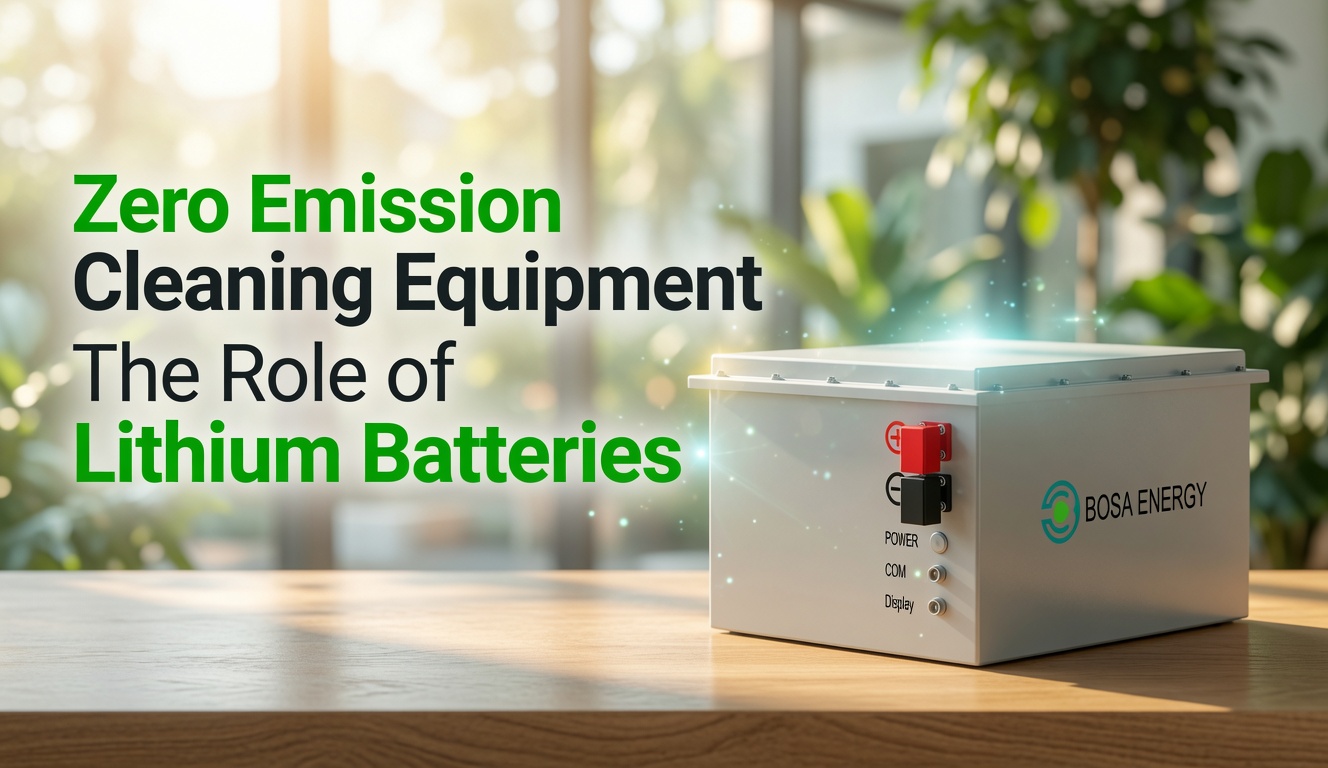
Modern zero-emission scrubbers, sweepers, and burnishers rely on LiFePO₄ packs. Key performance characteristics under industrial duty include:
- Cycle life of ≥3,500 cycles at 80 % depth of discharge (DoD)
- Full support for opportunity charging (15–40 % capacity recovery during short breaks)
- Recommended operating window that keeps state of charge (SOC) above 20–30 %
- Stable voltage delivery across the discharge curve, eliminating late-shift power fade
- Integrated battery management systems (BMS) with cell-level temperature, voltage, and current monitoring
- Compliance pathways under IEC 62619 (industrial applications) and UN 38.3
These attributes allow a single lithium-powered machine to cover multi-shift operations that previously required battery swaps or multiple lead-acid packs.
Performance Comparison
| Attribute | Lithium (LFP) | Lead-Acid (Flooded/AGM) | Propane / LPG / Gasoline |
|---|---|---|---|
| Tailpipe / exhaust emissions | Zero | Zero (but charging gases) | CO, NOx, particulates |
| Typical cycle life | ≥3,500 at 80 % DoD | 300–800 | Engine hours limited by maintenance |
| Opportunitätskosten | Fully supported | Damages pack if used routinely | N/A |
| Charge time (0–100 %) | 1–2 Stunden | 8–10 hours + cool-down | Refuel minutes |
| Wartung | Near zero (no watering) | Watering, equalization, corrosion | Engine, filters, spark plugs |
| Weight for equivalent energy | 30–50 % lighter | Heavier | Fuel + engine mass |
| Indoor air quality impact | Keiner | Potential hydrogen during charge | Direct emissions |
| Typical usable runtime gain | Up to 40–60 % vs lead-acid | Baseline | High but restricted by air quality rules |
| Total cost of ownership (5 yr) | Lowest in multi-shift use | Higher replacement & labor | Fuel + engine maintenance |
Selection Criteria (Priority Order)
When specifying zero-emission cleaning equipment, evaluate these factors in sequence:
- Chemistry and cycle rating — Require documented LiFePO₄ performance of ≥3,500 cycles at 80 % DoD with competent BMS thermal management.
- Opportunity-charging compatibility — Confirm the pack and charger support partial charges without warranty impact.
- SOC operating window — Design routes and break schedules so packs remain above 20–30 % SOC whenever practical.
- Certification path — Prefer IEC 62619 and UN 38.3 compliance plus machine-level safety listings.
- OEM integration — Factory lithium options from Tennant, Nilfisk, Kärcher and equivalent suppliers reduce integration risk versus third-party retrofits.
- Charger and infrastructure match — Size and locate chargers to capture the 15–40 % opportunity-charge window during natural pauses.
- Warranty alignment — Match pack warranty length to expected machine service life.