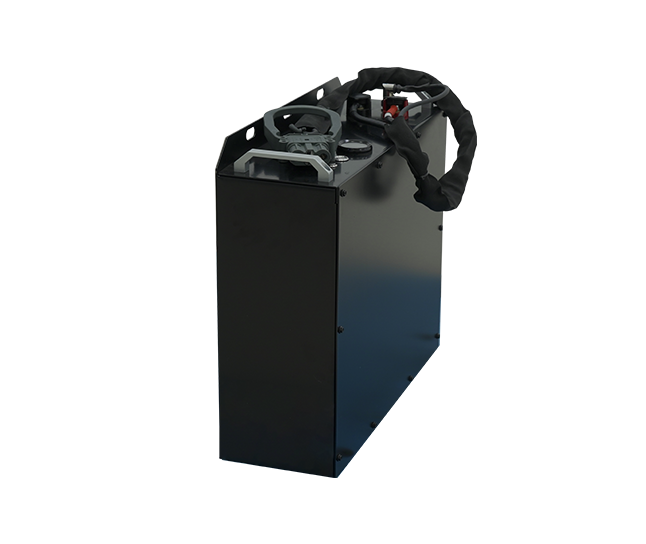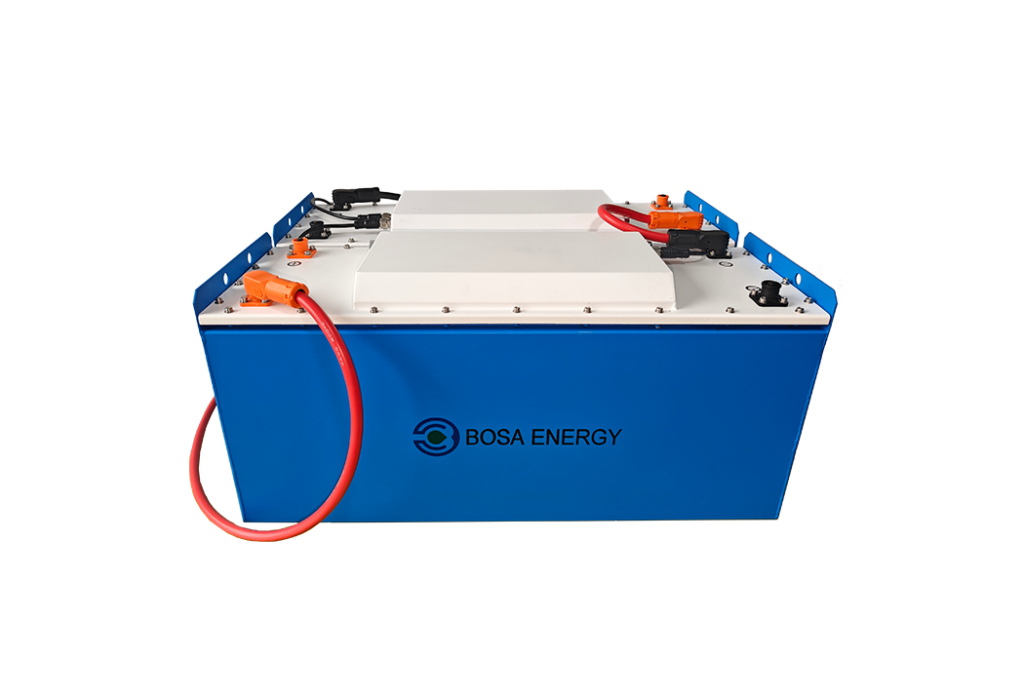

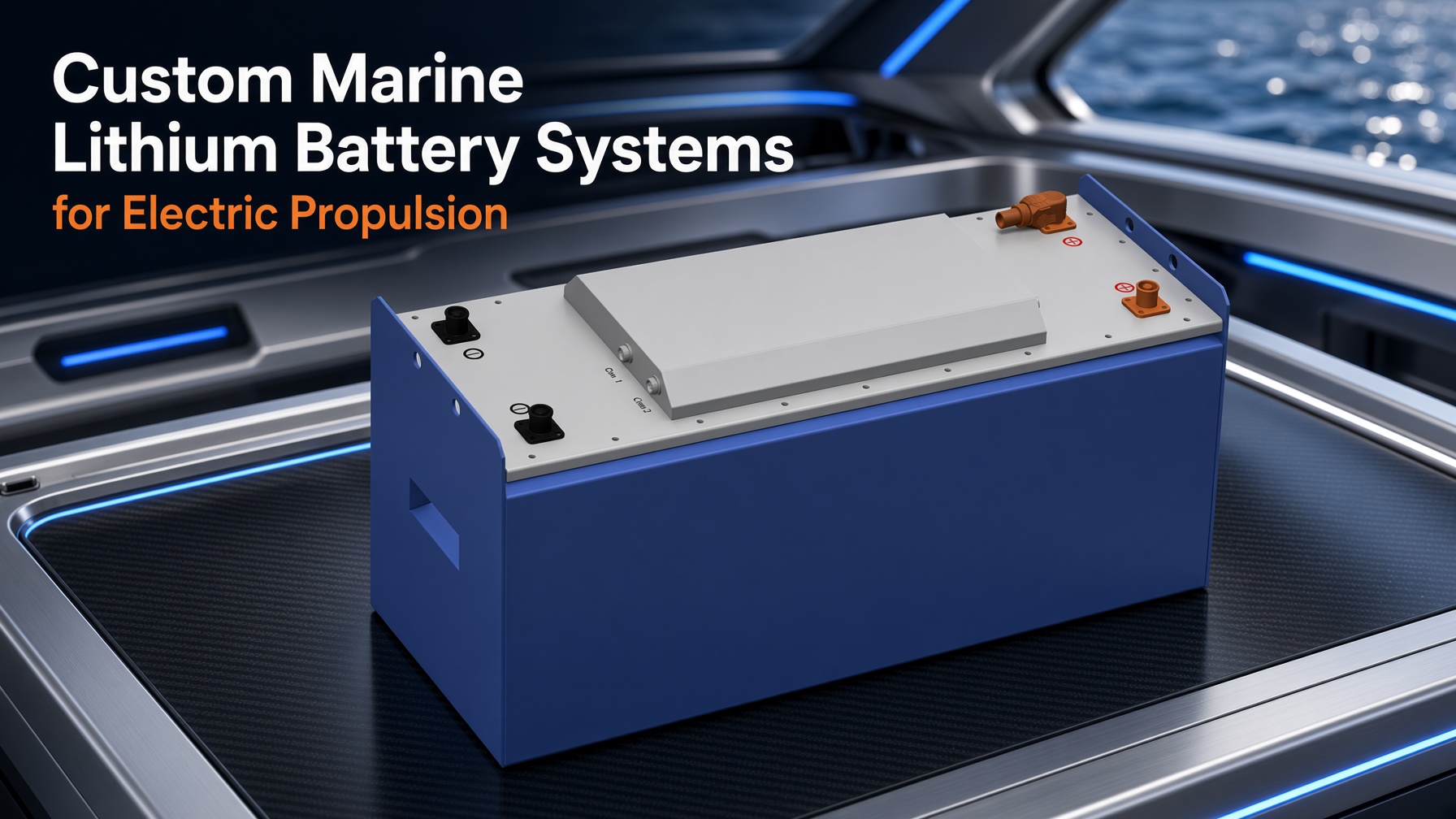
A propulsion pack is not a house brick with a larger label. The motor already has a voltage, a continuous current and a charger handshake. The hull already has a locker shape, a flood line and a dock window. Custom Marine Lithium Battery Systems for Electric Propulsion exist because those four constraints rarely match a catalogue 12.8 V module.
This is an architecture brief for yards, OEMs and owners who need a pack built around the motor, not a motor forced onto a spare locker. Lock duty first — small outboard, mid-voltage workboat, high-voltage daycruiser, yacht hybrid or classed commercial energy room. Then lock voltage, continuous C-rate, chemistry, ingress, cooling and the minutes the vessel actually spends on a cable. Nameplate kilowatt-hours are the last number.
Key Takeaways
- Custom means voltage, current, envelope, communication and charger authentication are written to the motor and the hull. It does not mean a stack of mismatched house bricks in series.
- Specify LiFePO₄ (LFP) for open marine propulsion banks. Industrial and purpose-built marine LFP commonly publishes ≥3,500–4,000 cycles at 80% depth of discharge (DoD). Torqeedo Deep Blue Battery 80 rates 3,750 cycles at 80% DoD / 4,000 at 75% DoD at 25 °C.
- Keep daily work above 20–30% state of charge (SOC). Restore 15–40% in the natural dock, shore or generator window. One overnight 100% charge is not a substitute for mid-day top-ups on a propulsion day.
- Small craft follow ISO 23625:2025 و ABYC E-13-2025. Flood-prone locations need IEC 60529 IP67; other locations IP55. Systems at or above 60 V DC sit partly outside the small-craft document.
- 2026 calibration points: ePropulsion E-Series 3.07–8.35 kWh at 51.2 V; Torqeedo Deep Blue Battery 80 79.2 / 77.6 kWh at 348 V; Candela C-8 69 kWh / 57 NM at 22 kn; Volvo Penta D13 IPS Hybrid LFP 147 or 221 kWh twin at ~650 V DC with 160 kW electric and DNV type approval; Caterpillar Marine production LFP racks to 1,420 VDC at 1C.
Table of Contents
- Why Propulsion Packs Are Specified, Not Shopped
- What “Custom” Actually Changes
- Voltage Rails From Outboard to Energy Room
- Chemistry, Cycle Life and the SOC Window
- 2026 Reference System Map
- Standards, Class and Integration Paper
- Charging Architecture for a Propulsion Day
- Buyer, Yard and Integrator Checklist
- التعليمات
- Decision Framework
- Authoritative References
Why Propulsion Packs Are Specified, Not Shopped
House load is hours of moderate current. Propulsion is hours of continuous current at a voltage the controller already expects. Mixing those two jobs into one string is how a “drop-in” install becomes a survey problem.
Capacity (kWh) only answers range. Voltage answers whether the motor and charger will handshake. Continuous current and C-rate answer whether the battery management system (BMS) folds power in the channel. Envelope, cooling and ingress answer whether the pack survives a season of spray and a closed locker. Custom work starts by writing those four numbers against the hull, not against a catalogue page.
Caterpillar Marine put the same point on the record in September 2026: hybrid and electric marine plants are still in a custom phase, even as production LFP racks appear. Standard modules exist. The energy room does not.
Custom Marine Lithium Battery Systems for Electric Propulsion are the plant that results when the yard treats voltage, current, cooling and paper as design inputs rather than afterthoughts.
What “Custom” Actually Changes
Custom is five deliverables, not a colour of powder coat.
Voltage matched to the controller. 48 V / 51.2 V for small outboards and pods. 72 V / 96 V / 144 V for higher-power mid-voltage work. ~348–350 V for Deep Blue-class daycruisers. ~650 V DC for yacht hybrids such as Volvo Penta IPS Hybrid. Hundreds to 1,420 VDC for classed commercial racks. Do not series-string 12.8 V house bricks onto any of those rails unless the pack maker documents the topology, the communication map and the charger that will authenticate the string.
Continuous current matched to the shaft. Peak 10-second figures on a brochure do not replace the continuous rating at the locker temperature. If the BMS limit sits below the controller draw, the boat folds mid-channel even though the nameplate kWh looks generous.
Mechanical envelope and mounting. Locker length, hatch size, shock mounts, cable exit and service access decide the pack geometry. A 1,800 × 853 × 236 mm Deep Blue Battery 80 will not drop into a tender well designed for four 12 V bricks. Custom housings exist so the energy sits where the hull can carry it.
Communication and charger handshake. CAN / CANopen / J1939 / RS485 to the motor controller, helm display and charger. A lead-acid charge profile on an LFP propulsion string is a field failure. The BMS must authenticate the charger; the helm must see SOC, temperature and an alarm before a vital load is dropped.
Cooling and ingress as part of the drawing. IP67 where the location can flood or take green water; IP55 or the class equivalent otherwise. Liquid cooling or forced ventilation when the locker will exceed the charge window. Cold LFP without a heater pad loses usable energy on the first hour of a winter start.
Those five items are why a 51.2 V 230 Ah IP67 pack, a 348 V 79.2 kWh cell-to-pack module and a 1,420 VDC liquid-cooled rack can all be LFP and still be three different products.
Voltage Rails From Outboard to Energy Room
Raising voltage cuts current for the same shaft power, which cuts cable section, connector heat and I²R loss. That is why 6 kW lives near 51.2 V and 50–160 kW lives at hundreds of volts.
| Duty class | Typical custom rail (2026) | What the pack must deliver | Calibration point |
|---|---|---|---|
| Small outboard / pod / sail-assist | 48 V / 51.2 V / 72 V | Continuous A at hull speed; same-model parallel only | ePropulsion E60 / E100 / E163: 3.07 / 5.12 / 8.35 kWh at 51.2 V; 3,000 cycles to 80% SOH |
| Mid-voltage workboat / performance hull | 96 V / 144 V | Continuous kW into a mid-power outboard or inboard | Configurable 96 V / 144 V LFP strings sized to motor current and locker volume |
| High-voltage daycruiser | ~348–350 V | Hours of continuous kW + DC-fast window | Torqeedo Deep Blue Battery 80: 79.2 kWh nominal / 77.6 kWh usable, 348 V, 79 kW continuous discharge, IP67 |
| Foiling closed OEM | OEM high-voltage architecture | Range at cruise speed, not at dock idle | Candela C-8: 69 kWh Polestar pack, 57 NM at 22 kn; official DC 10–80% in under 30 minutes |
| Mid-size yacht hybrid | ~650 V DC parallel hybrid | Silent approach + hotel without a night generator | Volvo Penta D13 IPS Hybrid: 160 kW electric, LFP 147 or 221 kWh per twin, DNV type-approved packs, CCS2 up to 215 kW DC |
| Commercial energy room | Hundreds to 1,420 VDC | 1C-class charge/discharge in a surveyed space | Caterpillar Marine production LFP (9 Sep 2026): liquid cooled, rackable, 1C, up to 1,420 VDC |
Sources: linked OEM pages and trade reports in the table. Use the rows as calibration, not as a shopping list.
ISO 23625:2025 warns that DC systems at 60 V and above carry extra requirements the small-craft document does not fully cover. Custom high-voltage propulsion lives above that line. Specify isolation monitoring, a physical disconnect and a charger the BMS will authenticate.
Chemistry, Cycle Life and the SOC Window
LFP is the default open-bank chemistry because thermal-runaway onset is higher and residual reactivity is lower than typical NMC. That is a risk reduction, not a licence to skip IP rating, fusing or a non-bypassable BMS. Closed OEM packs (Candela’s Polestar architecture) may use a different cell inside a builder-controlled envelope. Do not copy that chemistry into an open locker.
Nameplate cycles are measured at a stated DoD, temperature and rate. Field life is measured at the SOC floor the crew actually uses.
| Pack / class | كيمياء | Energy / voltage | Published cycle or warranty note | Hook |
|---|---|---|---|---|
| Typical custom marine LFP (open bank) | LFP | 48–144 V configurable | ≥3,000–3,500 cycles to ~80% SOH at 80% DoD | IEC 62619; IP65–IP67; CAN |
| ePropulsion E-Series | LFP | 3.07 / 5.12 / 8.35 kWh at 51.2 V | 3,000 cycles at 80% SOH | UN 38.3; parallel same model only |
| Torqeedo Deep Blue Battery 80 | LFP, cell-to-pack | 79.2 / 77.6 kWh, 348 V | 3,750 cycles at 80% DoD / 4,000 at 75% DoD @ 25 °C | IP67; IEC 62619 / 62620 |
| Candela C-8 (closed OEM) | Lithium-ion (builder envelope) | 69 kWh | OEM 8-year battery warranty | Official DC 10–80% in under 30 min; foil efficiency sets range |
| Volvo Penta IPS Hybrid marine pack | LFP | 147 or 221 kWh per twin | DNV type approval; liquid cooled / heated; shock-mitigated cradles | 43 kW AC / 215 kW DC / 250 kW generator-mode charge |
| Cat Marine production pack | LFP first chemistry | Up to 1,420 VDC, rackable | 1C charge and discharge; class certification in progress | Tugs, ferries, inland and hybrid yachts |
| Corvus Blue Whale NxtGen Energy | LFP | 24 kWh / 77 VDC module; 96–338 kWh / 308–1,078 VDC pack | Energy-first duty; high-rate bursts available for short windows; liquid cooled | Corvus product page |
| Corvus Blue Whale NxtGen Power | LFP (BYD Energy Storage cells) | Same NxtGen stack interface as Energy | High-rate LFP for tugs, workboats and ferry turnaround charge | WorkBoat, 27 Aug 2026 first commercial product from the Corvus–BYD cooperation |
Two operating rules convert a cycle rating into calendar years.
- Restore 15–40% in the dock, pontoon or generator window that already exists. Count energy returned, not connector clicks. Candela’s published 10–80% DC session and Volvo Penta’s 215 kW CCS2 plug are the high-power versions of the same rule a weekender uses on a 30 A shore cable.
- Keep daily work above 20–30% SOC. The last 10% is where voltage sag, heat and cycle damage concentrate. Parking a pack at 0–10% over a winter weekend spends calendar life. Store in the mid band.
Heat in a closed locker or energy room is the other fade driver. If the space exceeds the pack’s charge window (often ~0 °C to ~45–55 °C on LFP), add ventilation, liquid cooling or relocate.
2026 Reference System Map
Use these as calibration points for Custom Marine Lithium Battery Systems for Electric Propulsion, not as a brand shortlist.
Small electric outboard and RIB. ePropulsion E60 (3.07 kWh, 33 kg), E100 (5.12 kWh, 48.5 kg) and E163 (8.35 kWh, 76 kg) at 51.2 V. One E163 supports Navy 6.0 Evo at full output. Two E100s in series support a 96 V upgrade path. Parallel only inside the published limit of 16 same-model packs. This is the band where “drop-in 12 V house bricks in series” most often violates the maker’s map.
Configurable mid-voltage propulsion. 72 V, 96 V and 144 V LFP strings built to the motor’s continuous current, the locker volume and a CAN map the controller already speaks. IP67 metal or composite enclosures, heater pads for winter starts, and an authenticated charger are the custom work. Do not treat this band as a DIY series string of 12.8 V bricks.
High-voltage daycruiser. Torqeedo Deep Blue Battery 80: 348 V, 79.2 / 77.6 kWh, IP67, 79 kW continuous discharge, optional water-glycol cooling and damper kit. Deep Blue Battery 40 remains the 38 kWh sibling. This is a closed handshake; a lead-acid profile on this rail is a field failure.
Foiling closed system. Candela C-8: 69 kWh Polestar pack, C-Pod 45/50 kW, published 57 NM at 22 kn plus a short limp-home reserve, DC 10–80% in under 30 minutes. Hull efficiency, not pack size, is what makes the range claim possible. A planing hull with the same 69 kWh will not repeat 57 NM at 22 kn.
Mid-size yacht hybrid. Volvo Penta’s D13 IPS Hybrid, aimed at market later in 2026, couples IPS900–IPS1350 diesel (515–735 kW) to a 650 V DC parallel hybrid motor at 160 kW electric. Battery options are 147 kWh (four-pack) or 221 kWh (six-pack) LFP per twin installation, DNV type-approved, liquid cooled and heated, with CCS2 shore charge to 215 kW DC and generator-mode charge to 250 kW. Hotel load can run from the pack without a night generator. This is an integrated custom plant, not a locker of mixed bricks.
Commercial and large hybrid rooms. Caterpillar Marine’s first production pack, reported by WorkBoat on 9 September 2026, is LFP, 1C, liquid cooled and rackable to 1,420 VDC. Cat’s own marine page frames the same hardware as the move from an engine room to an energy room, with class certification in progress. Corvus Blue Whale NxtGen Power, launched 27 August 2026 with BYD Energy Storage cells, targets tugs, workboats and fast-charge ferries where power, not only energy, drives the drawing. AYK Energy’s Cosmos container (September 2026) adds a swappable IP67 / A60 option for ferry and RoPax duty after completing New Technology Qualification. A yacht that will be flagged, insured or chartered into a class society should not sail on recreational paper alone.
Immersion-cooled high-rate option. XING Mobility’s IMMERSIO CTP, shown at SMM Hamburg 2026, claims continuous 3C and higher volumetric density via cell-to-pack immersion cooling, with a Smart IQ vessel integration completed in April 2026. Treat published density and C-rate claims as project data until class paper is on the same drawing.
Standards, Class and Integration Paper
Do not buy a pack that cannot name the standard on the label.
ISO 23625:2025 — Small craft — Lithium-ion batteries. Published March 2025, it replaces ISO/TS 23625:2021. Scope is systems above 500 Wh used for house loads and/or electric propulsion on small craft. The 2025 edition requires IEC 62619 و IEC 62620, a defined audible alarm, EMC requirements for the BMS, IP67 in flood-prone locations and IP55 elsewhere. DC systems at 60 V and above sit partly outside this document.
ABYC E-13-2025 — Lithium Ion Batteries. The 2025 revision is the first update since July 2022 and was issued with the ABYC 65th supplement. A BMS is mandatory. No electrical connection may bypass it. E-13 works with E-10 and E-11; it does not replace them. Panbo records the 60 V notes and the carve-out for systems that already carry class or automotive-maker approval. BoatUS treats E-13 as the integration standard, not the cell-construction standard.
Class type approval. DNV, ABS, Bureau Veritas, Lloyd’s Register and RINA sit above recreational standards for commercial craft and for yacht hybrids that will be surveyed. Volvo Penta’s IPS Hybrid packs carry DNV type approval at launch. Caterpillar’s marine racks list class certification in progress. Recreational weekenders do not need class notation. A 20 m+ hybrid yacht should not skip the question.
UN 38.3. Transport test. Required to ship a spare module. Ask for the test summary.
BMS functions that are not optional. Over-charge, over-discharge, over-current on charge and discharge, high- and low-temperature cut-off, cell balancing, ground-fault detection on high-voltage rails, a hard-wired emergency stop, and a physical disconnect the installer cannot jumper. On propulsion above about 1,500 Wh, ISO 23625 also expects a state-of-health indication relative to original capacity. The helm needs an audible or visual alarm before a vital load is dropped.
Cybersecurity on networked plants. When the BMS sits on the vessel network — common on yacht hybrids and commercial rooms — ask for the cyber notation in the same request for quotation as the cell chemistry. Corvus Energy’s 2026 DNV cybersecurity type approval on Dolphin NxtGen is the current commercial benchmark.
Dedicated hotel reserve. Isolate VHF, nav lights, AIS, bilge and comms so a propulsion low-voltage cut-off cannot black out the boat. ABYC and good survey practice both expect this.
Charging Architecture for a Propulsion Day
A lithium propulsion plant is only as useful as the minutes the vessel already spends on a cable or a running generator.
Opportunity charge, 15–40%. Use the lunch stop, the marina afternoon, the generator window while the watermaker runs. Count kilowatt-hours returned. If the charger cannot put 15–40% back before the next leg, the pack is the wrong size or the shore plug is the wrong power.
Keep the daily floor at 20–30% SOC. Design the hardest published day — not the average Saturday — to finish above that band after hotel load, sea state and a missed charge. The last 10% is not a reserve you plan to spend.
Match plug to duty.
- Small craft: authenticated AC at the pedestal. A lead-acid profile on an LFP propulsion bank is how a “drop-in” install cooks cells.
- Daycruisers: CCS-class DC where it exists. Candela’s published 10–80% session in under 30 minutes is the high-efficiency example.
- Yacht hybrids: CCS2 at the quay (Volvo Penta publishes 215 kW DC) plus generator-mode charge underway (250 kW on the D13 IPS Hybrid). Hotel can stay on the pack at anchor so the generator stays off.
- Commercial rooms: 1C-class or MCS-class berth charge sized to the turnaround, not to a leisure 16 A cable.
Charge only with the charger the BMS authenticates. Opportunity charging is useful only when voltage, current and termination agree.
Buyer, Yard and Integrator Checklist
- Duty written down: small electric outboard, mid-voltage workboat, high-voltage daycruiser, yacht hybrid, or classed commercial energy room.
- House, cranking and propulsion kept on separate banks or on a documented dual-purpose pack. Chemistries not mixed in one string.
- Voltage, usable kWh, continuous current and peak C-rate matched to the motor controller — not only to a brochure watt-hour figure.
- Envelope, cable exit, shock mounts and service access drawn against the actual locker, not a generic box.
- CAN / display / charger handshake specified in the same purchase order as the cells.
- Chemistry chosen on purpose. LFP default for open banks. Closed OEM packs accepted only with the builder’s charger and BMS.
- Hardest day modelled to finish above 20–30% SOC after 10–20% sea-state and hotel margin.
- Charger sized to restore 15–40% in the real dock or generator window. Plug type (AC / CCS / CCS2 / MCS) written into the same order.
- ISO 23625:2025 + IEC 62619 + IEC 62620 on small-craft files. ABYC E-13 / E-11 installation where that code applies. UN 38.3 for any spare module.
- Class type approval (DNV / ABS / BV / LR / RINA) on commercial craft and on yacht hybrids that will be surveyed. Cybersecurity notation if the BMS is networked.
- IP67 if the location can flood or see green water; IP55 or the class equivalent otherwise. Connectors rated with the enclosure, not below it.
- BMS cannot be bypassed. Physical disconnect, temperature cut-off, ground-fault detection on high-voltage rails, and an alarm the helm can hear before cut-off.
- Dedicated reserve for VHF, nav lights, AIS and bilge after a propulsion cut-off.
- Liquid cooling or locker ventilation and energy-room temperature on the same sea-trial sheet as SOC.
التعليمات
Is a custom pack the same as a drop-in LFP brick? No. A drop-in brick replaces a lead-acid box on a 12.8 V house bus. A propulsion pack is sized to the motor’s voltage and continuous current, the hull envelope and a charger the BMS will authenticate. Series-stringing house bricks onto a 96 V or 350 V propulsion bus is how custom work is undone.
How long does a marine LFP propulsion pack last? Industrial and purpose-built marine LFP commonly publishes ≥3,500–4,000 cycles at 80% DoD. ePropulsion rates 3,000 cycles to 80% SOH. Torqeedo rates 3,750 / 4,000 cycles on the Deep Blue Battery 80. Calendar years follow the SOC floor: daily work above 20–30% SOC and 15–40% opportunity charges convert those cycles into a decade-class plant.
Do I need class type approval? Recreational small craft under ISO 23625 and ABYC E-13 generally do not. A hybrid yacht or workboat that will be flagged, insured or commercially chartered should ask for DNV / ABS / BV / LR / RINA paper on the pack, as Volvo Penta has done on the IPS Hybrid LFP racks.
What voltage should a custom propulsion plant use? The voltage the motor controller already expects. 51.2 V for small outboards, 96–144 V for mid-power work, ~350 V for Deep Blue-class daycruisers, ~650 V DC for yacht hybrids, and project voltage up to 1,420 VDC for classed rooms. Do not invent a mid-voltage string from house bricks.
Is NMC acceptable on an open propulsion locker? Only inside a closed OEM envelope the builder certifies, charges and cools. Open lockers should stay on LFP.
Can I opportunity-charge a custom high-voltage pack from a leisure pedestal? Only if the authenticated charger and the pedestal can restore 15–40% in the window you already have. A 16 A AC cable will not refill a 79 kWh or 221 kWh propulsion day. Size the plug with the pack.
Decision Framework
Choose the plant that matches the sentence you wrote for the vessel’s day.
- Small electric outboard or RIB. 51.2 V E-Series-class pack sized so the motor’s continuous current sits inside the BMS limit. Parallel same model only. Keep SOC above 20–30%.
- Mid-voltage workboat or performance hull. Custom 72 / 96 / 144 V LFP string: continuous current, IP67 envelope, CAN handshake, authenticated charger. Do not series-string house bricks.
- High-voltage daycruiser or foil. Closed OEM pack (Deep Blue 80-class or Candela-class). Specify continuous kW, IP67, IEC 62619 / 62620 and the DC plug that exists at the home pontoon.
- Mid-size motor yacht that wants silent marina mode and a quiet night. Integrated hybrid such as Volvo Penta D13 IPS Hybrid: 147 or 221 kWh LFP twin, 160 kW electric, CCS2, DNV paper. Hotel from the pack. Diesel and HVO100 for passage.
- Commercial or passenger work. Class type approval, cybersecurity on the BMS, liquid-cooled racks, 1C-class charge if the berth window is short. Containerized or rackable architecture if the energy room cannot be rebuilt.
If the charger cannot restore 15–40% in the window you already have, stop and resize the pack or the plug before you sign. That single test separates a specified propulsion plant from a brochure watt-hour figure.
Custom Marine Lithium Battery Systems for Electric Propulsion are already in the water: 51.2 V outboards that replace a two-stroke, 96–144 V workboat strings built to a locker drawing, 69 kWh foils that run 57 NM at 22 kn, 147–221 kWh yacht hybrids entering series production in 2026, and 1C racks to 1,420 VDC for surveyed energy rooms. The work is not a new cell slogan. It is a surveyed, authenticated, SOC-managed plant that finishes the hardest day above 20–30% and puts energy back in the minutes the vessel already spends at a quay.
Authoritative References
- ISO 23625:2025 — Small craft — Lithium-ion batteries
- ABYC E-13-2025 — Lithium Ion Batteries
- ABYC 65th supplement (E-11 and E-13 updates, August 2025)
- IEC 62619 — Secondary cells and batteries for industrial applications — Safety
- IEC 62620 — Secondary lithium cells and batteries for industrial applications
- Volvo Penta — Preparing to launch new IPS Hybrid propulsion system for yachts (May 2026)
- Candela C-8 official specifications
- Torqeedo Deep Blue Battery 80 product page
- Torqeedo Deep Blue Battery 80 datasheet (PDF)