
What the four 48 V classes actually store
Nameplate “48 V” on a lithium sweeper pack is a system class, not the cell-string voltage. Production LiFePO₄ strings for this class are 16S. Nominal voltage is 51.2 V. Charge cutoff is 58.4 V. Discharge cutoff sits near 40–43.2 V, depending on the BMS sheet. Energy is voltage × amp-hours:
| Class | Stored energy | Usable at 80% DoD |
|---|---|---|
| 105 Ah | 51.2 V × 105 Ah = 5,376 Wh ≈ 5.38 kWh | ≈ 4.30 kWh |
| 150 Ah | 51.2 V × 150 Ah = 7,680 Wh = 7.68 kWh | ≈ 6.14 kWh |
| 168 Ah | 51.2 V × 168 Ah = 8,602 Wh ≈ 8.60 kWh | ≈ 6.88 kWh |
| 230 أمبير/ساعة | 51.2 V × 230 Ah = 11,776 Wh ≈ 11.78 kWh | ≈ 9.42 kWh |
IEEE Spectrum’s 30 May 2026 drop-in review used Trojan’s 48-volt motive packs as the documented reference class: a 51.2 V LiFePO₄ system with a 40.48–58.40 V working window, 180 A continuous on the 105 Ah OnePack, calibrated to stay inside legacy 48 V controllers. The 171 Ah OnePack XR / HP family (8,755 Wh) is the nearest published OEM-adjacent envelope to 168 Ah. A 200 A golf-cart BMS that ignores broom-motor inrush, or a 36 V Tennant tray, is the wrong box.
Representative 2026 envelopes in each class:
| Pack | Energy / voltage window | Continuous / peak current | Envelope / mass | Cycle claim |
|---|---|---|---|---|
| Trojan OnePack 48 V 105 Ah | 51.2 V, 5.38 kWh; 40.48–58.40 V | 180 A cont.; 300 A pulse | 21.4 × 12.6 × 8.6 in; ~120 lb | Up to 4,000 cycles (IEEE Spectrum / Trojan 2026) |
| ROYPOW S51150P-AA 150 Ah | 51.2 V, 7.68 kWh | 180 A cont.; 315 A max | 31.50 × 14.19 × 8.78 in; ~146 lb; IP67 | 3,500+ cycles (vendor) |
| Eco Battery 51.2 V 150 Ah | 7,680 Wh; 43.2–58.4 V | 250 A cont.; 550–600 A pulse | 22 × 12.125 × 10.625 in; 165 lb; IP67 | Industrial drop-in sheet |
| BSLBATT B-LFP-48-168GC-A | 51.2 V, 8,601 Wh | 168 A cont.; 80 A charge | 24.41 × 14.96 × 10.04 in; 180 lb; IP67 | >4,500 cycles (vendor) |
| Fleet Lithium 51 V 168 Ah NexGen | 8.60 kWh; 43.2–58.4 V | 300 A BMS | 22 × 12 × 10.6 in; ~154 lb; IP65 | 5,000+ cycles @ 80% DoD (vendor) |
| Trojan OnePack XR 171 Ah | 51.2 V, 8,755 Wh; 40.48–58.40 V | 200 A (XR); 300 A (HP) | 21.4–21.5 × 12.8 × 10.5 in; 170 lb; IP65 | 4,000 cycles @ 25 °C, C/2 |
| Epoch LiMax BB51230A 230 Ah | 51.2 V, 11.78 kWh; 40–58.4 V | 300 A cont.; 500 A / 15 s | ~23.5 × 14.4 × 9.9 in; ~180–196 lb; IP67 | 4,000 cycles (vendor) |
| BSLBATT B-LFP-48-230GC-A | 51.2 V, 11,776 Wh | 205 A cont.; 100 A charge | 27.76 × 16.54 × 10.04 in; 227 lb; IP67 | >4,500 cycles (vendor) |
None of those SKUs is a Tennant, Nilfisk, or Hako factory sweeper pack. They are 16S motive modules sold into 48 V trays — golf, LSV, compact sweeper, and light industrial.
2026 factory sweeper platforms set the voltage baseline
A 48 V aftermarket pack does not convert a factory 24 V or 36 V sweeper.
- Tennant S16: 36 V platform. Flooded 240 / 360 Ah or factory lithium 4.1 / 8.2 / 12.2 kWh. Eco-Mode runtimes published at 3.9 / 6.5 h on the flooded options.
- Tennant X16 SWEEP, launched 7 April 2026: 36 V / 320 Ah lithium, >6 h Eco autonomous runtime, onboard / dock 1,200 W and fast off-board 3,200 W.
- Nilfisk SW3000 lithium: 24 V with three 50 Ah modules and a 24 V / 27 A ACE onboard charger. Published cover up to about 4 h.
- Compact warehouse 48 V / ~100 Ah class machines and 48 V utility carts with sweeper decks are the native home for the four packs in this briefing.
High-voltage municipal compact sweepers (Aebi Schmidt eSwingo 200+ at 75 kWh / 400 V, Bucher CityCat VR17e at 55 kWh, Hako Citymaster 1650 ZE at 55 kWh usable) sit outside this comparison.
Head-to-head comparison table
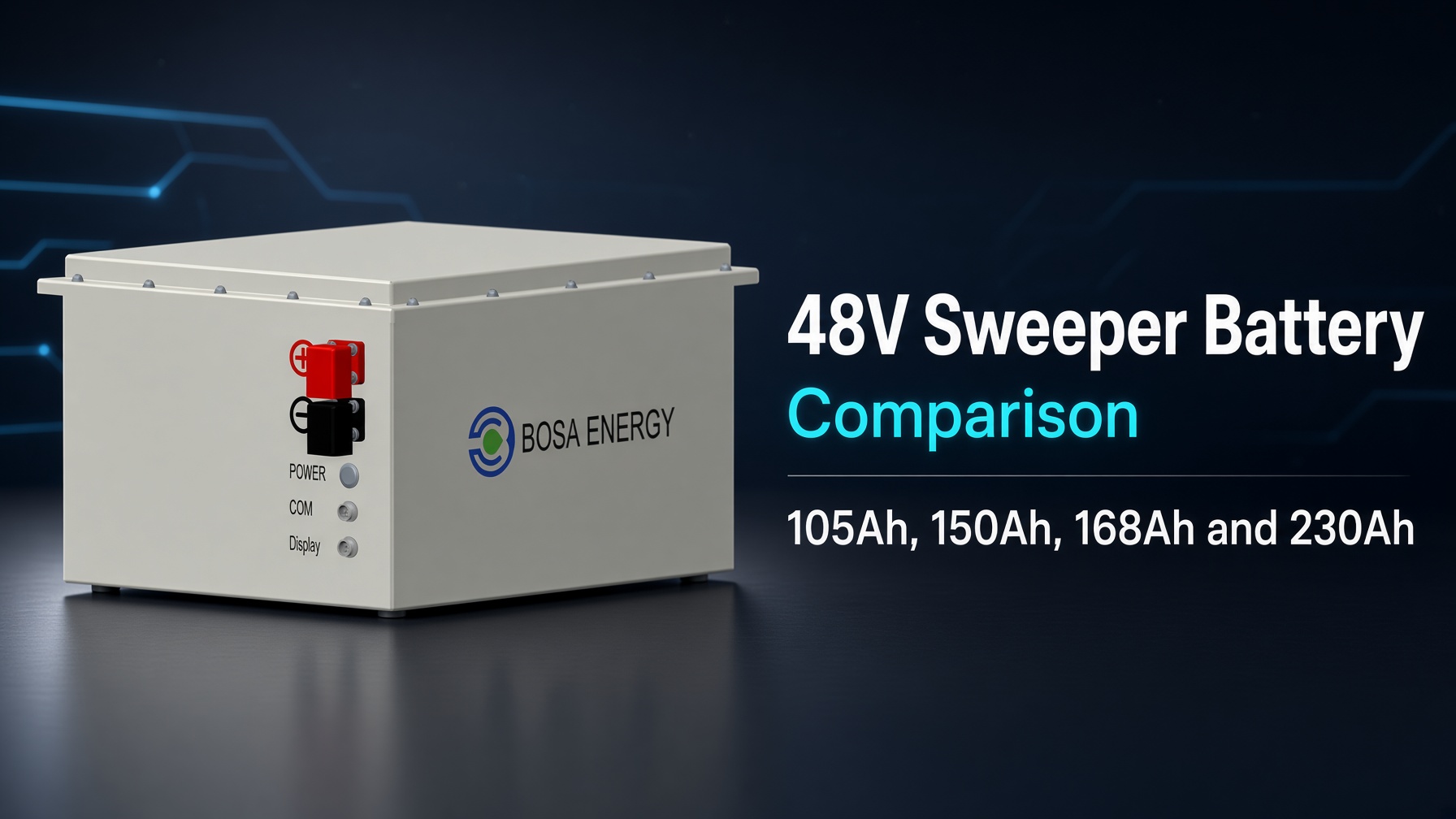
A 48V Sweeper Battery Comparison: 105Ah, 150Ah, 168Ah and 230Ah collapses to four numbers a facility manager can take to a tray measurement.
| Metric | 105 Ah | 150 Ah | 168 Ah | 230 أمبير/ساعة |
|---|---|---|---|---|
| Stored / usable (80% DoD) | 5.38 / 4.30 kWh | 7.68 / 6.14 kWh | 8.60 / 6.88 kWh | 11.78 / 9.42 kWh |
| Step vs previous class | Baseline compact | +1.84 kWh usable | +0.74 kWh usable | +2.54 kWh usable |
| Typical mass class | ~95–120 lb | ~139–178 lb | ~154–180 lb | ~180–227 lb |
| Typical continuous current | 175–210 A | 180–250 A | 168–300 A | 205–300 A |
| Typical charger overnight | 15–25 A | 25–40 A | 30–50 A | 50 A |
| Lunch-window charger | 40–60 A | 50–80 A | 50–80 A | 80–100 A |
| Best fit | Compact indoor 48 V, 1.4–1.8 kW, mid-shift plug | Mid compact / utility-sweeper, 1.6–2.0 kW | Full single-shift 1.6–2.2 kW | Heavy-duty 48 V, 2.0–3.0 kW, weak or no mid-day plug |
| Not a fit | Two-shift municipal; 24/36 V OEM | 24/36 V OEM; 230 Ah tray already empty | Compact 105 Ah tray; 24/36 V OEM | Compact tray; HV municipal 55–137 kWh |
150 Ah and 168 Ah are close on paper. The 18 Ah gap is 0.74 kWh usable — about 20–30 minutes at 1.8–2.2 kW. Buy 168 Ah when the tray already accepts that envelope and the logged week on 150 Ah ends near the 20–30% SOC floor. Buy 150 Ah when the tray is the slimmer golf/utility box and one opportunity charge already covers the shift.
Where each amp-hour class belongs
105 Ah — compact 48 V indoor and short yard loops. Warehouse aisles, light production floors, and dual-use 48 V utility carts with a sweeper deck. Average draw 1.4–1.8 kW. Plan a mid-shift plug or accept a 2.4–3.1 h cover.
150 Ah — the mid-compact step. Same platforms as 105 Ah when a logged week on 4.3 kWh usable ends below 20–30% SOC, or when broom + fan stay on for a longer single shift. Draw 1.6–2.0 kW. The Eco Battery 22 × 12.125 in box is often the drop-in that fits a 105 Ah tray better than a 31.5 in ROYPOW S51150P-AA.
168 Ah — full single-shift 48 V. Mid-size warehouse and yard sweepers that already exhaust 150 Ah, or flooded 48 V trays measured for the 24–29 in class envelope. Draw 1.6–2.2 kW. Trojan’s 171 Ah OnePack XR is the OEM-adjacent analog if the buyer wants a published 40.48–58.40 V window and a 4,000-cycle C/2 sheet.
230 Ah — heavy-duty 48 V with weak infrastructure. Outdoor loops, grade, wet debris, and machines that already empty a 168 Ah pack before the shift ends. Draw 2.0–3.0 kW. Not a substitute for a 55–80 kWh municipal compact.
Stay-flooded vs 105 vs 150 vs 168 vs 230 vs factory 24/36 V lithium
| Path | When it is rational | What you give up |
|---|---|---|
| Stay flooded 48 V | Single-shift indoor, watering discipline exists, pack still holds voltage under broom load | Watering labor, equalization, 30–50% usable, mid-life swap |
| 48 V 105 Ah LFP | Compact 48 V chassis, mid-shift plug available, tray matches ~21 × 13 × 9 in | Short cover without a plug |
| 48 V 150 Ah LFP | Logged week on 105 Ah ends low; tray accepts the 22–32 in class | Extra mass vs 105 Ah; confirm envelope before the PO |
| 48 V 168 Ah LFP | Full single shift at 1.6–2.2 kW; tray already in the 24–29 in class | Will not fit every compact 105 Ah box |
| 48 V 230 Ah LFP | 168 Ah still ends below 20–30% SOC; no reliable mid-day plug | Largest box and charger circuit; unused kWh if the log did not justify it |
| Factory 24/36 V OEM lithium | Tennant S16 / X16 SWEEP, Nilfisk SW3000, Hako 24 V riders | You stay on the OEM voltage. Do not force a 48 V pack |
Runtime model: kWh, motors, and opportunity charge
Use usable energy, not the Ah sticker. Hours ≈ usable kWh ÷ average kW.
| Average draw | 105 Ah (4.30 kWh) | 150 Ah (6.14 kWh) | 168 Ah (6.88 kWh) | 230 Ah (9.42 kWh) |
|---|---|---|---|---|
| 1.6 kW compact | ~2.7 h | ~3.8 h | ~4.3 h | ~5.9 h |
| 2.0 kW mid | ~2.2 h | ~3.1 h | ~3.4 h | ~4.7 h |
| 2.2 kW loaded | ~2.0 h | ~2.8 h | ~3.1 h | ~4.3 h |
| 2.4 kW heavy | ~1.8 h | ~2.6 h | ~2.9 h | ~3.9 h |
One 15–40% opportunity charge adds roughly 0.6–1.7 kWh on 105 Ah, 0.9–2.5 kWh on 150 Ah, 1.0–2.7 kWh on 168 Ah, and 1.4–3.8 kWh on 230 Ah. That is the difference between a four-hour cover and an eight-hour cover on the mid and heavy classes. Keep operating SOC above 20–30%. Do not plan a two-shift municipal street route on any of these four packs.
Tray, mass, current, and ballast
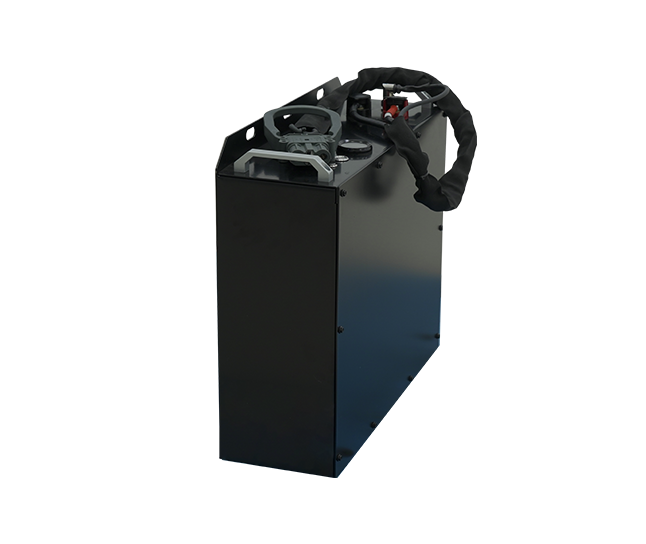
- Flooded 48 V trays often carry 300–500 lb of lead. Lithium in these classes is 95–227 lb. Check hopper-dump stability and steering ballast before the first loaded aisle.
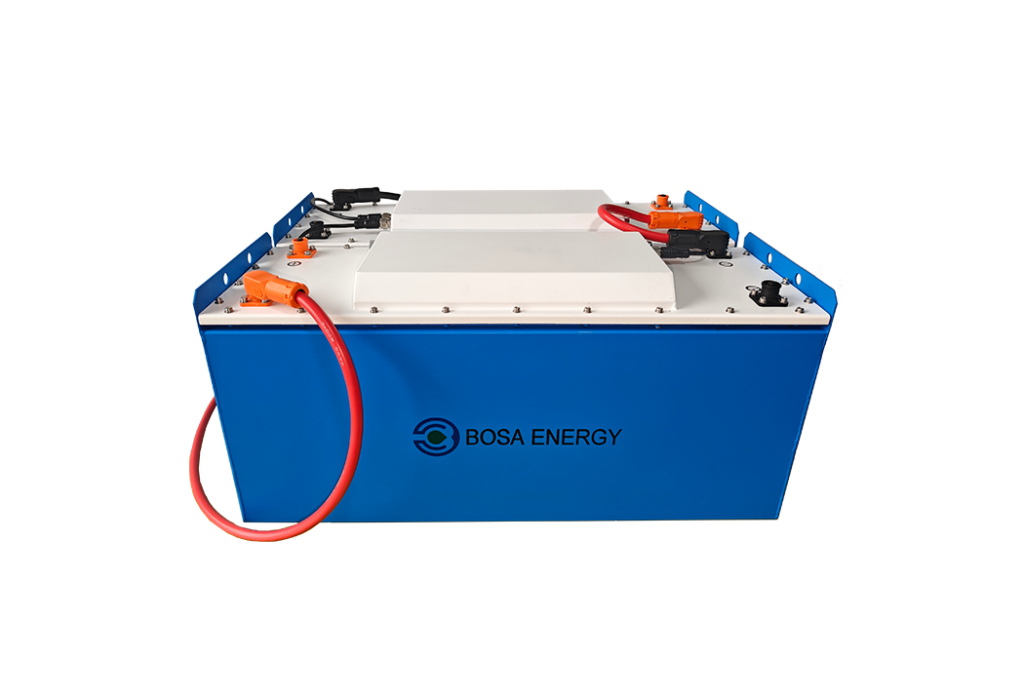
- Envelope is not interchangeable. A 21.4 × 12.6 in OnePack 105 Ah will not automatically accept a 31.5 in ROYPOW 150 Ah or a 27.8 in BSLBATT 230 Ah. Measure steel, hold-downs, and terminal reach.
- Continuous current must cover drive + broom + fan, not only the traction motor. Compact 48 V machines often sit at 40–80 A average and 150–250 A peaks when the main broom and fan start together. Size the BMS at or above the measured peak, with headroom.
- Hold-downs, terminal reach, and a 12 V accessory converter (lights, beacon, radio) belong on the same drawing.
Charging each energy class
Specify the charger before the pack. A flooded taper charger is the wrong algorithm and the wrong cutoff.
| Class | Overnight lithium charger | Lunch-window (15–40%) | Circuit note |
|---|---|---|---|
| 105 Ah | 15–25 A at 58.4 V (~5–7 h) | 40–60 A | ~0.9–1.5 kW overnight; ~2.3–3.5 kW lunch |
| 150 Ah | 25–40 A (~4–6 h) | 50–80 A | ~1.5–2.3 kW overnight; ~2.9–4.7 kW lunch |
| 168 Ah | 30–50 A (~4–6 h) | 50–80 A | ~1.8–2.9 kW overnight |
| 230 أمبير/ساعة | 50 A (~5–6 h) | 80–100 A | ~2.9 kW overnight; ~4.7–5.8 kW lunch |
Charge cutoff at 0 °C unless the pack has a documented heater. Trojan OnePack charge current falls to 0 A below 32 °F; apply the same rule unless the sheet lists a pad. First charge to 100% on the matched charger before the first loaded aisle.
A 48V Sweeper Battery Comparison: 105Ah, 150Ah, 168Ah and 230Ah that ignores the building circuit will strand the larger packs. Confirm breaker, receptacle, and cable gauge before ordering 80–100 A hardware.
Install sequence
- Identify the platform voltage. 24 V, 36 V, or 48 V. If it is not 48 V, stop and use the OEM lithium kit.
- Read the controller continuous and peak current, broom and fan motor ratings, and existing charger model.
- Measure the tray and hold-downs. Compare to the published envelope for the class you intend to buy — not the class below it.
- Confirm the voltage window. Pack 40–58.4 V must sit inside the controller and charger tolerance.
- Size energy from a logged week, not a brochure hour claim. Average kW × hours × 1.1–1.2.
- Specify the lithium charger first. Dedicated circuit, lithium algorithm, current that can add 15–40% in a lunch window if the duty cycle needs it.
- Pull the old pack. Isolate the key, chock the wheels, support the hood or seat. Follow site lockout.
- Set the new pack, torque terminals to the datasheet, fit any 12 V converter the accessories need, add ballast if flooded mass was removed, and mount the SOC display where the operator can see it without leaving the seat.
- First charge to 100% on the matched charger before the first loaded aisle. Update BMS firmware if the vendor ships it.
- Pilot one machine for two weeks. Log SOC at the start and end of each shift, peak current, limp-mode events, and hopper-dump stability. Copy the spec only after the pilot stays above 20–30% SOC with margin.
Selection checklist
- Machine is native 48 V, or the retrofit is documented for that 48 V controller.
- Chemistry is LiFePO₄, ≥3,500 cycles at 80% DoD.
- Published working window 40–58.4 V (or the OEM 48 V window).
- Continuous discharge ≥ measured drive + broom + fan current.
- Envelope measured against the actual tray for that Ah class.
- Ballast plan if flooded mass is removed.
- Matched lithium charger on a dedicated circuit; opportunity charging 15–40% planned.
- Operating SOC policy: stay above 20–30%.
- IP65 minimum, IP67 preferred.
- Warranty in writing (years and/or MWh), same coverage on the charger.
- Pilot machine before a fleet buy.