
Defining the Mining Truck Duty Cycle
Mining truck duty cycles differ fundamentally from on-road or warehouse applications:
- High power density requirements during loaded uphill segments (often multi-megawatt peaks).
- Frequent shallow-to-moderate depth-of-discharge (DoD) cycles rather than full daily discharges.
- Significant regenerative energy recovery on downhill runs, which can partially or fully offset energy used on the empty return in favourable profiles.
- Near-continuous operation across multiple shifts with limited stationary downtime.
- Harsh environmental exposure — high ambient temperatures (e.g., Pilbara), dust, vibration, and mechanical shock.
In conventional diesel trucks, the fuel tank provides 12–24 hours of autonomy. Battery-electric designs cannot match this energy density, so the battery must be sized and managed around the actual duty cycle and the chosen energy-replenishment method (static opportunity charging, battery swapping, trolley assist, or dynamic charging).
How Duty Cycles Drive Battery Design Choices
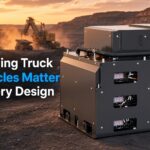
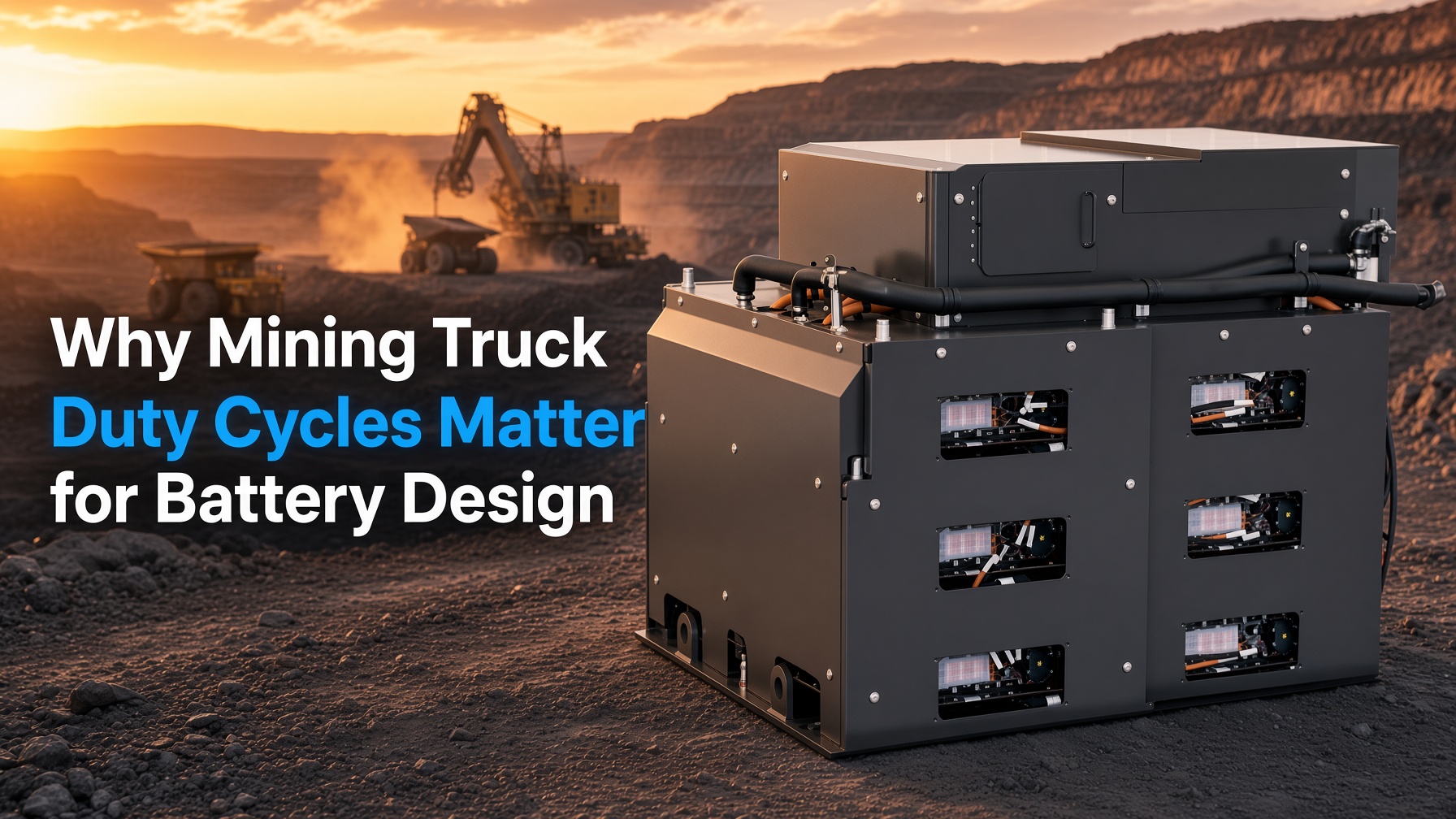
Why Mining Truck Duty Cycles Matter for Battery Design becomes clear when examining five primary engineering dimensions.
1. Energy Capacity and Usable Window
Battery energy is determined by the energy required per cycle minus recovered regeneration, multiplied by the number of cycles between charging opportunities, then adjusted for efficiency losses, degradation reserve, and a usable SoC window (commonly 20–80 % or tighter for longevity).
Real-world examples show that a 564 kWh LFP pack on a 240-tonne-class truck can support productive operation when regenerative braking and opportunity or dynamic charging are properly integrated. Oversizing increases weight and reduces payload; undersizing forces more frequent stops and lowers duty-cycle availability.
2. Power Capability and C-Rate
Loaded climbs demand high continuous and peak discharge power. Regenerative braking on steep descents requires high charge acceptance. Battery design must therefore prioritise cells and modules with strong power density and a robust Battery Management System (BMS) capable of managing rapid power reversals without excessive heat or cell imbalance.
3. Cycle Life and Depth of Discharge
Mining trucks accumulate a high number of cycles. Shallow DoD cycles (enabled by frequent top-ups or strong regeneration) dramatically extend calendar and cycle life compared with deep discharges. Lithium iron phosphate (LFP) chemistry is preferred because it routinely delivers ≥3,500–5,000 cycles at moderate DoD while offering superior thermal stability in high-ambient environments.
4. Thermal Management
Continuous high-power operation plus elevated ambient temperatures generate substantial heat. Effective liquid cooling, cell-level temperature monitoring, and conservative operating windows are mandatory. Duty-cycle simulation is used to size the thermal management system so that cell temperatures remain within the optimal band that maximises both performance and life.
5. Integration with Charging Philosophy
The duty cycle dictates whether the battery is designed primarily for:
- High-capacity stationary opportunity charging,
- Frequent battery swapping,
- Trolley-assist dynamic charging on grades, or
- Full dynamic charging while moving.
Each approach changes the required on-board energy, C-rate capability, and mechanical packaging.
Comparison of Battery Design Priorities by Duty-Cycle Characteristic
| Duty-Cycle Factor | Primary Battery Impact | Preferred Design Response | Typical 2026 Metric / Example |
|---|---|---|---|
| Loaded uphill power demand | Peak & continuous discharge power | High power-density cells + robust BMS | Multi-MW capability matched to motor output |
| Downhill regeneration | Charge acceptance & energy recovery | High regen current limit, efficient inverter | Can enable near-continuous operation |
| Cycle frequency & shift length | Cycle life & usable SoC window | LFP chemistry, shallow DoD (target 20–60 %) | ≥3,500 cycles at 80 % DoD rating |
| Ambient temperature extremes | Thermal management & safety | Liquid cooling, wide-temperature LFP cells | Operable in Pilbara conditions |
| Charging opportunity window | Energy capacity vs downtime | Right-sized pack + compatible charging interface | 564 kWh LFP (Cat 793 XE Early Learner) |
| Payload sensitivity | Battery mass & packaging | High energy density within safety constraints | Minimise mass to protect payload |
Real-World Validation: 2026 Pilbara Trials
In June 2026, BHP, Rio Tinto and Caterpillar advanced the trial of two Cat 793 XE Early Learner battery-electric haul trucks at the Jimblebar iron ore mine. The trucks, each equipped with a 564 kWh lithium iron phosphate battery pack and 480 kW electric motor output, had already accumulated more than 100 operating hours and completed over 200 test laps.
Initial testing focused precisely on the parameters that define Why Mining Truck Duty Cycles Matter for Battery Design: battery performance across repeated charge-discharge cycles, energy consumption per haul cycle, regenerative recovery efficiency, and suitability of charging infrastructure under real Pilbara conditions. The next phase evaluates dynamic charging systems that can replenish energy while the truck is in motion — a direct response to the continuous-duty nature of mining haulage.
These trials confirm that successful battery design is inseparable from accurate duty-cycle characterisation.
Selection Criteria and Practical Checklist
When evaluating or specifying a battery system for mining trucks, prioritise the following:
- Measured or simulated duty-cycle data — energy and power profiles for the specific haul roads, not generic figures.
- Chemistry matched to environment and cycle life — LFP for thermal stability and longevity in continuous heavy-duty use.
- Usable energy window — design for controlled SoC operation (typically avoid deep discharges below 20–30 % and prolonged 100 % SoC).
- Power and regen capability — verified continuous and peak ratings under the expected grade and payload.
- Thermal system capacity — proven under the highest ambient and continuous load conditions of the site.
- Certification and safety — compliance with IEC 62619 (industrial lithium batteries) and UL 2580 (electric vehicle batteries) or equivalent.
- Charging interface compatibility — static, trolley, or dynamic systems that match the planned energy-replenishment strategy.
- BMS sophistication — accurate SoC/SOH estimation, cell balancing, and predictive thermal management under mining duty cycles.
- Mass and packaging — impact on payload and centre of gravity.
- Total cost of ownership modelling — battery replacement interval, energy cost, and productivity impact over the truck life.