

What does VDA mean? In the automotive and lithium-battery industries, VDA most commonly stands for Verband der Automobilindustrie — the German Association of the Automotive Industry. This organization defines dimensional, quality, and safety frameworks that continue to shape prismatic battery modules, pack integration, and electromobility supply chains in 2026.
For battery pack designers, EV OEMs, commercial-vehicle manufacturers, and industrial energy-storage integrators, understanding what does VDA mean is essential when specifying interchangeable lithium-ion modules. The VDA framework underpins the widely adopted VDA355 footprint and related quality-management systems that remain high-volume solutions across passenger cars, commercial vehicles, and stationary storage.
Primary Definition: Verband der Automobilindustrie
The Verband der Automobilindustrie e.V. (VDA) is the leading trade association representing German automobile manufacturers and component suppliers. Founded in 1901 and headquartered in Berlin, it unites more than 600 members, including major OEMs such as BMW, Mercedes-Benz, and Volkswagen Group together with a broad base of Tier-1 and Tier-2 suppliers.
Core functions include:
- Political advocacy at national and European levels
- Development and publication of technical recommendations and quality standards
- Organization of the International Motor Show (IAA)
- Promotion of electromobility, battery safety, and sustainable raw-material supply chains
Official resources are maintained at the VDA website.
VDA and Lithium Battery Module Standards
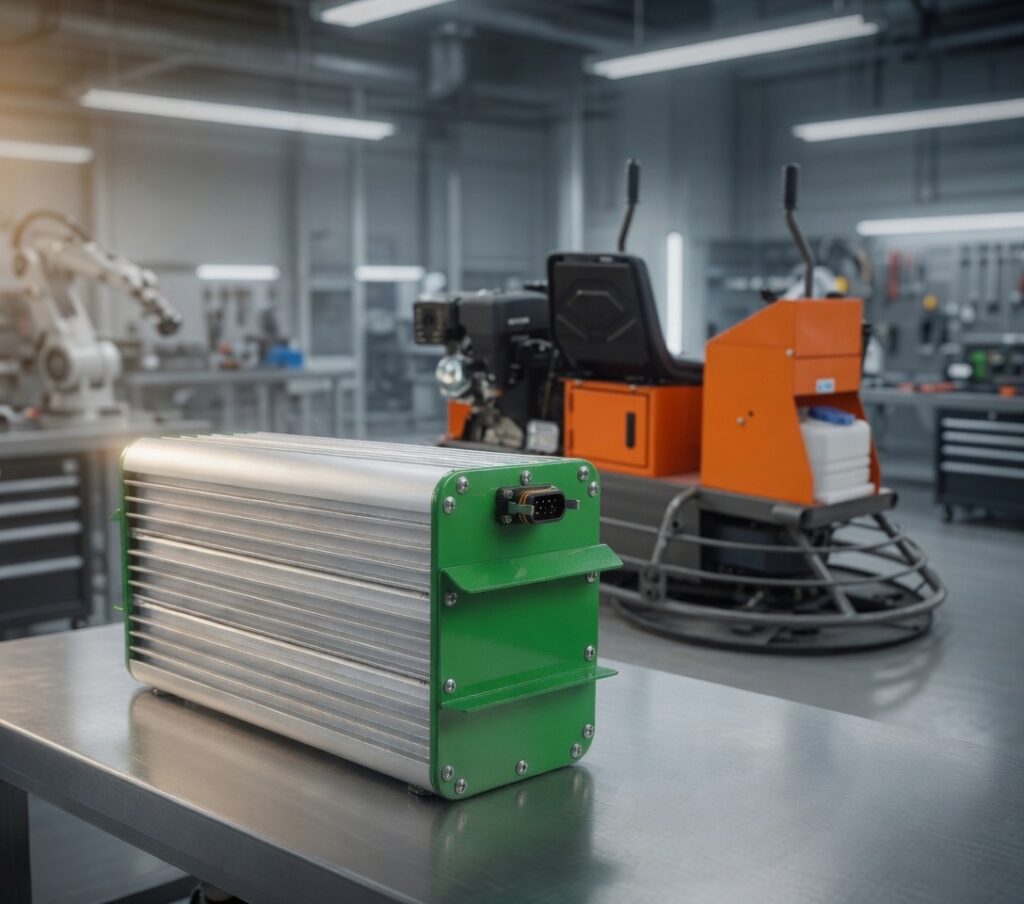
One of the most practical answers to what does VDA mean for battery engineers is the set of dimensional and interface guidelines that produced the VDA355 module family (and related formats such as VDA390 and VDA590).
VDA355 Module Overview
The VDA355 standard defines a modular prismatic lithium-ion battery envelope with typical external dimensions of:
- Length: 355 mm
- Width: 151–152 mm
- Height: 108–109 mm
Introduced around 2012, the format enables interchangeability among cell and module suppliers, lowers development cost, and simplifies vehicle integration and after-sales service. It originated in Volkswagen Group platforms and later became widely adopted in both European and Chinese new-energy vehicle markets.
Representative configurations in current production include:
| Configuration | Scheikunde | Nominale spanning | Typische capaciteit | Nominal Energy | Approx. Weight |
|---|---|---|---|---|---|
| 1P4S | LFP | 12.8 V | 135 Ah | ~1.73 kWh | 11.6 kg |
| 1P6S / 2P6S | NCM | 22.2 V | 100–122 Ah | ~2.2–2.7 kWh | 11–12 kg |
| 3P4S | NCM | 14.7 V | 153–174 Ah | ~2.3–2.55 kWh | 11–12.2 kg |
| 1P12S | NCM | 44.4 V | 50–58 Ah | ~2.5 kWh | ~11 kg |
These modules support natural or liquid cooling and are used in passenger EVs, commercial vehicles, industrial equipment, marine applications, and stationary energy storage. LiFePO₄ (LFP) variants are frequently selected for cycle life ≥3,500–5,000 cycles at 80 % depth of discharge, supporting opportunity-charging strategies that keep state of charge (SOC) above 20–30 %.
VDA recommendations also address battery-system testing, electrical power supply for automated driving (VDA 450), quality-management systems (VDA 6.x series), and battery state-of-health metrics. Under Euro 7 and GTR 22, disclosure of State of Certified Energy (SOCE) becomes mandatory for new vehicle types from 29 November 2026.
Why VDA Standards Matter in 2026
Measurable benefits continue to drive adoption:
- Supply-chain flexibility — Standardized footprints allow multiple cell suppliers to compete on the same mechanical interface.
- Reduced engineering cost — Pack designers reuse validated module designs across platforms.
- After-sales serviceability — Common dimensions simplify module replacement and inventory.
- Regulatory alignment — VDA positions on SOCE/SOCR influence European transparency requirements for used EVs and battery passports.
In July 2026 the share of electric vehicles in the German passenger-car market reached 41 %, underscoring the ongoing relevance of robust, standardized battery systems supported by the VDA.
Decision Checklist: Evaluating VDA-Compliant Battery Modules
When specifying or sourcing modules, confirm:
- External dimensions fall within 355 ± 1–2 mm × 151–152 mm × 108–109 mm
- Cell chemistry (LFP preferred for cycle life ≥ 3,500–5,000 cycles at 80 % DoD and opportunity-charging compatibility; NCM for higher energy density)
- Continuous and pulse current ratings match the application duty cycle
- Cooling interface compatibility (natural, air, or liquid)
- BMS communication protocol and voltage-sensing accuracy
- Relevant certifications (IEC 62619, UL 2580, or regional equivalents)
- Traceability and quality management aligned with VDA 6.x principles