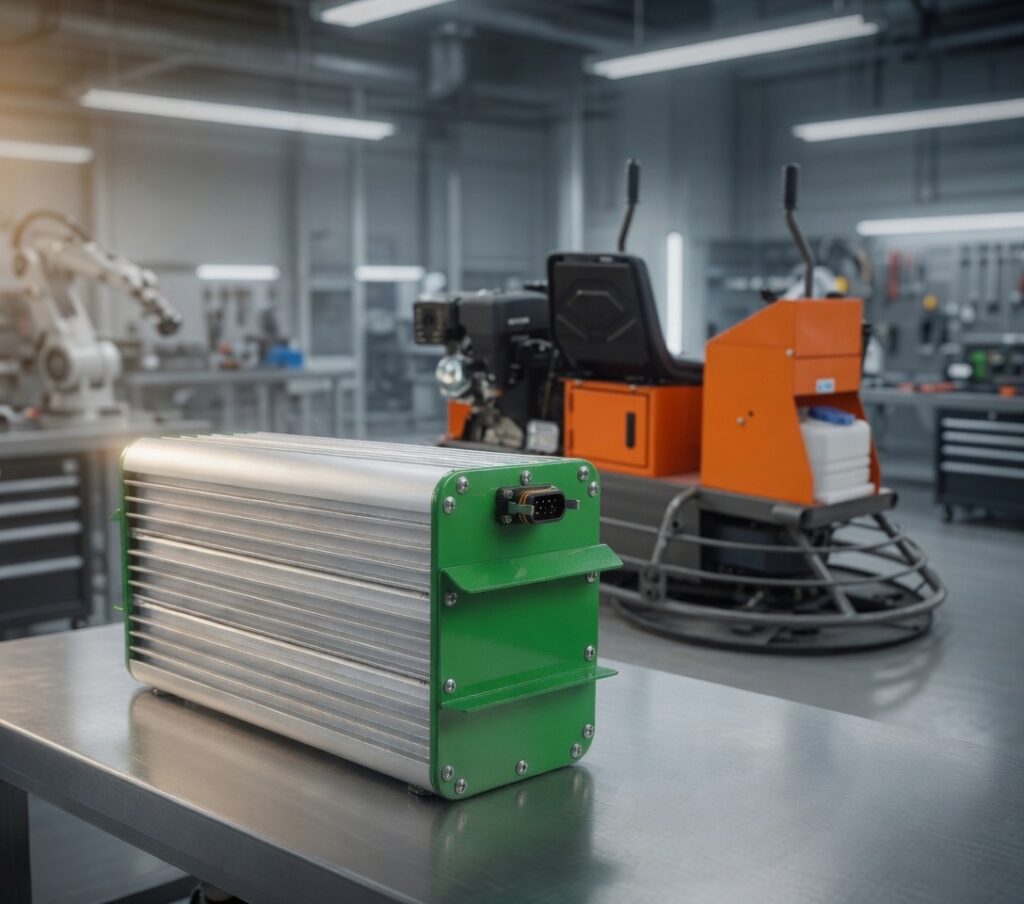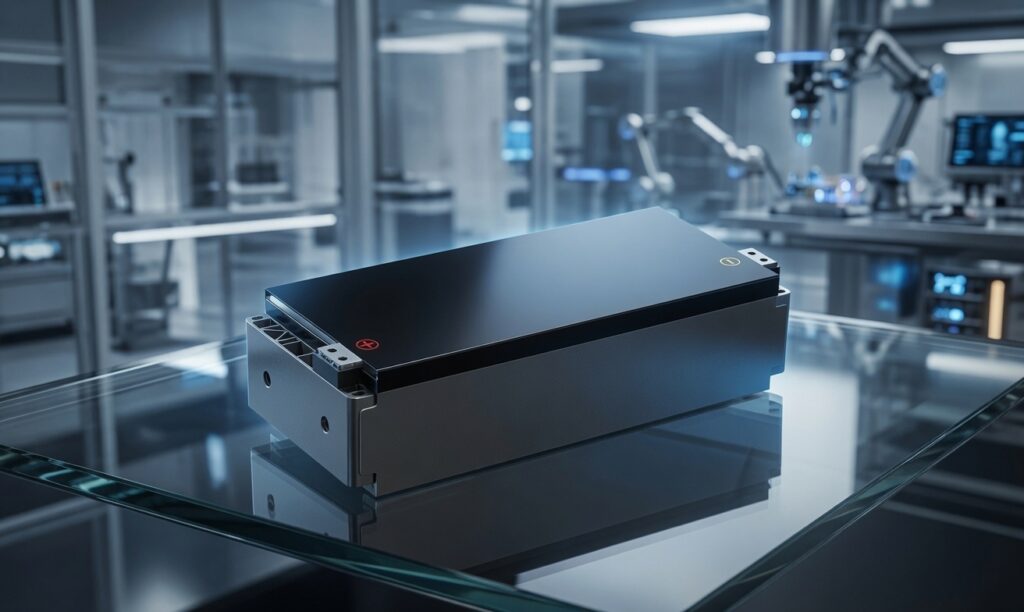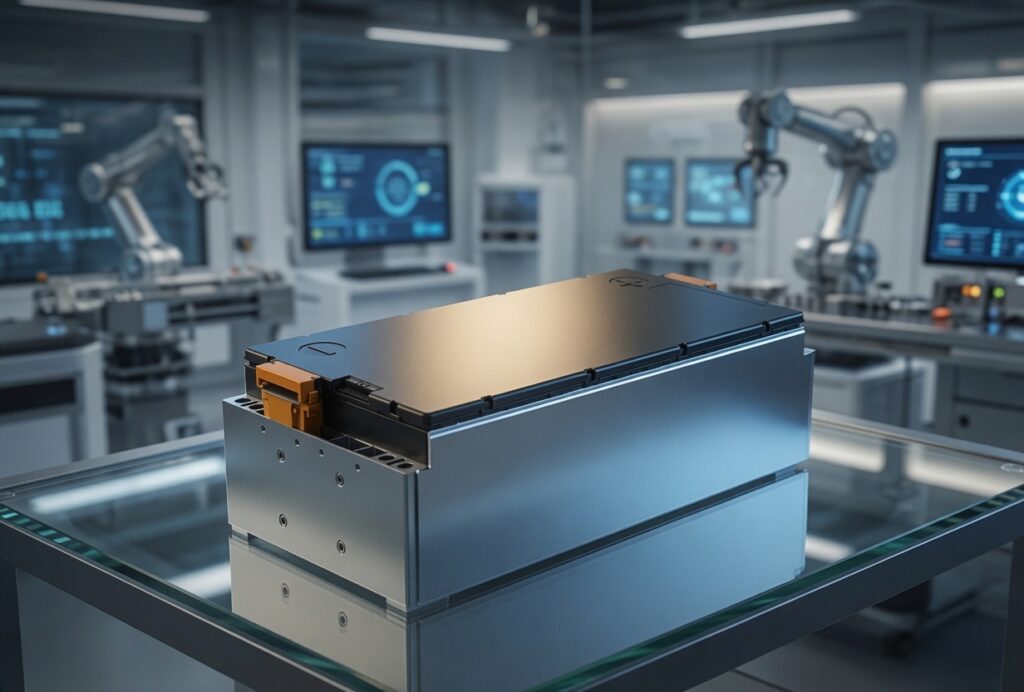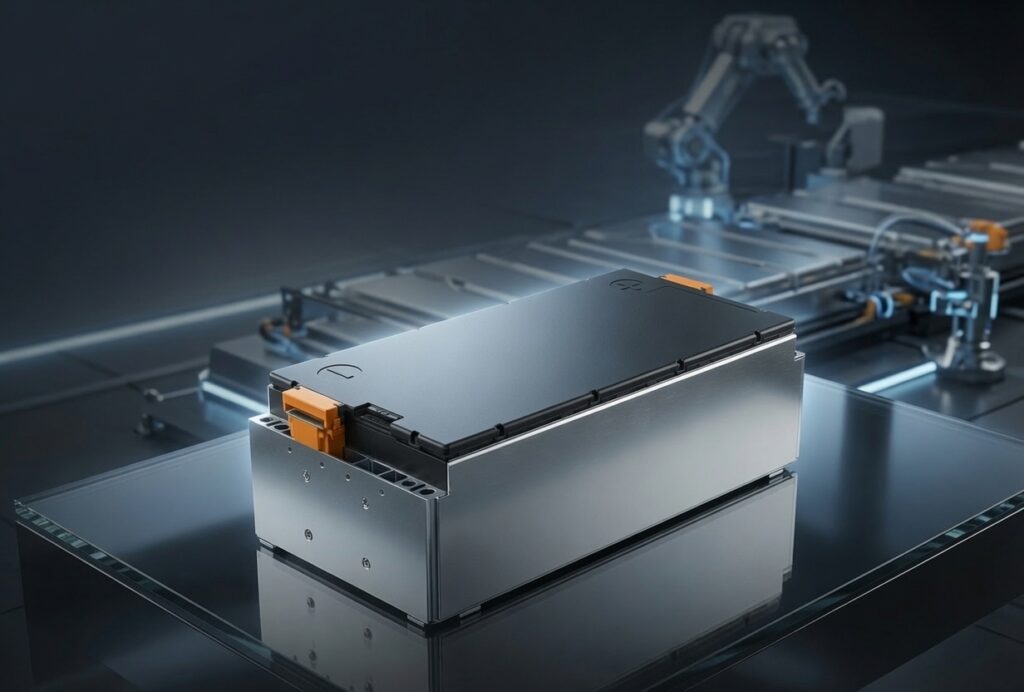

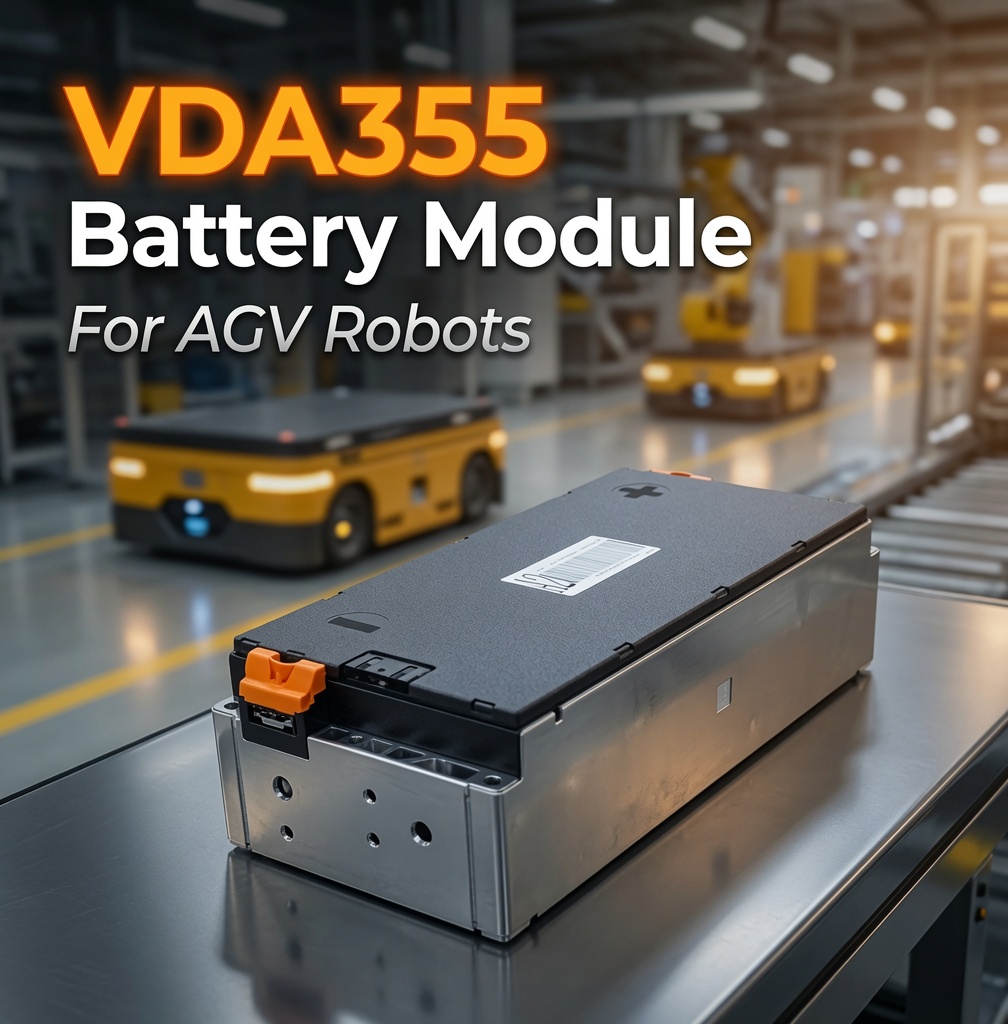
De VDA355 Battery Module has become one of the most reliable and versatile power solutions for modern industrial automation. Designed originally to automotive-grade standards, this standardized lithium-ion module delivers the perfect combination of high energy density, compact size, robust construction, and long service life — making it an outstanding choice for AGV battery modules En AMR battery modules.
As warehouses, factories, and logistics centers deploy larger fleets of Automated Guided Vehicles (AGVs) and Autonomous Mobile Robots (AMRs), operators need batteries that maximize uptime, minimize maintenance, and support fast opportunity charging. The VDA355 meets these demands exceptionally well.
What is the VDA355 Battery Module?
The VDA355 is a standardized lithium-ion battery module format developed by the German Association of the Automotive Industry (VDA — Verband der Automobilindustrie). The “355” refers to its nominal length of approximately 355 mm.
Typical dimensions: 355 × 151–152 × 108–108.5 mm Gewicht: 11–11.6 kg per module
These modules are available in multiple configurations (1P12S, 2P6S, 3P4S, 4P3S, etc.) and chemistries, primarily NMC (Nickel Manganese Cobalt) for higher energy density and LFP (Lithium Iron Phosphate) for enhanced safety and cycle life.
Because of their standardized dimensions and interfaces, VDA355 modules offer excellent interchangeability, simplified pack design, and lower total cost of ownership across electric vehicles, energy storage, and industrial robotics.
AGV Battery Module: Why VDA355 Excels in Automated Guided Vehicles
AGVs typically follow fixed or semi-fixed paths and operate continuously in structured environments. An effective AGV battery module must deliver consistent power under varying loads, withstand floor vibrations, support rapid charging, and maintain safety around personnel and goods.
Key advantages of the VDA355 as an AGV battery module:
- Vibration and shock resistance — Automotive-derived mechanical design with reinforced housings and anti-loosening structures.
- High energy density — More runtime per charge or lighter weight for the same capacity compared with legacy technologies.
- Modular scalability — Easily combine modules to achieve common AGV system voltages (24V and 48V are most popular) and required capacity.
- Opportunity and fast charging support — High charge-rate capability reduces downtime during short idle periods.
- Long cycle life — Typically 1,200–2,000+ cycles, significantly outlasting traditional batteries.
- Onderhoudsvrije werking — No watering, no equalization, no acid spills.
AMR Battery Module: Powering Next-Generation Autonomous Mobile Robots
AMRs navigate dynamically using LiDAR, cameras, and AI, constantly adapting to changing environments. This flexibility requires lightweight, high-performance batteries that do not compromise maneuverability or payload capacity.
The VDA355 is an ideal AMR battery module because:
- Its compact footprint fits easily into space-constrained robot chassis.
- Excellent power-to-weight ratio improves overall robot efficiency and battery runtime.
- High cycle life supports the intensive duty cycles typical of AMR fleets (often 24/7 operation).
- Proven thermal stability and safety features meet the stringent requirements of collaborative workspaces.
- Modular design allows rapid customization for different AMR models and payload classes.
Technical Specifications of VDA355 Battery Modules
Here are representative specifications drawn from production VDA355 modules:
| Parameter | Typical Values | Notities |
|---|---|---|
| Afmetingen (L×B×H) | 355 × 151–152 × 108–108.5 mm | Standardized |
| Gewicht | 11–11.6 kg | Per module |
| Configurations | 1P12S, 2P6S, 3P4S, 4P3S and others | Flexible voltage & capacity |
| Scheikunde | NMC or LFP | NMC = higher energy; LFP = higher safety |
| Nominal Voltage (examples) | 11.1V – 44.4V per module | Configurable to 24V / 48V packs |
| Energy per module | Up to ~2.35 kWh (NMC examples) | Depends on configuration |
| Levensduur van de cyclus | ≥1,200 cycles (up to 2,000+ under optimal conditions) | 25°C, typical DOD |
| Bedrijfstemperatuur | Wide range (e.g., discharge –20°C to +55°C) | Variant dependent |
| Key Features | Cooling gaps, vibration-resistant design, monitoring interfaces, high-strength enclosure | Automotive-grade |
These specifications make VDA355 modules excellent building blocks for custom AGV battery packs En AMR power systems.
VDA355 vs Traditional Lead-Acid Batteries for AGV & AMR Fleets
| Functie | Loodzuur | VDA355 Lithium Modules | Winnaar |
|---|---|---|---|
| Gewicht | Zwaar | 50–70% lighter for same energy | VDA355 |
| Oplaadtijd | 6–10+ hours | 1–3 hours or opportunity charging | VDA355 |
| Levensduur van de cyclus | 500–1,500 cycles | 1,200–2,000+ cycles | VDA355 |
| Onderhoud | Regelmatig water geven en controleren | Onderhoudsvrij | VDA355 |
| Energy Efficiency | 70–85% | 92–98% | VDA355 |
| Voltage Sag Under Load | Significant | Flat discharge curve | VDA355 |
| Safety & Environment | Acid risk, gassing | Sealed, stable, recyclable | VDA355 |
| Totale eigendomskosten | Higher long-term | Aanzienlijk lager | VDA355 |
Switching from lead-acid to VDA355 AGV battery modules or AMR battery modules typically delivers higher fleet availability, lower energy costs, and dramatically reduced maintenance.
Best Practices for Integrating VDA355 Modules into AGV and AMR Systems
Successful deployment involves several key considerations:
- Pack Architecture — Use series/parallel combinations of VDA355 modules to achieve target system voltage (commonly 24V or 48V) and desired runtime.
- Battery Management System (BMS) — Select a robust BMS with cell balancing, SOC/SOH monitoring, communication protocols (CAN, RS485, etc.), and full protection functions.
- Thermisch beheer — Utilize built-in cooling channels; add active cooling or heating for extreme environments.
- Mechanical Integration — Secure modules to handle continuous vibration; many designs include dedicated mounting points.
- Charging Strategy — Implement opportunity charging, fast DC chargers, or automated battery swapping tailored to lithium profiles.
- Validation & Compliance — Perform vibration, thermal, and safety testing; ensure compliance with relevant standards (UN38.3, IEC, etc.).
Working with experienced battery integrators ensures optimal performance and long-term reliability.
Frequently Asked Questions (FAQ)
What makes the VDA355 the best AGV battery module? Its standardized dimensions, automotive-grade durability, high energy density, vibration resistance, and modular flexibility make it ideal for continuous industrial operation with minimal downtime.
Can VDA355 modules be used as an AMR battery module? Yes. The compact size, lightweight construction, and excellent power characteristics make the VDA355 an outstanding AMR battery module for dynamic, sensor-rich autonomous robots.
What is the typical lifespan of a VDA355 battery module in AGV/AMR use? Most modules deliver 1,200–2,000+ cycles under normal industrial conditions, translating to 3–7+ years of service depending on depth of discharge, temperature control, and charging practices.
What voltages are commonly used with VDA355 modules in robotics? Modules are easily configured into popular 24V En 48V systems, as well as other custom voltages required by different AGV and AMR platforms.
Are VDA355 modules safe for human-robot collaborative environments? Yes. They feature reinforced enclosures, thermal stability (especially LFP variants), and integrate with advanced BMS that provide comprehensive protection against overcharge, over-discharge, short circuits, and excessive temperatures.
How does the total cost of ownership compare with lead-acid? Although the initial purchase price may be higher, VDA355 modules offer dramatically lower TCO through longer life, zero maintenance, higher efficiency, and increased productivity from reduced charging downtime.
Conclusion: Power Your AGV and AMR Fleet with Proven VDA355 Technology
De VDA355 Battery Module brings automotive-level engineering, standardization, and reliability to the world of industrial robotics. Whether you need a high-performance AGV battery module for fixed-path vehicles or a flexible AMR battery module for dynamic autonomous navigation, the VDA355 delivers superior runtime, safety, scalability, and long-term value.
As global supply chains accelerate their adoption of automation, choosing a proven, standardized battery platform like the VDA355 gives your operation a competitive advantage in uptime, safety, and total cost of ownership.
For tailored recommendations on VDA355 configurations, custom pack design, or integration support for your specific AGV or AMR fleet, consult with specialized lithium battery solution providers who have deep experience in both automotive-grade modules and industrial robotics applications.
Ready to upgrade your robot fleet? Contact a qualified battery engineering partner today to explore how VDA355 modules can transform the performance and economics of your AGV and AMR operations.