
Why the Decision Matters on the Ground in 2026
Emission zones, noise ordinances and indoor/night work restrictions continue to expand. Simultaneously, pack energy density, cycle life and price have reached commercial viability for 1–30 ton excavators.
Current production examples you will actually see on sites:
- Volvo EC230 Electric: 450 kWh, 600–650 V, indicative 7–8 h runtime
- Caterpillar 320 Electric: 387 kWh, 750 V
- JCB 19C-1E and similar compact class machines: 15–40 kWh range (typically ~19.8–20 kWh for a full 5-hour shift)
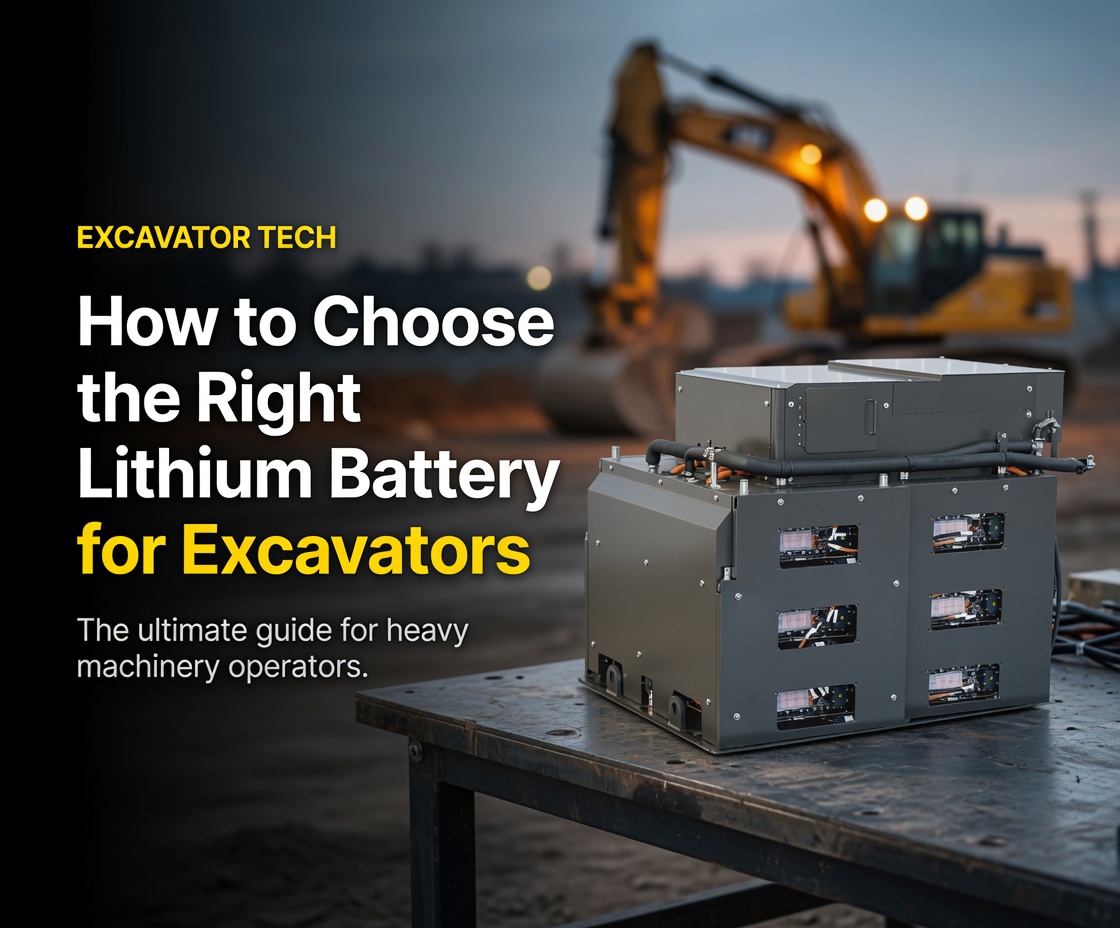
The technology is proven. The remaining variable is pack selection quality. Mastering How to Choose the Right Lithium Battery for Excavators is now a core equipment-specification skill for anyone responsible for uptime and operating cost.
Chemistry Selection: LFP Remains the Baseline
Lithium iron phosphate (LiFePO₄ / LFP) is the default chemistry for excavator traction packs in 2026 for quantifiable reasons:
- Thermal runaway threshold ≈ 270 °C (substantially higher than NMC)
- Documented cycle life ≥ 3,500–4,000 cycles at 80 % DoD under proper thermal management
- Superior tolerance to continuous vibration, shock and dust
- Lowest cost per cycle under multi-shift construction duty
- Usable temperature window of approximately –30 °C to +60 °C when active liquid cooling and heating are fitted
NMC is considered only when absolute energy density is the single overriding constraint (rare on excavators). LTO offers extreme cycle life and ultra-fast charge acceptance but at higher cost and lower energy density. For the overwhelming majority of applications, LFP delivers the best risk-adjusted outcome.
Capacity Sizing Against Real Duty Cycle
Incorrect capacity is the most common specification error you will see on sites that later complain about mid-shift power loss.
Required process:
- Measure actual kWh consumed over multiple representative shifts (do not rely solely on OEM “indicative” numbers).
- Apply 10–20 % margin for adverse soil, cold weather and incomplete opportunity charging.
- Size the pack so that end-of-shift state of charge remains above 20–30 % under the hardest duty.
- Account for regenerative energy recovery (typically 15–25 % of dig-cycle energy on modern machines).
- For multi-shift sites, design for 15–40 % capacity recovery during scheduled breaks rather than full overnight recharge only.
Practical example: a 20–25 ton excavator drawing 55–65 kWh in a productive 7-hour shift requires a usable pack in the 380–450 kWh range once margins are included. This matches the current Volvo EC230 Electric and Cat 320 Electric packs.
Voltage, Form Factor and Machine Integration
Voltage must match the machine’s traction and hydraulic motor architecture:
- Compact / mini excavators: 48–96 V systems (typical 15–40 kWh)
- Mid-size (15–25 ton): 600–750 V systems (350–450 kWh)
- Larger or hybrid machines: custom high-voltage packs integrated to OEM CANbus and power electronics
Form factor constraints are non-negotiable. The pack must occupy the space previously used by the diesel engine and cooling package without shifting centre of gravity or compromising counterweight balance. Vibration and shock loads on excavators exceed those of forklifts or trucks; mounting, busbar and cell restraint designs must be validated for continuous digging duty.
CANbus integration with the existing machine controller is mandatory so the operator receives accurate SOC, power-limit and thermal-derate information in the cab display. Modern telematics platforms that feed real-time pack data back to the fleet office further reduce the risk of unexpected mid-shift limits.
Thermal Management Requirements
Construction sites expose packs to ambient temperatures well outside laboratory conditions. Passive or basic air cooling will produce power derating or shutdown above ≈ 40 °C ambient or in sustained high-load dig cycles.
Minimum specification:
- Active liquid cooling for continuous dig duty
- Heating films or liquid heating for cold-start and winter operation
- IP67 (or higher) enclosure rating
- Cell-level temperature sensing with BMS authority to reduce power before limits are reached
These features are standard on current Volvo and Caterpillar electric excavators and should be treated as non-negotiable on any aftermarket or conversion pack.
Charging Architecture for Site Reality
- Overnight depot charging at moderate power remains the lowest-cost energy source.
- Opportunity charging (15–40 % capacity recovery during lunch or shift changes) is what keeps multi-shift machines productive.
- DC fast charging at 150–250 kW can move a mid-size pack from 20 % to 80 % SOC in approximately 60–90 minutes when site electrical infrastructure supports it.
Maintain pack SOC above 20–30 % whenever possible. Repeated deep discharges accelerate both calendar and cycle aging even with high-quality LFP cells. Modern BMS and telematics platforms make remote enforcement of this rule straightforward.
Total Cost of Ownership Framework
Capital cost of a quality lithium pack remains higher than a diesel powertrain or lead-acid starter battery. Payback is realised in three quantifiable areas:
- Energy cost — electricity is typically 50–70 % cheaper than diesel for equivalent work output.
- Maintenance — elimination of oil changes, fuel filters, DEF, exhaust aftertreatment and watering.
- Access and productivity — ability to operate indoors, at night, or inside low-emission zones closed to diesel machines.
For fleets operating ≥ 1,500 hours per year the crossover point commonly falls between year 2 and year 4. After that point the lithium machine continues to widen the advantage. Low-utilisation machines require site-specific modelling; the same pack that pays back rapidly on a two-shift urban site may not justify itself on seasonal rural work.