
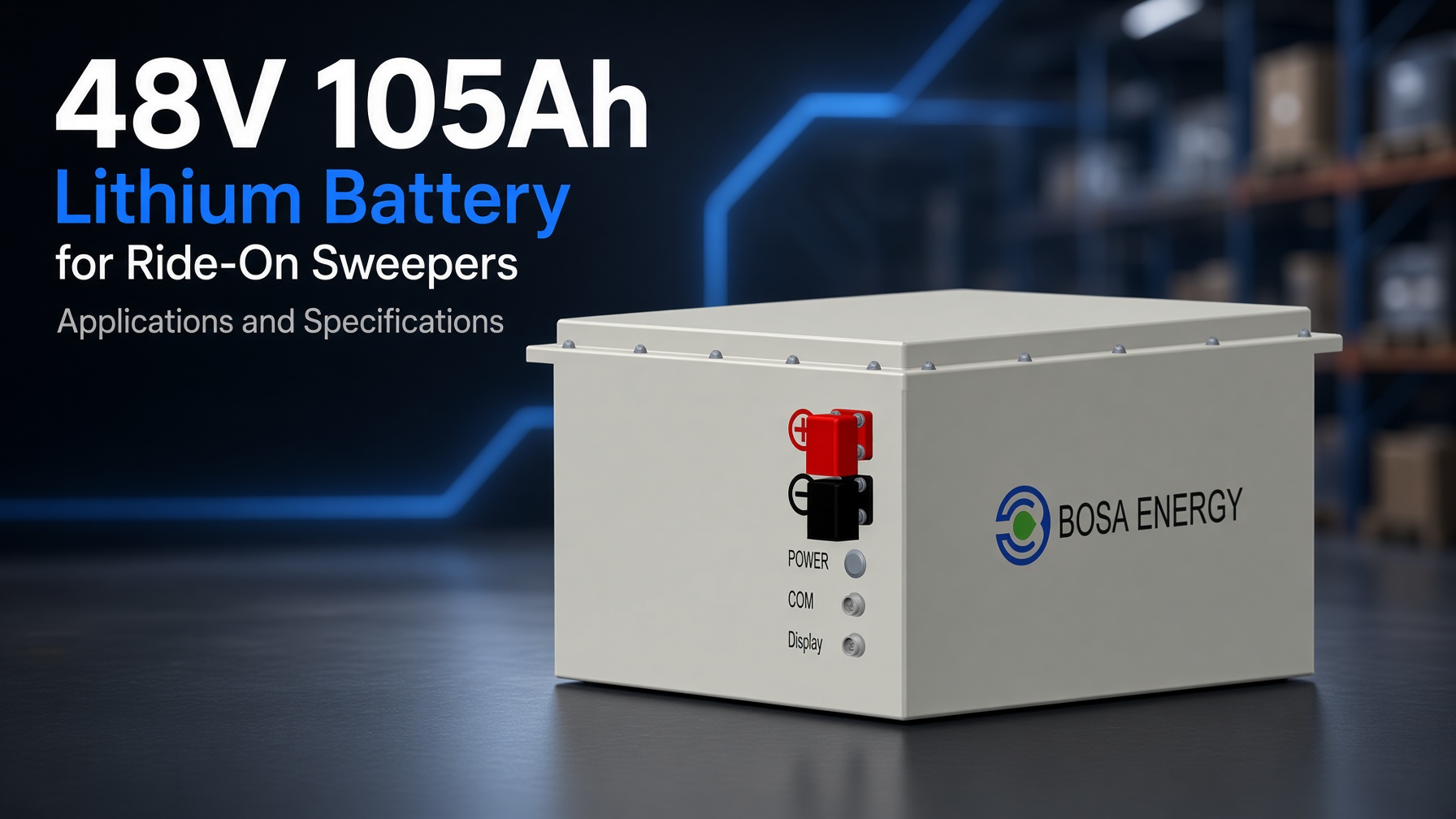
A 48V 105Ah Lithium Battery for Ride-On Sweepers: Applications and Specifications starts with the electrical class, not the brochure hour claim. At 51.2 V nominal a 16S LiFePO₄ string stores 5.376 kWh. Usable energy at 80% depth of discharge (DoD) is about 4.3 kWh. That pack fits compact 48 V ride-on sweepers, dual-use utility/sweeper platforms, and documented aftermarket trays. It does not drop into a 24 V or 36 V factory machine.
Key takeaways
- Specify LiFePO₄ packs rated at least 3,500 cycles at 80% DoD, with pack-level UL 2271 (light EV) or IEC 62619 (industrial cells/modules), UN 38.3 shipping, and a published 40–58.4 V working window on a 48 V platform.
- Factory 2026 ride-on sweepers from the major cleaning OEMs remain 24 V or 36 V: Tennant S16 is 36 V (240 / 360 Ah flooded or 4.1 / 8.2 / 12.2 kWh lithium); Tennant X16 SWEEP (7 April 2026) is 36 V / 320 Ah lithium with >6 h Eco runtime; Nilfisk SW3000 lithium is 24 V with three 50 Ah modules.
- A 48V 105Ah Lithium Battery for Ride-On Sweepers: Applications and Specifications belongs on native 48 V compact sweepers (warehouse and yard machines in the ~48 V / 100 Ah class), 48 V utility carts with sweeper decks, and flooded 48 V trays that have been measured for voltage window, current, and envelope.
- Opportunity charges of 15–40% of pack capacity between aisles or lunch windows are acceptable on lithium. Keep operating state of charge (SOC) above 20–30%.
- Platform match beats peak amp-hours. IEEE Spectrum’s 30 May 2026 review of drop-in motive packs put the rule in one sentence: design the lithium system around the electrical reality of the legacy platform, not the other way around.
Table of Contents
- What a 48 V 105 Ah sweeper pack actually is
- 2026 factory sweeper platforms set the voltage baseline
- Applications that justify 48 V / 105 Ah
- Stay-flooded vs 24/36 V OEM lithium vs 48 V 105 Ah
- Electrical specifications that matter on the floor
- Runtime model: kWh, motors, and opportunity charge
- Tray, mass, and ballast
- Charging a 5.4 kWh sweeper pack
- Safety and certification floor
- Install sequence
- Selection checklist
- Preguntas frecuentes
- Decision Framework
- Authoritative references
What a 48 V 105 Ah sweeper pack actually is
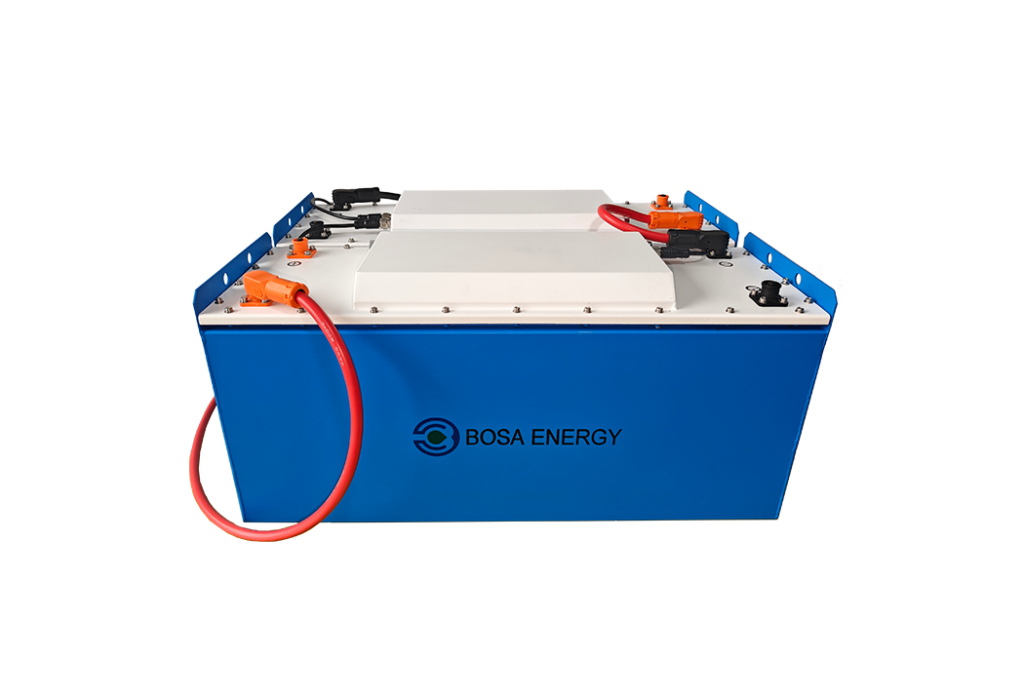
Nameplate “48 V” on a lithium sweeper pack is a system class, not the cell-string voltage. Production LiFePO₄ strings for this class are 16S. Nominal voltage is 51.2 V. Charge cutoff is 58.4 V. Discharge cutoff sits near 40 V. Energy is voltage × amp-hours:
51.2 V × 105 Ah = 5,376 Wh ≈ 5.38 kWh.
Usable energy at 80% DoD is about 4.3 kWh. That is the figure that should go into a runtime model, not the 105 Ah sticker.
IEEE Spectrum’s 30 May 2026 drop-in review used Trojan’s 48-volt, 105 ampere-hour OnePack as the documented reference: a 51.2 V LiFePO₄ system with a 40.48–58.40 V working window, 180 A continuous discharge, and 300 A pulse, calibrated to stay inside legacy 48 V controllers. That same window is the filter for a sweeper pack. A 200 A golf-cart BMS that ignores broom-motor inrush or a 36 V Tennant tray is the wrong box.
Representative 2026 48 V / 105 Ah envelopes:
| Pack | Energy / voltage window | Continuous / peak current | Envelope / mass | Cycle claim |
|---|---|---|---|---|
| Trojan OnePack 48 V 105 Ah (TR-48-110-M class) | 51.2 V, 105 Ah, 5.38 kWh; 40.48–58.40 V | 180 A cont.; 300 A / 30 s | 21.4 × 12.6 × 8.6 in; ~120 lb | Up to 4,000 cycles (IEEE Spectrum / Trojan 2026 briefing) |
| ROYPOW S51105L / S51105L-Z | 51.2 V, 105 Ah, 5.37–5.38 kWh; ~40–57.6 V | 100–200 A cont. class; 200 A / 10 s on the L-Z sheet | ~18.1 × 13.2 × 9.1–9.7 in; ~95 lb; IP66–IP67 | >3.500 ciclos |
| Eco Battery 51.2 V 105 Ah Skinny | 5,376 Wh; 43.2–58.4 V working | 175 A cont.; 300 A / 30 s; 500 A / 3 s | 22 × 9.75 × 10.43 in; 102.2 lb; IP67 | Industrial drop-in sheet |
| Renogy RBT48105LFP-GC | 51.2 V, 105 Ah, 5,376 Wh; 40–58.4 V | 210 A cont. class; 15–105 A charge | Golf-cart kit envelope | 5,000 cycles @ 80% DoD / 80% EOL (vendor) |
None of those SKUs is a Tennant, Nilfisk, or Hako factory sweeper pack. They are 16S motive modules sold into 48 V trays — golf, LSV, compact sweeper, and light industrial. Series connection is not supported. Parallel is listed on some Eco / golf-kit sheets only with the vendor harness.
A four-battery flooded 48 V set typically stores 150–210 Ah nameplate and delivers about half of that before voltage sag forces a recharge. The lithium pack’s usable energy is therefore closer to 1.3–1.8× a healthy flooded 48 V tray of similar physical size, not 105 ÷ 180.
2026 factory sweeper platforms set the voltage baseline
Darren Brittain, Trojan’s vice president of lithium commercial strategy for motive applications, stated the engineering filter in IEEE Spectrum on 30 May 2026: design the lithium system around the electrical reality of the legacy platform, rather than asking the vehicle to adapt to the battery. A 48 V 105 Ah aftermarket box that ignores that filter on a 36 V S16 is just an expensive warranty claim.
The 2026 factory ride-on sweeper anchors:
| Machine | System voltage | Battery option | Runtime / charge note |
|---|---|---|---|
| Tennant S16 compact ride-on | 36 V | Flooded 240 Ah / 360 Ah; lithium 4.1 kWh (110 Ah), 8.2 kWh (221 Ah), 12.2 kWh (331 Ah) | 3.9 h base / 6.5 h high-capacity / up to 8.5 h on 12.2 kWh Li; 67 dBA; 1.2 kW AC drive, 0.6 kW fan |
| Tennant X16 SWEEP (launched 7 April 2026) | 36 V | Lithium-ion 36 V, 320 Ah | >6 h Eco autonomous; onboard / X16 CHRG dock 1,200 W; fast off-board 3,200 W |
| Nilfisk SW3000 lithium | 24 V | 3 × 25.6 V 50 Ah Li-ion | Up to 4 h; Li pack draws 823 W vs 948 W flooded; 5-year / 1,500-cycle battery path on the ACE kit |
| Compact 48 V warehouse sweeper class (e.g. Lvtong LT-S2050SF type) | 48 V | 48 V / 100 Ah lithium | 3–4 h work; 2.2 kW drive; 48 V 25 A lithium charger, 4–7 h full charge |
The lesson is mechanical: match voltage first. A 48V 105Ah Lithium Battery for Ride-On Sweepers: Applications and Specifications is a 48 V specification. It is not a universal “lithium upgrade” for every ride-on sweeper on the floor.
Applications that justify 48 V / 105 Ah
Use the 5.38 kWh class when the machine is already 48 V, or when a new compact sweeper is specified that way.
Indoor warehouse and logistics docks. Compact 48 V ride-on sweepers with 1.8–2.2 m paths and 150 L hoppers. Average working draw of 1.2–1.8 kW gives 2.5–3.5 h on 4.3 kWh usable. Opportunity charge of 15–40% at the dock office extends that to a single-shift cover.
Outdoor yards, parking structures, and campus loops. Dust, water, and temperature swing. Specify IP65 minimum, IP67 preferred, and a charge cutoff at 0 °C. 105 Ah is enough for a morning loop plus a lunch plug; it is not a diesel replacement for an eight-hour municipal street sweeper (those platforms sit at 55–137 kWh and 400 V-class packs).
Dual-use 48 V utility / sweeper decks. Property-maintenance carts and light GSE that already run a 48 V controller and pick up a sweeper attachment. The Trojan OnePack 105 Ah window (40.48–58.40 V, 180 A continuous) is the documented drop-in reference for that electrical class.
Documented flooded-to-lithium retrofit on a native 48 V sweeper. Only after the tray, controller continuous rating, regen path, and charger circuit have been measured. Do not place this pack in a 36 V Tennant or 24 V Nilfisk tray.
Who should not specify 105 Ah at 48 V. Operators of Tennant S16 / S20 / X16, Nilfisk SW3000 / SW5500 battery versions, or any factory 36 V lithium kit. Buy the OEM pack. Operators who finish a logged week below 20% SOC on 105 Ah should move to 160–210 Ah at the same voltage, not force a second parallel box into a tray that cannot hold it.
Stay-flooded vs 24/36 V OEM lithium vs 48 V 105 Ah
| Criterion | Stay flooded (24/36/48 V) | Factory 24/36 V lithium (Tennant / Nilfisk path) | 48 V 105 Ah LiFePO₄ pack |
|---|---|---|---|
| Usable energy | ~50% of nameplate before sag | OEM-rated kWh (S16 4.1–12.2 kWh; X16 36 V 320 Ah) | ~4.3 kWh at 80% DoD |
| Ciclo de vida | 800–1,500 typical | OEM sheet (Nilfisk ACE 1,500-cycle / 5-year path; Tennant lithium kits) | ≥3,500 at 80% DoD; 4,000 on Trojan OnePack class |
| Mid-shift charge | Damages plates | Designed for opportunity charge | 15–40% opportunity charge is normal |
| Watering / room | Weekly water; spill risk | Ninguno | Ninguno |
| Mass in tray | 150–300+ kg typical 36 V set | OEM pack + ballast as specified | ~43–55 kg pack; confirm ballast |
| Warranty / support | Battery vendor only | Machine + pack from one OEM | Pack vendor; machine warranty may void if undocumented |
| Correct when | Single shift, existing chargers, no lithium budget | The machine is already that OEM platform | The sweeper is native 48 V or a measured 48 V retrofit |
Electrical specifications that matter on the floor
Write these numbers into the bid, not “48 V lithium.”
| Parámetro | Spec to require | Why it matters on a sweeper |
|---|---|---|
| Química | LiFePO₄, 16S | Flat voltage, thermal stability, cycle life |
| Nominal / charge / cutoff | 51.2 V / 58.4 V / ~40 V | Must sit inside the 48 V controller window |
| Energía | 5.38 kWh nameplate; model 4.3 kWh usable | Runtime is kWh ÷ average kW, not Ah ÷ mystery current |
| Continuous discharge | ≥ drive + broom + fan continuous, with margin | Compact 48 V sweepers list ~2.2 kW drive plus 0.5–0.7 kW broom and 0.2 kW suction; 80–120 A continuous is the working band at 48 V |
| Peak / inrush | Published 10–30 s rating | Side-broom and hopper-actuator starts |
| Charge current | 0.2–0.5C (20–50 A typical; up to 1C if the BMS and circuit allow) | Lunch-window 15–40% recovery |
| Ingress | IP65 min., IP67 preferred | Wash-down and wet-yard dust |
| Comunicación | SOC gauge as minimum; CAN / Bluetooth if the machine can use it | Operators still drive to a bar graph |
| Low-temp charge | Cutoff at 0 °C unless a heater is specified | Unheated sheds |
A broom motor that pulls 15 A continuous and 40 A on start does not need a 200 A golf-cart peak rating. It needs a published continuous rating above the measured working current and a BMS that does not limp-mode every time the filter shaker fires.
Runtime model: kWh, motors, and opportunity charge
Do not use golf-cart “40–50 mile” claims on a sweeper. Miles are the wrong unit.
Runtime (h) ≈ usable kWh ÷ average working kW.
| Duty | Typical average draw | 4.3 kWh usable, no mid-shift plug | With one 25% opportunity charge |
|---|---|---|---|
| Eco indoor, light debris | 1.0–1.2 kW | 3.6–4.3 h | 4.5–5.4 h |
| Standard warehouse sweep | 1.4–1.8 kW | 2.4–3.1 h | 3.0–3.9 h |
| Heavy outdoor / wet / grade | 2.0–2.4 kW | 1.8–2.2 h | 2.2–2.7 h |
The compact 48 V / 100 Ah warehouse class (2.2 kW drive, 3–4 h advertised) sits on the middle row. Tennant’s 36 V S16 lithium options go further because they store more kWh (8.2–12.2 kWh), not because 36 V is “more efficient” in the abstract. Nilfisk’s SW3000 lithium data is the useful efficiency check: the same machine draws 823 W on lithium versus 948 W on flooded — the pack voltage sag and extra mass of lead-acid show up as watts.
Keep SOC above 20–30%. Opportunity charges of 15–40% of pack capacity between zones are how a 5.38 kWh pack covers a six-hour shift it cannot cover on one pull.
Tray, mass, and ballast
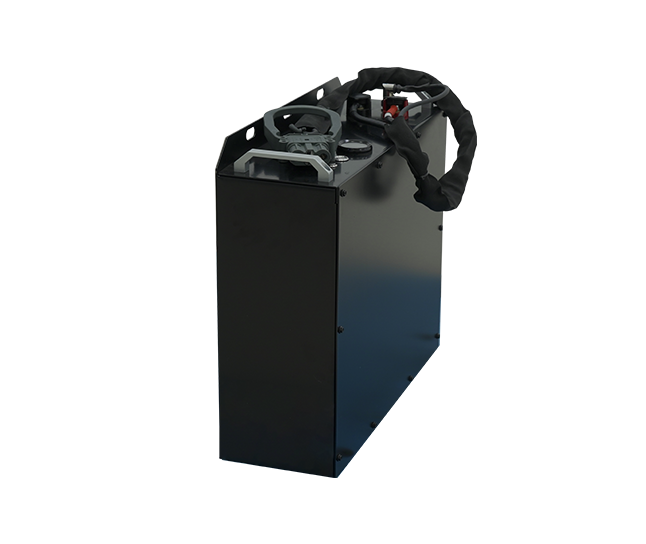
A 48 V 105 Ah LiFePO₄ pack weighs roughly 43–55 kg (95–120 lb). A flooded 48 V tray of four to six traction batteries often exceeds 150 kg. Removing that mass changes traction, hopper-dump stability, and gradeability on a ride-on sweeper.
- Measure the tray: length, width, height under the seat or hood, cable-exit side, and hold-down pattern.
- Confirm the pack envelope. Skinny golf-cart boxes (Eco ~22 × 9.75 × 10.4 in) and industrial rectangles (ROYPOW ~460 × 334 × 232–247 mm) are not interchangeable.
- If the OEM used battery mass as ballast, add documented ballast. Do not guess with steel plate against a live cable.
- Isolate the pack from wash-down spray at the hopper and from broom-thrown grit. IP67 is the housing rating, not a license to mount the pack in the debris stream.
Charging a 5.4 kWh sweeper pack
The flooded charger stays on the shelf. Lead-acid absorption and equalization voltages will trip a lithium BMS or cook a cell string.
| Charger current | Approx. 0–100% on 105 Ah | What it is for |
|---|---|---|
| 15–25 A (~0.15–0.25C) | 5–7 h | Overnight stall; matches the 48 V 25 A lithium charger used on compact 48 V / 100 Ah sweepers |
| 40–50 A (~0.4–0.5C) | 2.5–3.5 h | Single-shift turn plus a lunch recovery |
| 80–105 A (~0.8–1C) | ~1–1.5 h | Only if the BMS, terminals, and building circuit are rated; not a default kit charger |
Opportunity charging 15–40% does not require a 1C pack. A 25 A charger on 105 Ah adds about 25 Ah in one hour — 24% of nameplate — which is the lunch-window number most docks can actually use.
Charge only above 0 °C unless the pack has a heater. Store near 30–50% SOC if the machine will sit more than two weeks.
Safety and certification floor
Write the pack-level marks into the PO.
- UL 2271 (batteries for light electric vehicles) or a documented equivalent pack-level abuse test when the chassis is a light EV / utility / compact sweeper. “UL 1642 cells inside” is not the same as a UL 2271 pack.
- IEC 62619 for industrial cells and modules when the sweeper is specified as industrial equipment.
- UN 38.3 for shipping and replacement logistics.
- Cell- and pack-level over-voltage, under-voltage, over-current, short-circuit, and temperature cut-offs, with a redundant disconnect.
- Ingress IP65 minimum; IP67 preferred on outdoor and wash-down floors.
- Charger and pack tested as a pair.
IEEE Spectrum’s 30 May 2026 piece treated Trojan’s OnePack as a case study because the pack stays inside the legacy voltage window and the BMS enforces thermal and current limits without asking the vehicle to change. Apply that same test to any 105 Ah sweeper SKU.
Install sequence
- Identify the platform voltage. 24 V, 36 V, or 48 V. If it is not 48 V, stop and use the OEM lithium kit.
- Read the controller continuous and peak current, broom and fan motor ratings, and existing charger model.
- Measure the tray and hold-downs. Compare to the published 105 Ah envelope.
- Confirm the voltage window. Pack 40–58.4 V must sit inside the controller and charger tolerance.
- Size energy from a logged week, not a brochure hour claim. Average kW × hours × 1.1–1.2.
- Specify the lithium charger first. Dedicated circuit, lithium algorithm, current that can add 15–40% in a lunch window if the duty cycle needs it.
- Pull the old pack. Isolate the key, chock the wheels, support the hood or seat. Follow site lockout.
- Set the new pack, torque terminals to the datasheet, fit any 12 V converter the accessories need, and mount the SOC display where the operator can see it without leaving the seat.
- First charge to 100% on the matched charger before the first loaded aisle. Update BMS firmware if the vendor ships it.
- Pilot one machine for two weeks. Log SOC at the start and end of each shift, peak current, limp-mode events, and hopper-dump stability. Copy the spec only after the pilot stays above 20–30% SOC with margin.
Selection checklist
- Machine is native 48 V, or the retrofit is documented for that 48 V controller.
- Chemistry is LiFePO₄, ≥3,500 cycles at 80% DoD.
- Pack-level UL 2271 and/or IEC 62619, plus UN 38.3.
- Published working window 40–58.4 V (or the OEM 48 V window).
- Continuous discharge ≥ measured drive + broom + fan current.
- Envelope measured against the actual tray.
- Ballast plan if flooded mass is removed.
- Matched lithium charger on a dedicated circuit; opportunity charging 15–40% planned.
- Operating SOC policy: stay above 20–30%.
- IP65 minimum, IP67 preferred.
- Warranty in writing (years and/or MWh), same coverage on the charger.
- Pilot machine before a fleet buy.
Preguntas frecuentes
Can I put a 48 V 105 Ah lithium pack in a Tennant S16 or X16 SWEEP? No. Those machines are 36 V. The S16 lithium options are 4.1 / 8.2 / 12.2 kWh factory packs. The X16 SWEEP (7 April 2026) is 36 V / 320 Ah. Use the OEM kit.
Is 105 Ah enough for a full shift? On a compact 48 V sweeper drawing 1.4–1.8 kW, 4.3 kWh usable is about 2.4–3.1 h without a plug. Add one 15–40% opportunity charge or specify a larger kWh pack. Do not stretch 105 Ah across a two-shift municipal route.
How is this different from a 48 V 105 Ah golf-cart battery? Same cell string and often the same envelope. The sweeper duty cycle adds continuous broom and fan load, wash-down, and hopper-dump ballast. Demand the current rating, IP rating, and install sequence for the sweeper, not a “40-mile golf” headline.
Do I need a new charger? Yes. A 15–25 A lithium charger fills 105 Ah overnight. Size up only if the shift plan depends on a mid-day recovery and the building circuit can carry it.
What cycle life should I write into a bid? LFP ≥3,500 cycles at 80% DoD is the floor used across this briefing series. Trojan’s OnePack class is briefed at up to 4,000 cycles. Calendar life is still 8–12 years if SOC and temperature are respected.
Decision Framework
- Confirm system voltage. If the ride-on sweeper is 24 V or 36 V, specify the OEM lithium kit and stop. A 48 V pack will not make that machine safer or longer-running.
- Log the duty cycle for one week. Start-of-shift SOC, end-of-shift SOC, average current, debris load, and whether a mid-shift plug exists.
- Convert the log to kWh. If 4.3 kWh usable plus one 15–40% opportunity charge keeps SOC above 20–30%, a 48 V 105 Ah pack is sized. If not, step to 160–210 Ah at the same voltage or change the charge plan.
- If you retrofit, is the pack designed for this platform? Require a published working-voltage window, limp-mode preservation, UL 2271 / IEC 62619, and a matched charger. IEEE Spectrum’s 30 May 2026 Brittain rule still applies: the best pack is the one the legacy platform can safely use.
- Pilot, then copy. One machine, two weeks, SOC and current log. Specify that system once.
A 48V 105Ah Lithium Battery for Ride-On Sweepers: Applications and Specifications is a 5.38 kWh, 16S LiFePO₄ decision — not a generic lithium upgrade. Match the 48 V window, size from measured kWh, charge on a lithium profile, and keep SOC above 20–30%.
Authoritative references
- IEEE Spectrum, “A Better Way to Swap Lead-Acid With Lithium Batteries,” 30 May 2026 (Darren Brittain / Trojan platform-match interview; OnePack 48 V / 105 Ah, 51.2 V, 40.48–58.40 V): https://spectrum.ieee.org/lithium-batteries-lead-acid-ev
- Tennant Company, “Tennant Company Unveils X16 SWEEP for Autonomous, Around-the-Clock Industrial Sweeping,” 7 April 2026: https://s29.q4cdn.com/776944512/files/doc_news/Tennant-Company-Unveils-X16-SWEEP-for-Autonomous-Around-the-Clock-Industrial-Sweeping-2026.pdf
- Tennant Company, X16 SWEEP specifications (36 V, 320 Ah lithium; onboard 1,200 W / fast off-board 3,200 W): https://www.tennantco.com/content/dam/tennant/tennantco/products/machines/sweeper%20riders/x16-sweep/x16-sweep-specifications-en-noam.pdf
- Tennant Company, S16 Battery-Powered Compact Ride-On Sweeper product page: https://www.tennantco.com/en_eu/1/machines/sweepers/product.s16.battery-powered-compact-ride-on-sweeper.M-S16H.html
- Trojan Battery, Meet the OnePack family (48 V / 105 Ah, 180 A continuous): https://www.trojanbattery.com/technology/trojan-lithium-batteries/meet-the-onepack-family
- Trojan Battery, OnePack User’s Guide (TR-48-110-M electrical limits): https://assets.ctfassets.net/nh2mdhlonj7m/1B1RbqawOOkYd4LmNmfi23/c73ed8e3b728a484d93b6b1f6939ed5d/20260417-OnePack-Users-Guide.pdf
- ROYPOW, S51105 48 V 105 Ah LiFePO₄ product page: https://www.roypow.com/lifepo4-golf-cart-batteries-s51105-product/
- UL Standards, UL 2271 — Batteries for Use in Light Electric Vehicle (LEV) Applications: https://www.batterydesign.net/legislation-rules-and-regulations/ul-2271/
- IEC, IEC 62619 — Secondary lithium cells and batteries for industrial applications: https://webstore.iec.ch/publication/69122