
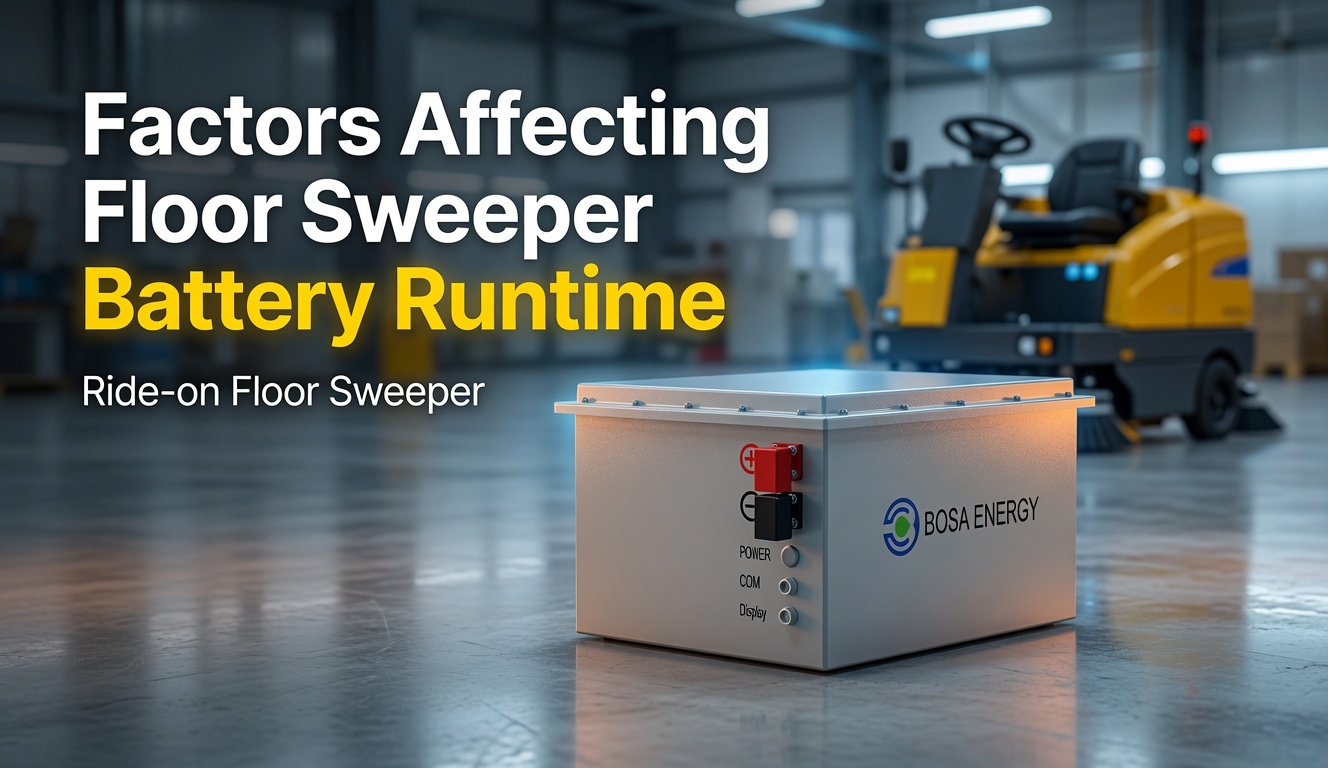
Metabeskrivelse: 2026 technical briefing on the factors affecting floor sweeper battery runtime. Quantified impacts of battery chemistry, voltage, brush load, floor condition, temperature, operator settings and charging practice. LiFePO₄ vs lead-acid metrics, opportunity-charging guidance, selection checklist and decision framework for industrial and commercial fleets.
Real-world floor-sweeper operating time is energy available divided by energy consumed. In 2026 the dominant variables are well quantified: battery chemistry and usable capacity, system voltage, continuous brush and vacuum load, floor surface and debris density, temperature, machine settings and battery state of health. Understanding the factors affecting floor sweeper battery runtime allows accurate pack sizing, shift planning and operating discipline so machines finish cleaning zones with margin rather than mid-shift power loss.
This briefing ranks the variables by impact, supplies current industrial metrics, and presents prioritised selection criteria for ride-on and walk-behind sweepers used in warehouses, distribution centres, factories and large commercial facilities.
Table of Contents
- Battery Chemistry and Usable Capacity
- System Voltage and Current Efficiency
- Brush Pressure, Vacuum Fan and Continuous Load
- Floor Condition, Debris Load and Surface Resistance
- Operating Temperature Effects
- Machine Speed, Operator Settings and Accessory Draws
- Battery Age, State of Health and Charging Practice
- Comparison Table: Relative Impact Ranking
- Practical Runtime Optimisation Measures
- Selection and Monitoring Checklist
- Ofte stillede spørgsmål
- Decision Framework: Matching Pack to Shift Requirements
Battery Chemistry and Usable Capacity
Battery chemistry is the highest-leverage variable among the factors affecting floor sweeper battery runtime. Flooded or AGM lead-acid packs are limited to approximately 50 % depth of discharge for acceptable cycle life. A nominal 36 V 200 Ah lead-acid bank therefore supplies roughly 100 Ah of usable energy under continuous sweeper load.
Quality LiFePO₄ packs deliver 90–100 % of rated capacity with minimal voltage sag. Cycle life routinely reaches 3,500–5,000+ cycles to 80 % remaining capacity when operated within recommended temperature and state-of-charge windows. Additional runtime-relevant advantages of LiFePO₄:
- Flat discharge curve maintains consistent brush and vacuum motor torque until the pack is nearly empty.
- Pack weight reduction of 40–60 % lowers continuous energy demand and improves manoeuvrability.
- High charge acceptance supports opportunity charging that restores 15–40 % capacity in short breaks without the absorption penalty of lead-acid.
Typical 2026 performance under identical moderate-load warehouse conditions:
- 36 V or 48 V LiFePO₄ packs commonly deliver 4–6+ hours continuous runtime.
- Comparable new lead-acid sets deliver 2–4 hours before voltage sag forces reduced performance or early return to charge.
Keep average state of charge above 20–30 % to maximise both calendar and cycle life. Size the pack so planned daily demand rarely forces deeper discharge.
System Voltage and Current Efficiency
Power = Voltage × Current. Raising system voltage reduces current for any given power demand, lowering I²R losses in cables, connectors and controllers and improving sustained performance under high brush torque. Dominant configurations in 2026 industrial sweepers:
- 24 V — compact walk-behind and light-duty machines
- 36 V — mid-size ride-on and many commercial models
- 48 V — larger ride-on sweepers with higher continuous power demand
A correctly sized 36 V or 48 V LiFePO₄ architecture typically provides the best balance of torque, efficiency and runtime for multi-shift warehouse duty. Conversion from a degraded lead-acid pack to a properly rated lithium pack of equivalent or slightly higher usable capacity frequently extends continuous runtime 30–50 % while eliminating mid-shift power fade.
Brush Pressure, Vacuum Fan and Continuous Load
Continuous mechanical load ranks among the highest-impact factors affecting floor sweeper battery runtime. Main broom pressure, side-brush engagement and vacuum-fan speed directly determine current draw. Aggressive settings on heavily soiled floors can increase power consumption 25–40 % relative to light-dust maintenance sweeping on smooth concrete.
Ride-on machines typically draw 800–1,800 W under normal operation depending on motor power, brush load and vacuum demand. Higher continuous draw shortens runtime proportionally. Operators who leave brushes and vacuum at maximum setting for light debris waste measurable capacity. Matching brush pressure and fan speed to actual soil conditions is free leverage that recovers 15–25 % of potential runtime on many shifts.
Floor Condition, Debris Load and Surface Resistance
Floor type and debris density compound the load effect. Rough concrete, textured industrial coatings, or heavy accumulations of sand, metal chips or packaging waste raise rolling resistance and brush torque. The same machine that achieves 5 hours on clean polished warehouse floors may deliver only 3–3.5 hours on a heavily soiled foundry or outdoor-adjacent loading dock.
Inclines and ramps add further demand. Climbing loading-dock ramps or multi-level facility slopes increases energy consumption significantly. Route planning that minimises prolonged grade work and prioritises high-debris zones early in the charge cycle remains a practical operational control.
Operating Temperature Effects
Cold reduces available capacity. Near 32 °F (0 °C) many packs deliver 15–25 % less runtime; deeper cold produces larger temporary losses. Lead-acid suffers more pronounced voltage sag than LiFePO₄. Elevated temperatures accelerate long-term degradation and may trigger BMS thermal limiting, although immediate runtime loss is usually smaller than the cold-weather penalty.
Operational controls:
- Park machines in temperature-controlled areas when practical.
- Avoid charging LiFePO₄ below freezing unless the pack incorporates self-heating.
- Maintain SOC above 20–30 % to improve cold-weather response and reduce the risk of low-voltage cut-off during high-load operation.
Machine Speed, Operator Settings and Accessory Draws
Energy consumption rises with travel speed and aggressive acceleration. Sustained high throttle and frequent stop-start patterns can reduce runtime 10–20 %. Cruising at moderate working speeds rather than maximum transport speed recovers measurable capacity on large-area shifts.
Continuous accessory loads (lights, additional dust-control systems, telematics modules) compete directly with propulsion and brush motors. On multi-hour cleaning routes the cumulative draw becomes measurable. Efficient system design and conscious management of non-essential loads protect available runtime.
Battery Age, State of Health and Charging Practice
Lead-acid packs commonly lose 30–50 % of original capacity within a few years under regular industrial use. LiFePO₄ degrades far more slowly and retains voltage stability longer, yet still benefits from disciplined practice:
- Avoid repeated discharges below 20 % SOC.
- Use a charger matched to chemistry and equipped for opportunity charging.
- Store long-term at approximately 40–60 % SOC.
- Employ opportunity charging; short 15–40 % top-ups between zones or shifts are cycle-life neutral for quality LiFePO₄ and keep average SOC high.
Accurate BMS coulomb counting and temperature protection are required for reliable remaining-runtime estimates in 2026. Telematics integration further allows fleet managers to track real energy consumption by zone and adjust settings or pack sizing accordingly.
Comparison Table: Relative Impact Ranking
| Factor | Typical Runtime Impact | Operator Controllable? | 2026 Guidance |
|---|---|---|---|
| Battery chemistry & usable capacity | Very high (Li +30–50 % or more) | Purchase / upgrade | LiFePO₄ 90–100 % usable vs lead-acid ~50 % |
| Brush pressure, vacuum & continuous load | High (25–40 % variation) | Yes | Match settings to soil level |
| Floor condition & debris density | High (20–40 % reduction) | Partially (zoning) | Higher Ah packs for heavy soil |
| System voltage & efficiency | Medium–high | At specification | Prefer 36 V / 48 V LiFePO₄ for larger machines |
| Temperature | Medium (10–25 % cold) | Partially | LiFePO₄ superior cold retention |
| Speed, acceleration & operator style | Medium (10–20 %) | Yes | Steady moderate speed is free leverage |
| Accessory & parasitic loads | Low–medium | Yes | Monitor continuous draw |
| Age, SOH & charging habits | High over time | Yes | SOC >20–30 %; opportunity charge lithium |
Practical Runtime Optimisation Measures
- Specify LiFePO₄ capacity equal to measured daily energy demand plus 20–30 % reserve so the pack rarely drops below 20–30 % SOC.
- Set brush pressure and vacuum fan to the minimum effective level for the actual soil conditions.
- Zone cleaning so high-debris areas are addressed early while the pack is at higher SOC.
- Operate at moderate working speeds with gradual acceleration; avoid unnecessary high-speed transport runs.
- Apply opportunity charging whenever the machine is stationary more than 15–20 minutes between zones or shifts.
- Keep average SOC above 20–30 %; avoid repeated deep discharges.
- Use real-time BMS power and predicted-runtime data rather than static pre-shift estimates.
- Store and charge within the manufacturer’s temperature window and confirm charger compatibility with lithium chemistry.
Selection and Monitoring Checklist
- Chemistry: LiFePO₄ preferred for daily or multi-shift industrial duty.
- Capacity: calculate from expected continuous hours × average power draw, then add reserve so SOC rarely falls below 20–30 %.
- Voltage: match machine requirement (24 V / 36 V / 48 V); higher voltage improves efficiency under load.
- Discharge ratings: continuous and peak must exceed motor and brush demand under loaded conditions.
- BMS: accurate SOC, temperature cut-offs, cell balancing and communication (CAN or equivalent) required.
- Charger: chemistry-matched and opportunity-charge capable.
- Mass: confirm weight reduction versus existing lead-acid bank and mounting compatibility.
- Displays / telematics: clear power, remaining capacity and predicted-runtime readouts preferred for fleet management.
- Documentation: record installation date, initial capacity and any dual-pack configuration for service history.
Ofte stillede spørgsmål
What are the primary factors affecting floor sweeper battery runtime? Battery chemistry and usable capacity, continuous brush and vacuum load, floor condition and debris density, system voltage, temperature, operator settings and battery state of health. LiFePO₄ packs typically deliver 30–50 % or more usable runtime than comparable lead-acid systems under identical industrial conditions.
What runtime can be expected from a typical industrial ride-on sweeper on lithium? 4–6 hours continuous is common for properly sized 36 V or 48 V LiFePO₄ packs under moderate warehouse load in 2026. Heavy debris, high brush pressure or cold conditions reduce this figure; opportunity charging and conservative settings extend the practical window.
How much does cold weather reduce runtime? 15–25 % near freezing; larger temporary losses in deeper cold. LiFePO₄ retains more usable capacity and voltage stability than lead-acid, yet performance still declines until the pack warms.
Can runtime be improved without replacing the pack? Yes. Correct brush and fan settings matched to soil level, moderate travel speed, reduced non-essential loads, consistent post-use charging and avoidance of deep discharges frequently recover 15–30 % of lost runtime on an existing pack.
Is opportunity charging compatible with lithium floor sweeper batteries? Yes. Quality LiFePO₄ systems with proper BMS accept partial charges without the cycle-life penalty of lead-acid. Short 15–40 % top-ups maintain high average SOC and support multi-shift coverage without full overnight recharges.
Decision Framework: Matching Pack to Shift Requirements
Answer these questions before specifying or upgrading:
- What is the longest continuous cleaning block required in a normal shift, including heavy-debris zones?
- What is the typical power draw under the most demanding floor and soil conditions encountered?
- Is the machine operated year-round in climates with cold winters, refrigerated areas or high ambient heat?
- Is opportunity charging available during short breaks or between zones?
- Are zero watering maintenance, consistent power delivery through the shift and multi-year cycle life higher priorities than lowest first cost?
Daily multi-shift use, heavy soil loads, temperature extremes or multi-year ownership almost always favour a correctly sized LiFePO₄ pack on total cost of ownership and performance in 2026. Size for measured energy demand plus reserve, maintain SOC above 20–30 %, and the factors affecting floor sweeper battery runtime become controlled design and operating variables rather than sources of mid-shift uncertainty.
Accurate quantification of the factors affecting floor sweeper battery runtime, combined with modern LiFePO₄ chemistry and disciplined BMS-supported operation, converts runtime from an unpredictable variable into a reliable system parameter for facility managers and cleaning contractors.