
What the pack actually has to do
A sidewalk sweeper and a 3.5-tonne compact municipal machine look different. Electrically they share the same load pattern: propulsion plus accessories that are not optional. On a street sweeper those accessories are disc or gutter brooms, the suction fan, water pumps, hopper lift, and often a high-pressure washer. Current arrives as short, high-amp bursts at curb speed, not a highway cruise.
Four metrics decide whether the pack finishes the route:
- Usable energy versus route demand. Size usable kWh so a normal shift ends above 20–30% SOC after broom, fan, grade, and water-pump loads—not after a brochure “eco” number measured on a flat empty car park.
- Charge-window fit. Most municipal crews have a 30–90 minute gap between zones, a depot lunch, or a night-shift hand-off. Lithium’s value is opportunity charging in that gap without an eight-hour cool-down or a diesel idling generator.
- Integration risk. A pack that blanks the OEM state-of-charge gauge, trips a low-voltage cut-out under hopper lift, or refuses the onboard charger creates service tickets. Voltage window, connector, charger algorithm, thermal path, and listing must match the chassis.
- Labor, noise, and mid-life cost. Diesel compact machines buy range with fuel and a service interval. Flooded 24 V / 48 V blocks on sidewalk machines demand watering and a mid-life set. Lithium removes watering on the low-voltage class and removes the local exhaust and noise constraint that keeps diesel machines out of residential nights.
IEEE Spectrum’s 30 May 2026 review of drop-in motive packs stated the engineering rule that municipal buyers should apply as well: design the lithium system around the electrical reality of the legacy platform, rather than asking the vehicle to adapt to the battery. That is the line from Darren Brittain, Trojan’s vice president of lithium commercial strategy for motive applications. It is the correct filter for every SKU on a sweeper bid sheet.
Compact municipal sweepers in 2026 are specified by usable kWh, charge window, and listing—not by a diesel horsepower comparison alone.
Why lithium changed the municipal duty cycle
Buyers search “street sweeper battery” because the constraint moved from hopper volume to energy availability. Three facts made that search rational in 2026.
- Night and low-emission access. Electric compact sweepers publish cabin and external noise figures that allow residential work after diesel machines are barred. Bucher rates the CityCat V20e at 92 dB(A) under 2000/14/EC. That is an operating-hours gain, not a brochure line.
- Shared industrial architecture. Sidewalk and walk-behind machines sit on 24 V and 36 V buses—the same family as Class III pallet trucks and ride-on floor sweepers. Mid-size compact municipal machines sit on 335–400 V and 500–600 V traction buses with Type 2 or CCS inlets. The cell chemistry preference is still thermal stability and cycle life, which is why LiFePO₄ dominates the low-voltage class and appears on several 55 kWh compact packs.
- Opportunity charging as policy. A 15–40% top-up at the depot or a public AC post is the municipal equivalent of a forklift lunch-room charge. Diesel cannot use that window. Flooded lead-acid can use it only by shortening life.
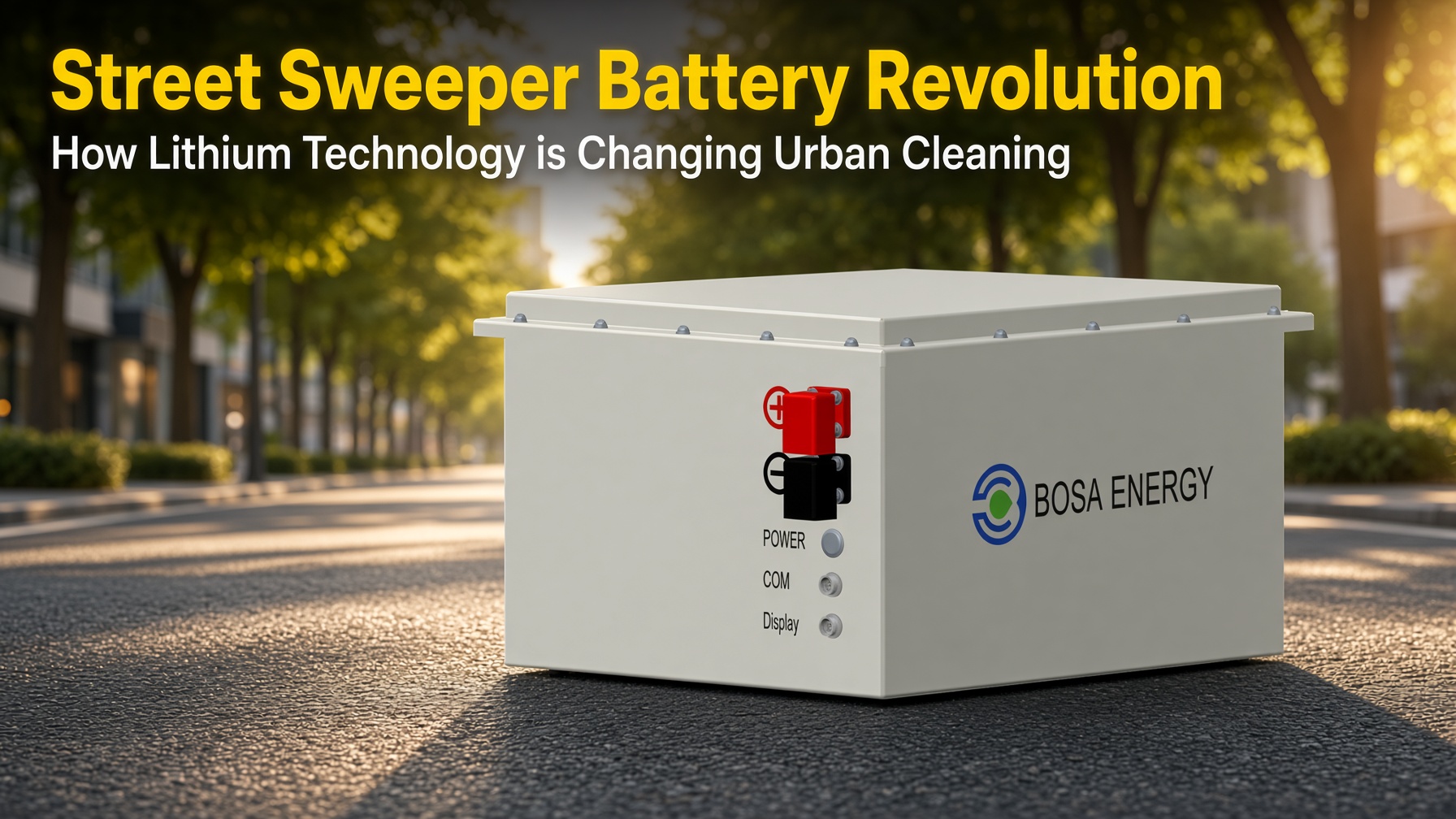
Those three facts are why Street Sweeper Battery Revolution: How Lithium Technology is Changing Urban Cleaning is a fleet-planning problem, not a single-machine shopping exercise. The pack has to match the route book, the depot electrical capacity, and the operator licence class (many 3.5-tonne machines remain Class B / car-licence in Europe).
2026 OEM lithium platforms
Aebi Schmidt eSwingo 200⁺ (75 kWh / 400 V)
Schmidt’s first fully electric compact sweeper is the cleanest published high-voltage compact rating this year. Official 2026 technical sheets list:
| Punkt | Rating |
|---|---|
| Pack | 75 kWh / 400 V, two individual battery packs |
| Published cycle life | at least 5,000 charging cycles |
| Operating time without recharge | up to 10 h |
| Oplade | full recharge in 4 h at 22 kW; ~8 h at 7 kW |
| Hopper | 2 m³ |
| Water | 400 L total (200 L fresh / 200 L service) |
| Sweeping width | 1,400–2,900 mm (2-brush) or up to 2,600 mm with third brush |
| Traction | rear-axle electric, 38–90 kW; travel up to 50 km/h / 20 mph |
| Empty weight (approx.) | 3,300–3,400 kg |
The dual-pack layout is the operational claim to test: can one pack be isolated for service without parking the machine, and does the BMS keep both strings inside the thermal window on a summer curb route. Specify the onboard charger rating against the depot circuit, not against a laboratory 22 kW post.
Bucher Municipal CityCat VR17e, V20e, and VR50e
Bucher’s 2026 electric map covers three municipal sizes with purpose-built Bucher Battery Packs rather than generic trays.
| Model | Pack | Chemistry note | Shift claim | Oplade | Chassis notes |
|---|---|---|---|---|---|
| CityCat VR17e | 55 kWh | LFP on the 2026 Italian brochure | minimum 10 h | 11 kW onboard, 4–5 h; DC ~60 min at 45 kW | 3.5 t class, car licence in many EU markets, 4,370 mm kerb turning circle |
| CityCat V20e | 63 kWh (some market sheets 80 kWh / 335 V) | automotive Li-ion | 8–10 h | 22 kW onboard, 2–3 h; recuperation on decel | articulated, 2 m³ hopper, ~1,800 kg payload, 40 km/h |
| CityCat VR50e | 137 kWh / 573 V | automotive prismatic Li-ion (NMC cells on the NA brochure) | up to 10 h | 22 kW onboard 5–6 h; DC 70–80 kW in 1.2–2 h (10–80% on CCS option) | 7.3 yd³ hopper class, four-wheel steer, PM2.5/PM10 4-star |
Treffpunkt Kommune’s 28 August 2026 municipal briefing is the current German-language confirmation of that ladder: VR17e for car-licence inner-city work, V20e-class machines for a full compact shift, VR50e-class 137 kWh packs for a ten-hour heavy compact route. Do not interchange those packs across chassis. The repair concept Bucher publishes is pack-specific.
High-voltage compact sweepers recover energy on decel and take Type 2 or CCS charge. The pack is a vehicle system, not a spare tray.
Hako Citymaster 1650 ZE (55 kWh usable)
Hako’s first all-electric sweeper in the 3.5-tonne class is an implement carrier as well as a sweeper. Official data:
- Usable capacity 55 kWh (SOC 0–100% as published), system output up to 50 kW
- Runtime up to 9 operating hours
- Onboard charger up to 22 kW, 2.5–3 h for full capacity, IEC 62196 Type 2
- Dual rear-wheel motors, 2 × 10 kW / 40 kW max, 40 km/h
- GVW 3,500 kg; empty sweeper weight about 2,630 kg
- Tractor T2a / Class B approval path in the EU technical sheet
The dual-use claim matters for TCO. A lithium compact that only sweeps has to earn its pack on cleaning hours. A Citymaster-class carrier that also grits, sprays, or ploughs spreads the pack cost across the year.
Tenax sidewalk class (24 V / 48 V LiFePO₄)
Tenax remains the low-voltage municipal reference: 100% electric sidewalk and pedestrian-zone machines with a published LIFE SOLUTION LiFePO₄ option.
- Minimum expected life 3,500 cycles; 24-month warranty on current LIFE SOLUTION pages
- Up to 10 hours on a standard sweeping shift at 25 °C
- Partial and frequent recharge in closed rooms
- Available on Electra 2.0 Neo, Electra 2.0 Hydro, Maxwind, Maxwind Hydro, and Smartwind
- Maxwind: 24 V LiFePO₄ / AGM / flooded options, 1,250–1,320 mm path, 110–130 L hopper, 8–10 h
This is the class closest to industrial floor-machine lithium. UL 2271 and IEC 62619 language from the warehouse world applies. Do not specify a 400 V compact pack for a 24 V sidewalk chassis.
Green Machines 500ze and related compact lithium
Green Machines published the early lithium compact benchmark and still lists the 500ze with single or dual lithium-ion packs. Historical and current dealer sheets cluster around 29.5 kWh (single) and 59 kWh (dual), with 4–8 hour recharge and up to a full shift—or two packs for extended hours. Treat those figures as a compact-class energy envelope, then confirm the current production BMS and charger with the dealer. The architecture lesson is unchanged: swap-capable packs and an onboard manager that balances strings.
Indoor and industrial cousins (Tennant, Nilfisk)
Urban cleaning is not only the public street. Logistics yards, ports, and municipal depots run ride-on floor sweepers on the same lithium rules. Tennant’s January 2026 T17 sheet lists 36 V lithium at 456 Ah / 17.5 kWh or 684 Ah / 26.3 kWh with up to 12 hours inside 24 hours when opportunity charged. Tennant also announced the X16 SWEEP autonomous industrial sweeper on 7 April 2026 with an optional CHRG dock for multi-shift recharge between cycles. Nilfisk’s SW3000 lithium variant remains the mid-size 24 V rider example: three 25.6 V 50 Ah modules, onboard 24 V 27 A charger, up to 4 hours. Those indoor SKUs do not replace a 75 kWh municipal compact. They prove the same operating model: opportunity charge, SOC floor, platform-matched BMS.
Diesel, hybrid, stay-flooded, or factory electric
| Path | Typical energy | Charge / fuel | Labor | Noise / local exhaust | Best fit |
|---|---|---|---|---|---|
| Stay diesel compact / truck | Diesel tank | Depot fuel | Engine service interval | High; night and LEZ limits | Long deadhead, no depot charger, highway transfer |
| Stay flooded on sidewalk machine | 24 V / 48 V wet blocks | 8–12 h + cool-down | Watering, equalization | Low on electric drive; gassing in the battery room | Staffed single-shift, tight capex |
| AGM / TPPL on sidewalk machine | 24 V / 48 V VRLA | Overnight | No watering | Lav | Overnight charge, no watering staff |
| Factory low-voltage LiFePO₄ | 24 V / 48 V, ≥3,500-cycle class | 2–6 h; 15–40% opportunity | Connector and charger only | Low; indoor charge allowed | Pedestrian zones, two-shift sidewalk routes |
| Factory high-voltage compact (55–80 kWh) | 335–400 V | Type 2 AC 2.5–5 h; some DC 60 min | HV-trained service | Low; night work | 3.5 t inner-city, car-licence fleets |
| Factory high-voltage heavy compact (130–140 kWh) | ~570 V | AC overnight or CCS 1–2 h | HV-trained service | Lav | 8–10 h heavy compact routes, larger hoppers |
| Truck-mounted BEV sweeper (200–270 kWh class) | 500–600 V LFP | Depot DC | HV + body OEM | Zero tailpipe | Wide carriageways, high hopper mass |
Nameplate amp-hours are not comparable across the table. A 240 Ah flooded 24 V sidewalk set at 50% usable DoD is not a 150 Ah LiFePO₄ set at 80% usable DoD. A 75 kWh compact pack is not a 55 kWh pack with a faster DC inlet. Compare usable kWh, day-end SOC on the measured route, and hours inside a 24-hour window.
Selection criteria that move TCO
Rank these in order. Do not start with crate price.
- Route energy, not brochure hours. Log broom, fan, grade, and water-pump current on a representative week. Size usable kWh so the worst day ends above 20–30% SOC with a reserve for a blocked drain or an extra dump.
- Charge window versus inlet. A 22 kW Type 2 onboard charger is useless on a 7 kW depot circuit. A CCS option on a VR50e-class machine only pays if the depot has DC. Write the electrical upgrade into the bid, not as a year-two surprise.
- Licence and mass class. A 3.5-tonne car-licence machine expands the operator pool. Crossing into a heavier class can erase the labor saving that justified lithium.
- Chemistry and cycle life. Prefer LiFePO₄ at ≥3,500 cycles and 80% DoD on low-voltage sidewalk machines. On high-voltage compact chassis, accept the OEM cell chemistry only with a published thermal design, a repairable pack concept, and a cycle or energy-throughput warranty.
- Ballast and payload. Lithium is lighter than the diesel engine-plus-tank or the flooded set it replaces. Confirm hopper payload, broom downforce, and gradeability after the weight cut. Sidewalk machines may need ballast; compact municipal machines may gain payload.
- Service model. High-voltage packs need OEM-trained technicians and a documented isolation procedure. Low-voltage LiFePO₄ trays are closer to industrial floor-machine service. Price the training, not only the crate.
Five-year TCO usually flips when the machine works two shifts, works nights, or avoids a mid-life flooded replacement and a diesel particulate-filter service cycle. Single-shift machines with cheap depot diesel and no LEZ constraint can still lose a pure-NPV comparison. Run the route book, not a generic 40% saving claim.
Operating rules that protect cycle life
- Keep operating SOC above 20–30%. The last tenth of capacity is the expensive tenth.
- Use opportunity charges of 15–40% of pack capacity between routes. Do not wait for a full 0–100% every night if the OEM allows partial charge.
- Pair the pack with the matching lithium charger. A leftover flooded or diesel-heater circuit is not a charger.
- Hold charge and storage inside the OEM temperature window. High-voltage packs include a BMS thermal loop; sidewalk LiFePO₄ packs may add a heat pad. Neither is optional in a winter depot.
- Inspect connectors, high-voltage interlocks, and charger inlets on the same cadence you used to water flooded cells. Connector wear replaces watering as the routine failure mode.
- Recalculate energy after a duty-cycle change: new night routes, winter water-heating, or a third brush all move kWh/h.
Those rules are how Street Sweeper Battery Revolution: How Lithium Technology is Changing Urban Cleaning stays a cost reduction instead of a warranty dispute.