
Primary Causes of Accelerated Power Loss
1. Sulfation and Incomplete Charging (Lead-Acid Dominant)
When a lead-acid battery sits discharged—even for a few hours—lead sulfate crystals form on the plates. Repeated incomplete charges harden these crystals, permanently reducing available capacity and elevating internal resistance. Industry data consistently identifies sulfation as the single largest cause of early runtime loss in floor scrubbers.
Typical sequence:
- Chronic partial-state-of-charge cycling in multi-shift use
- Capacity drop measurable within 300–500 cycles
- Voltage sag under brush and vacuum load, shortening usable runtime by 30–50 %
Flooded batteries compound the problem when electrolyte levels fall below the plates.
2. Natural Cycle and Calendar Aging
| كيمياء | Typical Cycle Life (80 % DoD) | Calendar Life (daily use) | Capacity Retention at 5 Years |
|---|---|---|---|
| Flooded Lead-Acid | 300–500 | من سنتين إلى أربع سنوات | 40–60 % |
| AGM / Gel | 400–800 | 3–5 years | 60–75 % |
| LiFePO₄ Lithium | ≥ 3,500–5,000 | 5–10 years | 85–90 % |
A two-year-old lead-acid pack that once delivered four hours now commonly delivers 2–2.5 hours under identical load. Lithium packs retain far more of their original capacity under the same duty cycle.
3. Increased Electrical Load from Machine Condition
Worn brushes, high pad pressure, clogged filters, or dragging motors raise current draw. A scrubber that previously operated at 40–50 A may now peak at 70–80 A. The battery must supply higher amperage, accelerating voltage drop and heat generation. Cold warehouses further reduce available capacity (lead-acid can lose 20–30 % below 10 °C).
4. Terminal Corrosion, Loose Connections, and Charger Mismatch
Corrosion increases resistance. Poor contact forces the battery to work harder and can trigger premature low-voltage cut-out. Using a charger with an incorrect voltage or algorithm profile damages both lead-acid and lithium packs.
5. Operator and Storage Habits
- Leaving the machine discharged overnight
- Interrupting charge cycles before completion
- Storing in high ambient temperatures
- Infrequent use without periodic full charges
These practices accelerate the same sulfation and calendar-aging mechanisms listed above.
Lead-Acid vs Lithium: Performance Reality Check
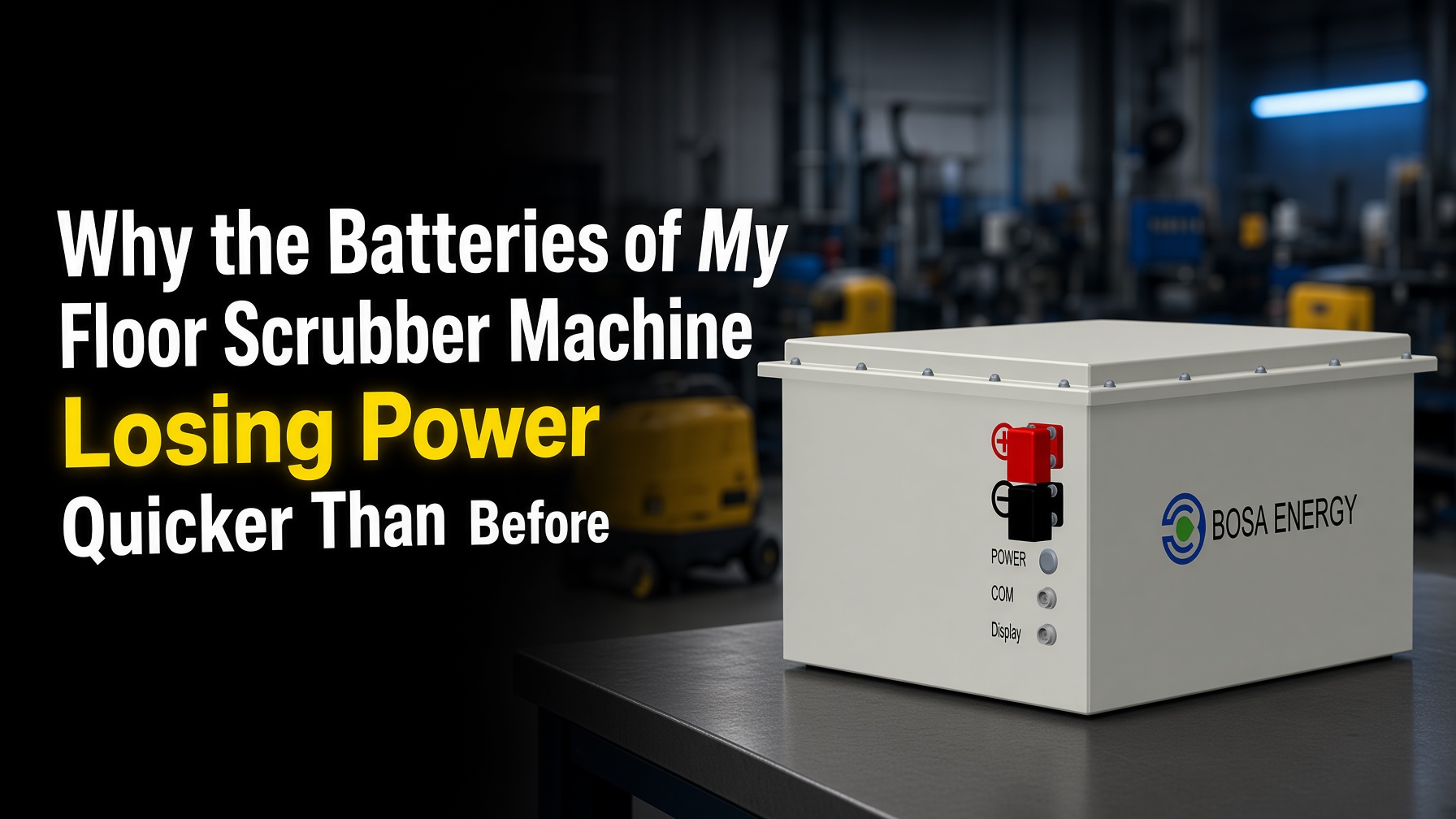
LiFePO₄ batteries address the root causes of Why the Batteries of My Floor Scrubber Machine Losing Power Quicker Than Before? through three inherent advantages:
- Flat voltage curve — consistent brush RPM and vacuum performance until the low-SOC cutoff
- Tolerance for opportunity charging (15–40 % top-ups during breaks) without cycle-life penalty
- Recommended operating window that keeps state of charge (SOC) above 20–30 % while still allowing deep usable capacity
Modern industrial LFP packs certified to IEC 62619 deliver ≥ 3,500 cycles at 80 % depth of discharge and support fast charging that returns the machine to service in 2–4 hours rather than 8–12 hours.