
Discover reliable MEB590 module suppliers for your electric vehicle battery projects. As the EV industry accelerates toward 2030, standardized battery modules like the MEB590 have become essential for cost-effective, high-performance powertrains. This comprehensive guide, written from the perspective of industry experts with extensive hands-on experience in lithium-ion battery module design, manufacturing, and global supply chains, covers everything procurement managers, battery pack engineers, and OEMs need to know about sourcing MEB590 modules.
Whether you’re scaling production for passenger EVs, commercial vehicles, or exploring energy storage integrations, choosing the right MEB590 module supplier can significantly impact your project’s timeline, cost, quality, and long-term reliability.
What Is the MEB590 Module?
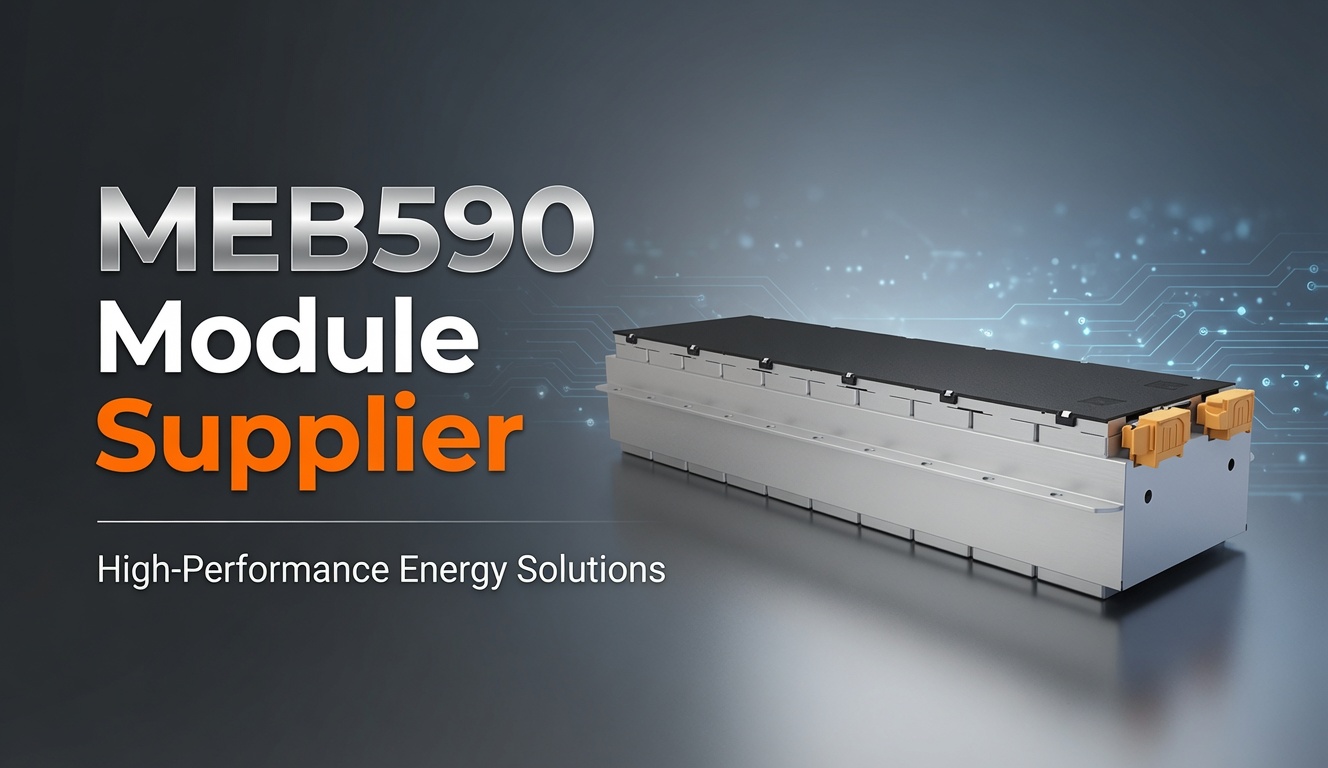
The MEB590 module is a standardized, large-format prismatic lithium-ion battery module developed as part of Volkswagen’s groundbreaking Modular Electric Drive Matrix (MEB) platform. Launched in 2018 alongside VW’s aggressive electrification strategy, the MEB platform was designed to reduce costs, improve reliability, and optimize battery lifecycle management across a wide range of electric vehicles—from compact cars to SUVs and commercial vans.
“MEB” stands for Modularer Elektrobaukasten (Modular Electric Drive Toolkit). The “590” refers to the module’s approximate length of 590 mm, distinguishing it from earlier smaller VDA-standard modules such as the VDA355 (355 mm) and VDA390. The MEB platform opened its battery module specifications to other automakers, creating an industry-wide standard that promotes interoperability, economies of scale, and faster time-to-market for new EV models.
Evolution from VDA Standards
The German Association of the Automotive Industry (VDA) introduced standardized battery module dimensions in 2012 to simplify design, manufacturing, and replacement. As market demand for longer driving ranges grew, module sizes evolved:
- VDA355 → VDA390 → VDA590 / MEB590
The MEB590 module builds directly on VDA principles but optimizes for higher energy density and integration efficiency. It uses advanced prismatic NMC (Nickel-Manganese-Cobalt) cells arranged in various series-parallel configurations. This larger format allows battery pack designers to use fewer modules per pack, reducing interconnects, improving thermal management, lowering overall system weight, and cutting assembly costs.
Real-world impact: Manufacturers report meaningful reductions in battery pack complexity and improved consistency across cells and modules—critical for achieving the high safety and performance standards demanded in modern EVs.
Key Technical Specifications of MEB590 Modules
MEB590 modules are engineered for automotive-grade performance. While slight variations exist between suppliers (depending on cell selection and housing design), here are the typical parameters based on widely adopted industry configurations:
| المعلمة | Typical Value (Example Configurations) | ملحوظات |
|---|---|---|
| Module Dimensions | 590 × 225 × 108–116 mm | Length is the defining “590” standard |
| وزن | 30.5 – 33.5 kg | Varies with cell thickness and housing |
| كيمياء | NMC (NCM) prismatic cells | High energy density; common grades from leading cell makers |
| Common Configurations | 2P8S, 1P12S, 2P6S, 1P8S variants | Flexible voltage and capacity options |
| الجهد الاسمي | 22.2V – 44.5V+ (depending on series count) | e.g., ~29.36V for popular 2P8S |
| سعة | 113Ah – 338Ah per module (system level) | e.g., 227Ah in 2P8S with ~113.5Ah cells |
| Nominal Energy | 6.6 – 6.85 kWh per module | Enables high pack-level energy with fewer modules |
| Specific Energy | ~220–230 Wh/kg (module level) | Excellent for range extension |
| دورة الحياة | ≥2,000 cycles @ 80% SOH (typical) | Automotive-grade longevity |
| درجة حرارة التشغيل | Charge: -20°C to +55°C Discharge: -30°C to +55°C | Wide operating window |
| تبريد | Natural / passive (many designs); liquid cooling options available | Simplifies pack integration |
| Voltage Range | e.g., 22.4V – 34.8V for 2P8S | Safe operating window |
Popular cell formats inside MEB590 modules:
- Single-layer cells (~220 × 100 × 22 mm)
- Double-thickness (~220 × 100 × 44 mm)
- Triple-thickness (~220 × 100 × 66 mm)
These allow manufacturers to fine-tune capacity and voltage while maintaining the outer module envelope for seamless pack integration.
Benefits of Choosing MEB590 Standard Modules
Sourcing MEB590 modules from a qualified supplier delivers multiple strategic advantages:
- Cost Efficiency Through Standardization Shared platform technology reduces R&D, tooling, and validation costs. Fewer unique parts mean lower inventory complexity and easier scaling.
- Higher Energy Density & Vehicle Range Larger modules with advanced NMC cells deliver more energy per kilogram and per cubic meter than older smaller modules. Real-world packs achieve excellent range without excessive weight penalties.
- Improved Manufacturing & Assembly Efficiency Standardized mechanical and electrical interfaces speed up pack assembly lines. Reduced module count per vehicle simplifies wiring harnesses and thermal systems.
- Enhanced Consistency & Quality Larger modules with fewer cells per module (in some configs) or optimized grouping improve cell-to-cell balance and overall pack uniformity—key for BMS performance and longevity.
- Scalability Across Vehicle Segments The same MEB590 building block supports passenger cars, light commercial vehicles, minibuses, and even certain industrial or marine applications.
- Supply Chain Resilience Because the format is widely adopted, multiple qualified cell and module suppliers exist, reducing single-source risk compared to fully custom designs.
How to Choose a Reliable MEB590 Module Supplier
Not all suppliers are created equal. With years of direct experience supplying automotive-grade battery modules to OEMs and Tier-1 integrators worldwide, here are the critical factors procurement and engineering teams should evaluate:
1. Automotive-Grade Manufacturing & Certifications
Look for suppliers with:
- IATF 16949 certification (automotive quality management)
- ISO 9001 / ISO 14001
- UN38.3, IEC 62133, or equivalent safety testing
- Experience with PPAP (Production Part Approval Process) and APQP
- Rigorous incoming cell inspection and traceability systems
2. Cell Quality and Sourcing Transparency
Premium MEB590 modules use Grade-A prismatic NMC cells from reputable manufacturers (e.g., CALB and similar tier-1 suppliers). Ask for:
- Full cell-level specifications and batch traceability
- Third-party test reports (capacity, internal resistance, cycle life)
- Evidence of consistent supply agreements with cell makers
3. Technical Expertise & Customization Capability
A strong supplier should offer:
- Standard MEB590 configurations off-the-shelf
- Custom variants (different series-parallel, FPC integration, housing materials, sensor placement)
- Engineering support for pack-level mechanical, thermal, and electrical integration
- CAD models, 3D step files, and detailed datasheets
4. Production Capacity, Lead Times & Scalability
- Proven monthly/annual output capacity
- Transparent lead times (typically 8–16 weeks depending on volume and customization)
- Ability to ramp quickly for new programs
- Flexible MOQ policies for prototypes vs. mass production
5. Quality Assurance & Testing
Demand:
- 100% end-of-line testing (capacity, voltage, insulation resistance, leak tests)
- Environmental and mechanical validation (vibration, shock, thermal cycling)
- Full traceability from cell to finished module
- Warranty terms (typically 2–8 years or cycle-based, depending on application)
6. Supply Chain Stability & After-Sales Support
- Geographic diversification or strong domestic production
- Robust logistics and packaging for global shipping
- Responsive technical support and field failure analysis capability
- Long-term roadmap alignment (next-gen cells, higher energy densities)
Pro tip from industry experience: Always request sample modules for your own validation testing (DVT/PVT phases). A reputable supplier will gladly support this and provide detailed test data.
Common Applications for MEB590 Modules
- Passenger Battery Electric Vehicles (BEVs) — Primary use case; enables competitive range in compact and mid-size platforms.
- Light Commercial Vehicles & Vans — High payload efficiency thanks to high energy density.
- Minibuses & Shuttle Fleets — Proven in real-world deployments with excellent reliability.
- Specialty Vehicles — Certain construction, mining, or port equipment where standardized high-capacity modules reduce development time.
- Stationary Energy Storage (emerging) — Some integrators adapt MEB590 modules for commercial & industrial ESS where automotive-grade robustness is valued.
Future Trends in MEB590 and Standardized Modules (2026 and Beyond)
The industry continues to push module-level energy density higher through:
- Advanced NMC and emerging NCA/LFP blends
- Thicker electrode designs and improved cell formats
- Better thermal interface materials
- Integrated smart features (embedded sensors, advanced FPC)
Standardization efforts are expanding. More OEMs are adopting or creating compatible platforms, which benefits buyers through increased supplier competition and falling costs per kWh.
Sustainability is also rising: suppliers with strong recycling partnerships and lower-carbon cell production will gain preference.
Frequently Asked Questions (FAQ)
What is the difference between MEB590 and VDA355 modules? VDA355 modules are smaller (~355 mm long) and suited for earlier or more compact EV designs. MEB590 modules are significantly larger, delivering higher energy per module, fewer interconnects, and better overall pack efficiency—ideal for longer-range vehicles.
Can MEB590 modules be used in non-Volkswagen vehicles? Yes. Because VW opened the MEB platform specifications, the 590 module format has been widely adopted across the industry by multiple OEMs and battery pack manufacturers.
What cycle life can I expect from a quality MEB590 module? Automotive-grade modules typically achieve ≥2,000 cycles to 80% State of Health under standard conditions. Actual life depends on usage profile, temperature management, and charging habits.
Are MEB590 modules liquid-cooled or air-cooled? Most standard designs use passive/natural cooling. However, experienced suppliers can integrate liquid cooling plates or provide guidance on pack-level thermal management for high-performance or fast-charge applications.
How do I get started with sourcing MEB590 modules? Contact a specialized supplier for current datasheets, pricing, lead times, and sample availability. Provide your target voltage, capacity, volume, and application details for the most accurate recommendation.
What certifications should a supplier have for automotive use? At minimum: IATF 16949, UN38.3 transport certification, and relevant functional safety considerations. Additional customer-specific requirements (e.g., ISO 26262 ASIL levels) may apply for certain programs.
Why Work with an Experienced MEB590 Module Supplier?
Sourcing battery modules is not just about price—it’s about partnership. An experienced supplier brings:
- Deep technical knowledge of MEB590 integration challenges
- Proven quality systems that protect your brand reputation
- Flexible support from prototype through mass production
- Long-term supply security in a dynamic global market
We combine advanced manufacturing capabilities with rigorous quality control and responsive engineering support. Our team has successfully delivered thousands of MEB590 and VDA-standard modules into real-world EV programs across multiple continents.
Ready to discuss your MEB590 module requirements? Whether you need standard configurations, custom adaptations, or full technical consultation for your next battery pack project, our experts are here to help. Request a quote, technical datasheet, or schedule a discovery call today.
Contact us via our website or email to receive prompt, professional support tailored to your specific application and volume needs.
About This Article This guide was developed by battery systems specialists with deep expertise in EV powertrain components, module design, and global supply chain management. All technical information is based on current industry standards and widely published specifications for MEB590 / VDA590 modules as of 2026. Specifications can vary by supplier—always verify latest data directly with your chosen partner. This content is intended for informational purposes to support informed procurement decisions.
Keywords: MEB590 module supplier, MEB590 battery module, VDA590 module, MEB 590 EV battery, standardized lithium battery module, NMC MEB590 supplier, automotive battery module manufacturer
Last Updated: July 2026