
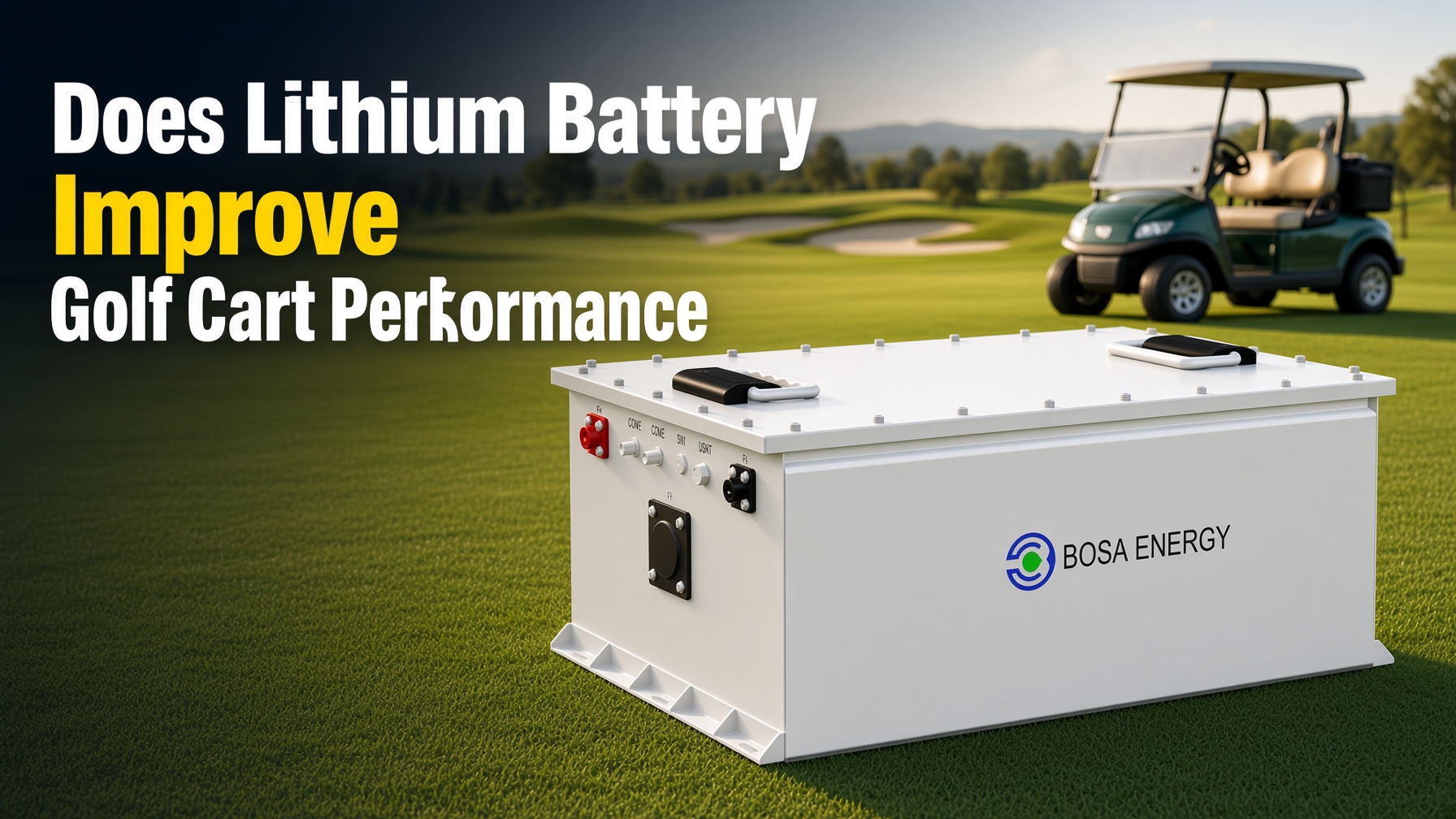
Yes. Switching from traditional lead-acid to a modern LiFePO₄ (lithium iron phosphate) pack is one of the highest-impact upgrades available for golf carts in 2026. The improvement is measurable across acceleration, sustained speed, hill-climbing ability, range, weight distribution, and long-term consistency. This article examines the engineering reasons, quantifies the gains, and provides decision criteria so fleet managers and private owners can evaluate whether the upgrade matches their duty cycle.
The core answer to “does lithium battery improve golf cart performance” is affirmative for nearly every real-world use case that involves hills, passengers, frequent rounds, or multi-year ownership. Gains come from three physical advantages: dramatically lower mass, a flat voltage discharge curve, and higher usable energy density. Independent data and fleet conversions confirm that a lithium battery does improve golf cart performance in measurable, repeatable ways.
Performance Gains Quantified
Independent tests and manufacturer data consistently show the following typical improvements when a stock 36 V or 48 V lead-acid bank is replaced with a matched LiFePO₄ system of equivalent or higher usable capacity:
| Metric | Lead-Acid (Typical) | LiFePO₄ Lithium (Typical) | Practical Gain |
|---|---|---|---|
| Pack weight (48 V system) | 320–400 lb | 80–150 lb | 50–70 % lighter |
| Voltage under load | Drops steadily | Remains nearly flat to ~10–15 % SOC | Consistent power |
| 0–10 mph acceleration | 8–10 s | 4–6 s | Noticeably quicker response |
| Top-speed stability | Declines after 50 % discharge | Holds near peak until low SOC | 1–3 mph higher effective speed on stock carts |
| Usable capacity | ~50 % of rated Ah | 90–100 % of rated Ah | 30–50 % more range |
| Hill-climbing under load | Noticeable fade mid-round | Full torque retained | Stronger performance on grades |
| Cycle life at 80 % DoD | 300–800 cycles | ≥3,500–5,000 cycles | 5–10× longer service life |
These figures align with field reports from resort fleets and private conversions. A lithium battery does improve golf cart performance most dramatically in acceleration feel and late-round consistency rather than by dramatically raising the absolute top speed of a governed stock cart. For operators focused on daily drivability, the question “does lithium battery improve golf cart performance” is answered by the combination of lower mass and stable voltage.
Why Lithium Delivers Better Performance
1. Weight Reduction
A conventional 48 V lead-acid bank of six 8 V batteries commonly weighs 350–400 lb. An equivalent LiFePO₄ pack typically weighs 80–120 lb. Removing 250–300 lb of unsprung and battery-compartment mass improves acceleration, reduces energy required to climb hills, lessens stress on suspension and tires, and raises the effective payload capacity of the cart. The lighter cart also exhibits more responsive handling and shorter braking distances.
2. Flat Voltage Curve
Lead-acid voltage sags as state of charge declines. By mid-round the motor receives lower voltage, torque falls, and the cart feels sluggish. LiFePO₄ chemistry maintains a remarkably flat voltage profile across most of the discharge curve. The motor continues to see near-nominal voltage until the pack is nearly empty, so acceleration and hill-climbing ability remain consistent from the first hole to the last.
3. Higher Usable Energy and Efficiency
Lithium packs can safely use 90–100 % of rated capacity without the severe life penalty that deep discharges impose on lead-acid. Combined with round-trip efficiencies typically above 95 % (versus 70–80 % for lead-acid), the result is both longer range per charge and less wasted energy as heat.
4. Higher Continuous and Peak Current Capability
Quality lithium packs with robust BMS support higher continuous discharge rates and brief high-current peaks. This translates into stronger instantaneous torque for starts and short climbs, provided the motor and controller can accept the current.
Real-World Speed and Acceleration Context
A lithium battery does improve golf cart performance, yet expectations must remain realistic. Most stock Club Car, EZ-GO, and Yamaha carts are electronically or mechanically governed to approximately 12–15 mph. A pure battery swap commonly yields a 1–3 mph increase in observed top speed and a much more noticeable improvement in acceleration and sustained speed on grades. Claims of 18–25 mph from a battery change alone usually require simultaneous controller, motor, or governor modifications and may affect street-legal or course-use compliance. Even without those modifications, the answer to does lithium battery improve golf cart performance remains yes on the metrics that affect everyday use.
For neighborhood or utility use where higher speeds are desired and permitted, pairing a lithium pack with a compatible higher-amperage controller is the proven route.
Charging, Opportunity Charging, and Operational Flexibility
Lithium packs accept charge rates of 0.5 C–1 C (and sometimes higher) without the heat and life penalties of lead-acid. Full recharge commonly occurs in 2–4 hours versus 8–12 hours. Partial opportunity charging—adding 15–40 % capacity during short stops—is fully supported and does not harm cycle life. Keeping daily depth of discharge moderate and state of charge above 20–30 % further extends calendar and cycle life.
Safety and Certification
Prefer packs carrying UL 2271 certification (Batteries for Use in Light Electric Vehicle Applications). UL 2271 includes abuse testing relevant to golf-cart duty: overcharge, short-circuit, crush, and environmental exposure. LiFePO₄ chemistry itself offers superior thermal stability compared with other lithium variants. A properly designed BMS adds cell balancing, over-current, over-voltage, under-voltage, and temperature protection.
Selection Checklist
When evaluating whether a lithium battery will improve golf cart performance for a specific fleet or private cart, verify:
- Documented LiFePO₄ chemistry with published cycle life ≥3,500 cycles at 80 % DoD.
- UL 2271 (or equivalent IEC 62619 / UN 38.3) certification and transparent BMS specifications.
- Weight of the complete pack relative to the existing lead-acid bank (target ≥50 % reduction).
- Continuous and peak discharge current ratings matched to the motor and controller.
- Compatible charger capable of the recommended charge profile and opportunity-charge rates.
- Mechanical fit (GC2/GC8 form factor or tray adapter) and secure mounting provisions.
- Warranty covering both cycle life and calendar life under stated operating conditions.
- Clear SOC display or communication interface for operators.
الأسئلة الشائعة
Does a lithium battery make a golf cart faster? On a stock governed cart the top-speed increase is typically modest (1–3 mph). Acceleration, sustained speed on hills, and late-round performance improve substantially.
How much range improvement can I expect? Most conversions report 30–50 % more usable range under identical conditions because of higher usable capacity, lower weight, and reduced voltage sag.
Is the upgrade worthwhile for occasional flat-course use? The performance difference is smaller on flat terrain with light loads. Long-term cost of ownership, zero maintenance, and consistency still favor lithium for most owners who keep the cart more than three to four years.
Do I need to change the controller or motor? A pure drop-in replacement improves performance without other changes. Maximum speed and acceleration gains require matching higher-current components and verifying controller programming.
What about cold-weather performance? LiFePO₄ retains more capacity than lead-acid in moderate cold. Extreme low-temperature charging may require heated packs or reduced charge rates; check manufacturer specifications.
Decision Framework
Answer these four questions:
- Does the cart regularly carry passengers, climb grades, or operate multiple rounds per day?
- Is consistent acceleration and power delivery throughout the discharge cycle important?
- Will the cart remain in service long enough for the higher cycle life and lower maintenance of lithium to offset the upfront cost (typically five or more years)?
- Can the chosen pack meet UL 2271 (or equivalent) safety requirements and fit the existing tray or an approved adapter?
If the answers are predominantly yes, a lithium battery does improve golf cart performance and delivers a clear operational and ownership advantage.
Authoritative References
- RELiON Battery – “Are Lithium Golf Cart Batteries Better Than Lead-Acid?” and golf-cart applications: https://relionbattery.com/blog/best-golf-cart-batteries-lithium-ion-lead-acid و https://relionbattery.com/applications/golf-carts
- U.S. Battery Manufacturing – US48V105 added to Essential Li® line of UL 2271 certified batteries: https://www.usbattery.com/us48v105-added-to-the-essential-li-line-of-batteries-that-are-ul-2271-certified/
- UL Standards & Engagement – ANSI/CAN/UL/ULC 2271:2023 Standard for Batteries for Use In Light Electric Vehicle (LEV) Applications (third edition, September 2023): https://webstore.ansi.org/standards/ul/ansiululc22712023
In summary, the evidence from physics, laboratory testing, and field deployments is consistent: a properly specified lithium battery does improve golf cart performance across the metrics that matter most to drivers and operators—acceleration, consistency, range, and long-term reliability. For the majority of golf cart applications in 2026, the answer to “does lithium battery improve golf cart performance” is a clear yes when the pack is correctly sized, certified, and installed.