
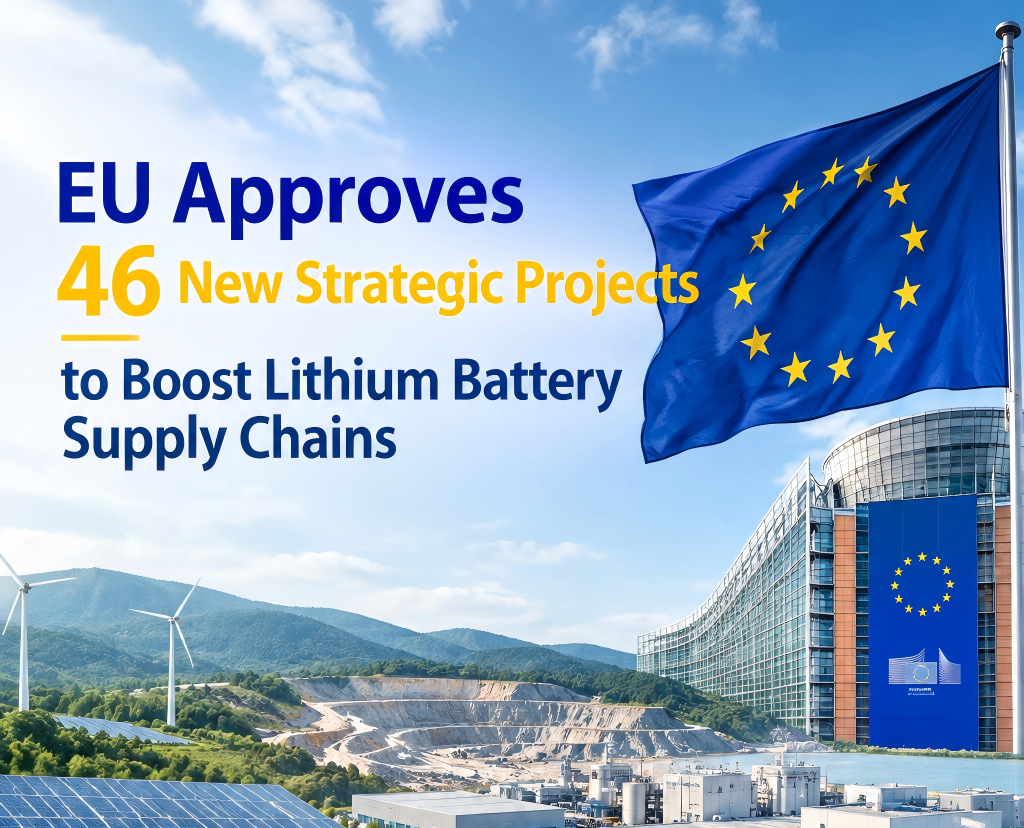
On October 9, 2026, the European Commission unveiled a second list of 46 Strategic Projects under the Critical Raw Materials Act (CRMA). Spanning 16 member states, these projects carry an estimated investment of €21.1 billion and focus heavily on battery metals—lithium, nickel, cobalt, manganese, and graphite—to reduce dependence on external suppliers, particularly China, and strengthen Europe’s battery value chain.
This follows the first batch of 47 EU projects announced in March 2025, bringing the total number of strategic projects within the EU to 93. Industry Commissioner Stéphane Séjourné stated that the combined 2025 and 2026 portfolios could allow the EU to fully meet its 2030 extraction targets for lithium, nickel, rare earths, magnesium, and tungsten, as well as its processing target for lithium and recycling targets for lithium and cobalt.
Project Structure and Battery Focus
The 46 projects cover the full value chain: 8 extraction, 11 processing, 19 recycling, and 8 integrated projects (three combining extraction and processing, five combining processing and recycling). Battery-related projects include:
- 7 lithium projects
- 12 nickel projects
- 10 cobalt projects
- 5 manganese projects
- 4 graphite projects
Strategic Project status provides faster permitting—approximately 27 months for mines and 15 months for processing and recycling facilities—along with support in accessing public and private financing, though it does not guarantee direct funding.
Germany Emerges as a Lithium Hub
Germany stands out with a cluster of projects covering extraction through to battery-grade materials:
- Zinnwald Lithium: Hard-rock lithium extraction and processing in Saxony.
- Altmark Lithium Extraction: Lithium recovery from underground brine in Saxony-Anhalt.
- AMG Lithium: A refining and recycling hub in Bitterfeld, designated as a European Lithium Refining and Recycling Hub.
- Vulcan Energy’s Lionheart project: Direct lithium extraction (DLE) from geothermal brines in the Upper Rhine Graben, combined with geothermal energy production. Phase one targets 24,000 tonnes per year of battery-grade lithium hydroxide monohydrate (enough for roughly 500,000 electric vehicles). The project reached final investment decision in 2026 with a financing package of about €2.2 billion, with commercial production planned for 2028.
Additional German projects such as Cylib (battery recycling) and Pure Battery Technologies (nickel-cobalt-manganese precursor materials) further strengthen midstream chemical processing capabilities.
The Netherlands and Belgium contribute strongly on the recycling and metallurgy side, helping form a North-West European value chain: Germany focuses on extraction and refining, the Netherlands on recycling (including projects that convert end-of-life batteries into “black mass”), and Belgium leverages expertise from companies such as Umicore.
Strategic Importance and Remaining Challenges
Under the CRMA, the EU aims by 2030 to extract at least 10%, process 40%, and recycle 25% of its annual needs for strategic raw materials, while limiting any single non-EU country’s share to no more than 65% at any stage of the value chain. The new project list is viewed as a key step toward these benchmarks, especially amid ongoing EU-China trade tensions, lithium price volatility, and setbacks at European battery cell projects (including Northvolt’s bankruptcy and delays at ACC).
Challenges remain significant. Many of the 2025 projects are behind schedule, and developers have previously warned of liquidity and financing pressures. Only about a quarter of CRMA projects are currently on track. Nickel and manganese may still face supply gaps by 2030. The rising adoption of LFP and sodium-ion chemistries also creates uncertainty for producers focused on high-nickel materials.
Outlook
The announcement marks a concrete move by Europe toward greater autonomy in battery materials. If the projects advance successfully, they should improve supply-chain resilience for electric vehicles and energy storage. Success will depend on timely financing, efficient permitting, and alignment with downstream battery manufacturers and automakers. For Chinese lithium-ion companies, the developments increase pressure to localize further in Europe while also opening potential collaboration opportunities in areas such as cathode materials and recycling.
This article is based on the European Commission’s October 9, 2026 announcement and related reporting from Politico, Industrylinqs, and official EU materials.