
Lithium Chemistry Delivers Measurable Operational Gains
Industrial lithium iron phosphate (LiFePO₄ / LFP) and selected NMC packs outperform legacy lead-acid and diesel systems on the metrics that matter for agricultural duty cycles:
- Cycle life of ≥3,500–5,000 cycles at 80 % depth of discharge (DoD) versus 1,000–1,500 for typical flooded lead-acid.
- Opportunity charging of 15–40 % capacity during short breaks restores usable energy without full-cycle degradation when state-of-charge (SOC) is held above the 20–30 % floor.
- Energy density and power density that support continuous 40–130 hp output with near-instant torque and regenerative recovery on downhill or braking events.
- Near-zero local emissions, noise levels typically 10–20 dB lower than diesel equivalents, and elimination of fuel storage, exhaust after-treatment, and frequent oil changes.
- Integrated BMS thermal management that maintains performance across –20 °C to +45 °C ambient ranges common on farms.
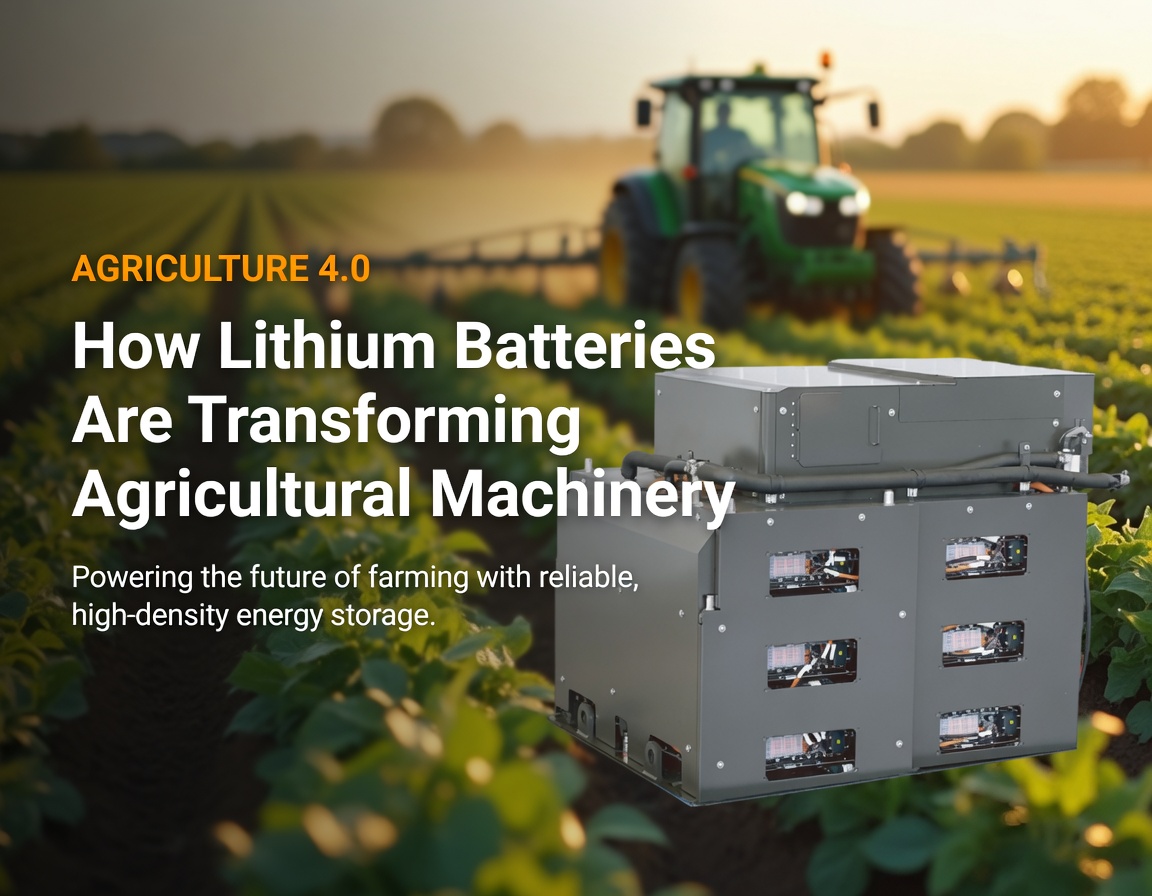
These attributes make How Lithium Batteries Are Transforming Agricultural Machinery a practical productivity and total-cost-of-ownership (TCO) decision rather than a purely environmental one.
Current OEM Platforms and Performance Benchmarks (2026)
Major manufacturers have moved beyond prototypes into limited series or early commercial units:
| Machine / Model | Power Rating | Battery Capacity | Typical Runtime | Charging Notes | Primary Use Cases |
|---|---|---|---|---|---|
| John Deere E-Power (prototype) | 130 hp continuous | Modular up to 195 kWh | Up to ~8 h | High-power CHIMERO / CCS capable; target 80 % in ~30 min | Orchards, vineyards, livestock, municipal |
| Fendt e100 Vario (e107 V / S) | 55 kW / 75 hp continuous; 66 kW / 90 hp peak | 100 kWh | 4–7 h (partial load) | AC 22 kW (~5 h full); DC 80 kW (20–80 % in ~45 min) | Specialty crops, greenhouses, municipal |
| Monarch MK-V | 40 hp continuous / 70 hp peak | ~80–105 kWh | 4–14 h (duty dependent) | AC Level 2 (5–6 h with 80 A) | Dairy feed push, vineyards, autonomous tasks |
| CLAAS TORION 537e SINUS | ~30 kW drive + 15 kW hydraulics | 32.2 kWh (std) / 64.4 kWh (opt) | 8–16 h | On-board charger; 1.5–3 h full | Livestock barns, material handling |
John Deere’s modular Kreisel immersion-cooled packs (up to five ~39 kWh modules) and ~800 V architecture were demonstrated at Grüne Woche 2026, with limited market availability targeted for 2027 and broader production in 2028. Fendt’s e100 series entered series production earlier and is now available in both narrow-track (vineyard/orchard) and standard configurations. These platforms illustrate the practical reality of How Lithium Batteries Are Transforming Agricultural Machinery across power classes from compact specialty units to 100+ hp utility tractors.
Technical Advantages Over Diesel and Lead-Acid
- Duty-cycle flexibility – Short opportunity top-ups (15–40 %) keep SOC in the high-efficiency band and eliminate the need for multi-battery swap systems common with lead-acid.
- Maintenance reduction – No oil changes, fuel filters, or diesel particulate filters; BMS diagnostics replace many mechanical inspections.
- Precision and autonomy readiness – Electric drivetrains pair cleanly with by-wire controls, camera/LiDAR suites, and telematics already present on modern platforms.
- Energy cost and TCO – Electricity costs per kWh are typically far lower than diesel on a work-equivalent basis; lower maintenance and longer cycle life further improve five- to ten-year ownership economics.
- Environmental and regulatory fit – Zero tailpipe emissions support indoor livestock work, urban-adjacent operations, and emerging low-emission zone requirements.
High-quality industrial LFP packs certified for vibration, thermal abuse, and functional safety remain the preferred chemistry for most agricultural applications because of their inherent thermal stability and long calendar life under partial-state-of-charge operation.
Selection Criteria for Agricultural Lithium Systems
When evaluating lithium solutions, prioritize the following measurable factors:
- Capacity sizing – Size packs so that daily energy demand can be met with opportunity charging while keeping SOC above 20–30 %. Over-sizing improves resilience but raises capital cost.
- Voltage architecture – 400 V systems suit compact machines; 600–800 V architectures reduce current, cable size, and losses on higher-power tractors.
- Thermal management – Active heating for cold starts and cooling (air or liquid/immersion) for summer peak loads are essential for consistent runtime and cycle life.
- BMS and telematics – Cell-level monitoring, predictive SOH tracking, and remote alerts prevent deep discharges and enable fleet-level optimization.