
1. Why Europe is a different market from “export in general”
The EU does not mainly police batteries at the border with a single tariff line. It polices them as a lifecycle product.
Regulation (EU) 2023/1542 — the Batteries Regulation — has applied since 18 February 2024, with obligations switching on in stages by battery category (portable, LMT, EV, industrial, SLI). The current consolidated text, incorporating later amendments, is on EUR-Lex:
- Consolidated version (as of 31 July 2025): CELEX 02023R1542-20250731
- Official summary: Sustainability rules for batteries and waste batteries
- Commission policy hub: Batteries — European Commission
If you sell cells, modules, packs, EV batteries, industrial batteries above the relevant energy thresholds, or products with embedded batteries into Germany, France, the Netherlands, Italy, Spain, Nordics or any other Member State, this regulation is the master document. National EPR portals and labelling languages sit underneath it. They do not replace it.
2. The EU timeline that should sit on every export calendar
Dates below are the ones exporters to Europe should treat as hard planning gates. Some are already live. Others are close enough that 2026 contracts must already contain the data fields.
| When | What becomes mandatory (headline) | Who feels it first |
|---|---|---|
| Already in force | CE / conformity framework, safety and performance baseline, waste and collection architecture | All economic operators placing batteries on the Union market |
| 18 Feb 2025 onwards | Carbon-footprint declaration for electric-vehicle batteries | EV cell, pack and vehicle exporters |
| 18 Feb 2026 | Carbon-footprint declaration extended to many rechargeable industrial батарейки | Storage and industrial pack exporters |
| 18 Aug 2026 | General battery information label (Article 13 / Annex VI), plus carbon-footprint performance class labelling for EV batteries once the implementing acts are in place | Every labelled SKU sold in the EU |
| 18 Feb 2027 | Digital battery passport for EV, LMT and industrial batteries (QR / unique identifier, ~90 data attributes) | Anyone still shipping these categories without a data system |
| 18 Aug 2027 | Supply-chain due diligence for cobalt, natural graphite, lithium and nickel (date moved by a 2025 amendment) | Groups above the turnover threshold |
| 2027–2028 | Recycled-content declarations and, later, maximum life-cycle carbon-footprint thresholds | High-carbon or poorly documented chemistries |
The due-diligence delay is official, not informal. Regulation (EU) 2025/1561 amended Article 48 of the Batteries Regulation and moved the main due-diligence application date from 18 August 2025 to 18 August 2027. That extra time is useful only if suppliers start collecting mine-to-cathode evidence now.
3. What “placing on the EU market” really requires
3.1 An economic operator established in the Union
Non-EU manufacturers cannot treat a bill of lading as market access. The Batteries Regulation works with the Union market-surveillance framework. Batteries — including batteries inside equipment — generally need an economic operator established in the EU who can be held responsible: manufacturer, importer, authorised representative, or (in some fulfilment models) an EU fulfilment service provider.
Practical meaning for a China-based exporter:
- Selling to an EU importer of record can shift several duties onto that importer.
- Selling DDP / direct-to-customer without an EU presence usually means appointing an authorised representative.
- EPR (extended producer responsibility) is still registered per Member State. One EU AR does not automatically settle German, French and Dutch collection schemes.
3.2 Carbon footprint is no longer a CSR slide
For EV batteries, the declaration phase is already running. Industrial batteries follow in 2026. The Commission will then lock performance classes and, later, maximum thresholds. A pack that cannot produce a third-party-verifiable life-cycle figure under the EU method will not compete on price for long. It may eventually be barred.
What European buyers now ask for in RFQs:
- system boundary and PEF-style calculation notes
- cell, module and pack energy figures used in the kgCO₂e/kWh metric
- electricity mix at the plant
- cathode / anode / electrolyte origin
- verification body
Chinese factory LCA tools are a starting point. They are not automatically accepted. Budget for an EU-recognisable verifier.
3.3 The battery passport (18 February 2027)
From that date, EV, LMT and industrial batteries placed on the EU market need a digital passport reachable from a QR code or equivalent carrier on the product. Expected mandatory clusters include:
- identity: manufacturer, model, batch / serial, chemistry, capacity, date
- carbon footprint and performance class
- material composition and recycled content
- supply-chain and due-diligence status
- performance, durability and expected lifetime
- dismantling, repair and recycling information (with access rights split between public, customs, and certified repairers / recyclers)
If you are quoting 2027 European deliveries in September 2026, the passport is already a contract issue. Retrofitting serial-level data after cells have left the formation line is the expensive way to comply.
3.4 Recycled content, collection and waste
The regulation sets collection targets and, over the next decade, rising recovery rates and minimum recycled content for cobalt, lead, lithium and nickel. European OEMs are already writing recycled-content clauses into 2027–2030 supply agreements. Exporters who only sell virgin-material LFP or NMC without a recycling partner will find those clauses harder each year.
Used and waste batteries are a separate, stricter channel. Do not ship end-of-life packs to Europe as “second-life goods” without the testing and documentation that distinguish used batteries from waste.
3.5 Removability and spare parts (portable / LMT)
From 18 February 2027, portable batteries in products sold in the EU must in principle be removable and replaceable by the end user, with spare batteries available for five years after the last unit of the model is placed on the market. Derogations exist and were expanded by a 2026 delegated act, but consumer electronics, tools and light mobility should not assume an exemption.
4. Transport rules: the shipment can fail before customs sees it
Lithium batteries are Class 9 dangerous goods. EU market rules do not waive UN transport law.
Authoritative references:
- IATA cargo programme page: Batteries
- IATA Battery Shipping Regulations overview: Battery Shipping Regulations
- IATA lithium-battery fact sheet (Dec 2025): Fact sheet — lithium batteries
- IMO dangerous goods work: IMO — Dangerous Goods
- UN Manual of Tests and Criteria, subsection 38.3 (UN 38.3): via UNECE — Dangerous Goods
Classification cheat-sheet for Europe-bound cargo
| Configuration | Typical UN number | Air | Sea (IMDG, Amdt. 42-24 mandatory from 1 Jan 2026) |
|---|---|---|---|
| Li-ion cells / batteries shipped alone | UN3480 | Cargo aircraft only in most cases; SoC generally ≤ 30% | Fully regulated unless a special provision such as SP188 applies |
| Li-ion packed with or contained in equipment | UN3481 | PI 966 / PI 967; quantity and section limits; SoC cap now also bites many “packed with equipment” shipments | Declaration, packing and stowage as applicable |
| Li-metal | UN3090 / UN3091 | Stricter than Li-ion | Same logic, different packing instructions |
| Containerised BESS (the container is the system) | Often UN3536, not UN3480 | Rarely realistic by air | Do not mis-declare as loose cells |
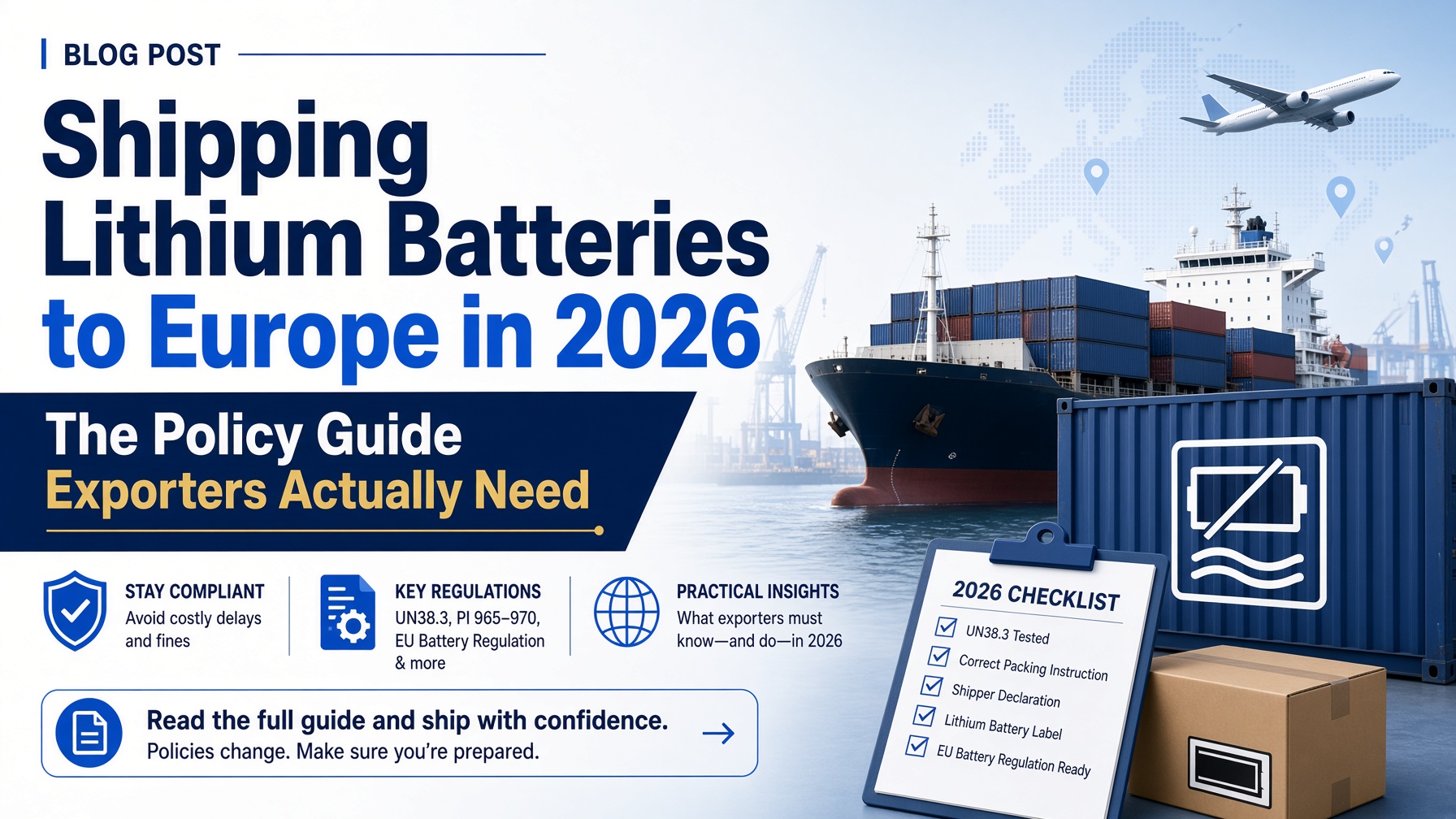
Non-negotiables for a clean European arrival:
- Valid UN 38.3 test evidence for the exact cell / battery type.
- Correct UN number — especially for storage containers.
- Inner protection against short circuit; UN-spec outer pack where required.
- Class 9 label plus lithium-battery mark on the same face as required.
- Shipper’s dangerous-goods declaration when the shipment is fully regulated.
- State of charge within the modal limit (air is unforgiving; IATA has been tightening SoC for batteries packed with equipment as well as for standalone UN3480).
Carriers and some EU ports apply operator variations on top of IATA / IMDG. Confirm the airline or shipping line before you book, not after the truck reaches the terminal.
5. China-side policy that changes the landed cost into Europe
European buyers care about EU law. They still pay a price that starts in China. Two 2026 tax changes matter for CIF / DDP quotes into Rotterdam, Hamburg, Antwerp or Piraeus.
5.1 VAT export rebate on battery products
Announcement No. 2 of 2026 of the Ministry of Finance and the State Taxation Administration:
- 1 April 2026 – 31 December 2026: VAT export rebate on listed battery products cut from 9% to 6%
- From 1 January 2027: rebate removed for those battery products
- Consumption-tax export exemption / refund policy is left unchanged by that notice
- The rebate rate follows the export date on the customs declaration
Lithium primary batteries, lithium-ion accumulators and vanadium flow batteries are in the battery list. From 2027, a Chinese exporter can no longer treat a 9% rebate as part of the Europe price.
5.2 Consumption tax is back — but direct exports are carved out
Announcement No. 20 of 2026 (Ministry of Finance, GACC and STA):
- From 1 September 2026, mercury-free primary cells, NiMH, lithium primary batteries, lithium-ion batteries and all-vanadium flow batteries are taxed at 2%
- From 1 September 2027, the rate rises to 4%
- Sodium-ion, solid-state and fuel cells stay exempt through 31 December 2028 (semi-solid is not treated as solid-state)
- Direct exports remain outside consumption tax; tax already paid on batteries later exported can be refunded
For a Europe-bound shipment that is declared as export at the Chinese port, consumption tax should not sit in the FOB as a sunk cost. The disappearing VAT rebate will.
5.3 Export-control pause — watch 10 November 2026
In October 2025 China published dual-use style controls on high-energy-density lithium-ion batteries (gravimetric energy density ≥ 300 Wh/kg), certain high-tap-density LFP cathodes, ternary precursors, artificial-graphite anode items, and related equipment and technology. Implementation was then suspended until 10 November 2026.
Until that date, those items do not need the extra dual-use licence solely because of that list. After that date, the pause may lapse. High-nickel / high-energy SKUs aimed at European premium EV programmes should have a licensing Plan B.
A separate easing already helps one niche product line: lithium–thionyl chloride cells or packs with ≤ 1 kg of thionyl chloride per unit no longer need the controlled-chemicals and dual-use licences from 1 January 2026, provided the content is correctly declared.
6. Member-State extras European buyers will still ask you about
EU regulations are directly applicable. National offices still run:
- EPR registration and eco-contribution (Stiftung ear in Germany, SYDEREP / relevant schemes in France, and equivalents elsewhere)
- language of labels and instructions
- waste-battery take-back contracts
- market-surveillance inspections at warehouse level
A pack that satisfies 2023/1542 can still be blocked in one Member State if nobody is registered as producer. Build a country matrix (DE / FR / NL / IT / ES / Nordics / PL) before you promise pan-EU distribution.
Carbon Border Adjustment Mechanism (CBAM) reporting for selected precursor materials can sit beside the battery rules. It does not replace the battery passport, but purchasing teams in Europe increasingly ask for both.
7. A practical checklist for 2026–2027 EU shipments
Before you sign the 2027 framework contract
- Name the EU importer or authorised representative in the contract
- Split SKUs: portable vs LMT vs EV vs industrial — duties differ
- Agree who owns carbon-footprint calculation and verification cost
- Reserve serial / QR architecture for the 18 February 2027 passport
- Map cobalt, lithium, nickel and graphite one tier beyond the cathode plant
- Confirm recycled-content pathway if the OEM has 2028–2031 targets
Before the cargo is booked
- UN 38.3 report matches the exact type shipped
- UN number and packing instruction match configuration (do not force BESS into UN3480)
- SoC, labels and DG declaration match IATA or IMDG
- Chinese export date is understood for the 6% vs 0% VAT rebate
- Consumption-tax refund paperwork is queued if tax was paid upstream
Before the first truck leaves the EU warehouse
- EPR number live in each target Member State
- Label set includes the separate-collection symbol and Article 13 information
- Technical file ready for a market-surveillance request
8. What this means commercially
Europe is not closing the door on imported lithium batteries. It is closing the door on undocumented ones.
The exporters who will still grow share in Germany, France, the Benelux ports and the Nordics are not necessarily the cheapest on a January 2026 spot quote. They are the ones who can hand a European OEM:
- a verifiable carbon number,
- a passport-ready data model,
- a named EU responsible person,
- a clean dangerous-goods file,
- a 2027 price that no longer assumes a 9% Chinese VAT rebate.
Everyone else will still find buyers in a tight spot. They will not find multi-year platform awards.