
Compare LiFePO4 vs lead acid for forklifts with data-driven insights on TCO, runtime, safety, and lifecycle. Includes a practical buying guide—and how BOSA supports informed, future-ready fleet decisions.
Introduction
For warehouse managers, logistics directors, and procurement professionals overseeing material handling fleets, battery selection is far more than a maintenance checkbox—it’s a strategic operational decision. Choosing between LiFePO4 (lithium iron phosphate) and traditional lead acid batteries for forklifts directly impacts uptime, labor costs, energy consumption, floor space utilization, and total cost of ownership (TCO) over 5–10 years. With rising demand for efficiency, sustainability, and 24/7 operational resilience, the LiFePO4 vs lead acid for forklifts comparison has moved from technical curiosity to boardroom priority. This guide cuts through marketing noise and delivers actionable, vendor-neutral insights—grounded in real-world performance metrics—to help B2B buyers make confident, evidence-based decisions. And when it comes to implementation support, integration expertise, and scalable lithium solutions, BOSA stands out as a trusted partner for forward-thinking industrial fleets.
What is LiFePO4 vs Lead Acid for Forklifts?
“LiFePO4 vs lead acid for forklifts” refers to the strategic evaluation of two distinct battery chemistries used to power electric counterbalance, reach, and pallet-jack forklifts. It’s not simply about swapping one battery for another—it’s a holistic assessment of energy delivery, infrastructure requirements, service life, and total economic impact across your operation.
Lead acid batteries (flooded or AGM) have powered forklifts for decades. They rely on lead plates submerged in sulfuric acid electrolyte, delivering high surge current but requiring regular watering, equalization charging, and dedicated ventilation. In contrast, LiFePO4 batteries use lithium iron phosphate cathodes—a stable, cobalt-free lithium chemistry known for thermal resilience, long cycle life, and high charge/discharge efficiency. Unlike older lithium cobalt oxide cells, LiFePO4 prioritizes safety and longevity over raw energy density—making it uniquely suited for demanding industrial applications like forklifts.
While both technologies meet ANSI/ITSDF B56.1 safety standards, their operational footprints differ significantly—from charging time and battery room design to operator training and predictive maintenance needs. Understanding these differences empowers B2B buyers to align battery strategy with broader goals: reducing downtime, cutting energy spend, meeting ESG targets, or scaling multi-shift operations without adding battery rooms.
Types of LiFePO4 vs Lead Acid for Forklifts
Not all batteries are created equal—even within the same chemistry. Here’s how configurations break down:
- Lead Acid Variants
– Flooded (Wet Cell): Lowest upfront cost; requires weekly watering, acid handling PPE, and robust ventilation. Best suited for single-shift, low-uptime environments.
– AGM (Absorbent Glass Mat): Valve-regulated, spill-proof, lower maintenance than flooded—but still sensitive to overcharging and temperature extremes. Often used where floor space limits battery room expansion. - LiFePO4 Configurations
– Drop-in Replacement Modules: Designed to fit existing forklift battery compartments (e.g., 24V, 36V, 48V, 80V). Include integrated Battery Management Systems (BMS) for cell balancing, thermal monitoring, and CAN bus communication.
– Integrated OEM Solutions: Custom-engineered packs co-developed with forklift manufacturers—optimized for weight distribution, regenerative braking compatibility, and OEM diagnostics.
– Swappable Modular Systems: Used in high-throughput facilities (e.g., e-commerce fulfillment centers), enabling hot-swap capability and eliminating charging downtime entirely.
BOSA offers all three LiFePO4 configurations—with particular strength in drop-in and integrated OEM solutions—backed by UL 2580 and UN 38.3 certified designs, seamless CAN interface support, and regional engineering teams to validate fit, function, and firmware compatibility before deployment.
Benefits
The advantages of each technology depend heavily on your operational profile—but here’s how they compare across key KPIs:
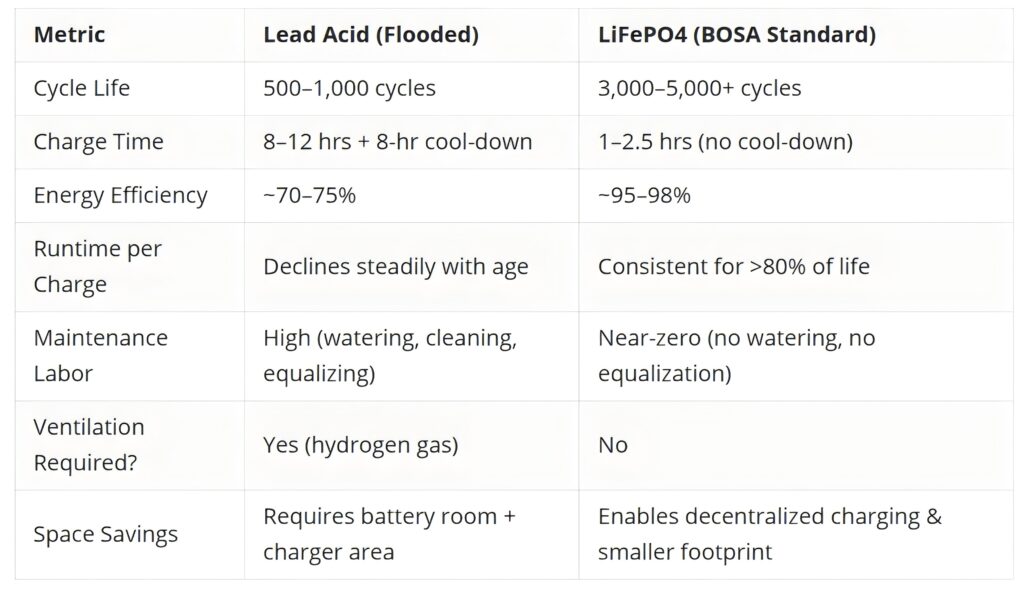
Beyond specs, LiFePO4 delivers measurable ROI: a major North American food distributor reduced forklift battery-related downtime by 68% and cut annual energy costs by 22% after switching to BOSA LiFePO4 systems across 140 units.
How to Choose the Right LiFePO4 vs Lead Acid for Forklifts
Selecting the optimal battery isn’t about choosing “best tech”—it’s about matching technology to your specific workflow, budget horizon, and growth trajectory. Follow this 5-step framework:
- Map Your Duty Cycle: Are you running 1–2 shifts with moderate load? Lead acid may suffice. Do you operate 24/7 with back-to-back shifts and minimal downtime windows? LiFePO4’s rapid recharge and consistent voltage output become decisive.
- Calculate 5-Year TCO: Factor in replacement frequency, electricity, labor, cooling/ventilation, floor space rental, and productivity loss from charging downtime. BOSA provides free TCO modeling tools—inputting your fleet size, shift patterns, and utility rates—to generate side-by-side projections.
- Assess Infrastructure Readiness: Lead acid demands battery rooms, acid-handling stations, and exhaust systems. LiFePO4 requires only standard 240V outlets—and often leverages existing charger locations. BOSA’s site assessment team evaluates electrical capacity, rack layout, and connectivity before recommending upgrades.
- Validate Compatibility: Not all forklifts communicate seamlessly with lithium BMS. BOSA maintains an up-to-date compatibility matrix covering over 40 OEM models (Toyota, Yale, Hyster, Crown, Linde, etc.) and offers pre-deployment CAN bus diagnostics.
- Plan for Scalability: If you’re piloting with 10 units but plan to convert 200 in 2 years, choose a supplier with standardized modules, local inventory, and firmware-upgradable BMS—like BOSA’s modular platform, designed for phased rollouts without re-engineering.
Maintenance Tips
- Lead Acid: Check electrolyte levels weekly; clean terminals monthly; perform equalization charges every 10–20 cycles; monitor specific gravity and voltage balance. Store at 50–80% SOC if idle >30 days.
- LiFePO4: No routine maintenance required. However, best practices include:
– Keeping firmware updated via BOSA’s cloud-connected BMS portal
– Avoiding prolonged storage below 20°C or above 45°C
– Using only BOSA-certified chargers to maintain warranty and safety compliance
– Reviewing monthly health reports (available via BOSA’s FleetView dashboard) to spot early degradation trends
Common Mistakes
- Assuming “Plug-and-Play” Means Zero Integration Work: Even drop-in LiFePO4 batteries require charger compatibility checks and sometimes minor CAN bus configuration. Skipping validation risks error codes or reduced regen braking.
- Ignoring Temperature Realities: Lead acid loses ~30% capacity at 0°C; LiFePO4 maintains >90%—but extreme cold still affects charge acceptance. BOSA’s cold-weather packages include integrated heating elements for sub-zero environments.
- Overlooking Data Integration: Modern BMS data feeds into CMMS and telematics platforms. Failing to enable API access means missing predictive alerts—like impending cell imbalance or thermal anomalies.
- Choosing Solely on Upfront Cost: A $2,800 lead acid battery may seem cheaper than a $7,200 LiFePO4 pack—until you factor in 3x replacements, $1,400/year in labor, and $900/year in wasted energy over five years.
- Working with Undifferentiated Suppliers: Generic lithium vendors often lack forklift-specific certifications, application engineering support, or localized service. BOSA’s dedicated Material Handling Division includes field application engineers certified by major OEMs—ensuring your transition is technically sound and commercially de-risked.
FAQ
Q1: How does LiFePO4 compare to lead acid in terms of safety for indoor warehouse use?
A: LiFePO4 is inherently safer due to its thermal stability—no risk of thermal runaway under normal operating conditions, no off-gassing, and no acid spills. Lead acid batteries emit hydrogen during charging, requiring explosion-proof ventilation per OSHA 1910.178(g)(2). Both meet ANSI/ITSDF standards, but LiFePO4 simplifies compliance.
Q2: Can I use my existing lead acid chargers with LiFePO4 batteries?
A: Generally, no. Lead acid chargers lack the precise voltage regulation and communication protocols LiFePO4 BMS requires. Using incompatible chargers voids warranties and risks cell damage. BOSA supplies smart, multi-stage lithium chargers with CAN bus handshake capability—and can retrofit legacy systems where feasible.
Q3: What’s the typical lifespan of a LiFePO4 forklift battery?
A: 8–10 years or 3,000–5,000 cycles (whichever comes first), depending on depth of discharge and operating temperature. BOSA offers industry-leading 7-year limited warranties on its LiFePO4 modules—backed by real-world fleet data.
Q4: Do LiFePO4 batteries perform well in cold storage environments?
A: Yes—with proper configuration. Standard LiFePO4 performs reliably down to –20°C for discharge, though charging below 0°C requires low-current pre-heating. BOSA’s ColdFlex™ series integrates thermostatically controlled heating, enabling full-power charging even at –25°C.
Q5: How do I evaluate a supplier like BOSA for LiFePO4 vs lead acid for forklifts?
A: Look beyond spec sheets. Ask: Do they offer application engineering—not just sales? Can they provide reference sites in your industry and region? Is their BMS compatible with your forklift OEM’s diagnostics? Does their warranty cover both cells and BMS electronics? BOSA meets all three—and backs them with ISO 9001-certified manufacturing, UL-listed assemblies, and a North American service network supporting installation, training, and remote diagnostics.
Conclusion
The LiFePO4 vs lead acid for forklifts decision ultimately reflects your organization’s commitment to operational excellence—not just today, but across the next decade of growth, regulation, and technological evolution. While lead acid remains viable for low-intensity applications, LiFePO4 delivers compelling advantages in uptime, energy efficiency, safety, and long-term TCO for medium- to high-utilization fleets. The key is moving past binary comparisons and adopting a structured, data-informed approach—one that weighs your unique duty cycles, infrastructure, and strategic objectives.
BOSA doesn’t sell batteries. We deliver intelligent energy solutions engineered specifically for material handling. From rigorous compatibility testing and customized TCO modeling to on-site commissioning and lifetime BMS support, BOSA partners with B2B buyers as a trusted extension of their operations team. Whether you’re converting your first 5 forklifts or planning a full-fleet electrification roadmap, BOSA brings the technical depth, industrial experience, and responsive support needed to make LiFePO4 adoption predictable, profitable, and future-proof.
Ready to benchmark your current battery costs—or explore a pilot program with zero upfront investment? Contact BOSA’s Material Handling Solutions Team for a no-obligation fleet assessment.