
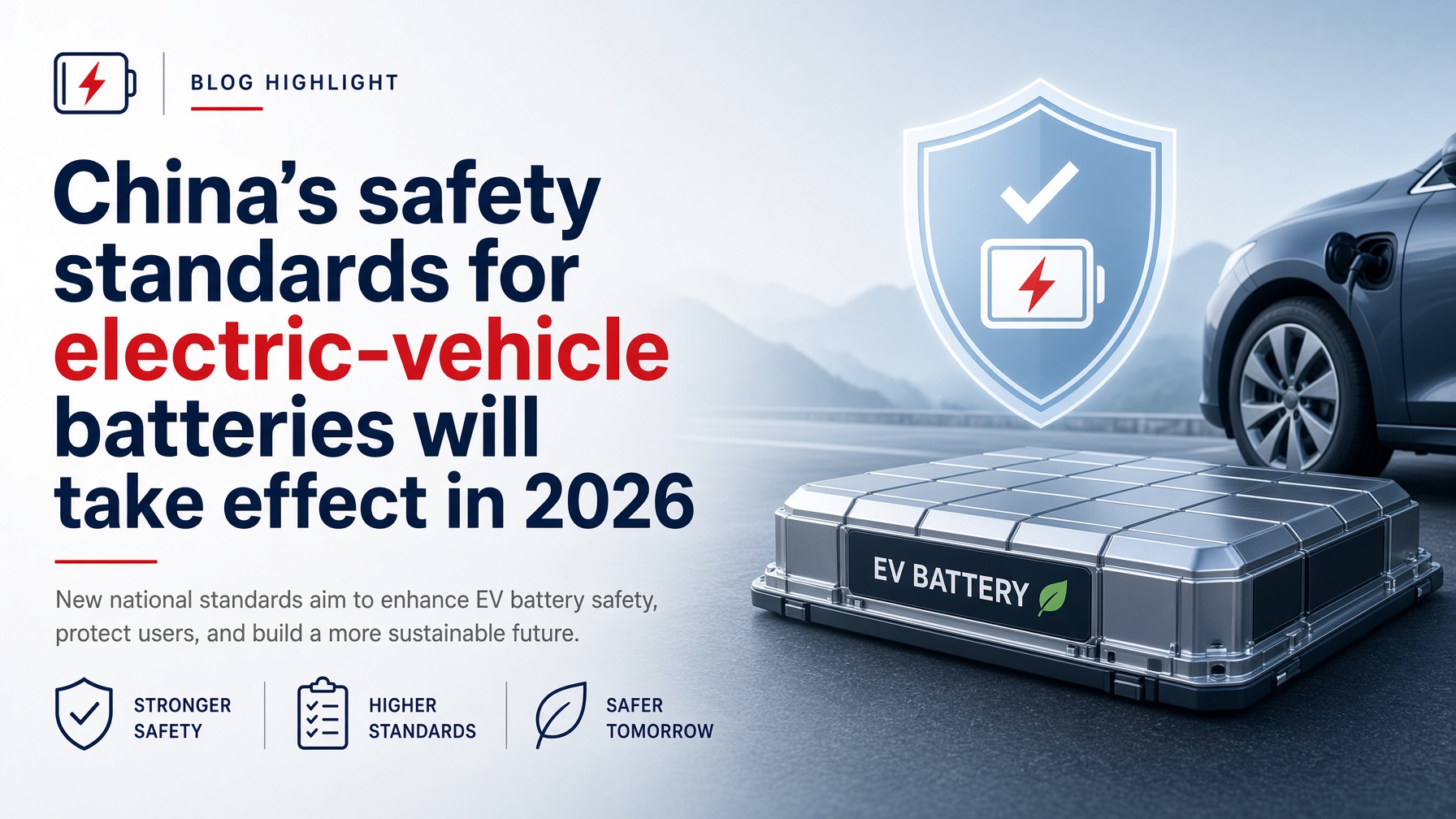
China’s mandatory national standards for electric-vehicle traction batteries and vehicle-level electrical safety entered force on 1 July 2026. The two core documents—GB 38031-2025 (Electric vehicles traction battery safety requirements) and GB 18384-2025 (Electric vehicles safety requirements)—replace the 2020 editions and establish the world’s first enforceable “no fire, no explosion” rule for power batteries after single-cell thermal runaway.
For fleet buyers, OEMs, and battery suppliers, the practical consequence is immediate: new vehicle models declared after the effective date must demonstrate system-level intrinsic safety, while existing models received a one-year transition window until 1 July 2027. Understanding the precise technical thresholds, cost implications, and verification methods is now essential for procurement and product planning decisions.
Core Requirements of the New Standards
GB 38031-2025 shifts the safety paradigm from post-event warning to pre-event prevention. The decisive change is the thermal-propagation test:
| Requirement | GB 38031-2020 (previous) | GB 38031-2025 (current) |
|---|---|---|
| Thermal runaway outcome | Warning signal ≥5 min before fire or explosion | No fire and no explosion for ≥120 min observation period |
| Smoke | Not specified | Must not enter passenger compartment or harm occupants |
| Bottom impact | Not required | 30 mm steel ball / 150 J energy, three impacts; no leakage, rupture, fire or explosion |
| Fast-charge durability | Not required | 300 fast-charge cycles (typically 20–80 % SOC) followed by external short-circuit test; no fire or explosion |
| High-voltage isolation | Software-based acceptable | Physical one-touch cutoff required under companion standard GB 18384-2025 |
The companion vehicle standard, GB 18384-2025, mandates an independent hardware high-voltage disconnect that can be operated by a single tap or long press and functions without reliance on the vehicle’s main controller software. This dual-layer architecture—battery pack intrinsic safety plus vehicle-level physical isolation—addresses the most common real-world failure modes: underbody debris strikes, curb impacts, and cumulative degradation from repeated high-power charging.
Implementation Timeline and Scope
- 1 July 2026: New vehicle models and major variants must comply fully with both standards to receive type approval.
- 1 July 2027: All previously approved models still in production must meet the new requirements or cease sales.
- Scope is limited to traction (propulsion) batteries; auxiliary or non-propulsion batteries remain outside the mandatory provisions of GB 38031-2025.
Industry data indicate that approximately 78 % of domestic battery makers already possessed mature non-propagation designs by mid-2026; the remaining capacity is either investing in upgrades or exiting the passenger-car segment. System-level cost increases are estimated at 15–20 %, or roughly RMB 3 000–5 000 per vehicle pack, with leading LFP producers absorbing a larger share through scale.
Practical Implications for Buyers and Fleet Managers
China’s safety standards for electric‑vehicle batteries will take effect in 2026 and have already raised the baseline for risk assessment in procurement. Key operational effects include:
- Lower residual risk of thermal events in high-utilisation fleets (delivery, ride-hailing, industrial).
- Clearer documentation trail for insurance underwriting and residual-value modelling.
- Preferential treatment for packs that can demonstrate “no fire, no explosion” certification in export markets that are aligning with Chinese technical requirements.
- Accelerated phase-out of low-cost ternary packs that cannot economically meet the new containment criteria, reinforcing LFP’s structural advantage in thermal stability.
When specifying batteries, request the formal test reports covering the updated thermal-propagation protocol, bottom-impact results, and the 300-cycle fast-charge short-circuit sequence. Verify that the vehicle-level physical disconnect is present and independently operable.
Buyer Checklist
- Confirm the vehicle or battery system carries type-approval documentation referencing GB 38031-2025 and GB 18384-2025.
- Obtain the thermal-propagation test report showing ≥120 min without fire or explosion and no passenger-compartment smoke intrusion.
- Verify bottom-impact and post-fast-charge short-circuit test results are included.
- Inspect the high-voltage isolation device: it must be a physical hardware switch independent of software.
- For multi-shift or high-mileage fleets, prioritise chemistries and pack architectures already proven at scale under the new regime (primarily LFP with advanced thermal barriers).
- Factor the estimated 15–20 % pack cost uplift into total-cost-of-ownership models, offset by reduced insurance premiums and lower downtime risk.
- For used or residual stock vehicles, note the 2027 compliance deadline and residual warranty exposure.
Preguntas frecuentes
Do the standards apply only to new vehicles?
New models and major changes require full compliance from 1 July 2026. Existing approved models may continue production until 1 July 2027 provided they ultimately meet the requirements.
Is “no fire, no explosion” absolute?
The requirement is that a single-cell thermal runaway must not propagate into fire or explosion of the pack within the defined observation window, and any smoke must not endanger occupants. An alarm is still required.
How do these rules affect battery chemistry choice?
LFP’s higher thermal-runaway onset temperature and lower energy release give it a structural compliance advantage. Leading producers of both LFP and high-nickel chemistries have already commercialised non-propagation designs, but cost differentials favour LFP for most volume applications.
Will the standards influence global markets?
Chinese type-approval data and test methods are increasingly referenced by regulators in Southeast Asia, the Middle East and parts of Europe. Export-oriented OEMs treat compliance as a baseline credential.
Is there a related durability standard?
Yes. The recommended standard GB/T 46991.1-2025 addresses state-of-certified-energy (SOCE) display accuracy (±5 %) and minimum capacity retention thresholds at defined age/mileage points. It complements but is separate from the mandatory safety rules.
Decision Framework
When evaluating electric-vehicle batteries after the 2026 regulatory shift, apply the following sequence:
- Regulatory gate: Does the pack and vehicle carry valid GB 38031-2025 / GB 18384-2025 documentation?
- Technical verification: Have the thermal-propagation, bottom-impact and post-300-cycle short-circuit tests been passed under the new protocols?
- Architecture fit: Is the high-voltage disconnect a true physical device independent of software control?
- Chemistry and cost: Does the selected chemistry deliver the required safety margin at acceptable total cost of ownership for the duty cycle?
- Supply resilience: Can the supplier demonstrate production-scale compliance rather than prototype-level results?
China’s safety standards for electric‑vehicle batteries will take effect in 2026 and have already reset the minimum acceptable safety floor for the world’s largest EV market. Buyers who treat the new thresholds as a procurement filter rather than a compliance afterthought will reduce operational risk and position their fleets for both domestic and export requirements.
Authoritative References
- Official announcement: “China’s new EV battery safety standard to take effect in July 2026”, English.gov.cn (Xinhua / MIIT), 15 April 2025. https://english.www.gov.cn/news/202504/15/content_WS67fe4271c6d0868f4e8f1b70.html
- Implementation coverage: “China’s toughest battery safety rules take effect in July, raising bar for makers”, CnEVPost, 30 June 2026. https://cnevpost.com/2026/06/30/china-toughest-battery-safety-rules-take-effect-july/
- Official enforcement report: “Stricter rules on battery safety put into force”, China Daily, 6 July 2026. https://www.chinadaily.com.cn/a/202607/06/WS6a4b0d04a310986e2b463ae3.html
- Technical summary: “Stricter EV and battery standards take effect in China”, electrive.com, 1 July 2026. https://www.electrive.com/2026/07/01/stricter-ev-and-battery-standards-take-effect-in-china/
- Standard status confirmation: National public service platform for standards information (SAMR), GB 38031-2025, published 28 March 2025, implemented 1 July 2026. https://openstd.samr.gov.cn/