
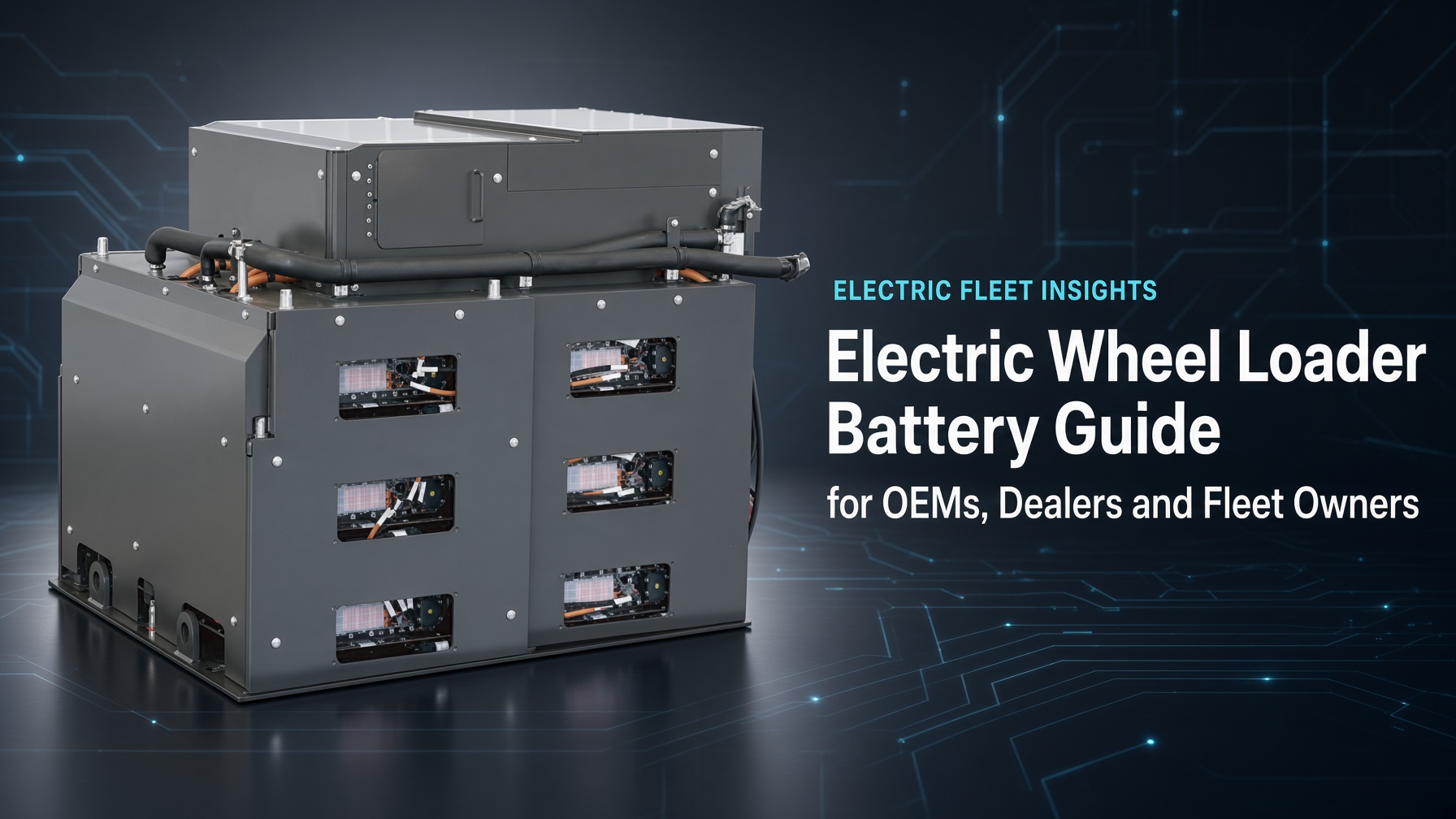
An electric wheel loader battery is not a drop-in energy box. It is a traction system that must match voltage architecture, peak hydraulic current, thermal path, CAN protocol, enclosure rating and the real duty cycle of the site. In 2026 production packs run from compact 32–64 kWh modules on 5–7 tonne machines to 256–432 kWh mid-size packs and 700–1,001 kWh large loaders. Published runtimes of “up to 8 hours” only hold when usable energy, C-rate and charging windows are sized to the work, not to the brochure.
The market has already moved past the prototype stage. China’s first-half 2026 loader sales reached 82,052 units, of which 25,445 were electric — up 82.4% year on year — and domestic electric penetration hit 57%. Through August 2026 the same China Construction Machinery Association series shows 104,658 loaders sold year to date; domestic electric units reached 30,480 and electric exports 2,575. August itself delivered 10,832 loaders, with electric machines at 3,056 units (56% of the month) and electric exports at 476 units (8.8% of exports). SANY shipped 403 electric wheel loaders in August 2026 alone. That volume does not change the specification problem. It only raises the cost of getting the pack wrong.
Electric Wheel Loader Battery Guide for OEMs, Dealers and Fleet Owners is a specification document first. Measure average kWh per productive hour, keep end-of-shift state of charge (SOC) above 20–30%, treat 15–40% opportunity charges as part of capacity, and require industrial safety marks before the machine ships. This briefing maps 2026 OEM packs, shows how duty sizes energy and cooling, and gives each buyer group — OEM, dealer, fleet owner — a decision method that survives a full shift.
Key Takeaways
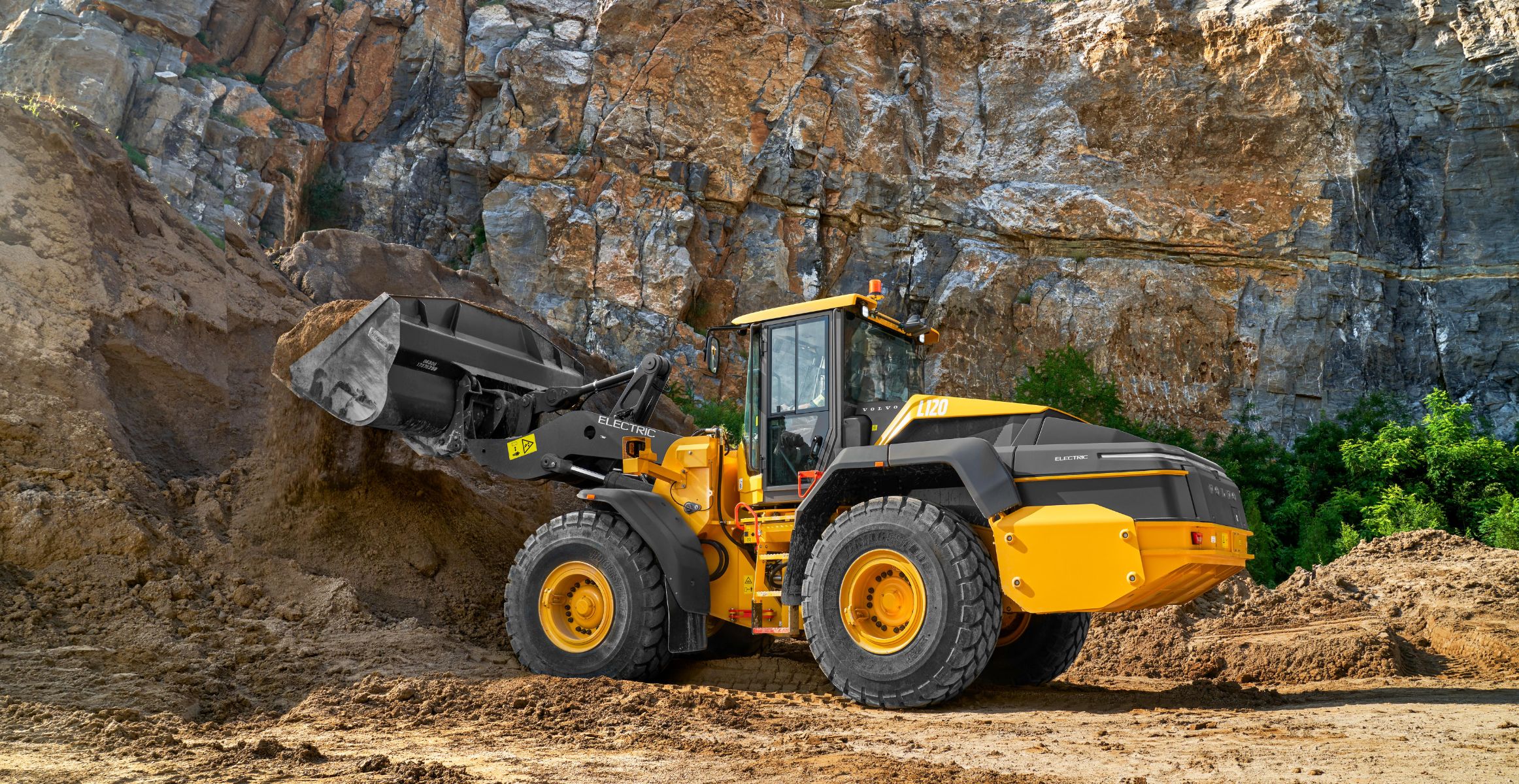
- Pack energy in 2026 clusters by class: compact 32–64 kWh (Liebherr L 507 E 32.2 / 64.4 kWh at 322 V; Cat 906 Electric 64 kWh installed / 55 kWh usable NMC at ~300–306 V), mid-size 256–432 kWh (Cat 950 GC Electric 256 kWh at 600 V; Volvo L120 Electric 282 kWh installed / 268 kWh usable LFP at 600–618 V; SANY SW956E 282 / 350–359 kWh CATL LFP; LiuGong 856H-E Max 423–432 kWh CATL LFP at 618 V), large 700–1,001 kWh (LiuGong 8110TE 706 kWh; XCMG XC9108-EV 700 kWh; XCMG XC9150-EV 1,001 kWh CATL).
- LiFePO₄ (LFP) is the default chemistry on production mid-size and large loaders because of thermal stability and ≥3,500–5,000 cycles at 80% depth of discharge (DoD). Compact platforms still use NMC where chassis volume is the constraint — Cat’s 906 Electric is an NMC, passively air-cooled 64 kWh pack. Industrial cells and packs should carry IEC 62619. Traction packs treated as EV systems should carry UL 2580. Transport requires UN 38.3.
- Runtime is application-dependent. Volvo rates the L120 Electric at 5–9 hours on light-to-medium duty. Cat rates the 950 GC Electric at up to 8 hours with a mid-shift 45-minute charge at up to 290 kW, and the 906 Electric at up to 8 hours with a mid-shift charge. Liebherr rates the L 507 E at up to 8 hours on 32.2 kWh and up to 16 hours on the optional 64.4 kWh second pack.
- Opportunity charging that restores 15–40% during breaks is how two-shift and heavy-rehandling sites close the energy gap without buying a second pack. Match charger power to the real break, not to a theoretical hour.
- Volvo publishes ~30% lower maintenance and, in Asia-market literature, ~65% lower energy cost versus the diesel equivalent. A LiuGong 856E that worked a corrosive phosphate plant from 2022 reached 19,977 hours with 86.8% state of health (SOH), 455,000 kWh throughput and 534 t CO₂ avoided. Those figures only hold if SOC, thermal management and charger handshake stay inside the design window.
- Specify the pack as part of the machine: voltage, usable kWh, continuous and peak current, liquid thermal loop on mid-size 600 V systems, IP65–IP67 enclosure, BMS lock-out, CCS2 / GB/T / Type 2 connector, and a warranty written in both hours and residual capacity.
Table of Contents
- Why the Pack Is a System, Not a Commodity
- 2026 OEM Pack Map
- Duty Cycle and Energy Sizing
- Chemistry, C-Rate and Thermal Design
- Charging Architecture
- What Each Buyer Must Specify
- Certification and Integration
- TCO Levers That Actually Move the Number
- OEM, Dealer and Fleet Checklist
- Preguntas frecuentes
- Decision Framework
- Authoritative References
Why the Pack Is a System, Not a Commodity
A wheel loader spends its energy on travel, lift, tilt, steering and hydraulic attachments. Peak current arrives when the machine piles into a stockpile and raises the boom at the same time. Average current is much lower. The pack must deliver both without voltage sag that starves the inverter or heat that shortens cycle life.
Voltage architecture is the first lock. Compact electrics commonly sit at 300–322 V. Mid-size production machines sit at 600–618 V. Large Chinese platforms sit near 580–720 V on 700–1,001 kWh LFP packs. Mixing a 48 V industrial module into a 600 V traction bus is not a retrofit; it is a new high-voltage design.
Usable energy is not nameplate energy. Volvo lists 282 kWh installed and 268 kWh usable on the L120 Electric — 95% of nameplate, with the reserved band used for BMS protection, cold-weather derate and end-of-life fade. Cat’s 906 Electric publishes 64 kWh installed and 55 kWh net usable on the European datasheet. Size the shift against usable kWh and a 20–30% SOC floor, not against the larger printed number.
Mechanical design is part of the electrical spec. Loaders take stone strike, wash-down, dust and vibration. IP65 is the indoor / paved-yard minimum. IP67 is the outdoor and corrosive-plant default on machines such as the LiuGong 856H-E Max. The enclosure, isolator, service disconnect and BMS lock must survive the same abuse as the chassis.

2026 OEM Pack Map
Use this table as the first filter. Capacities and charge figures are OEM-published. Runtime footnotes are the duty-cycle clause.
| Machine | Class | Pack / chemistry | Voltaje | Published runtime | Charge path |
|---|---|---|---|---|---|
| Liebherr L 507 E | Compact stereo, ~5.9 t | 32.2 kWh std / 64.4 kWh optional Li-ion | 322 V | Up to 8 h / up to 16 h | Type 2 / CCS2; 22 kW onboard 1.1–2.1 h (10–90%); optional DC to 45 kW |
| Cat 906 Electric | Compact, ~6.2 t | 64 kWh installed / 55 kWh usable NMC, air-cooled | 300–306 V | Up to 8 h with mid-shift charge | Onboard AC: 6 kW max single-phase overnight; 18 kW max three-phase |
| Volvo L120 Electric | Mid-size, ~20 t | 282 kWh installed / 268 kWh usable LFP | 600–618 V | 5–9 h light–medium duty | CCS2 or GB/T; DC 165–282 kW by market; 20–80% in ~2 h at 165 kW; 10–100% in ~1 h 40 min at 180 kW; 40 kW overnight ~7 h; PU750 ~250 kW ≈ 1 h 50 min |
| Cat 950 GC Electric | Mid-size, ~19.8 t | 256 kWh | 600 V | Up to 8 h with 45-min mid-shift charge at max 290 kW | 22 kW AC onboard; DC max 290 kW CCS2 liquid-cooled |
| SANY SW956E | Mid-size ~19–20 t | CATL LFP 282 / 350–359 kWh | 450–657 V band | 4–6 h (282) / 6–8 h (350) typical; some markets 6–10 h | Dual CCS2 up to 2 × 150 kW; EU sheet 15–93% in ~60 min at 2 × 150 kW |
| LiuGong 856H-E Max | Mid-size ~21–22 t | CATL LFP 423 kWh (EU) / 432 kWh (NA spec) | 618 V | 8.6 h heavy / 11.7 h light (EU literature) | ~90 min at 300 kW; IP67 pack; liquid cooling; 5 yr / 10,000 h battery–motor–controller warranty |
| LiuGong 8110TE | Large quarry | 706 kWh LFP (pack also used as counterweight) | HV traction bus | Production-shift quarry duty | Dual ports up to ~600 kW; ~1 h recharge at high-output infrastructure |
| XCMG XC9108-EV | Large, ~35 t / 11 t payload | CATL LFP 700 kWh | 580 V | 7–9 h typical; ≥8 / 7 h light / medium in CN sheet | Dual-gun CCS2 2 × 320 kW; 80 kW onboard; CN market four-gun GB/T |
| XCMG XC9150-EV | Extra-large, ~59 t | CATL LFP 1,001 kWh | HV / MCS-ready | 8–9 h published | CCS2 720 kW; MCS 1,200 kW; 100 kW onboard; ~105 kWh/h mixed draw in dealer literature |
Sources: Volvo L120 Electric product data, Caterpillar battery-electric machine page, Liebherr IFAT 2026 L 507 E brief and the April 2026 L 507 E specification sheet, SANY Europe SW956E, LiuGong 856H-E Max NA spec, XCMG XC9108-EV.
The spread inside one size class is the point. A 20-tonne loader is not “a 280 kWh machine.” It is a 256, 282, 350 or 432 kWh machine depending on whether the OEM expects a mid-shift DC plug. A 35–59 tonne electric is a 700–1,001 kWh machine with megawatt-class yard power, not a stretched mid-size pack.

Duty Cycle and Energy Sizing
Duty cycle is the sequence of travel, pile penetration, lift, dump and idle. Power profile is the kW at each step. Capacity is the area under that curve plus margin.
Planning bands for 2026 fleets:
| Duty class | Typical work | Compact 5–7 t draw | Mid-size 18–22 t draw | Large 35–59 t draw | Planning implication |
|---|---|---|---|---|---|
| Light | Indoor recycling, paved yard, frequent pauses | ~4–8 kWh/h | ~25–40 kWh/h | ~60–80 kWh/h | Overnight AC often enough on the larger compact pack |
| Medium | Rehandling, truck loading, mixed travel | ~8–12 kWh/h | ~40–55 kWh/h | ~80–105 kWh/h | Size to 7–8 h usable with 20–30% SOC floor; schedule 15–40% opportunity charge |
| Pesado | Quarry face, steep short cycles, two-shift continuous | ~12–18 kWh/h | ~55–80+ kWh/h | ~105–130+ kWh/h | Need larger pack, liquid cooling, DC in the break window, or a modular second pack |
XCMG European dealer literature on the XC9108-EV quotes ~90 kWh/h on mixed large-loader work. XC9150-EV dealer literature quotes ~105 kWh/h. Those figures are why a 700–1,001 kWh pack is not oversized for an 11–15 tonne payload machine.
A workable sizing method:
- Log at least five representative shifts with the bucket and attachment mix you actually use.
- Compute average kWh per productive hour. Separate travel-heavy days from stockpile days.
- Multiply by the longest productive window before a planned charge.
- Add 10–20% for adverse material, cold start and incomplete opportunity charging.
- Divide by the usable window (typically 0.70–0.80 of nameplate if you honour a 20–30% SOC floor).
- Confirm peak current for simultaneous travel-plus-lift does not hit BMS limits.
- Confirm charger power can restore 15–40% inside the real break.
Worked mid-size example. Medium rehandling at 50 kWh/h × 7 productive hours = 350 kWh throughput. Add 15% site margin → 403 kWh. With a 25% SOC floor, nameplate ≈ 537 kWh if there is no mid-shift charge. Introduce a 45-minute 250–290 kW opportunity charge that restores ~15–25% and the 256–282 kWh OEM packs become viable. That is the arithmetic behind Cat’s “up to 8 hours with a mid-shift 45-minute charge” and Volvo’s 5–9 hour band.
Worked compact example. Medium yard work at 10 kWh/h × 6 hours = 60 kWh. Add 15% → 69 kWh throughput. Honour a 25% SOC floor → nameplate ≈ 92 kWh with no mid-shift charge, or the published 64 kWh Cat 906 / optional 64.4 kWh Liebherr pack if a lunch charge is scheduled. Liebherr’s dual-pack option (32.2 + 32.2 kWh) is the compact version of the same idea: buy energy in modules matched to the shift, not a single oversized box.
Electric Wheel Loader Battery Guide for OEMs, Dealers and Fleet Owners at this step is a measurement problem. “Operate all day” is not a requirement. “Complete a six-hour productive window at 0 °C and finish above 20% SOC” is.
Chemistry, C-Rate and Thermal Design
LFP is the industrial default on production mid-size and large wheel loaders in 2026. Volvo specifies Lithium Iron Phosphate on the L120 Electric. LiuGong, SANY and XCMG specify CATL LFP. Reasons that survive a jobsite:
- Thermal-runaway threshold near 270 °C versus a lower threshold on many NMC formulations.
- Published cycle life ≥3,500–5,000 at 80% DoD to ~80% residual capacity on industrial cells. SANY’s European SW956E sheet lists >2,800 full discharge cycles on the 350 kWh CATL pack — treat that as a floor, not a target.
- Lower cell cost and simpler thermal management for the 5–10 year machine life that fleet owners actually hold.
NMC or NCA still appears where the chassis cannot accept the volume of a lower-density LFP pack of the same kWh. Cat’s 906 Electric is the current compact example: 64 kWh NMC, passively air-cooled, 55 kWh usable, ambient window about −18 °C to 43 °C. That is an OEM packaging decision, not a fleet preference. Aftermarket replacements for compact and mid-size machines should stay on LFP unless the inverter and thermal loop were designed for a different chemistry.
C-rate sets interconnects, fusing and cooling. A pack sized only for average energy will current-limit when the operator piles in and raises the boom. Specify continuous discharge and a 10–30 second peak that covers the hydraulic spike. Recuperation on braking and downhill travel returns energy; it does not remove the need for peak-discharge hardware.
Thermal hardware decides whether the cycle rating is real. Mid-size 600 V packs on 20-tonne loaders use active liquid cooling and heating. Volvo states active cooling and heating of the high-voltage battery on the L120 Electric (−25 °C to 45 °C operating window in the product guide). LiuGong specifies intelligent liquid temperature control and an IP67 pack on the 856H-E Max. Air-cooled compact modules are acceptable on light 40–60% utilisation. They are not acceptable on two-shift rehandling. Heat is what converts a 4,000-cycle datasheet into a 1,500-cycle field result.
Charging Architecture
Charging is inventory policy. The pack you buy is only as large as the charger you can plug in during the shift you actually run.
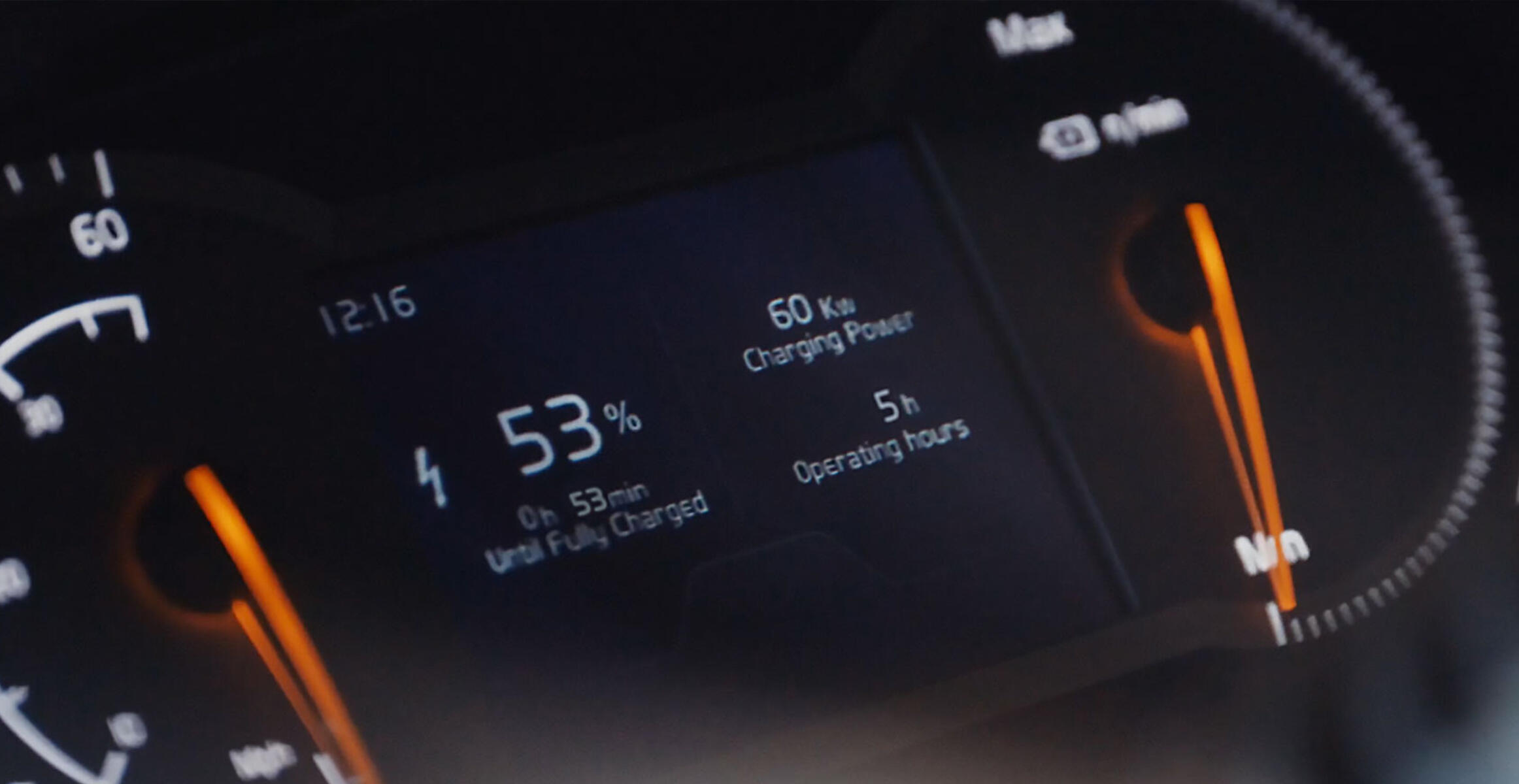
Overnight AC. Onboard 6–22 kW covers compact machines. Cat’s 906 Electric is explicit: 6 kW max single-phase overnight and 18 kW max three-phase. Volvo publishes a 40 kW DC / ~7-hour path for the L120 Electric. Use overnight AC when the machine parks 8–12 hours.
Opportunity DC. 15–40% restored in a 20–45 minute break is the multi-shift lever. Cat’s 950 GC Electric is explicit: up to 8 hours with a mid-shift 45-minute charge at max 290 kW on CCS2 with a liquid-cooled cable. Volvo’s 165–180 kW DC path puts 20–80% in about two hours and 10–100% in about 1 hour 40 minutes; the PU750 ~250 kW unit is published at about 1 hour 50 minutes. SANY’s dual CCS2 at 2 × 150 kW is the European mid-size equivalent (15–93% in about 60 minutes on the EU sheet).
High-power dual-gun and MCS. Large loaders such as the XCMG XC9108-EV publish dual CCS2 at 2 × 320 kW in Europe and four-gun GB/T in China. The XC9150-EV publishes 720 kW CCS2 and 1,200 kW MCS. That architecture is for sites that already have megawatt-class yard power. Do not specify it for a municipal depot that only has a 63 A three-phase tap.
Modular second pack. Liebherr’s 32.2 / 64.4 kWh option is the compact version of buying time instead of buying charger power. A second factory pack is often cheaper than a 300 kW yard charger on a one-machine site.
Keep daily work above 20–30% SOC. Short opportunity charges that stay inside 20–80% SOC are easier on LFP than repeated deep discharges to cutoff followed by a 100% overnight top. Charge inside the published temperature window. Below about −10 °C an LFP pack without a thermal pad loses a large share of available energy; Volvo and Cat both publish active thermal loops on mid-size machines for that reason.
Connector standard must be decided at order. CCS2 is the European and North American mid-size default. GB/T appears on China-market Volvo and on many Chinese OEM machines. Type 2 AC plus optional CCS2 is the Liebherr compact path. MCS appears only on extra-large platforms. A dealer that stocks the wrong inlet sells a machine that cannot use the customer’s charger.
What Each Buyer Must Specify
OEMs. Lock voltage, usable kWh, continuous and peak current, thermal loop, enclosure rating, CAN map, crash and vibration qualification, and service disconnect before the first prototype leaves the lab. The pack is a structural and electrical member — LiuGong’s 8110TE uses the pack as counterweight. Changing it after type approval is a new machine. Require cell- and pack-level IEC 62619, UL 2580 where the traction system is treated as an EV, UN 38.3 for shipping, and a BMS that can lock the machine on a fault rather than only open a contactor. Design the charge inlet and liquid-cooled cable path at the same time as the pack. Volvo’s L120 Electric and Cat’s 950 GC Electric both treat charger, pack and driveline as one product.
Dealers. Sell the charging plan with the machine. A 282 kWh loader without a 150 kW+ DC option on a two-shift rehandling yard is an incomplete quote. Stock the correct inlet adaptor, the OEM-matched charger, and a spare high-voltage connector set. Train technicians on isolation, SOH readout and connector inspection — those three items replace watering as the hands-on maintenance on lithium fleets. Do not quote “up to 8 hours” without writing the duty assumption and the mid-shift charge into the proposal.
Fleet owners. Buy hours, not nameplate kWh. Log energy for two weeks before you sign a multi-unit order. Write the SOC floor, opportunity-charge window and residual-capacity warranty into the contract. Track SOH monthly. LiuGong’s public 19,977-hour / 86.8% SOH phosphate-plant case is the benchmark; it is also the result of staying inside the thermal and SOC window in a harsh plant. Budget charger infrastructure in year one. A pack that is 15% oversized and a charger that is 15% underpowered is the expensive combination.
Este Electric Wheel Loader Battery Guide for OEMs, Dealers and Fleet Owners treats those three roles as one specification chain. A weak link in any of them shows up as a machine that dies at 14:30.
Certification and Integration
Minimum pack marks for a 2026 production loader:
| Estándar | What it covers | Who should require it |
|---|---|---|
| IEC 62619 | Safety of secondary lithium cells and batteries in industrial / motive applications | Every OEM and every aftermarket pack |
| UL 2580 | Batteries for electric vehicles and mobile equipment — electrical, mechanical and thermal abuse | North American traction systems and any pack sold as an EV component |
| UN 38.3 | Transport testing of lithium batteries | Every shipped pack, including service replacements |
| IEC 60529 (IP65–IP67) | Ingress of dust and water | Outdoor and wash-down machines; IP67 preferred on corrosive sites |
| ISO 13849 / functional-safety BMS | Performance level of the safety functions that isolate the pack | OEMs integrating a third-party pack into a type-approved machine |
The BMS must speak the machine’s CAN language, report SOC / SOH / cell-temperature / isolation resistance, and lock propulsion and hydraulics on a hard fault. A pack that only flashes a light is not integrated. High-voltage interlock, manual service disconnect and a labelled isolation point are part of the same package.
Aftermarket or retrofit packs for compact loaders must reproduce voltage, current limits, pre-charge, interlock and envelope. An 80 V 560 Ah industrial module that worked on one compact platform is not a universal loader battery. Treat every retrofit as an engineering project with a change-control file.
TCO Levers That Actually Move the Number
Capital cost of the pack is visible. The levers that change five-year cost are not.
| Lever | Published signal | What the model must include |
|---|---|---|
| Energía | Volvo Asia literature ~65% lower energy cost vs diesel L120 | Industrial tariff, charger efficiency, idle vs productive kWh |
| Mantenimiento | Volvo 30% lower; LiuGong EU literature up to 50% lower maintenance / up to 70% lower 5-year opex | Connector, coolant-loop and SOH inspection replacing engine service |
| Uptime | Opportunity charging that restores 15–40% | Removal of a spare machine or spare pack from a two-shift roster |
| Residual capacity | LiuGong 5 yr / 10,000 h battery–motor–controller warranty; 19,977 h at 86.8% SOH in a phosphate plant | Warranty written to hours and remaining capacity, not calendar years only |
| Infrastructure | Industrial-lithium fleet studies put charger-upgrade spend at 50–60% of conversion budget | Yard board sized before the second machine is ordered |
| Volume | SANY 403 electric loaders in August 2026; China H1 domestic electric penetration 57%; Jan–Aug domestic electric 30,480 / electric exports 2,575; August electric share 56% | Supply is proven; site energy is not |
Do not model TCO on “up to 8 hours” and a residential electricity rate. Model it on measured kWh/h, the industrial tariff, the mid-shift charge window, and one pack life to 80% SOH.
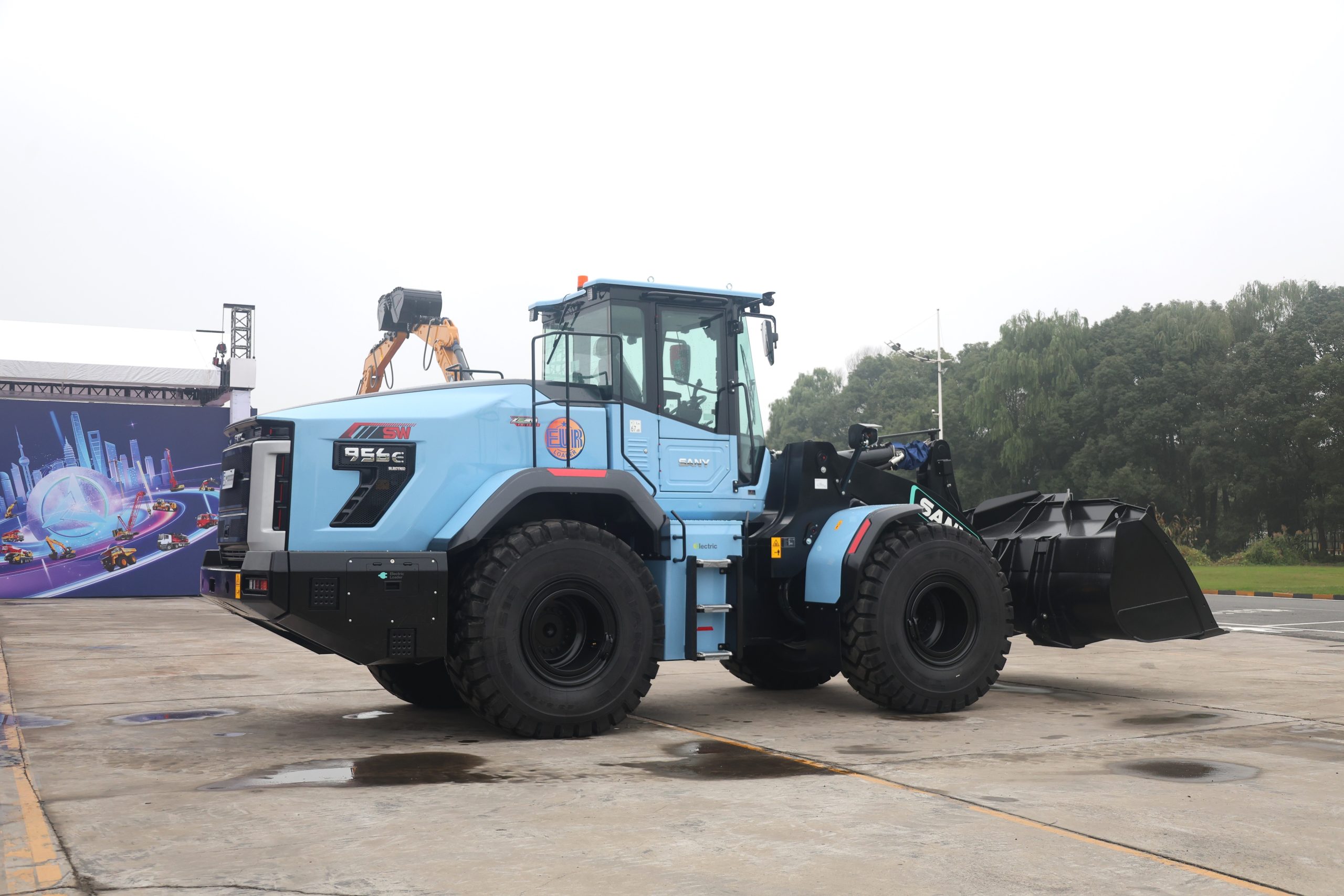
Export is the next constraint, not domestic volume. Electric loaders were roughly 4% of Chinese loader exports in H1 2026 and 8.8% in August. XCMG’s first overseas new-energy plant at Weda Bay, Indonesia, started production on 27 July 2026 with the six-tonne XC968-EV. SANY completed a 40-unit SW970E delivery to a Thai rice mill on 17 July 2026 and booked a further 50 SW956E units at the handover. Dealers outside China now have to specify inlet standard, grid capacity and residual-capacity warranty in the same quote that used to stop at bucket size.
OEM, Dealer and Fleet Checklist
- Duty written as productive hours, material, travel share and ambient range — not “all day.”
- Usable kWh sized so the hardest representative shift ends above 20–30% SOC after a 10–20% margin.
- Chemistry LFP unless the OEM chassis forces a denser cell; cycle rating ≥3,500 at 80% DoD.
- Continuous and peak current confirmed against simultaneous travel-plus-lift.
- Active liquid thermal management on mid-size 600 V packs; thermal pad or loop on compact packs that work below 0 °C.
- Enclosure IP65 minimum, IP67 on outdoor and corrosive sites.
- Charge inlet decided (CCS2, GB/T, Type 2, MCS on extra-large) and charger power matched to the break window so 15–40% can be restored.
- IEC 62619 on cells and pack; UL 2580 where the traction system is an EV; UN 38.3 on every shipped unit.
- BMS reports SOC, SOH, isolation and temperature; BMS can lock the machine.
- Warranty in hours and residual capacity, not only calendar years.
- Connector, cable and coolant-loop inspection on the maintenance plan.
- Telematics reviewed monthly; SOH trend is the replacement trigger, not a surprise cutoff.
Preguntas frecuentes
How many kWh does an electric wheel loader need? Multiply average machine power by the productive window before the next planned charge, then add margin and divide by the usable SOC window. A mid-size loader drawing 50 kWh/h for 7 hours needs about 350 kWh of throughput before margin. With a 25% SOC floor that is a ~470–540 kWh nameplate without opportunity charging, or a 256–282 kWh OEM pack if a mid-shift DC charge restores 15–25%.
Is LFP the right chemistry for every loader? For industrial aftermarket and for most 2026 production mid-size and large machines, yes. LFP gives the thermal margin and ≥3,500-cycle life that fleet owners hold for 8–12 years. OEMs still use NMC when the chassis cannot accept LFP volume — Cat 906 Electric is the compact example. Do not mix chemistries on one thermal loop.
Can a compact pack run two shifts? Only with a second module (Liebherr 64.4 kWh option) or a mid-shift charge that restores 15–40%. A single 32 kWh pack rated “up to 8 hours” is a one-shift pack on medium duty. Cat’s own compact-fleet study found 83% of 906-class machines work fewer than four hours a day — which is why a 64 kWh pack plus a lunch charge covers most utility sites.
What certifications should be on the purchase order? IEC 62619, UL 2580 for North American traction systems, UN 38.3 for transport, and an IP rating that matches the site. Ask for the certificate file, not a logo on a datasheet.
When should a fleet replace the pack? When SOH approaches the warranty floor (commonly 80% remaining capacity) or when usable energy no longer covers the shift with the planned opportunity charge. Hours alone are the wrong trigger. A lightly used machine can hit calendar fade first; a two-shift rehandler will hit cycle fade first. LiuGong’s public position is that packs stay in the machine until ~70% SOH and then move to stationary second life.
Is battery swap better than charging? Swap exists on some Chinese compact and mid-size platforms. Mainstream Western and premium mid-size machines in 2026 are charge-based (CCS2 / GB/T) because the pack is structural and the site already needs a charger for overnight top-up. Specify swap only if the OEM offers a type-approved swap pack and the site has the handling equipment.
Decision Framework
- Write the duty in productive hours, material and ambient range.
- Measure or class-estimate kWh per productive hour.
- Size usable energy to finish above 20–30% SOC with a 10–20% margin.
- Decide whether the gap is closed by more kWh, a mid-shift 15–40% charge, or a modular second pack.
- Lock voltage, chemistry (LFP default), C-rate, liquid thermal loop and IP rating to that duty.
- Lock the inlet and charger power at the same time as the pack.
- Put IEC 62619, UL 2580 where required, UN 38.3 and a residual-capacity warranty on the order.
- Review SOH and connector condition on a fixed interval.
If those eight items are in the file, the machine will finish the shift. If any one of them is a brochure sentence, it will not.
Electric Wheel Loader Battery Guide for OEMs, Dealers and Fleet Owners ends on that test. The right pack is the one that still has 20% SOC at the end of the hardest day you actually run, with the charger you actually own, under the marks the insurer and the type-approval file require.
Authoritative References
- Volvo Construction Equipment, L120 Electric product specifications — 282 kWh LFP, 268 kWh usable, 600 V, 5–9 h indicative runtime, CCS2, DC charge paths.
- Volvo Construction Equipment, L120 Electric Asia specification — 618 V, 282 kWh, GB/T, stated ~65% energy-cost and 30% maintenance reduction versus diesel.
- Volvo Construction Equipment, L120 Electric product guide (EN) — 618 V, 282 kWh LFP, active HV-battery cooling, DC charge up to 282 kW.
- Caterpillar, Battery Electric Machines — Cat 906 Electric 300 V / 64 kWh, 6 kW single-phase / 18 kW three-phase AC; Cat 950 GC Electric 600 V / 256 kWh, mid-shift 45-minute charge at max 290 kW CCS2.
- Liebherr, Wheel loaders at IFAT 2026 y L 507 E specification sheet — 32.2 / 64.4 kWh, 322 V, modular second pack, Type 2 / CCS2 charge times.
- SANY Europe, SW956E — CATL LFP 350 kWh, >2,800 full cycles, 6–8 h, 2 × 150 kW, 15–93% in ~60 min.
- The Driven, SANY ships 603 electric trucks and loaders in August 2026 — 200 electric dump trucks and 403 electric wheel loaders in one month.