
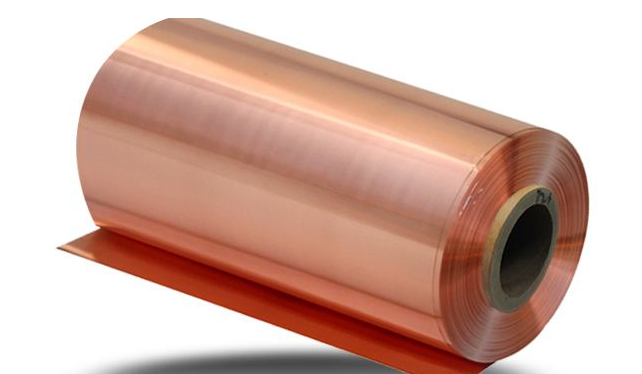
Copper foil serves as the negative electrode carrier and current collector in lithium-ion batteries. The thickness of the copper foil plays a crucial role in lithium batteries, affecting their performance and safety. We will now analyze in detail how the thickness of the copper foil specifically impacts the battery, aiming to provide a reference for lithium battery professionals and enthusiasts.
I. Impact on Battery Energy Density
1. Mass Energy Density: As the negative electrode current collector, copper foil itself does not participate in electrochemical reactions. The thinner the copper foil, the higher the proportion of active materials (such as graphite) in the battery. For example, reducing the copper foil thickness from 10μm to 6μm reduces the overall mass of inactive materials in the battery by about 40%, allowing more active material to be accommodated in the same volume, theoretically increasing the mass energy density by 5%-8%.
2. Volumetric Energy Density: The thickness advantage of thinner copper foil directly reduces the volumetric proportion of inactive materials inside the battery. Taking the 18650 battery as an example, using 8μm copper foil compared to 12μm copper foil can increase the internal space utilization of the cell by about 3%, resulting in a corresponding increase in volumetric energy density.
II. Impact on Battery Internal Resistance and Rate Performance
1. DC Internal Resistance (DCR)
The DC resistance of copper foil is inversely proportional to its thickness. According to Ohm’s law, the resistance of 10μm thick copper foil is approximately twice that of 5μm thick copper foil. Actual measurement data shows that the internal resistance of a lithium battery with 10μm copper foil at 25℃ is approximately 60mΩ, while the internal resistance of a battery with 5μm copper foil can be reduced to below 45mΩ. Lower internal resistance helps reduce heat loss during charging and discharging.
2. Rate Performance
Thin copper foil, due to its lower resistance, results in a more uniform current distribution during high-current charging and discharging, avoiding localized overheating. For example, a battery using 6μm copper foil can achieve an 85% capacity retention rate at a 10C rate, while a battery using 10μm copper foil only achieves 78%. The improvement in rate performance of thin copper foil is particularly significant in high-power batteries.

III. Impact on Battery Cycle Life
1. Mechanical Strength and Cycle Stability
Copper foil thickness is positively correlated with mechanical strength: the tensile strength of 10μm copper foil is approximately 280MPa, while that of 4μm copper foil drops to 220MPa. Thin copper foil is prone to microcracks during electrode rolling or cycling, leading to poor contact between the current collector and the active material, and increased internal resistance. Experiments show that batteries with 4μm copper foil retain 82% capacity after 500 cycles, while batteries with 8μm copper foil can achieve 88%.
2. Risk of Lithium Dendrite Penetration
Copper foil with a thickness less than 5μm is more susceptible to dendrite penetration during long-term cycling if lithium dendrite growth occurs on the negative electrode, leading to internal short circuits. Studies show that batteries using copper foil thinner than 5μm have an internal short-circuit failure rate approximately 30% higher in the later stages of cycling compared to batteries with 8μm copper foil.
IV. Impact on Battery Safety
1. Thermal Conductivity and Heat Dissipation
The thickness of the copper foil affects the internal thermal conductivity of the battery. The thermal conductivity of 10μm copper foil is approximately 2W/(m·K). Although increasing the thickness has a limited effect on improving thermal conductivity, thinner copper foil results in a shorter heat dissipation path when heat is concentrated under high current. The risk of localized overheating needs to be compensated for through structural design (such as adding thermally conductive adhesive).
2. Needle Penetration Test Performance
Thick copper foil (e.g., 10μm) can delay the occurrence of internal short circuits in needle penetration tests because copper foil itself has a certain mechanical barrier effect. Test data shows that the peak thermal runaway temperature of a battery using 10μm copper foil during needle penetration is 210℃, while the peak temperature of a battery using 6μm copper foil reaches 240℃, indicating a higher risk of thermal runaway.
V. Thickness Selection Strategies for Different Application Scenarios