
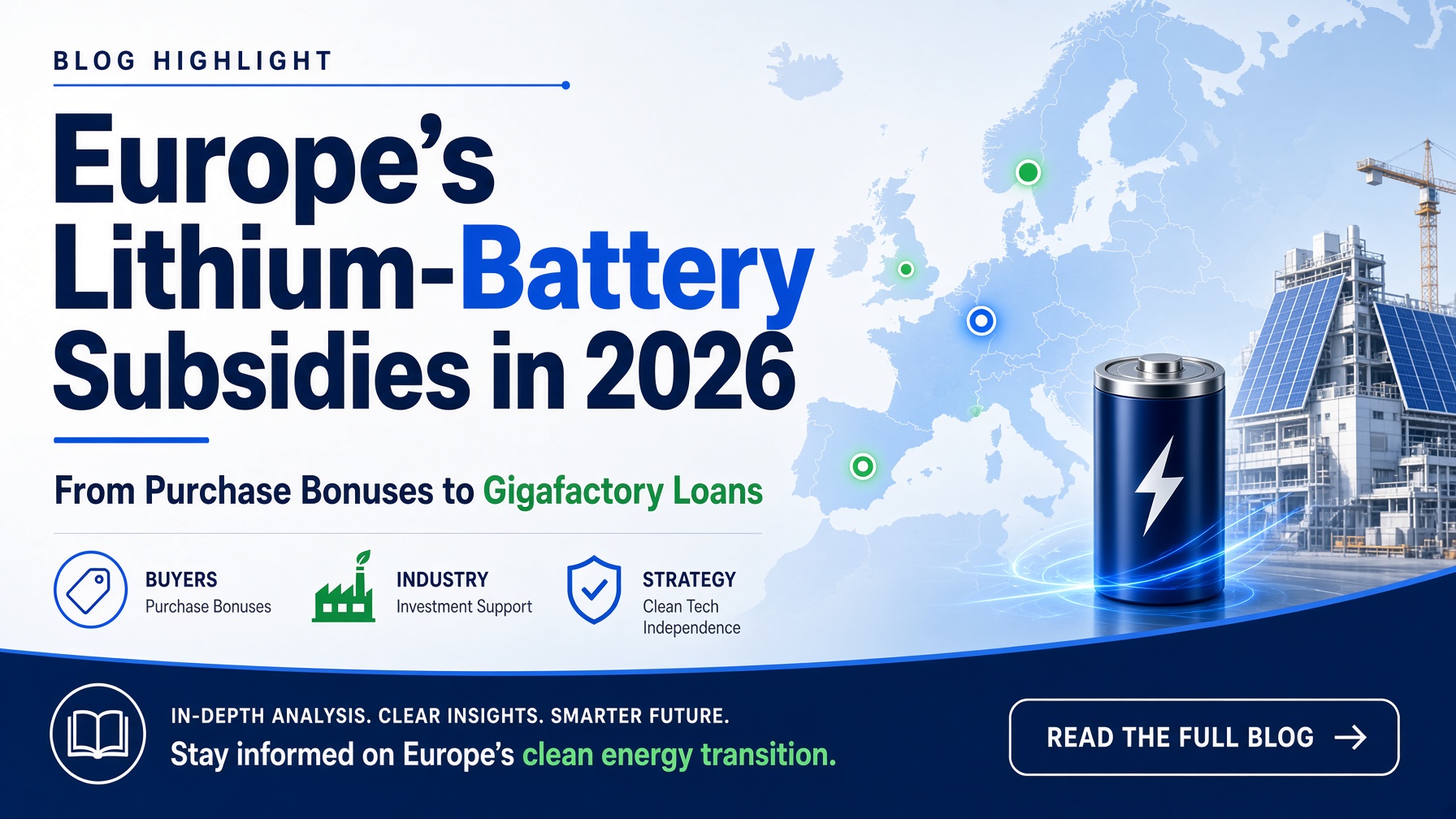
Dek: The EU is no longer just paying people to buy electric cars. It is now lending money to cell plants, screening where batteries are made, and letting member states s tack national aid on top. Here is the policy map, with primary sources.
Note for readers: This briefing is current as of 2 September 2026. National windows open and close quickly; always check the official pages before making investment or purchase decisions.
Europe’s lithium-ion battery market is being shaped by three layers of public money. The first is EU industrial finance for cell plants and raw materials. The second is national EV purchase aid, which still moves demand but is now income-tested and, in several countries, tilted toward European cells. The third is storage support, which is turning batteries into a grid asset as well as a car component.
That shift matters. For years, Europe tried to build a battery industry mainly with research grants, Important Projects of Common European Interest (IPCEIs), and consumer rebates. In 2025–2026 the Commission added a more direct instrument: interest-free loans for factories that are already climbing toward commercial scale.
1. The EU layer: the Battery Booster is the headline
On 16 December 2025 the Commission adopted a Battery Booster Strategy. On 9 June 2026 it turned that strategy into a legal instrument: Commission Decision (EU) 2026/1283, which creates the Battery Booster Facility.
The official climate-action pages are the cleanest starting point:
- New Battery Booster set to inject €1.5 billion into the European battery industry
- Battery Booster Facility programme page
- Call for proposals
- Commission launch notice, 28 July 2026
The design is unusually specific for an EU industrial scheme:
| Rule | What the Commission set |
|---|---|
| Budget for 2026 | Up to €1.5 billion from Innovation Fund / ETS auction revenues |
| Instrument | Interest-free loans, not classic grants |
| Cap | €500 million per recipient, and no more than 60% of eligible costs |
| Location | Production in the European Economic Area |
| Προϊόν | Cells suitable for electric-vehicle use |
| Scale | Planned capacity of at least 10 GWh a year |
| Project stage | Ramp-up, not a paper factory |
| Extra filter | The applicant’s first full commercial-scale EV cell project globally |
| Call window | Opened 28 July 2026; deadline 30 September 2026, 23:59 CEST |
The Commission says it chose loans over grants to force tighter capital discipline and to crowd in private finance. First awards and first payments are meant to land before the end of 2026.
The same package also earmarks up to €300 million for critical raw materials in the battery chain — lithium, cobalt, nickel, manganese and graphite — on top of projects already labelled strategic under the Critical Raw Materials Act. That upstream money sits beside the Booster itself in the Battery Booster Strategy communication.
What came immediately before the Booster
The Booster did not appear in a vacuum.
- In December 2024 the Innovation Fund opened a dedicated battery-cell call of about €1 billion. In July 2025 the Commission awarded €852 million to six cell-manufacturing projects in France, Germany, Sweden and Poland. The European Battery Alliance summary lists Automotive Cells Company and Verkor in France, Cellforce Group and Leclanché in Germany, NOVO One in Sweden, and LG Energy Solution in Poland.
- A further €200 million from the Innovation Fund was added to InvestEU as loan guarantees for the battery value chain.
- Two battery IPCEIs, approved in 2019 and 2021, authorised more than €6.1 billion in national state aid across the chain, from materials to recycling. The Commission recaps that history in the same 2026 strategy communication.
The rules that now sit behind every national EV rebate
Two legal texts are changing how member states may spend money:
- Ο EU Batteries Regulation (EU) 2023/1542 — carbon-footprint declarations, recycled-content targets, due diligence and, over time, a battery passport.
- Ο Net-Zero Industry Act — from January 2026, new or updated EV support schemes must include resilience and sustainability criteria. In practice, that is the legal hook for “made in Europe” weighting.
Ο Clean Industrial Deal State Aid Framework (CISAF), applied from 25 June 2025, also makes it easier for governments to subsidise manufacturing of batteries and other net-zero technologies until 2030.
2. National purchase subsidies: still large, no longer universal
Consumer bonuses still matter because they pull cell demand forward. They are no longer a flat cheque for anyone who buys a battery car.
A useful official dashboard for country-by-country EV incentives is the Commission’s European Alternative Fuels Observatory (EAFO).
Germany: up to €6,000, income-tested
Berlin restarted purchase aid in 2026 after dropping the old Umweltbonus.
Official pages:
- Federal government explainer: up to €6,000
- English summary from the Federal Environment Ministry
- BAFA eligibility rules
Core terms:
- Budget: €3 billion from the Climate and Transformation Fund, 2026–2029, enough for an estimated 800,000 vehicles.
- Who can apply: private individuals only.
- What is eligible: new M1 cars first registered in Germany from 1 January 2026; purchase or lease; 36-month holding period.
- Base rate: €3,000 for battery-electric and fuel-cell cars; €1,500 for eligible plug-in hybrids and range-extenders.
- Top-ups: €500 per child (max two children), plus income adders. A low-income household with two children can reach €6,000 on a BEV.
- Taxable household income is generally capped around €80,000, rising to €90,000 with children.
- Plug-in hybrids and range-extenders are only aided until 30 June 2027, and only if they emit no more than 60 g CO₂/km or offer at least 80 km of electric range.
Germany also extended the vehicle-tax exemption for pure EVs. Cars first registered through 2030 can stay exempt for up to ten years, but not beyond 31 December 2035. See the federal government tax note.
France: a social bonus plus a European-battery top-up
France replaced the old ecological bonus with a “coup de pouce” financed through energy-saving certificates, then added a separate battery premium for cars whose cells are European. The premium is stackable, applies to purchase or long-term lease, and is limited to cars priced at or below €47,000 and weighing under 2.4 tonnes. Amounts vary by manufacturer and household type, commonly in the €1,000–€2,000 range for the European-cell adder.
The policy logic is explicit: public money should follow European cells, not just a European badge on the tailgate. The EAFO country pages and French government bonus communications are the places to check current model lists, because eligibility changes when a carmaker switches cell suppliers.
Italy: scrap-and-replace, up to €11,000 for households
Italy’s scheme was formalised by a Ministry of Environment and Energy Security decree of 8 August 2025. The EAFO write-up is the clean official-adjacent summary.
- Envelope: about €597.3 million under the recovery plan, until mid-2026.
- Target: replace around 39,000 older combustion vehicles.
- Households: up to €11,000 if ISEE is €30,000 or less, or €9,000 if ISEE is between €30,000 and €40,000, when buying a new BEV and scrapping a Euro 5 or older car.
- Micro-enterprises: up to €20,000 on a new electric light-commercial vehicle, capped at 30% of the purchase price.
Spain: MOVES III is over; Auto+ and PERTE VEC take the load
On 3 December 2025 Prime Minister Pedro Sánchez presented Spain Auto 2030. The demand pillar is Programa Auto+.
Official government pages:
What the government has put on the record:
- €400 million in 2026 purchase aid, of which €350 million is the 2026 call for private individuals.
- Retroactive to purchases from 1 January 2026.
- Line 1 applications run until 31 December 2026, 14:00 (peninsular time).
- Maximum grants in the published call: €4,500 for passenger cars (M1), €5,000 for vans (N1), €1,100 for electric motorcycles, €1,500 for quadricycles.
- The scheme is centrally run by the Ministry of Industry and Tourism, not by the regions.
- Scoring favours zero-emission vehicles and European production.
On the industrial side, Spain Auto 2030 adds €580 million to PERTE VEC, the strategic project for electric and connected vehicles, on top of earlier recovery-fund rounds for battery assembly, cells and recycling. A separate €300 million “MOVES Corridors” programme targets public charging on TEN-T gaps.
Smaller markets still use cash, but the map is patchy
- Cyprus remains one of the most generous per-vehicle schemes in Europe, with published support of up to €12,000 for a new BEV and up to €19,000 for vulnerable groups. Use EAFO for the live figures.
- Latvia has been preparing an extension of national EV support under its emissions-allowance auction instrument. The EAFO note on Latvia puts the draft budget at €40 million through 2029, with €4,000 for a new BEV or PHEV.
- Several western markets — including the Netherlands, Belgium and Austria — have already ended or sharply cut untargeted purchase grants and now lean on tax treatment, company-car rules or infrastructure.
3. Factory subsidies: this is where the lithium-battery money really sits
Purchase bonuses sell cars. State aid builds plants.
Hungary has used regional aid and the new CISAF toolbox more aggressively than almost any other member state. In August 2025 the Commission approved €264 million in Hungarian aid for Sunwoda’s cell plant in Nyíregyháza. In December 2025 it approved a €4.1 billion Hungarian scheme for cleantech manufacturing capacity under CISAF. The Commission’s state-aid press material is the primary source for both decisions; search the Commission press corner for the Sunwoda and Hungarian CISAF cases. CATL’s Debrecen project is separately planned at a scale that would make it one of Europe’s largest cell sites.
Poland is already a production heavyweight because of LG Energy Solution’s Wrocław complex. That company’s next-generation cylindrical-cell line was one of the six Innovation Fund winners in 2025. Warsaw is also spending at national level on storage rather than only on cars: a programme of about PLN 4.15 billion was allocated to 172 large-scale storage projects totalling roughly 3.9 GW / 14.5 GWh, with grants covering 45% to 65% of costs depending on company size.
France and Germany are trying to grow European-owned champions rather than only host Asian plants. ACC and Verkor took Innovation Fund grants. Germany had earlier received Commission approval for a large aid package to Northvolt’s German factory. Those files live in the Commission’s state-aid register.
Spain is using PERTE VEC to keep assembly plants and nearby battery lines in the country as the car industry electrifies.
The industrial pattern is now clear. Eastern member states compete on speed, site aid and tax credits. Western member states compete on Innovation Fund awards, IPCEI participation and “European content” rules in consumer schemes.
4. Storage: the second demand curve
Lithium batteries in Europe are no longer only an automotive story.
Italy is using a long-term storage contracting mechanism, MACSE, with 15-year contracts aimed at four-hour and longer systems. Greece has kept renovation and business storage grants alive under “Save 2025.” Poland’s large-scale tender is the most straightforward capacity subsidy in Central Europe.
The Netherlands has not put home batteries into the standard ISDE household scheme yet. Instead it is funding battery materials and long-duration storage through the National Growth Fund and paying for flexibility assets that relieve grid congestion. France is trying to improve the business case by reforming capacity-market rules and grid tariffs rather than by writing household cheques.
For EU-wide context on storage and flexibility, the Commission’s energy pages and national regulators remain better sources than trade-press round-ups.
5. How to read the policy if you write about the industry
Three conclusions are solid enough to put in a close.
First, Brussels is now financing output, not just research. The Battery Booster is a ramp-up loan for plants that already exist on the ground. That is a different instrument from Horizon grants or even IPCEI aid.
Second, demand subsidies are becoming a local-content tool. France’s European-cell premium and Spain’s Auto+ scoring are early examples of the Net-Zero Industry Act’s resilience logic. From 2026, any new national EV scheme is supposed to ask where the battery comes from.
Third, the map is uneven on purpose. Hungary and Poland are concentrating cell gigawatts. Germany and Italy are concentrating socially targeted car cheques. Spain is trying to do both, with a smaller consumer budget and a still-large industrial programme.
If Europe’s bet works, the next two years will show up in factory utilisation rates, not in the headline size of purchase bonuses. If it fails, the Booster loans will look small next to the cost gap with subsidised Asian supply.
Official sources
European Union
- Commission Decision (EU) 2026/1283 establishing the Battery Booster Facility
- Battery Booster Strategy communication, EUR-Lex
- Commission news: €1.5 billion Battery Booster
- Battery Booster Facility page
- Call for proposals
- DG GROW launch notice, 28 July 2026
- Innovation Fund
- EU Batteries Regulation (EU) 2023/1542
- Net-Zero Industry Act
- Critical Raw Materials Act
- Clean Industrial Deal State Aid Framework
- European Alternative Fuels Observatory
- Italy EV incentive note on EAFO
- Latvia EV support note on EAFO
- European Battery Alliance on the €852 million Innovation Fund awards
- InvestEU
- Commission state-aid register
- Commission press corner
Germany
- Bundesregierung: E-Auto-Förderung
- Federal Environment Ministry, English grant page
- BAFA eligibility
- Vehicle-tax exemption extension