
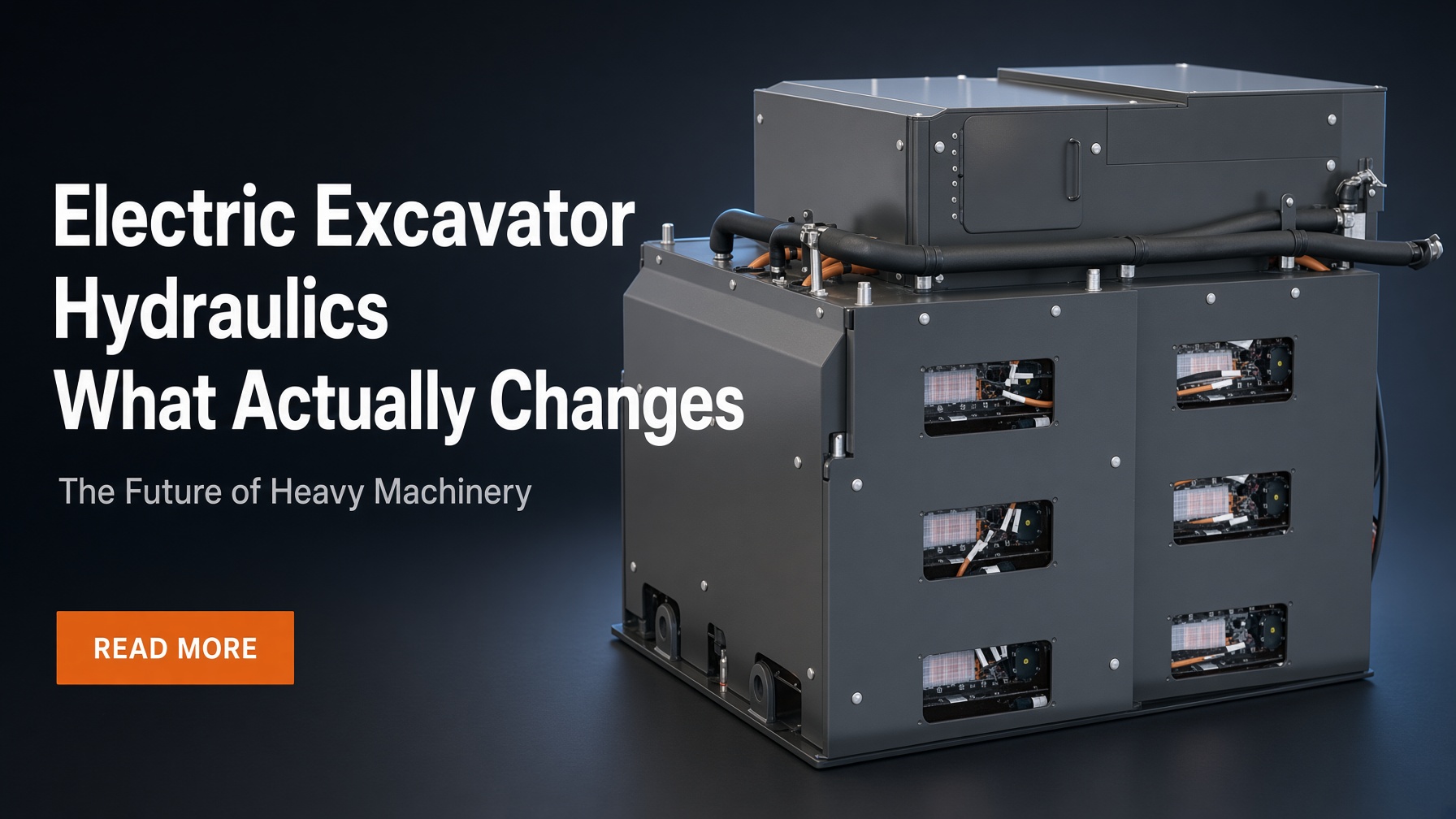
An electric excavator still digs with oil. Cylinders, buckets, breakers and auxiliary circuits remain hydraulic because force density and the attachment ecosystem have not been replaced at production scale. What changes is the path that creates that oil flow: the diesel engine and its idle band give way to a high-voltage motor that can stop, restart and change speed on demand. Valves, pumps and regeneration logic then decide whether that electrical advantage reaches the bucket — or is dumped as heat the pack has to pay for.
Electric Excavator Hydraulics: What Actually Changes? is therefore not a question about cylinders. It is a question about prime-mover behaviour, pump architecture, valve metering, regeneration return to the DC bus, and the maintenance items that disappear versus the ones that stay. This briefing maps those changes against 2026 production machines, puts numbers on the efficiency lever, and gives fleet and OEM buyers a specification method that survives a real shift.
Key Takeaways
- The working end does not change. Boom, arm, bucket, swing motor, travel motors, holding valves and hydraulic attachments stay. Breakout force and implement pressure on a 2026 mid-size electric sit in the same band as the diesel sibling — Volvo’s EC230 Electric publishes 34.3 / 36.3 MPa implement pressure and 2 × 208 L/min axial piston pumps.
- The prime mover does change. A diesel must idle to keep a pump spinning. An electric motor is near 99% efficient at the shaft and draws near-zero energy when the machine is not working. Closed-centre valves and on-demand pumps convert that fact into kWh. Open-centre conversions do not.
- Conventional hydraulics still waste a large share of prime-mover power through flow-sharing and throttling. Danfoss states that a typical excavator hydraulic system can waste up to 70% of useful power. That waste is free-ish on diesel idle; on a battery it is runtime.
- Three production architectures coexist in 2026: electric motor + inherited load-sensing stack; electro-hydraulic independent-metering main control valve (MCV); and multi-outlet digital displacement. Volvo cites a 10% hydraulic-efficiency gain on the updated EC230 Electric and up to 25% on IMVT large excavators. June 2026 field tests of Danfoss Dextreme Max on a 30 t battery-electric Develon DX300LC-7 cut energy use 35% on a 30% grading / 70% digging mix and extended runtime 53% on the same three 140 kWh packs.
- Regeneration on boom-down and swing typically recovers 15–25% of dig-cycle energy when the BMS will accept the current. Near 80–90% state of charge (SOC) or in the cold, regen is clipped. The hydraulic controller needs a fallback.
- Size usable energy so the hardest representative shift ends above 20–30% SOC. Treat 15–40% opportunity charges as planned capacity. Specify IEC 62619 on industrial packs and UL 2580 where the system is treated as EV traction. LiFePO₄ (LFP) remains the industrial default at ≥3,500–5,000 cycles at 80% depth of discharge (DoD) unless chassis volume forces NMC/NCA.
Table of Contents
- What Does Not Change
- The Seven Things That Do Change
- Three Hydraulic Architectures in 2026
- 2026 OEM Hydraulic Map
- How the Change Shows Up in kWh
- Operator Feel, Noise and Maintenance
- Certification and Interlocks
- Fleet, OEM and Site Manager Checklist
- Συχνές ερωτήσεις
- Decision Framework
- Authoritative References
What Does Not Change
Inspection platforms that already service mixed fleets make the same point: hydraulics, undercarriage, tracks, buckets and structure keep the diesel checklist. The electric machine changes the powertrain, not the working end.
What a 2026 buyer should treat as unchanged unless the datasheet says otherwise:
- Cylinder geometry, pin-to-pin dimensions and attachment coupler interface.
- Implement pressure band (typically 30–36 MPa on mid-size crawlers).
- Auxiliary flow for breakers, shears, augers and thumbs. Confirm the number, not assume it.
- Holding valves, hose-rupture valves and load-control hardware on boom and arm.
- Hydraulic oil type, filtration stages and cooler circuit — oil still ages, still carries water and still has a viscosity window.
- Travel and swing as hydraulic motors on almost every production electric in this class.
That continuity is why OEMs electrify the pump rather than converting the fleet to electromechanical actuators. Volvo CE has stated the roadmap in public: electrified hydraulic pumps and full electromechanical actuation will coexist, because force density, cost and the tool ecosystem are not the same at 2 t and at 50 t. The 2017 EX02 concept proved a full electromechanical chain is possible. Volume 20 t+ digging in 2026 still uses oil.
The Seven Things That Do Change
1. The prime mover no longer has an idle tax
A diesel that sits at 30% idle still burns fuel to keep the pump at pressure. An electric that is not swinging or tracking draws near-zero traction energy. Hydraulic standby still costs some kWh, but only if the valve stack is open-centre and the pump is spinning. Volvo’s EC230 Electric product page states the motor is around 99% efficient and that no energy is used when the machine is not moving and working.
The practical change: auto-idle on a diesel saves fuel. Pump-stop or closed-centre standby on an electric saves the shift.
2. Pump speed is now a control variable
Diesel pumps live inside a narrow engine-speed band. Electric pumps can be variable-displacement at roughly constant motor speed, or fixed-displacement at variable motor speed, or a digital multi-outlet unit whose chambers fire only when a service asks for flow.
A 2025 Engineering Reports vehicle test of an electro-hydraulic excavator using a variable-speed fixed-displacement pump cut total energy consumption 44.3% versus a fixed-speed variable-pump baseline on the published S8 cycle. That is a control change, not a cylinder change.
3. Valve architecture decides whether electrification is finished
First-generation conversions keep the original main control valve. Flow-sharing and meter-in / meter-out losses stay. The pack is then sized to feed those losses.
Second-generation machines change the MCV. Volvo’s updated EC230 Electric uses a new electro-hydraulic system and new MCV with summation, boom / arm / swing priority, regeneration and power boost. Volvo separately reports up to 25% efficiency from Independent Metering Valve Technology (IMVT) on large diesel excavators — closed-centre, independent cylinder-chamber control, poppet and electro-hydraulic valves instead of mechanically coupled spools. The same logic is what an electric machine needs if the brochure hour figure is to survive a truck-loading day.
4. Regeneration has a new destination
Diesel hybrids often parked recovered boom energy in a hydraulic accumulator. On a battery-electric machine the high-value path is back onto the DC bus, provided the cells can accept the current.
Typical recovery on a tuned electro-hydraulic machine is 15–25% of dig-cycle energy. An IEEE Access paper dated 25 February 2026 on an electro-hydraulic hybrid swing drive reported a 22.1–31.2% cut in peak swing power and a 53.4–66.6% cut in swing energy versus a conventional hydraulic-motor swing. Boom-down remains the larger store of potential energy.
The change that bites in the field: at high SOC or low cell temperature the BMS clips regen. If the hydraulic controller has no meter-out or accumulator fallback, boom-down speed changes under the operator.
5. Heat is now a kilowatt-hour problem
Throttling losses always became cooler load. On diesel that cooler is powered by fuel the operator already budgeted. On electric, every wasted bar across a spool is a bar the pack discharged and will not get back. Digital and independent-metering architectures cut that heat at source, which also shrinks cooler demand and oil-temperature rise on a continuous-breaker day.
Cold is the other half. Thick oil raises pump torque. Cold cells cut available capacity. Auto warm-up of hydraulic oil — listed on the EC230 Electric product guide — and pack preconditioning are one winter plan, not two.
6. Peak current, not average flow, sizes the electrical side
A mid-size pump set at 2 × 208 L/min and 34–36 MPa is a short-burst power demand in the hundreds of kilowatts. The inverter, DC link, connectors and pack C-rate must be rated for that pulse. A pack sized only for average kWh/h will current-limit under simultaneous boom-and-swing or under a hammer.
7. The safety boundary moved
A pack fault that does not lock the pumps is not an integrated machine. The BMS must command hydraulic lock-out and a controlled depressurisation path. High-voltage connectors join oil hoses on the daily walk-around. OSHA 29 CFR 1910.178 does not write the excavator rule set the way it writes the forklift rule set, but the handling logic for a damaged high-voltage pack is the same: isolate, do not open, follow the OEM procedure.
Three Hydraulic Architectures in 2026
Production machines sit on one of three paths. Do not treat “electric pump” as the finished specification.
| Architecture | What changed versus diesel | Typical 2026 fit | Energy implication |
|---|---|---|---|
| Electric motor + inherited valve stack | Engine replaced by a PMSM; original load-sensing pump and MCV retained | Most compact conversions and first-generation mid-size electrics (JCB 19C-1E Bosch Rexroth load-sensing; early electric 20 t class) | Fastest route to production. Flow-sharing and standby losses remain. Pack must be sized for those losses. |
| Electro-hydraulic / independent metering | Electric pumps plus a digitally controlled closed-centre MCV with priority, regeneration and, on some platforms, IMVT-class independent chamber control | Mid-size production crawlers that must match diesel cycle times (Volvo EC230 Electric new MCV; IMVT on large Volvo excavators) | Volvo cites a 10% hydraulic-efficiency gain on the updated EC230 Electric and up to 25% on IMVT large excavators. Standby flow drops. Regeneration has a defined path. |
| Digital displacement / multi-outlet pump | A Digital Displacement pump/motor with independently controlled outlets feeds boom, arm, bucket and swing only when demanded | 16–30 t conversions and OEM programmes that need runtime more than a larger pack (Danfoss Dextreme Max / DDP180D) | 16 t simulation −24.8% energy (418 → 314 kWh / 8 h). 30 t field mix −35% energy / +53% runtime. Peak C-rate on the pack falls with peak hydraulic waste. |
| Electromechanical actuation (EMA) | Electric actuators replace selected cylinders | Concept and selected tool circuits (Volvo EX02). Not the 2026 volume path for 20 t+ digging | Highest electrical efficiency and no oil on that circuit. Force density, cost and attachments still favour hydraulics for digging. |
The purchase rule is simple. If the answer to “what changed in the valve stack?” is “nothing,” price the residual losses into the pack or into a mid-shift charge.
2026 OEM Hydraulic Map
Nameplate hours already assume a hydraulic duty. Read the footnote.
| Machine | Pack / voltage | What changed in hydraulics | Published runtime caveat |
|---|---|---|---|
| JCB 19C-1E | 14.8 / 19.8 kWh, 48 V | Bosch Rexroth load-sensing; 18 cc variable pump, 42 L/min; 235 bar implement; 9 kW cont / 20 kW peak PMSM | ~4 h (3-pack) / ~5 h (4-pack) typical cycle |
| Takeuchi TB20e | 24.7 kWh / 73 V | Electric drive of the existing compact hydraulic circuit; charge-while-operating supported | Up to 8 h at 65% load |
| Cat 301.9 Electric | 32 kWh NMC / 48 V | Mini electro-hydraulic circuit; Cat DC 9 kW option | Up to 8 h at 40–60% utilisation; 3–4 h when travel and attachments dominate |
| Volvo ECR25 Electric (current EU) | 40 kWh / 48 V | Compact electro-hydraulic; motor response replaces diesel idle | Up to 8 h |
| Volvo EC230 Electric (high-capacity) | 650 V / 450 kWh NCA (also 600 V / 264 kWh and Brazil LFP 423 kWh classes) | New electro-hydraulic system and new MCV: summation, boom/arm/swing priority, regeneration, power boost, auto warm-up; 2 × 208 L/min; 34.3 / 36.3 MPa; 110 kW cont / 160 kW peak | Indicative 7–8 h; 10% hydraulic-efficiency gain versus prior electric generation |
| Cat 320 Electric | 750 V / 387 kWh | Diesel 320 hydraulic architecture electrified; boom/stick regeneration retained; tethered AC option | Up to 8 h or unlimited tethered |
| Volvo EC500 Electric (pre-production, Spring 2027 target) | Onboard HV pack rated 2–3 h continuous + 35 m cable reel on a 400 V base | 50 t-class electro-hydraulics sized to match the diesel EC500 | Grid-first machine; battery is a buffer. Norway quarry / road / tunnel pilot as of September 2026 |
| Liebherr R 9150 E / R 9400 E class | Grid via trailing cable or substation | Mining excavator hydraulics retained; diesel powertrain replaced | Unlimited while connected. Fortescue R 9400 E passed 1 million tonnes moved |
Sources for the hydraulic columns: Volvo CE EC230 Electric product page and product guide, Caterpillar battery-electric machines, JCB 19C-1E specification sheets, Takeuchi TB20e, Electrek EC500 Electric, 10 September 2026, and Danfoss / Construction Equipment International coverage of the June 2026 Dextreme Max field result.
A compact 11–20 kWh pack is a four-hour continuous machine whose hydraulics are a load-sensing conversion. An eight-hour brochure day on a 387–450 kWh mid-size pack is created by utilisation below the continuous-breaker band, plus electro-hydraulic efficiency, plus — on many sites — a tether or a 15–40% mid-shift add.
How the Change Shows Up in kWh
Use three planning classes. Adjust with logger data from your own fleet when you have it.
| Duty class | Typical work | Compact 1.5–3 t draw | Mid-size 20–25 t draw | Hydraulic lever that moves the number |
|---|---|---|---|---|
| Light | Landscaping, utility trench in soft ground, frequent pauses, indoor / basement work | ~5.0 kWh/h | ~25–35 kWh/h | Closed-centre standby and pump-stop versus diesel idle |
| Medium | General construction, truck loading, mixed soil, some travel | ~6.0–6.7 kWh/h | ~35–50 kWh/h | Priority logic and boom/arm regeneration decide whether the 7–8 h brochure holds |
| Βαρύς | Breaker / hammer, hard material, high travel, two-shift or continuous face work | ~8–12 kWh/h | ~50–65+ kWh/h | Digital displacement or IMVT-class metering, higher C-rate, liquid thermal management, DC fast charge or tether |
Sources behind the compact band: a 2026 comparative white paper on a 2.6–2.8 t / 20 kWh / 48 V machine reported ~5.0 kWh/h in light urban work and 6–6.7 kWh/h in medium continuous trenching, with hydraulic pressure and breakout matching the diesel counterpart.
Sources behind the mid-size band: a 2,300-working-day field study published in World Electric Vehicle Journal (2026) recorded 28 kWh/h average on a 17 t wheeled electric and 52 kWh/h on a 35 t machine. Volvo’s 450 kWh pack covering 7–8 hours and Cat’s 387 kWh pack covering “up to 8 hours” imply a 48–64 kWh/h envelope when the pack is worked hard.
Danfoss quantified the hydraulic-efficiency lever twice. A 16 t simulation of a conventional electric-plus-swashplate architecture needed about 418 kWh for an eight-hour shift; a Digital Displacement architecture cut that to 314 kWh (−24.8%). In June 2026 field tests of Dextreme Max on a 30 t battery-electric Develon DX300LC-7 — Editron EM-PMI375 motor, EC-C1200 inverter, three 140 kWh packs, DDP180D pump/motor with ten independently controllable outlets — energy use fell 49.2% in air grading and 31% in air dig-and-dump. On a 30% grading / 70% digging mix the cut was 35%, which extended runtime 53% on the same pack. Cycle times were largely unchanged.
That is the commercial meaning of Electric Excavator Hydraulics: What Actually Changes? If hydraulics waste 25–35% of battery energy, buying a 25–35% larger pack is the expensive way to buy the same shift.
Operator Feel, Noise and Maintenance
What operators notice first is not a pressure gauge.
- Instant torque. There is no turbo spool-up. Combined boom-and-swing can feel sharper if the MCV priority map is not retuned for the electric motor’s response.
- Lower vibration. Combustion pulsation is gone. Compact electric machines publish cabin and exterior levels well below the diesel sibling (Volvo EC230 Electric product guide: LpA 67 dB in cab / LWA 97 dB external on the cited configuration). Precision grading in a basement benefits; an operator used to diesel “feel” may initially over-command joysticks.
- Noise at the pump, not at the stack. A variable-speed electric pump that hunts will be more audible than a diesel ever was, because the engine note is no longer masking it.
- Attachments stay. Confirm auxiliary flow and pressure. A breaker that was happy on diesel idle pressure may starve if the electric pump-stop logic is too aggressive.
Maintenance subtracts engine items and adds electrical items. Diesel oil, filters, DEF, turbo, starter and exhaust go away. What is added: battery state-of-health, high-voltage cable and connector inspection, thermal-management verification, inverter checks, charging-port condition, insulation-resistance tests, and calibration of any regenerative hydraulic path. Hydraulic oil, filters, hoses, pins and undercarriage keep the original interval logic.
Chemistry still follows duty. LFP is the default for industrial aftermarket and many compact packs because of thermal stability and ≥3,500–5,000 cycles at 80% DoD. Volvo CE still states LTO for intensive cycles, LFP for safety and cost, and NMC/NCA when density is the constraint — which is why the high-capacity EC230 Electric pack is published as NCA at 650 V / 450 kWh.
Certification and Interlocks
High-voltage traction and high-pressure hydraulics share one machine.
- Require IEC 62619 on industrial cells and packs.
- Require UL 2580 where the pack is treated as EV traction.
- Confirm UN 38.3 for transport of spare modules.
- Confirm the BMS can command a hydraulic lock-out and a controlled depressurisation path.
- Confirm the charger handshake is the one the BMS will accept.
- On tethered machines, treat the feeder, earth-fault protection and cable-reel interlock as part of the hydraulic-and-battery specification, not as site electrics after the fact.
Keep daily work above 20–30% SOC. Deep discharge spends the cycle budget the datasheet assumed you would not spend, and it removes the regen headroom the hydraulic controller is counting on. Opportunity charges that restore 15–40% during lunch or rotation are planned capacity, not a rescue.
Fleet, OEM and Site Manager Checklist
Use this list before a purchase order or a conversion sign-off.
- Working-end parity confirmed: implement pressure, auxiliary flow, coupler and attachment list match the diesel duty you are replacing.
- Pump and valve architecture named (inherited load-sensing, independent-metering MCV, digital displacement, or mixed).
- Regeneration path documented for boom-down and swing, including BMS current-accept limit and hydraulic fallback.
- Measured kWh per productive hour on the actual attachment mix, not a brochure “up to” hour figure.
- Usable pack energy sized so the hardest representative shift ends above 20–30% SOC after a 10–20% cold and adverse-soil margin.
- Opportunity-charge window mapped: 15–40% restore, charger kW matched to the real break — or tether evaluated for a stationary face.
- Chemistry matched to cycle budget: LFP ≥3,500–5,000 cycles at 80% DoD unless density forces NMC/NCA.
- IEC 62619 and, where applicable, UL 2580 on the pack. UN 38.3 on spare modules.
- BMS hydraulic lock-out and charger handshake tested, not assumed.
- Thermal plan for cells and for hydraulic oil on the coldest and hottest site days.
- Inspection template updated: engine items removed, high-voltage and connector items added, hydraulic oil / hose / pin items retained.
Electric Excavator Hydraulics: What Actually Changes? fails as a purchase if the RFQ only names kilowatt-hours and leaves the valve stack as “same as diesel.”
Συχνές ερωτήσεις
Do hydraulic attachments still work on an electric excavator? Yes on every 2026 production electric excavator in this briefing. Confirm auxiliary flow and pressure, and confirm that pump-stop or eco logic does not starve a breaker that relied on diesel idle pressure.
Does swapping the engine for a motor finish the hydraulic job? No. That conversion removes idle fuel burn. It does not remove flow-sharing and throttling losses. Those losses now come out of the pack.
How much energy does a better hydraulic architecture actually save? Plan on 10% for a retuned electro-hydraulic MCV on a mid-size production machine (Volvo’s published figure on the updated EC230 Electric) and 25–35% when independent metering or digital displacement removes flow-sharing across a mixed grading/digging day (IMVT on large Volvo excavators; Danfoss Dextreme Max June 2026 field mix).
How much does regeneration return? Plan on 15–25% of dig-cycle energy on a tuned machine when the pack can accept the current. Near the top of the SOC window, or in the cold, the BMS will clip. The hydraulic controller needs a fallback.
Is LFP required? It is the default for industrial aftermarket and many compact packs. Mid-size OEM packs still use NCA/NMC when the hour target will not fit in the available envelope. Specify the cycle budget and the thermal system, then accept the chemistry that meets both.
Where does a tether beat a bigger pack or a better pump? Stationary or short-travel faces with a reliable feeder: quarry benches, indoor demolition, tunnel portals. Volvo’s EC500 Electric pilot and Cat’s 320 / 395 tethered options are built on that logic. The pack becomes a buffer, not the shift.
What standards should the RFQ name? IEC 62619 on the industrial pack. UL 2580 where the system is treated as EV traction. UN 38.3 on modules that will be shipped as spares. Charger protocol written as a line item. Hydraulic lock-out on a pack fault written as a line item.
Decision Framework
- Write down what must not change: attachment list, implement pressure, auxiliary flow, coupler, cycle time.
- Name the hydraulic architecture you are actually buying. If the answer is “electric motor on the original pump,” price the residual flow-sharing losses into the pack.
- Log the duty. Convert soil, attachment, travel share and idle share into kWh per productive hour.
- Size usable energy so the hardest shift ends above 20–30% SOC after margin. Do not size to brochure hours.
- Decide how the missing energy arrives: overnight AC, 15–40% opportunity charge, or tether. Match charger power to the window.
- Close the interlocks. BMS must lock hydraulics. Regen must have a fallback. Cold-oil and cold-cell derates must be in the winter plan.
- Re-count after the first 90 days. If measured kWh/h is above the bid assumption, the fix is as likely to be valve logic and operator mode as it is another module.
Use Electric Excavator Hydraulics: What Actually Changes? as the RFQ heading when the alternative is a pack quote that never named the pump.
Cylinders, buckets and breakers stay. Idle, pump control, valve metering, regeneration return and the safety boundary with the pack do not. Specify those seven changes as one energy path, keep SOC above 20–30%, and treat 15–40% opportunity charges and tethers as capacity — not as improvisation.
Authoritative References
- Volvo Construction Equipment, EC230 Electric — 650 V / 450 kWh high-capacity pack, indicative 7–8 hour runtime, electro-hydraulic MCV, CCS2 charging, ~99% motor efficiency statement.
- Volvo Construction Equipment, Updated EC230 Electric boasts full-day operation — 10% hydraulic-efficiency gain, 110 kW continuous / 160 kW peak.
- Volvo Construction Equipment, Electro-Hydraulics May Change the Future of Excavator Design — IMVT closed-centre independent metering, up to 25% efficiency on large excavators.
- eMobility Engineering, Rough, Tough and Electric: Volvo CE’s Off-Highway EVs — e-pump versus electromechanical actuation coexistence; EX02 concept.
- Industrial Vehicle Technology International, The future of electro-hydraulics — IMVT closed-centre architecture and independent cylinder control.
- Caterpillar, Cat battery-electric machines — 320 Electric 750 V / 387 kWh, tethered option; 301.9 Electric 48 V / 32 kWh.
- Electrek, New, 50-ton Volvo EC500 Electric excavator never needs charging — 10 September 2026, onboard buffer plus 35 m cable reel, Norway pilot, production target Spring 2027.
- Danfoss Power Solutions, Dextreme Max reduces electric excavator power consumption by 35%, extending runtime by 53% — June 2026 field result on a 30 t Develon DX300LC-7.
- Mobility Engineering Technology, Digital Hydraulics Increase Electric-excavator Runtime — 3 March 2026, architecture and JCMAS air-cycle results.