
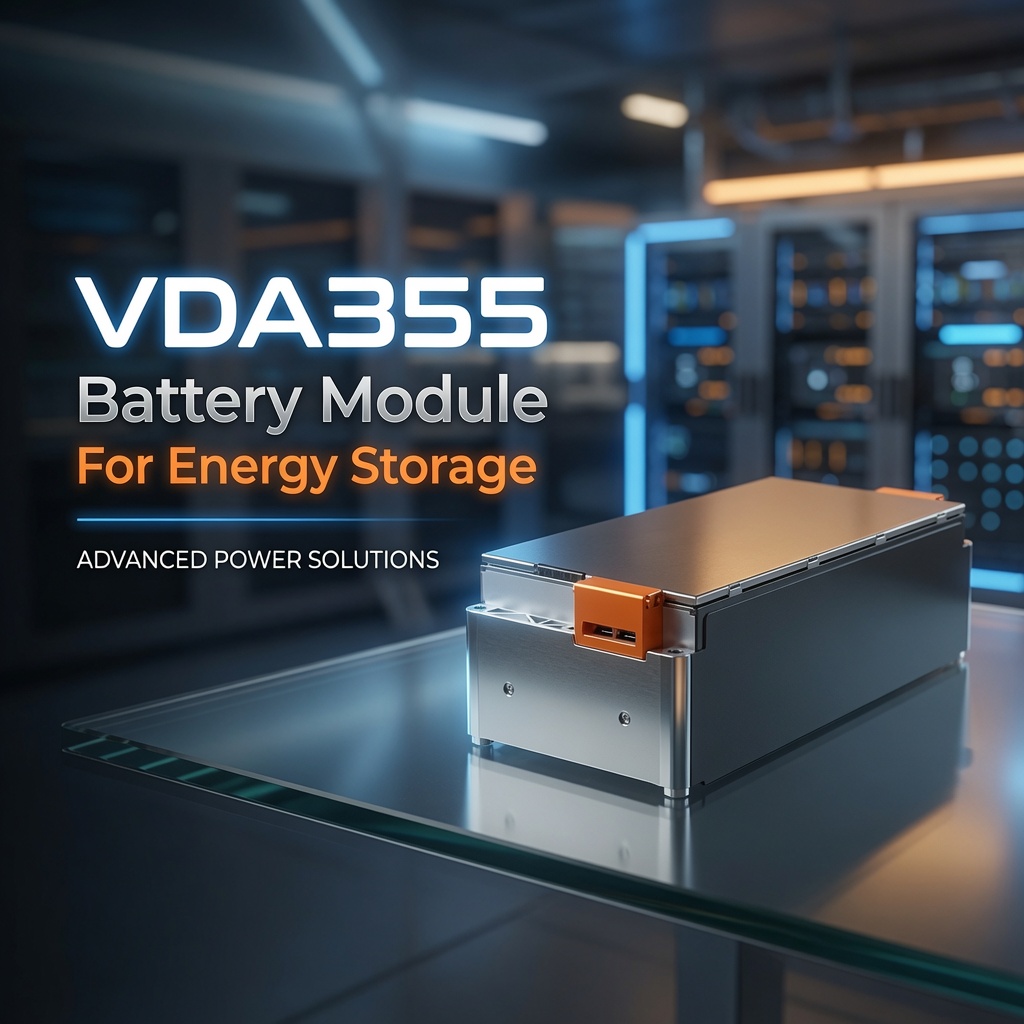
The global shift toward renewable energy has created strong demand for reliable, scalable, and cost-effective energy storage battery modules. Among the most versatile options available today is the VDA355 ESS Module — a standardized lithium-ion battery module originally developed for electric vehicles but now widely adopted in stationary energy storage systems (ESS).
This article provides a comprehensive, expert overview of the VDA355 Battery Module, its technical advantages, real-world applications in ESS, and practical guidance for system integrators, project developers, and energy professionals. Whether you are designing a residential solar storage system, a commercial BESS, or a grid-scale installation, understanding the VDA355 standard helps you make informed decisions.
What is the VDA355 ESS Module?
The VDA355 module is a standardized battery module format established by the German Association of the Automotive Industry (Verband der Automobilindustrie — VDA). Introduced around 2012, it was initially created to promote interchangeability, simplify vehicle design, and streamline maintenance across different EV platforms (notably early Volkswagen Group vehicles).
Key dimensions (consistent across reputable manufacturers):
- Length: 355 mm (±1 mm)
- Width: 151–152.5 mm
- Height: 108–108.5 mm
The module typically uses high-quality prismatic lithium-ion cells in various series-parallel configurations (common examples: 1P4S, 1P6S, 1P12S, 2P6S, 3P4S). It features an aluminum frame or extruded housing, integrated flexible printed circuit (FPC) for cell voltage and temperature monitoring, and robust busbar connections.
Because of its compact size, high energy density, and proven automotive-grade reliability, the VDA355 ESS Module has become a popular building block for energy storage battery modules in both new installations and retrofit projects.
Why VDA355 Battery Modules Excel in Energy Storage Systems
Standardization is the biggest advantage. System designers can create modular racks and cabinets that accommodate modules from multiple qualified suppliers without major mechanical redesigns. This reduces engineering time, lowers risk, and improves supply chain resilience.
К дополнительным преимуществам относятся:
- High volumetric and gravimetric energy density — Modules typically weigh 11–12.5 kg and deliver 1.7–2.6 kWh depending on chemistry and configuration.
- Excellent power capability — Many variants support continuous discharge rates of 1–2C or higher, making them suitable for peak shaving, frequency regulation, and fast-response applications.
- Proven thermal management design — Most modules include optimized interfaces for air or liquid cooling and good cell-to-cell thermal uniformity.
- Cost competitiveness — High-volume production from the EV supply chain (Sunwoda, CALB, SVOLT, and others) keeps per-kWh costs attractive.
- Масштабируемость — Easily combine modules in series and parallel to achieve desired system voltage (48V, 400V, 800V+, etc.) and capacity.
These characteristics make the VDA355 Battery Module especially attractive for modular ESS designs ranging from 10 kWh residential units to multi-MWh containerized systems.
Technical Specifications of VDA355 Energy Storage Battery Modules
Specifications vary by chemistry (NMC vs LFP), cell configuration, and manufacturer. Always refer to the supplier’s latest datasheet. Representative examples:
| Параметр | LFP Example (1P4S) | NMC Example (1P4S) | Notes / Typical Range |
|---|---|---|---|
| Номинальное напряжение | 12.8 V | 14.6–14.8 V | Varies with configuration |
| Nominal Capacity | 135 Ah | 150–177 Ah | Higher in multi-parallel configs |
| Nominal Energy | ~1.73 kWh | ~2.2–2.6 kWh | Per module |
| Габариты (Д×Ш×В) | 355 × 152 × 108.5 mm | 355 × 151.5 × 108 mm | Industry standard |
| Масса | 11.6 kg | 11–12.5 kg | — |
| Continuous Discharge | 270 A (~2C) | 150–200+ A | High power capability |
| Operating Temp (Discharge) | -20°C to +55°C | -20°C to +55°C | Chemistry dependent |
| Cycle Life (typical) | 4,000–6,000+ @ 80% DoD | 2,000–4,000+ | LFP generally superior for ESS |
| Охлаждение | Natural / Liquid | Liquid recommended | Depends on power density |
LFP chemistry is generally preferred for stationary energy storage battery modules due to superior thermal stability, longer calendar and cycle life, and lower fire risk. НМК offers higher energy density and may be chosen when space or weight is critical and robust safety systems (advanced BMS, fire suppression) are in place.
Real-World Applications of VDA355 ESS Modules
VDA355 modules are successfully deployed in:
- Residential and small commercial solar + storage systems
- Peak shaving and demand charge reduction for industrial facilities
- Microgrids and off-grid renewable installations
- EV charging station buffer storage
- Containerized or cabinet-style commercial & industrial (C&I) BESS
- Second-life and hybrid new/repurposed projects (with proper testing and recertification)
The standardized form factor simplifies rack design, allowing integrators to achieve high packing density while maintaining serviceability. Many successful projects use drawer-style or fixed racks with centralized master BMS and liquid cooling manifolds when high C-rates are required.
NMC vs LFP VDA355 Modules for ESS: Making the Right Choice
| Factor | LFP VDA355 | NMC VDA355 | Recommendation for ESS |
|---|---|---|---|
| Безопасность | Excellent (stable chemistry) | Good (requires robust protection) | LFP preferred for most sites |
| Cycle / Calendar Life | Superior | Good | LFP for long-duration storage |
| Плотность энергии | Good | Higher | NMC when space is limited |
| Cost per kWh (2026) | Very competitive | Competitive | Project-specific |
| Thermal Runaway Risk | Very low | Higher | LFP for residential & occupied spaces |
For most stationary ESS Battery Module applications, LFP-based VDA355 modules provide the best balance of safety, longevity, and total cost of ownership.
Best Practices for Designing and Integrating VDA355 Modules into ESS
- BMS Architecture — Use modules with reliable cell-level monitoring (FPC) and pair them with a high-quality master BMS that supports balancing, SOC/SOH estimation, CAN/RS485 communication, and multi-level protection.
- Mechanical Integration — Secure modules properly to handle their weight and any vibration. Maintain recommended clearances for airflow or cooling plates.
- Терморегулирование — Passive cooling suffices for low-to-moderate C-rates; active liquid cooling is recommended for high-power or high-ambient-temperature installations.
- Safety & Compliance — Design to relevant standards (UL 9540 / UL 9540A, IEC 62619, NFPA 855, local fire codes). Include fire detection/suppression where required.
- Monitoring & Maintenance — Implement remote monitoring via EMS/SCADA. Plan for periodic inspections and firmware updates.
- Sourcing — Choose suppliers with proven automotive or ESS track records, consistent quality, and clear warranty terms (typically 5–10 years or cycle-based).
Frequently Asked Questions about VDA355 Battery Modules for Energy Storage
What does “VDA355” mean? It refers to the standardized module dimensions (approximately 355 mm long) defined by the German automotive industry association (VDA) to enable interchangeability across vehicle platforms and, increasingly, energy storage applications.
What are the exact dimensions of a VDA355 battery module? Industry-standard size is 355 mm (L) × 151–152.5 mm (W) × 108–108.5 mm (H). Minor variations (±1 mm) exist between manufacturers.
Can VDA355 modules be used for home solar battery storage? Yes — particularly LFP versions. They offer excellent modularity and performance when integrated with a professional BMS, inverter, and safety systems. Proper installation by qualified personnel is essential.
What is the typical cycle life of a VDA355 ESS module? LFP variants commonly achieve 4,000–6,000+ cycles to 80% capacity retention under recommended conditions. NMC variants typically deliver 2,000–4,000 cycles. Actual life depends on temperature, DoD, and C-rate.
Do VDA355 modules require liquid cooling? Not always. Many installations use natural or forced air cooling successfully. Liquid cooling is recommended for high continuous power, high ambient temperatures, or dense packing.
How does VDA355 compare with larger prismatic cell racks (e.g., 280 Ah cells)? VDA355 offers superior standardization and supplier flexibility. Larger prismatic formats can achieve higher energy density per rack in some designs but may require more custom engineering. VDA355 excels in modular, serviceable, and multi-supplier projects.
Are VDA355 battery modules safe for stationary use? When properly integrated with certified BMS, thermal management, and fire protection systems, both LFP and NMC VDA355 modules are used safely worldwide. LFP chemistry provides an additional safety margin for residential and occupied-space applications.
Where can I source quality VDA355 ESS modules? Reputable manufacturers and distributors specializing in EV and ESS components. Always request recent test reports, UL/IEC certifications where applicable, and warranty documentation.
Conclusion: Why VDA355 Remains a Strong Choice for Energy Storage
Он VDA355 Battery Module combines automotive-grade engineering, proven reliability, and true standardization in a compact, high-performance package. Whether you prioritize maximum safety and longevity (LFP) or higher energy density (NMC), the VDA355 platform gives system designers and project owners a flexible, cost-effective foundation for building scalable energy storage battery modules and complete ESS solutions.
As the energy transition accelerates, standardized modular formats like VDA355 will continue to play a key role in delivering reliable, maintainable, and economically viable energy storage.
Ready to explore VDA355 solutions for your next ESS project? Contact qualified integrators or module suppliers for current datasheets, pricing, and system design support. Always engage certified professionals for installation and commissioning to ensure safety and optimal performance.
This article is for informational purposes and reflects industry knowledge as of 2026. Specifications and best practices should be verified with current manufacturer documentation and applicable local standards.