
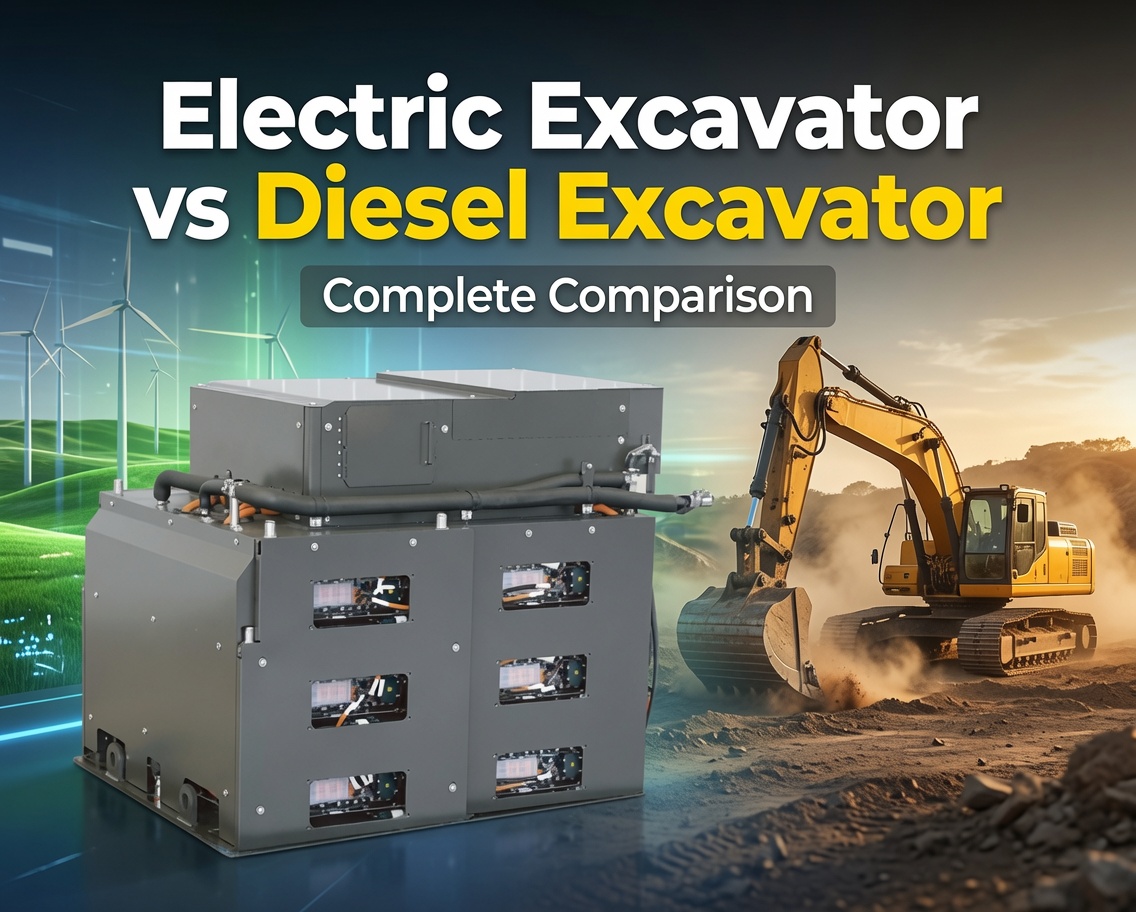
Choosing between an electric excavator and a diesel excavator is no longer a future-looking decision. In 2026, battery-electric models from Volvo, Caterpillar, JCB, Komatsu and others deliver diesel-equivalent digging force, cycle times and productivity while cutting energy costs, noise and emissions. This Electric Excavator vs Diesel Excavator: Complete Comparison gives facility managers, fleet owners and project estimators the measurable criteria needed to decide which powertrain fits a given site, duty cycle and total-cost target.
Table of Contents
- Performance and Power Delivery
- Runtime, Refueling and Charging Reality
- Operating Costs and Total Cost of Ownership
- Emissions, Noise and Jobsite Suitability
- Maintenance, Reliability and Uptime
- Side-by-Side Specification Comparison
- When to Choose Electric vs Diesel
- Selection Checklist
- Часто задаваемые вопросы
- Decision Framework
Performance and Power Delivery
Modern electric excavators match or exceed diesel counterparts on the metrics that drive daily output.
Electric motors deliver peak torque from zero rpm. That eliminates the lag inherent in diesel engines as they spool up, producing smoother, more precise hydraulic control and, in documented cases, faster cycle times. Volvo’s EC230 Electric (23-tonne class, 450 kWh battery) is rated to deliver the same breakout and tear-out forces as its diesel sibling while offering more responsive hydraulics. Caterpillar’s 320 Electric (≈387 kWh) is specified for equivalent digging performance with the option of tethered unlimited runtime.
Energy conversion efficiency further widens the gap. Electric drivetrains convert 90–95 % of stored energy into useful work; diesel engines typically convert only 35–40 %. The result is lower heat, less vibration and reduced mechanical stress on pumps and cylinders.
Runtime, Refueling and Charging Reality
Runtime remains the most common practical constraint for battery-electric machines.
| Machine Class | Typical Diesel Runtime | Typical Electric Runtime (single charge) | Charging / Refuel Options |
|---|---|---|---|
| Mini (1–3 t) | Full shift + reserve | 4–8 h (JCB 19C-1E ≈5 h typical) | On-board AC, 110/230 V; optional DC fast |
| Midi / Mid-size (15–25 t) | 12–16+ h continuous | 5–8 h (Volvo EC230 7–8 h; Cat 320 up to 8 h) | DC fast (CCS), overnight AC, optional tether |
| Large / Quarry | Continuous with fuel trucks | Limited unless tethered or battery-swap | Grid connection or modular packs |
Diesel refueling takes 5–10 minutes. Electric fast charging (CCS) can restore 20–80 % in 1–2 hours on larger packs; full overnight AC charging is standard for single-shift operations. Opportunity charging during lunch or shift changes routinely extends effective daily runtime to a full shift on many urban and utility sites. For continuous high-intensity work, tethered (cable) operation or battery-swap systems remove the runtime limit entirely.
Operating Costs and Total Cost of Ownership
Energy and maintenance dominate lifetime cost. Independent 2026 analyses show consistent patterns:
- Energy cost: electric models typically consume 20–40 kWh/h in the 20-tonne class versus 13–18 L/h diesel. At commercial electricity rates, hourly energy cost is 60–80 % lower.
- Maintenance: electric machines eliminate oil changes, fuel filters, DEF/DPF systems and many engine-related services. Lifetime maintenance is commonly 30–50 % lower.
- Upfront premium: 30–60 % higher purchase price for battery-electric units (mini machines at the lower end, mid-size at the higher end).
Example 20-tonne class, 12 000-hour lifetime (IDTechEx-aligned figures):
- Diesel 10-year TCO ≈ $410 000–420 000
- Electric 10-year TCO ≈ $440 000–450 000 before incentives
High-utilization sites (1 500–2 000+ hours/year) close the gap in 3–6 years. Low-hour fleets may never recover the premium. Incentives, lower electricity rates and rising diesel prices accelerate payback.
Emissions, Noise and Jobsite Suitability
Electric excavators produce zero tailpipe emissions and operate 10–20 dB quieter than diesel equivalents. Cabin noise often falls below 70–75 dB(A). These characteristics make electric the only practical choice for:
- Indoor demolition and renovation
- Urban night work and noise ordinances
- Hospitals, schools and residential zones
- Sites subject to Stage V / Tier 4 Final or local zero-emission mandates
Diesel remains necessary where grid power or charging infrastructure is unavailable and continuous multi-shift operation is required without interruption.
Maintenance, Reliability and Uptime
Fewer moving parts translate directly into higher mechanical availability. Electric motors are essentially maintenance-free. Battery management systems (BMS) monitor cell temperature, state of charge and health in real time, protecting the pack and providing predictive alerts. Service intervals for hydraulic systems remain, but overall planned maintenance hours drop significantly.
Diesel machines still require daily fluid checks, periodic engine overhauls and emissions-system servicing. Cold-weather starting and high-altitude derating can also affect diesel reliability more than well-managed lithium packs.
Side-by-Side Specification Comparison
| Criterion | Diesel Excavator | Electric Excavator | Advantage |
|---|---|---|---|
| Peak torque delivery | RPM-dependent lag | Instant from 0 rpm | Electric |
| Cycle time / productivity | Baseline | Equal or faster (documented) | Electric |
| Энергоэффективность | 35–40 % | 90–95 % | Electric |
| Typical shift runtime | 12–16+ h | 4–8 h (extendable with opportunity charge/tether) | Diesel |
| Refuel / recharge time | 5–10 min | Overnight AC or 1–2 h DC fast | Diesel |
| Hourly energy cost | High (fuel price volatile) | 60–80 % lower | Electric |
| Maintenance cost | Higher (engine + after-treatment) | 30–50 % lower | Electric |
| Noise (operator station) | 85–100+ dB | 60–75 dB typical | Electric |
| Tailpipe emissions | CO₂, NOx, PM | Zero | Electric |
| Upfront capital | Lower | 30–60 % premium | Diesel |
| Best application | Remote, continuous heavy duty | Urban, indoor, regulated, single/two-shift | Context-dependent |
When to Choose Electric vs Diesel
The core insight from any rigorous Electric Excavator vs Diesel Excavator: Complete Comparison is application matching.
Prefer electric when:
- The site has reliable grid access or can support fast charging.
- Noise or emissions restrictions apply.
- Daily utilization is predictable and within one full shift (or opportunity charging is feasible).
- Total cost of ownership over 5–8 years is the primary metric.
- Operator comfort and reduced fatigue matter.
Prefer diesel when:
- The machine must run continuously for 12+ hours with minimal interruption.
- The jobsite is remote or lacks electrical infrastructure.
- Capital budget is tightly constrained and utilization is low.
- Maximum multi-shift flexibility without charging logistics is required.
Hybrid and tethered electric configurations increasingly bridge the gap for larger machines.
Selection Checklist
- Confirm daily energy demand (kWh or litres) under your actual duty cycle.
- Verify charging infrastructure capacity and available downtime windows.
- Calculate 5- and 10-year TCO including electricity rate, diesel price and maintenance differentials.
- Check local incentives, emissions zones and noise ordinances.
- Evaluate residual value and battery warranty (typically 5–8 years or 3 000–5 000 cycles for industrial lithium packs).
- Pilot one unit on a representative project before fleet-wide conversion.
- Confirm dealer support for high-voltage diagnostics and battery service.
Часто задаваемые вопросы
Are electric excavators as powerful as diesel models in 2026? Yes. Leading mid-size models (Volvo EC230 Electric, Cat 320 Electric) deliver equivalent or better breakout force, lift capacity and cycle times through instant torque and higher system efficiency.
How long does a battery last on an electric excavator? Industrial lithium packs are typically warranted for 5–8 years or several thousand cycles. Real-world capacity retention after 3 000 full cycles often exceeds 80 % when managed by a quality BMS.
What is the payback period for switching to electric? High-hour machines (1 500+ hours/year) commonly achieve payback in 3–6 years. Low-hour machines may take longer or never recover the premium without incentives.
Can electric excavators work in cold weather? Yes. Modern packs include thermal management. Performance is maintained within specified ambient ranges; extreme cold may reduce available capacity until the pack warms.
Is charging infrastructure a major barrier? For fixed or urban sites it is solvable with overnight AC or DC fast chargers. For remote multi-shift work it remains a genuine constraint unless tethered or battery-swap solutions are used.
Decision Framework
Start with the duty cycle and site constraints, not the technology preference. Map daily hours, soil conditions, noise/emission rules and available power. Run a site-specific TCO that includes energy, maintenance, residual value and any incentives. If the numbers favor electric and infrastructure is feasible, the operational advantages—lower energy cost, quieter operation, zero local emissions and reduced operator fatigue—compound over the machine’s life. If continuous remote operation is non-negotiable, diesel (or a hybrid/tethered solution) remains the practical choice.
This Electric Excavator vs Diesel Excavator: Complete Comparison is designed as a practical decision tool rather than a one-size-fits-all recommendation. Use the tables, checklist and TCO logic above to evaluate your own fleet data.
In short, the Electric Excavator vs Diesel Excavator: Complete Comparison shows that electric models have reached performance parity in 2026 and already win on total cost and site suitability for a growing share of applications. Match the machine to the job, not the other way around.
Data drawn from 2026 OEM specifications (Volvo EC230 Electric 450 kWh / 7–8 h, Cat 320 Electric 387 kWh, JCB 19C-1E), industry TCO analyses and field reports. Always verify current regional pricing, incentives and dealer support for your specific application.