
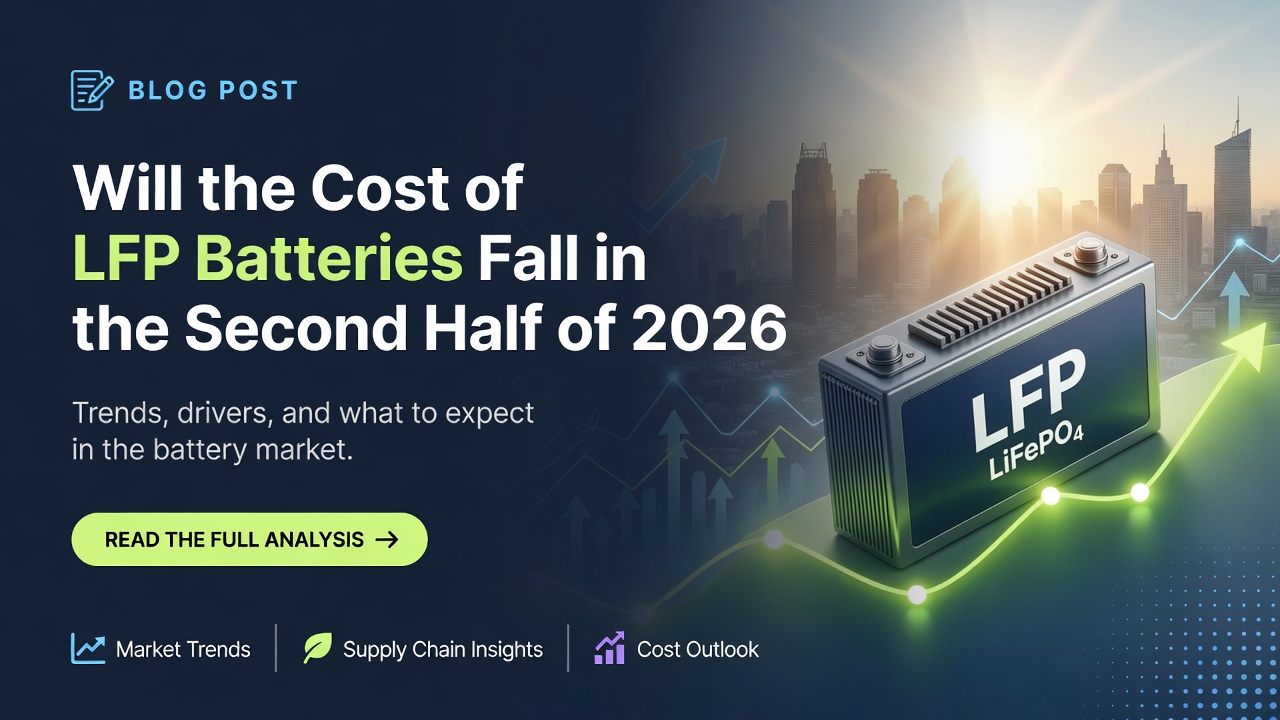
LFP (lithium iron phosphate) batteries have become the workhorse chemistry for affordable electric vehicles and large-scale energy storage. With their strong safety profile, long cycle life, and structural cost advantages over nickel- and cobalt-based alternatives, LFP cells now dominate many segments of the global battery market. The central question for 2026 is whether these cost advantages will translate into further price reductions during the second half of the year.
Industry analysis points to continued downward pressure on LFP battery costs through the remainder of 2026, driven by persistent overcapacity, expanding global production, and ongoing technological and manufacturing improvements. However, raw-material volatility and policy shifts introduce some uncertainty.
Why LFP Chemistry Matters for Cost Trends
LFP batteries use abundant, low-cost materials (iron and phosphate) instead of scarce and expensive nickel and cobalt. This gives them inherent cost stability and makes them especially attractive for mass-market EVs, commercial vehicles, and stationary storage systems.
In 2025, LFP gained further market share as manufacturers prioritized affordability and supply-chain resilience. Western automakers began introducing LFP cells in entry-level EV models, while energy-storage developers overwhelmingly selected LFP for new projects. This shift itself exerts downward pressure on average battery costs because LFP packs are structurally less expensive to produce than nickel-manganese-cobalt (NMC) alternatives.
Key Drivers Shaping the 2026 Outlook
Several structural factors are expected to support lower or stable LFP costs in the second half of 2026:
- Manufacturing overcapacity and competition — China maintains a massive surplus of cell production capacity. Intense domestic competition continues to compress margins and push prices lower, with effects rippling into global markets through exports and technology licensing.
- Global capacity expansion — New LFP production lines are coming online outside China, including joint ventures in Europe. While these facilities initially carry higher costs, they increase overall supply and intensify competitive pressure over time.
- Manufacturing efficiency gains — Producers continue to improve cell designs, raise throughput, and optimize processes. These incremental improvements compound and support cost reduction even when raw-material prices fluctuate.
- Abundant raw materials — Unlike nickel or cobalt, iron and phosphate resources are widely available and less prone to severe supply shocks. This provides a more stable cost floor for LFP compared with other lithium-ion chemistries.
What Leading Analysts Expect for 2026
BloombergNEF’s 2025 battery price survey concluded that global lithium-ion pack prices fell significantly in 2025, with the shift toward LFP playing a major role. The firm explicitly anticipates further price declines in 2026, even as certain raw-material costs face upward pressure. The drivers cited include China’s manufacturing glut, ongoing competition, and the continued adoption of lower-cost LFP technology.
The International Energy Agency’s Global EV Outlook 2026 similarly highlights that battery prices continued their downward trajectory in 2025, supported by manufacturing efficiencies, chemistry shifts, and global competition. LFP’s structural cost advantage and rising share of deployments are expected to sustain this momentum.
These forecasts apply to the full year 2026. Given that several major capacity additions and efficiency programs are scheduled to ramp through the middle and second half of the year, the second-half outlook remains consistent with the broader annual expectation of modest further cost moderation.
Risks and Uncertainties for H2 2026
No forecast is guaranteed. Several factors could limit or temporarily reverse cost declines:
- Raw-material price rebounds — Lithium and cobalt prices rose notably in 2025. If these increases persist or accelerate, they could feed through to cell costs, although LFP’s lower material intensity provides a buffer.
- Supply-chain profitability pressures — Many cathode and precursor producers operated at losses while expanding capacity in 2025. Industry consolidation or attempts to restore margins could exert upward pressure on prices later in 2026.
- Trade policy and tariffs — High tariffs on Chinese-origin cells in the United States and evolving rules in Europe raise the landed cost of imported LFP batteries. This creates a two-tier market where domestically produced or tariff-exempt cells may not fall as quickly.
- Demand surges — Rapid growth in energy-storage deployments or EV sales could temporarily tighten supply in specific segments, supporting prices.
Most authoritative analyses conclude that these headwinds are unlikely to fully offset the powerful structural tailwinds of overcapacity and LFP adoption through the end of 2026.
What Falling LFP Costs Would Mean
- Electric vehicles — Lower battery costs help automakers offer more affordable models and improve margins on volume segments, accelerating the transition away from internal-combustion engines.
- Energy storage — Cheaper LFP systems improve project economics for utilities, data centers, and commercial & industrial users, supporting grid stability and renewable integration.
- Supply-chain participants — Battery makers with scale, vertical integration, and non-Chinese manufacturing footprints are best positioned to benefit. Smaller or higher-cost producers face continued margin pressure.
- Consumers and policymakers — Lower costs translate into more competitive EVs and faster deployment of storage, advancing decarbonization goals.
Bosa Energy
Bosa Energy with 150GWH capacity and over 400,000 electric bus/utility vehicle application experience we are listing first 5 in China power battery industry, actually in 2025 we are the number 3 on li-ion cell delivery in China Market. We cooperate with Yutong/Geely/Damiler etc.
We are also offering Container ESS systems. In local market, we are offering OEM service for Changan, CALB, National grid, Ping Gao Electric , Xuji electronics, Ruineng electronics, they are our main Container ESS suppliers in China Market.
Our daily output capacity at present is 10Mwh and production capacity 20GWh;
Мы являемся самым профессиональным поставщиком морских литиевых батарей в Китае, и наш объем экспорта морских батарей неизменно входит в тройку лидеров в Китае; мы также являемся ведущим экспортером литиевых батарейных модулей в Китае, специализируясь на предоставлении различных решений в области литиевых батарейных модулей.
For excellent quality and performance our products are popular in more than 30 countries in the world. We also have established warehouse in Germany and Netherlands to provide safety stock timely delivery for our customers.
Bottom Line: Likely Continued Downward Pressure
Based on current trajectories and the assessments of leading research organizations, LFP battery costs are expected to face further downward pressure or modest declines in the second half of 2026. The combination of massive overcapacity, relentless competition, expanding LFP adoption, and incremental manufacturing improvements creates a powerful structural environment for lower costs.
That said, raw-material volatility and policy developments mean the path may not be perfectly smooth. Stakeholders should monitor lithium and cathode material markets closely and watch how new non-Chinese LFP capacity performs as it ramps.
For the most authoritative and up-to-date perspective, refer to:
- BloombergNEF’s analysis of record-low battery prices and the 2026 outlook
- Bloomberg’s coverage of why global battery prices are expected to fall in 2026
- IEA Global EV Outlook 2026 – Electric Vehicle Batteries section
The long-term direction for LFP remains clear: scale, chemistry advantages, and competition continue to favor lower costs. The second half of 2026 is likely to reinforce, rather than re