
Prioritised Selection Criteria
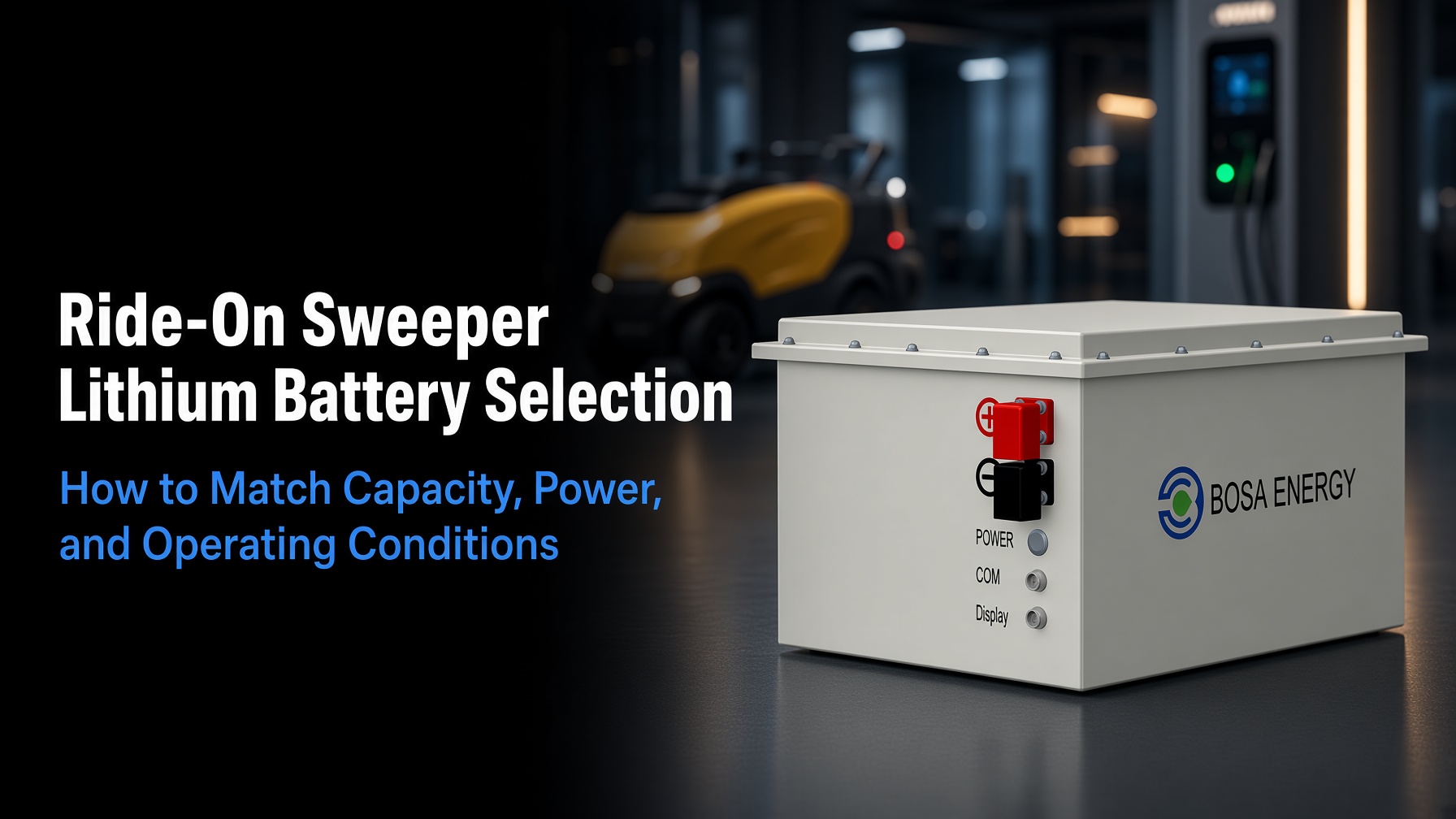
Rank these factors in order of impact when performing Ride-On Sweeper Lithium Battery Selection: How to Match Capacity, Power, and Operating Conditions:
- Usable energy (kWh) matched to real daily demand – Calculate swept area × energy intensity (typically 0.15–0.35 kWh per 1,000 m² under load) plus 20–30 % reserve.
- Continuous and peak power capability – The pack must sustain simultaneous propulsion, main broom, vacuum, and side brooms without voltage sag that slows the machine.
- Chemistry and cycle life – Specify LiFePO₄ rated ≥3,500 cycles at 80 % DoD.
- Opportunity-charging tolerance – Battery and charger must accept repeated 15–40 % SOC recoveries without life penalty.
- Voltage platform and BMS communication – 24 V or 36 V systems dominate; CAN or RS485 integration improves fleet visibility.
- Environmental protection and certifications – IP65 preferred; UL 2271 and/or IEC 62619 required.
- Warranty transparency – Minimum 5-year or 3,500-cycle coverage with clear SOC and temperature limits.
This ordered approach prevents the common error of buying on nameplate Ah alone.
Matching Capacity to Daily Energy Demand
Capacity is expressed in usable kWh, not nominal Ah. Industrial ride-on sweepers typically draw 0.8–2.5 kW continuous under load.
| Machine Class | Δυναμικό | Lithium Energy Example | Practical Runtime (Eco / High Load) | Typical Daily Fit |
|---|---|---|---|---|
| Compact mid-size (Nilfisk SW3000 class) | 24 V | ~3.8 kWh (3 × 50 Ah) | Up to ~4 h | 8,000–20,000 m² light–medium debris |
| Mid-to-large industrial (Tennant S16 class) | 36 V | 4.1 / 8.2 / 12.2 kWh | 2.8 / 5.6 / 8.5 h | 20,000–50,000+ m² multi-shift |
| Custom high-capacity packs | 24–36 V | 6–15+ kWh | 5–10 h with opportunity charging | Continuous or heavy-debris sites |
Matching Power Delivery to Machine Load Profile
Capacity alone is insufficient if the pack cannot deliver the required current without voltage drop.
- Continuous power demand for a mid-size industrial sweeper is typically 1.5–3 kW (propulsion + main broom + vacuum + side brooms).
- Peak currents occur during acceleration, ramp climbs, or simultaneous high-dump and full broom engagement.
- LiFePO₄ maintains a flatter voltage curve than lead-acid, so broom speed and travel speed remain consistent until near the end of the usable SOC window.
- Specify continuous discharge rating that covers the machine’s maximum simultaneous load plus 20–30 % margin, and peak (10–30 s) capability for acceleration and hopper lift.
A pack that meets Ah capacity but lacks continuous current capability will force the operator to reduce broom speed or travel speed late in the shift, lowering productivity.
Operating Conditions That Change Battery Requirements
Operating conditions modify both capacity and power needs:
- Multi-shift or continuous operation – Requires either higher capacity or aggressive opportunity charging (15–40 % SOC recoveries). Single overnight charge becomes inadequate.
- Heavy debris density – Increases power draw and filter loading; energy intensity can rise toward the upper end of the 0.15–0.35 kWh/1,000 m² range.
- Ambient temperature extremes – Below 0 °C, charge acceptance drops and usable capacity falls unless the pack includes thermal management. Above 40 °C, continuous current limits may be reduced by the BMS.
- Dust and occasional wash-down – Demand IP65 or higher enclosure ratings and sealed connectors.
- Uneven floors and vibration – Require robust mechanical design and vibration-tested cells/modules.
When these conditions are present, the correct Ride-On Sweeper Lithium Battery Selection: How to Match Capacity, Power, and Operating Conditions prioritises higher usable energy, higher continuous discharge rating, and stronger environmental protection over the lowest first-cost option.
LiFePO₄ vs Lead-Acid Performance Comparison
| Παράμετρος | Lead-Acid (Flooded / AGM) | LiFePO₄ Lithium |
|---|---|---|
| Cycle life at 80 % DoD | 300–700 | ≥3,500 – 5,000+ |
| Full charge time | 8–12 h | 1.5–3 h |
| Χρέωση ευκαιρίας | Harmful / limited | Fully supported (15–40 % SOC recovery) |
| Usable capacity window | ~50–60 % recommended | 80–90 % usable |
| Weight for equivalent energy | Baseline | 40–60 % lighter |
| Voltage stability under load | Sag increases late in shift | Flat curve until near empty |
| Συντήρηση | Watering, equalisation, terminal cleaning | Κανένας |
| Typical industrial warranty | 1–2 χρόνια | 5 years / ≥3,500 cycles |
In multi-shift industrial environments the cycle-life and opportunity-charging advantages translate directly into higher machine utilisation and lower total cost of ownership.
Opportunity Charging and SOC Management
High-intensity schedules rarely allow a full 8–12 hour overnight charge for every machine. LiFePO₄ packs solve this by tolerating frequent partial charges.
Best-practice rules used by 2026 industrial fleets:
- Maintain state of charge (SOC) between 20–30 % minimum and 80–90 % maximum for maximum cycle life.
- Use short opportunity charges (20–45 minutes) to recover 15–40 % of capacity during breaks, hopper dumps, or zone changes.
- Avoid routine deep discharges below 20 % SOC.
- Integrate BMS data or fleet telematics to track kWh per 1,000 m² and adjust routes or charge schedules accordingly.
Correct application of these rules routinely increases daily productive coverage 30–60 % versus an equivalent lead-acid system limited to one full charge per day.