
Temperature Control Determines Forklift Fleet Uptime
Battery electrochemical reactions are temperature-dependent. Lower temperatures slow ion mobility and raise internal resistance; higher temperatures accelerate side reactions that consume active material and electrolyte. Industry data consistently show:
- Lead-acid capacity falls approximately 1–1.5 % for every 1 °C drop below 25 °C; at –20 °C usable capacity can drop below 50 % of nameplate.
- Lithium iron phosphate (LiFePO₄ / LFP) packs retain 80–95 % capacity at –20 °C when equipped with active heating, versus 40–50 % for flooded lead-acid.
- Sustained operation above 35–40 °C can roughly halve calendar and cycle life for every additional 10 °C rise (Arrhenius relationship).
- Quality industrial LFP packs rated ≥3,500 cycles at 80 % depth of discharge (DoD) deliver 7–10+ years of multi-shift service when state-of-charge (SOC) is kept above the 20–30 % floor and opportunity charging (15–40 % capacity top-ups) is performed within recommended thermal windows.
- Battery-related downtime in multi-shift operations frequently exceeds $100–$300 per hour in lost throughput.
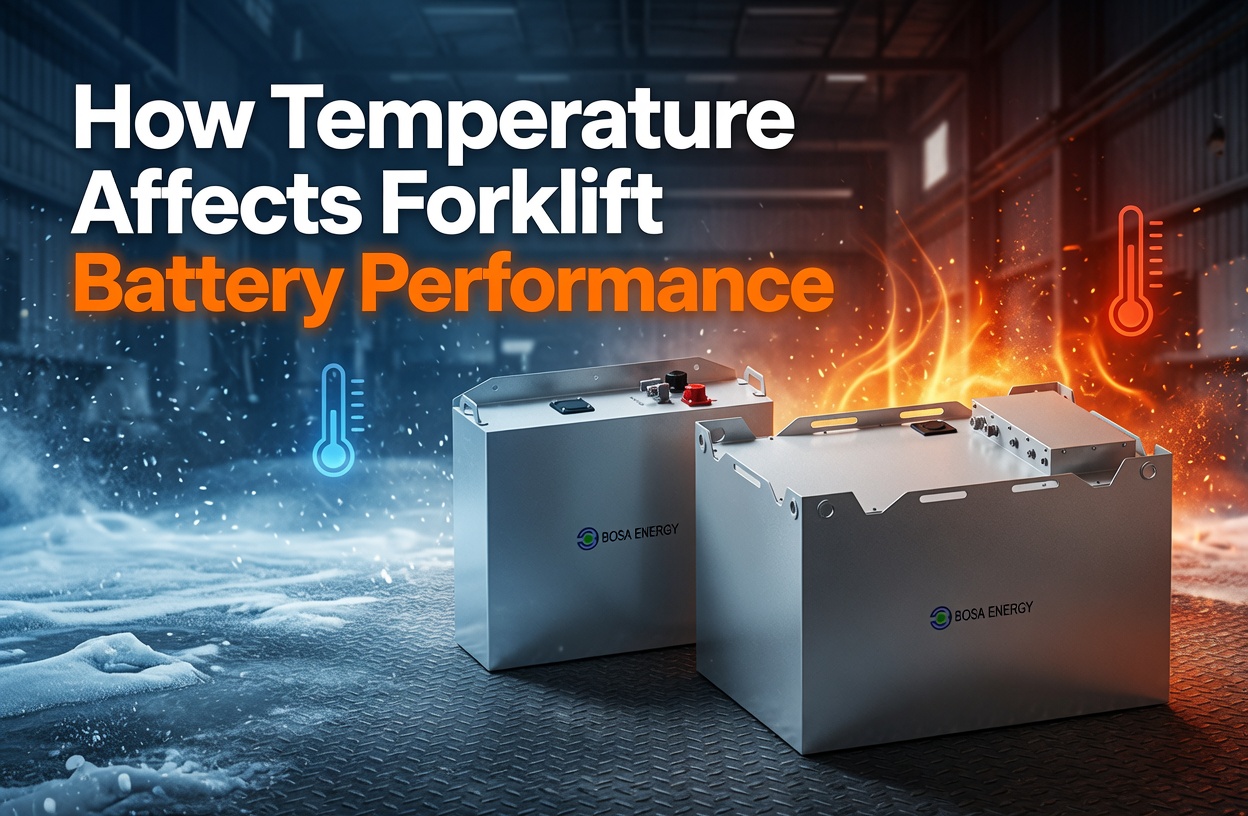
How Temperature Affects Forklift Battery Performance therefore sits at the intersection of productivity, energy cost, and total cost of ownership (TCO).
Cold Temperature Effects on Capacity, Power, and Charging
Cold environments (freezers, refrigerated docks, outdoor winter yards) produce three primary effects:
- Reduced available capacity – Thickened electrolyte and slower kinetics limit the energy that can be extracted before voltage sags below usable limits.
- Increased internal resistance – Higher resistance causes greater voltage drop under load, reducing lift speed and travel performance.
- Restricted charge acceptance – Charging below 0 °C risks lithium plating on the anode of lithium cells (permanent capacity loss) and undercharging of lead-acid packs that promotes sulfation.
Typical capacity retention at 0 °C and –20 °C:
| Τύπος μπαταρίας | Capacity at 0 °C | Capacity at –20 °C | Chargeability Below 0 °C |
|---|---|---|---|
| Flooded Lead-Acid | 60–75 % | 35–50 % | Poor; high risk of undercharge |
| AGM / Gel | 70–80 % | 45–60 % | Limited |
| Industrial LFP (no heat) | 85–95 % | 70–85 % | Restricted (plating risk) |
| Industrial LFP (active BMS heating) | 90–98 % | 80–95 % | Enabled once cells reach safe threshold |
In cold-storage operations, lead-acid fleets often require 2–3 spare batteries per truck plus a heated charging room. LFP packs with integrated heaters and BMS temperature interlocks allow charging and continuous operation inside the freezer, eliminating battery changes and cutting monthly downtime by 70–90 % in documented conversions.
High Temperature Effects on Degradation and Safety
Elevated temperatures accelerate irreversible chemical processes:
- Lead-acid: accelerated grid corrosion, electrolyte evaporation, and plate sulfation. Life can be cut by half for every 10–15 °C sustained rise above 25–30 °C.
- Lithium (LFP): faster solid-electrolyte interphase (SEI) growth and mild electrolyte decomposition. LFP remains far more thermally stable than NMC chemistries, with decomposition temperatures typically above 250 °C, but continuous operation above 45–50 °C still shortens cycle life.
- Both chemistries experience higher self-discharge rates and reduced charge efficiency as temperature climbs.
Opportunity charging remains advantageous for lithium even in warm environments because short 15–40 % top-ups generate less heat per charge event than full overnight charges, provided the BMS enforces temperature limits and charging current is moderated when cells exceed ~40–45 °C.
Lithium vs Lead-Acid Temperature Performance Comparison
| Παράμετρος | Flooded Lead-Acid | Industrial LFP Lithium |
|---|---|---|
| Optimal operating range | 15–30 °C (50–86 °F) | 15–35 °C (optimal); –20 to 60 °C operable |
| Capacity retention at –20 °C | 35–50 % | 80–95 % (with heating) |
| Capacity retention at 45–50 °C | Noticeable permanent degradation | Stable with BMS thermal management |
| Charge acceptance below 0 °C | Severely reduced | Enabled by active heating + BMS interlock |
| Heat generation during charging | High (electrolysis + resistance) | Lower; opportunity charging further reduces heat |
| Typical cycle life impact of heat | –50 % life per ~10–15 °C rise | Moderate acceleration of SEI growth; still ≥3,500 cycles achievable |
| Safety / gas generation | Hydrogen evolution increases with heat | Minimal gas; UL 2580 / IEC 62619 thermal tests |
| Recommended SOC floor | Avoid deep discharge | Keep ≥20–30 % |
LFP packs certified to UL 2580 and IEC 62619 incorporate cell-level temperature sensing, charge current limiting, and (in premium designs) active heating or cooling. These features make How Temperature Affects Forklift Battery Performance far more predictable and controllable than with conventional lead-acid systems.
Optimal Operating and Charging Temperature Windows
- Lead-acid charging: Best between 15–27 °C. Avoid charging when electrolyte temperature exceeds ~45 °C; open vent caps and ensure ventilation per OSHA 29 CFR 1910.178(g).
- LFP charging: Preferred 0–45 °C; many systems lock out charging below 0 °C until heaters raise cell temperature. Discharge is typically permitted down to –20 °C or lower.
- Storage: Both chemistries prefer 10–25 °C. Long-term storage of lithium packs at high SOC and elevated temperature accelerates calendar aging.
Modern telematics and BMS platforms log cell or pack temperatures continuously, enabling fleet managers to correlate thermal exposure with capacity fade and to adjust charging schedules or ventilation before permanent damage occurs.
- Specify chemistry and thermal features for the duty environment – Cold-storage or outdoor fleets should require active heating and low-temperature charge interlocks. High-ambient sites benefit from forced-air or liquid cooling options and higher thermal mass designs.
- Enforce opportunity-charging discipline within thermal limits – Short top-ups (15–40 % capacity) during breaks keep SOC in the 20–80 % band and limit heat generation. Full balancing charges can be scheduled during cooler periods.
- Control the battery room / charging zone – Maintain ambient temperatures in the 15–30 °C range where practical. Provide adequate ventilation (OSHA requirements for hydrogen dispersal on lead-acid; heat extraction for lithium).
- Monitor and act on BMS / telematics data – Set alerts for cell temperatures outside 0–45 °C during charge or sustained high temperatures during discharge.
- Match charger capability to thermal strategy – Opportunity chargers for lithium should support temperature-compensated current limits; lead-acid opportunity charging requires careful management of heat and gassing.