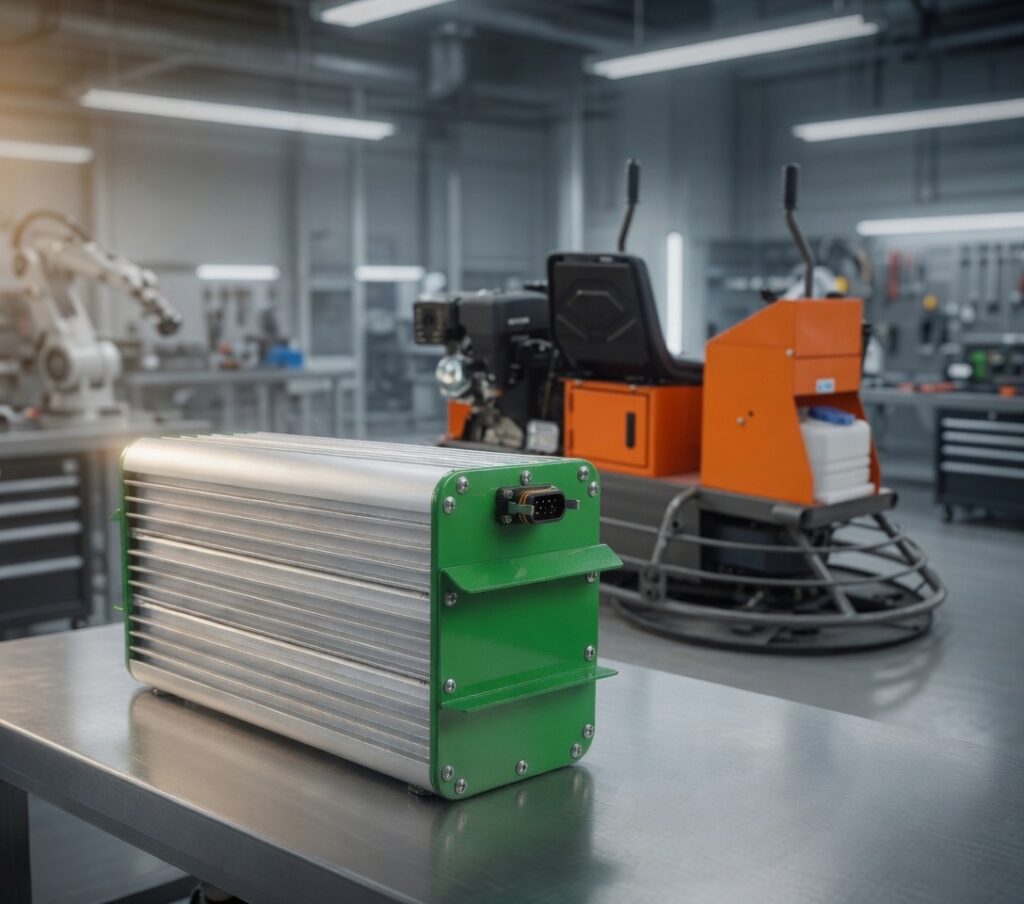

Μετα-Περιγραφή: Practical 2026 floor sweeper battery maintenance tips for lead-acid and LiFePO₄ packs. Quantified schedules, charging rules, inspection checklists, opportunity-charging guidance, SOC limits and decision framework that protect cycle life and keep industrial sweepers running across multi-shift operations.
Battery performance determines whether a ride-on or walk-behind floor sweeper finishes its assigned zones on schedule. In warehouses, distribution centres, factories and large commercial facilities, neglected packs cause mid-shift power loss, reduced brush torque and premature replacement. The following floor sweeper battery maintenance tips rank the actions that deliver the largest extension of usable life and the lowest total cost of ownership for both flooded lead-acid and modern LiFePO₄ systems.
These floor sweeper battery maintenance tips are written for facility managers and operators who need measurable results rather than generic advice. They incorporate current industrial metrics: LiFePO₄ packs routinely achieve ≥3,500 cycles to 80 % remaining capacity when operated above 20–30 % state of charge, while properly maintained flooded lead-acid packs typically deliver 300–500 cycles under the same duty.
Table of Contents
- Why Maintenance Discipline Still Matters in 2026
- Lead-Acid Floor Sweeper Battery Maintenance Tips
- Lithium (LiFePO₄) Floor Sweeper Battery Maintenance Tips
- Recommended Inspection and Care Schedule
- Relative Impact Ranking of Maintenance Actions
- Common Mistakes That Shorten Battery Life
- Practical Monitoring and Selection Checklist
- Συχνές ερωτήσεις
- Decision Framework: Matching Care to Fleet Duty Cycle
Why Maintenance Discipline Still Matters in 2026
Even the best chemistry fails early under chronic abuse. Deep discharges below 20 % SOC, wrong chargers, ignored temperature limits and dirty high-current connectors remain the primary causes of premature capacity loss. Lithium systems eliminate watering and most corrosion work, yet still require correct charging profiles and basic physical care. Lead-acid systems continue to demand disciplined watering and full charge cycles. Applying the correct set of floor sweeper battery maintenance tips converts these variables from liabilities into controllable cost drivers.
Lead-Acid Floor Sweeper Battery Maintenance Tips
Flooded, AGM and gel packs still power a large installed base of floor sweepers. Their chemistry is unforgiving of neglect.
- Recharge immediately after use
Never leave a pack sitting in a discharged state. Sulfation begins within hours. Plug the machine in at the end of every shift, even if residual capacity remains. - Complete every charge cycle
Interrupted charges leave the pack under-equalised and accelerate plate wear. Allow the charger to reach float before unplugging. - Water only after a full charge
Electrolyte expands during charging. Adding distilled water beforehand causes overflow and acid dilution. Check levels every 5–10 cycles and top up to approximately 3–6 mm above the plates with distilled water only. - Keep terminals clean and tight
Acid vapour produces corrosion that raises resistance and generates heat under load. Clean monthly with a baking-soda solution, dry thoroughly and apply a thin film of terminal protectant. - Avoid repeated deep discharges
Limit average depth of discharge to 50 % or less. Running to cut-off voltage on every shift halves expected cycle life. - Perform periodic equalisation
Most industrial chargers include an equalisation mode. Use it monthly or according to manufacturer guidance to reverse stratification.
Lithium (LiFePO₄) Floor Sweeper Battery Maintenance Tips
Quality industrial LiFePO₄ packs with integrated BMS remove the majority of traditional chores. The remaining actions are low-effort and high-leverage.
- Use only a LiFePO₄-compatible charger
Lead-acid algorithms can over-voltage cells or trigger repeated BMS protection events. Confirm charger profile matches the pack chemistry and voltage. - Practise opportunity charging
Partial charges of 15–40 % capacity during breaks or lunch periods are safe and recommended. They keep average SOC higher and reduce the need for deep discharges. - Maintain SOC above 20–30 %
Avoid routine discharges below this window. Occasional full charges to 100 % allow the BMS to complete cell balancing. - Respect temperature windows
Preferred charging range is typically 0 °C to 45 °C. Many current industrial packs include internal heaters for cold sites. Do not charge a frozen pack without heater support. - Inspect connectors and mounting weekly
Vibration and high current make Anderson-style connectors the remaining wear point. Check for tightness, arcing marks or dust accumulation. Wipe vents and cooling surfaces. - Monitor BMS indicators
Train operators to note temperature faults, cell-imbalance warnings or sudden capacity drop. Early intervention prevents mid-shift shutdowns. - Store at 40–60 % SOC
For machines or spare packs idle for weeks or months, store in a moderate-temperature area and top up every 3–6 months.
Recommended Inspection and Care Schedule
| Συχνότητα | Lead-Acid Actions | LiFePO₄ Actions | Typical Time |
|---|---|---|---|
| Daily / End of shift | Immediate charge + visual leak/corrosion check | Visual connector check + BMS display glance | 30–90 s |
| Εβδομαδιαίος | Terminal inspection; water level if due | Dust wipe, mounting security, cable routing | 1–3 min |
| Monthly | Equalisation charge; thorough terminal clean | Full charge to 100 % for balancing; diagnostic review | 5–15 min |
| Τριμηνιαίος | Capacity trend review; cable and tray inspection | Deeper compartment clean; capacity verification if runtime has dropped | 10–20 min |
| As needed | Distilled-water top-up after full charge | BMS fault investigation or supplier health report | Variable |
Most fleets fold these checks into the existing pre-shift walk-around. No specialised tools beyond a rag, air hose and the correct charger are required for routine care.
Relative Impact Ranking of Maintenance Actions
| Rank | Action | Impact on Cycle Life / Runtime | Applies To |
|---|---|---|---|
| 1 | Avoid deep discharge (keep SOC ≥20–30 %) | Highest | Both |
| 2 | Correct charger profile | Very high | Both (critical for lithium) |
| 3 | Opportunity / timely charging | High | Both (especially lithium) |
| 4 | Watering discipline (distilled, post-charge) | High | Flooded lead-acid only |
| 5 | Terminal / connector cleanliness | Medium–high | Both |
| 6 | Temperature management | Medium | Both |
| 7 | Periodic equalisation / full balancing charge | Medium | Lead-acid / lithium respectively |
Following these ranked floor sweeper battery maintenance tips produces the largest measurable gains in both chemistry families.
Common Mistakes That Shorten Battery Life
- Leaving packs discharged overnight or over weekends
- Using a lead-acid charger on a LiFePO₄ pack (or vice-versa)
- Adding water to flooded cells before charging
- Ignoring early BMS warning lights
- Running brushes and vacuum at maximum setting on light-soil floors (unnecessary load accelerates capacity fade)
- Storing lithium packs at 100 % SOC for months without periodic top-up
Each of these errors is fully avoidable with the routines outlined above.
Practical Monitoring and Selection Checklist
- Confirm charger chemistry and voltage match the installed pack
- Record weekly runtime or SOC at end of typical shift
- Keep average SOC above 20–30 % under normal duty
- Verify connectors remain tight and free of arcing marks
- For lithium: confirm BMS communication is active on the machine display or app
- For flooded lead-acid: schedule distilled-water checks after full charges
- Prefer packs rated ≥3,500 cycles at 80 % DoD with UL 2580 or equivalent industrial certification when specifying replacements
- Size usable capacity so planned daily demand stays within the preferred SOC window even after opportunity charging
Συχνές ερωτήσεις
How often should I water flooded lead-acid floor sweeper batteries?
Check every 5–10 charge cycles and only after a complete charge. Use distilled water exclusively.
Do lithium floor sweeper batteries need any watering?
No. Sealed LiFePO₄ packs contain no free electrolyte.
Is opportunity charging safe for lithium packs?
Yes. Quality industrial LiFePO₄ systems are designed for it. Restoring 15–40 % capacity during short breaks is standard practice and extends overall service life.
Can I leave a lithium pack on the charger indefinitely?
Most industrial chargers and BMS units support safe float or standby modes. Follow the specific manufacturer instructions.
What is the single most important floor sweeper battery maintenance tip?
Keep average state of charge above 20–30 % and never allow routine deep discharges. This rule delivers the largest life extension for both lead-acid and lithium chemistries.
When should I consider upgrading from lead-acid to lithium?
When labour cost of watering and terminal cleaning, mid-shift power fade, or the need for opportunity charging in multi-shift operations become measurable problems.
Decision Framework: Matching Care to Fleet Duty Cycle
- Identify chemistry currently installed (flooded / AGM / LiFePO₄).
- Map shift pattern: single-shift overnight charge versus multi-shift opportunity charging.
- Apply the corresponding column of the inspection schedule above.
- Track end-of-shift SOC or residual runtime for four weeks.
- If average SOC routinely falls below 20–30 % or watering labour exceeds 15–20 minutes per machine per week, evaluate a properly sized LiFePO₄ conversion.
- Specify replacement packs with documented cycle life ≥3,500 at 80 % DoD, compatible BMS, and industrial safety certification.
Bottom Line
Correct application of these floor sweeper battery maintenance tips converts battery care from a recurring cost centre into a predictable, low-effort routine. Lead-acid systems reward strict watering and full-charge discipline. LiFePO₄ systems reward correct chargers, opportunity charging and basic connector hygiene. In both cases the payoff is the same: longer cycle life, consistent torque across the shift, and lower five-to-seven-year total cost of ownership. Implement the ranked actions, fold them into existing walk-arounds, and the machines stay productive instead of waiting on the charger or the repair bay.