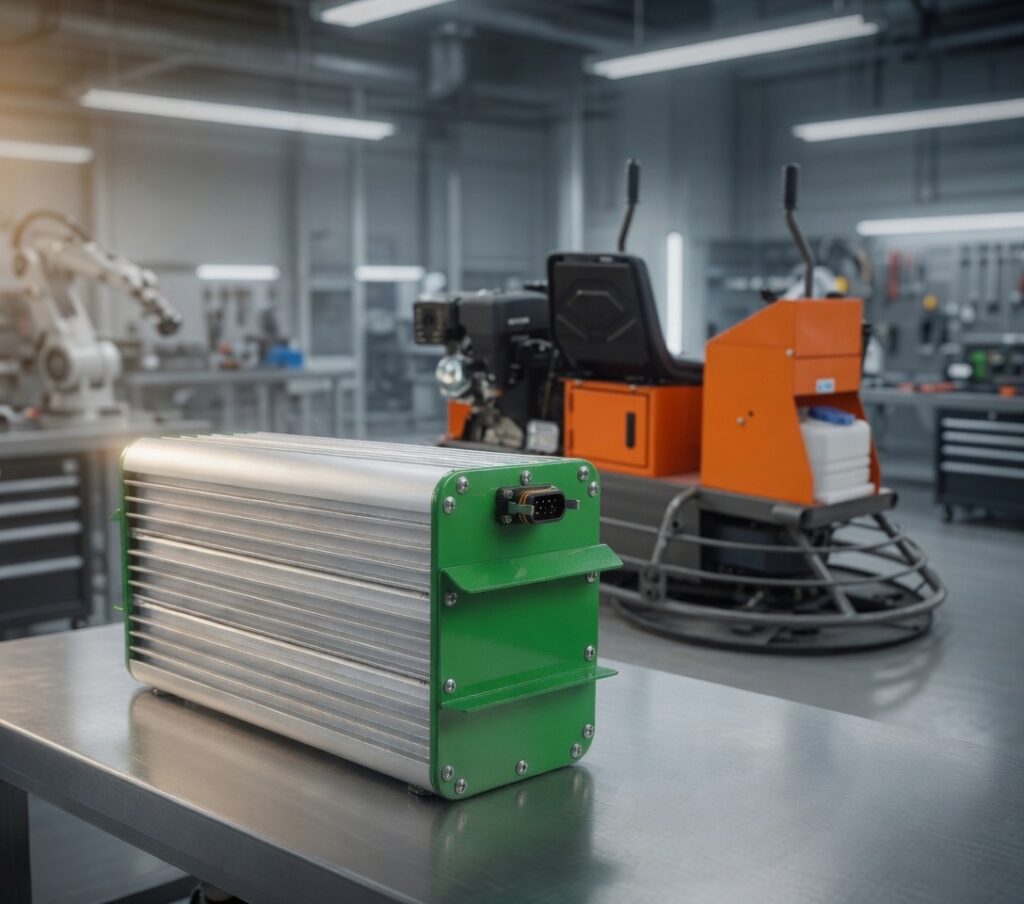

Battery life is not a brochure number. It is the product of chemistry, depth of discharge, temperature, charger match, and how many hours the truck actually works. A flooded lead-acid pack in single-shift service typically delivers 1,000–1,500 cycles and three to five calendar years. A specified industrial LiFePO₄ (LFP) pack is commonly rated at ≥3,500–5,000 cycles at 80% depth of discharge (DoD), which in well-managed multi-shift service is a seven- to ten-year planning window.
Electric Forklift Battery Life: Maximise Performance & Cut Costs is a procurement and operations problem, not a maintenance slogan. The same pack that lasts a decade under opportunity charging and a 20–30% state-of-charge (SOC) floor will fail early if operators park it at 10% overnight, use an unmatched charger, or ignore battery-management-system (BMS) faults. In 2026 the buyer’s control set is clear: specify LFP with UL 2580 on the traction system and IEC 62619 on industrial cells, charge in 15–40% opportunity windows, and treat cycle life as a cost line—not a warranty footnote.
Interact Analysis now treats 2026 as the inflection year when lithium-ion is expected to overtake lead-acid inside the electric forklift segment. That shift only pays if the pack you buy actually delivers its rated cycles on your floor. This briefing gives fleet and facility managers a decision-grade framework: how life is measured, which variables consume it, how to keep lift and travel performance flat through the shift, and where the cost reduction actually appears.

Key Takeaways
- Measure life in cycles at a stated DoD, then convert to hours and calendar years for your shift pattern. Do not compare a 1,500-cycle lead-acid claim with a 3,500-cycle LFP claim as if they were the same unit of work.
- Specify industrial LFP with a published rating of at least 3,500 cycles at 80% DoD, a documented BMS, and third-party UL 2580 / IEC 62619 evidence.
- Opportunity-charge lithium during breaks for a 15–40% capacity add. Keep operating SOC above 20–30%. Do not run lithium like a lead-acid pack that must be emptied and then equalized.
- Performance holds because LFP voltage stays flatter through the discharge. Independent warehouse tests reported by The Raymond Corporation showed up to a 17% gain in pallet moves per hour versus lead-acid, with modelled breakeven in 10–16 months.
- Cost reduction comes from fewer replacements, no watering or swap labour, 95–98% round-trip efficiency versus ~70–85% for flooded lead-acid, and one pack per truck on multi-shift work. Plan on 30–50% lower five- to ten-year total cost of ownership (TCO) on high-utilisation fleets when the operating rules above are enforced.
Table of Contents
- How Battery Life Is Measured
- Lead-Acid vs LFP: Life, Performance, and Cost
- What Consumes Electric Forklift Battery Life
- Charging Rules That Protect Cycles and Output
- Where Performance Gains Show Up on the Floor
- Where the Cost Reduction Is Real
- Certification and Safety Constraints
- Fleet Manager Checklist
- Συχνές ερωτήσεις
- Decision Framework
- Authoritative References
How Battery Life Is Measured
Three numbers are routinely mixed, and that mixing is why two quotes for the same truck can look a decade apart.
Cycle life. One cycle is a stated DoD returned to a full or balancing charge. Industrial LFP datasheets in 2026 most often quote ≥3,500 cycles at 80% DoD to 80% remaining capacity. Some OEM and aftermarket lines publish 4,000–5,000 cycles under the same end-of-life definition. Flooded lead-acid is typically 1,000–1,500 cycles at a comparable DoD if watering and equalization are done on schedule.
Operating hours. Hours are what the warehouse actually buys. A two-shift truck at 3,000 hours per year that opportunity-charges rather than deep-cycles will consume fewer full equivalent cycles than a truck that is driven to 10% SOC every day. That is why a 3,500-cycle LFP pack can cover eight to ten calendar years on one fleet and five years on another.
Calendar life. Cells age even when parked. High storage temperature and storage at 0–10% SOC accelerate calendar fade. A spare pack left discharged in a hot trailer is not “saving cycles.” It is spending calendar life.
Convert the vendor’s cycle rating into your hours before you sign. Example: 3,500 cycles × 80% of a 36 kWh pack ≈ 100,800 kWh of throughput to the 80% capacity point. Divide by your measured kWh per operating hour and you have a planning life in hours, not a slogan.
A documented multi-shift proof point is the factory-integrated Linde E18 that passed 32,000 operating hours in continuous three-shift dairy service. At the audit the pack had completed about 1,618 equivalent full cycles against an expected ~4,000-cycle life to 80% residual capacity. Hours and cycles are not the same ledger. Opportunity charging is why that truck could work a decade of shifts without burning the cycle budget.

Lead-Acid vs LFP: Life, Performance, and Cost
Use this table as the first filter. If the fleet is single-shift with an existing battery room and a three-year horizon, flooded lead-acid can still win on cash. If the fleet is two- or three-shift, the LFP column is the cost model.
| Factor | Flooded lead-acid | Industrial LFP lithium |
|---|---|---|
| Rated cycle life | ~1,000–1,500 cycles at ~80% DoD | ≥3,500–5,000 cycles at 80% DoD |
| Typical calendar window | 3–5 years single-shift | 7–10 years when SOC and temperature are controlled |
| Full charge time | 8–10 h plus cool-down | 1–2 h to a high SOC; no cool-down |
| Χρέωση ευκαιρίας | Not a design intent; partial cycling without equalization shortens plates | Design intent: 15–40% adds during breaks |
| Operating SOC floor | Avoid chronic deep discharge; water after charge | Keep above 20–30% SOC |
| Voltage under load | Sags as SOC falls; lift and travel slow late in the shift | Flat through most of the usable window |
| Round-trip efficiency | ~70–85% | ~95–98% |
| Packs per multi-shift truck | Two or three plus a hoist or transfer cart | One pack that stays in the truck |
| Daily labour | Watering, cleaning, equalization, change-outs | Connector inspection and BMS / SOC review |
| Upfront pack cost | Lower | Typically 1.5–3× a single lead-acid pack; the gap has narrowed in 2026 |
| 5–10 year TCO (high utilisation) | Higher: replacements, labour, energy waste, spare packs | 30–50% lower when opportunity charging is used |
| Certification to demand | Truck listing; charger match | UL 2580 on the traction pack; IEC 62619 on industrial cells/systems |
Cat Lift Trucks publishes 4,000+ cycles before capacity drops to 80% of original on its LFP line, with a five-year warranty frame. Linde Material Handling states that composition-dependent Li-ION packs are designed for more than 2,500 full cycles in real service, with 24 V walkie packs committed to 75% residual capacity after 2,500 cycles at 90% DoD and 48 V / 90 V packs committed to 80% residual after 2,500 full cycles at 20 °C. Aftermarket industrial LFP commonly sits at the ≥3,500-cycle / 80% DoD mark used throughout this briefing. Demand the test condition, not only the headline number.
What Consumes Electric Forklift Battery Life
Most early failures are operating failures, not cell-chemistry failures.
Depth of discharge. Cycle life is not linear. A pack that regularly goes to 10% SOC will not deliver the 80% DoD rating printed on the sheet. Keeping daily work above 20–30% SOC is the single highest-leverage life control on lithium fleets.
Unmatched chargers. A lead-acid charger on an LFP pack, or a lithium charger that cannot talk to that BMS, over-voltage, under-current, or skips balancing. The BMS will eventually cut out. Until it does, cells drift.
Temperature. Heat accelerates both cycle fade and calendar fade. Cold cuts available capacity and, if the pack has no thermal management, invites charging into a restricted window. Specify the operating band on the data sheet and keep charging alcoves inside it.
Connector and cable abuse. On lithium fleets this has replaced watering as the failure operators actually touch. A burned pin, cracked housing, or hanging cable is a resistance heater on every charge.
Impact and isolation failures. A mast strike or a dropped spare pack can create an internal short that does not announce itself until the next charge. Charging a compromised pack is how a handling event becomes a thermal event.
Oversized C-rate relative to the cell. Continuous high-rate lift and travel on an undersized Ah pack raises cell temperature and shortens life even when SOC looks healthy. Size energy for the shift plus a 1.1–1.2× margin, not for the cheapest nameplate that fits the compartment.
Electric Forklift Battery Life: Maximise Performance & Cut Costs depends on treating these six items as supervised metrics, not as toolbox talks.

Charging Rules That Protect Cycles and Output
Charging is where life is either banked or spent.
Lead-acid discipline. Full charge plus cool-down. Water after the charge with distilled or deionized water, not before. Periodic equalization per the OEM. Designated area, brakes on, vent caps functional, covers open, no smoking—29 CFR 1910.178(g) still governs the room. Chronic opportunity charging of flooded cells is a plate-life reduction, not a productivity trick.
Lithium discipline. Use only the charger specified for that pack. Opportunity-charge during natural breaks for a 15–40% capacity add. Keep the working band above 20–30% SOC. A weekly full charge is useful for balancing on many OEM systems; it is not a substitute for mid-shift top-ups. Do not park at 0–10% over a weekend.
Opportunity charging is not a full cycle. A 20-minute plug that returns 15–25% of capacity is how multi-shift fleets run one pack per truck. Count equivalent full cycles from BMS throughput, not from the number of times the connector clicked.
Telematics. SOC, temperature, cell imbalance, and charge-complete flags are life instruments. If the BMS reports over-temperature, isolation, or persistent imbalance, the pack is out of the queue until a technician clears it.
OSHA STD 01-11-004 (STD 1-11.4) still allows charge-only stations to skip the (g)(2) spill-facility clause when batteries stay in the truck, no maintenance is performed, and no electrolyte is present. It does not waive designated areas, brakes-on positioning, ignition control, or trained personnel.
Where Performance Gains Show Up on the Floor
Life extension only pays if the truck still lifts and travels at the required rate through the last hour of the shift.
LFP’s flat discharge curve is the performance mechanism. Lead-acid voltage sags as acid is consumed; hydraulic speed and acceleration fall with it. LFP holds usable voltage across most of the working SOC window, so the operator does not “nurse” the truck after lunch.
Raymond’s customer-site comparison, conducted with NYSERDA support and published in its power-choice white paper, recorded 21 pallet moves per hour on the lithium truck versus 18 on the lead-acid truck over a five-week, ~4,000-pallet window—a 17% productivity difference—together with lower heat generation (0.7 kWh versus 1.4 kWh per typical discharge). Modelled financials in that paper put breakeven at 10–16 months and lifetime ROI at 415–656% under the stated assumptions. Treat those ROI figures as a modelled range, not a guarantee. Treat the 17% move-rate figure as evidence that voltage sag is an operating cost.
Secondary performance effects that show up in 2026 fleet data:
- No mid-shift change-out on two- and three-shift lithium trucks, so the hour that used to sit on a transfer stand is now travel and lift time.
- Faster return to a high SOC (typically 1–2 hours for a full charge; minutes for a useful opportunity add) versus 8–10 hours plus cool-down.
- Lower battery-room heat load, which matters in cold stores and in buildings that were paying to ventilate hydrogen.
Performance is lost again if the pack is undersized for peak lift current, if connectors add resistance, or if the truck is run into the BMS cutoff every shift. Life and performance are the same control loop.
Where the Cost Reduction Is Real
Do not stop at the pack invoice. Build a five-year or eight-year TCO with the lines that actually move.
Replacements. One specified LFP pack is intended to cover two to three lead-acid replacement cycles. That is the largest capital offset after year three.
Labour. Watering, equalization, and change-outs disappear on a sealed LFP fleet. Connector inspection does not. Budget minutes per shift for plug and cable checks, not hours per week for watering.
Energy. Round-trip efficiency of 95–98% versus 70–85% is a real kWh reduction. On a multi-shift truck the difference compounds every day.
Infrastructure. A lead-acid multi-shift operation buys spare packs, a hoist or transfer cart, a ventilated room, and spill controls. A lithium opportunity-charge alcove still needs a designated area, impact protection, and a chemistry-correct emergency plan, but it does not need a second 1,050 kg jar for every truck.
Downtime. The expensive hour is the one the truck is not moving pallets. Swap time, cool-down, and “waiting for a charged spare” dominate lead-acid multi-shift cost. Lithium cost is dominated by the first invoice and by any pack that is isolated after impact and not covered by a ready spare.
Batteries International reported in May 2026 that LFP retail pricing has moved close to lead-acid on popular 48 V classes, with multi-shift TCO commonly about 40% lower and documented five-year savings above $120,000 on a ten-truck fleet under the cases cited. Use those figures as a direction check, then run your own hours, tariff, and labour rate.
Indicative 5-year shape for a two- or three-shift counterbalance (order-of-magnitude, not a quote):
| Cost line (per truck, 5 years) | Flooded lead-acid (2 packs + swaps) | Industrial LFP (1 pack, opportunity charge) |
|---|---|---|
| Packs purchased | Initial + mid-life replacement | One specified pack |
| Swap and watering labour | Material | Near zero |
| Electricity | Higher (heat + inefficiency) | Lower |
| Battery-room / hoist allocation | Material | Minimal alcove |
| Unplanned downtime | Higher | Lower if connectors and isolation are supervised |
| Directional 5-year TCO | Baseline | Commonly 30–50% lower on high-utilisation fleets |
Single-shift, low-hour fleets with a paid-off battery room can invert that result on a three-year horizon. Run the hours before you standardise.
Electric Forklift Battery Life: Maximise Performance & Cut Costs is therefore a utilisation test. If annual hours and shift count are high, buy cycles and enforce the SOC band. If they are low, the extra capital may not clear.

Certification and Safety Constraints
A long-life pack that is not listed for the application is not a cost reduction.
- UL 2580 — batteries for use in electric vehicles, the listing industrial-truck buyers should demand on the traction pack.
- IEC 62619 — secondary lithium cells and batteries for industrial applications, including functional-safety expectations on the BMS.
- 29 CFR 1910.178(g) — changing and charging storage batteries on powered industrial trucks. Designated area, brakes on, lifting equipment when packs are handled, ignition control, trained personnel.
- UN 38.3 — transport testing for lithium cells and packs moving off site.
LFP is the default industrial chemistry because of thermal stability and cycle life, not because every lithium pack is equivalent. NMC and ceramic-separator designs exist in the material-handling market with different cycle and energy-density trade-offs; demand the test report for the chemistry you are actually buying.
Damaged-pack rule, unchanged: a dropped, collided, swollen, or BMS-faulted pack is isolated and not charged until a qualified technician clears it.
Fleet Manager Checklist
Use this as a quarterly audit, not as a poster.
Specify
- Cycle life is published at a stated DoD (target ≥3,500 cycles at 80% DoD for LFP).
- UL 2580 evidence is on the traction pack; IEC 62619 is on the cells or system as specified.
- Charger is the BMS-matched unit, not a leftover lead-acid charger.
- Usable kWh covers measured shift demand × 1.1–1.2, with opportunity-charge windows identified on the floor plan.
Operate
- Opportunity charging is used for 15–40% adds during breaks.
- Trucks are not parked below 20–30% SOC.
- Connectors, strain reliefs, and cables are inspected every shift.
- BMS thermal, imbalance, and isolation alarms are reviewed, not cleared-and-ignored.
- Damaged or swollen packs are tagged out and isolated.
Account
- TCO includes replacements, labour, kWh, infrastructure, and downtime—not only the invoice.
- Telematics or hour-meter plus kWh throughput is used to forecast remaining life.
- Training matches the chemistry on the floor (watering module retired where no electrolyte remains).
Συχνές ερωτήσεις
How long does an electric forklift battery last in 2026? Flooded lead-acid: typically 1,000–1,500 cycles and three to five years in single-shift service. Specified industrial LFP: commonly ≥3,500–5,000 cycles at 80% DoD and seven to ten years when opportunity charging and the 20–30% SOC floor are enforced. Hours, not the calendar, decide where you land inside those bands.
Does opportunity charging shorten lithium life? Not when it is the intended use. Short 15–40% top-ups with a matched charger are how LFP avoids deep cycles. What shortens life is repeated discharge below 20–30% SOC, high cell temperature, and chargers the BMS cannot control.
Will a longer-life pack make the truck faster? Not by itself. LFP keeps voltage flatter, which holds lift and travel closer to rated speed late in the shift. Raymond’s published comparison recorded up to 17% more pallet moves per hour versus lead-acid under the test conditions. Undersized Ah or a damaged connector will erase that.
Is lithium always cheaper? No. On low-hour single-shift fleets with an existing battery room, lead-acid can win on a three-year cash view. On two- and three-shift fleets the five- to ten-year TCO is commonly 30–50% lower for specified LFP because replacements, swap labour, and energy waste fall.
What certifications should be on the purchase order? UL 2580 for the traction battery system, IEC 62619 for industrial cells and batteries, a charger that communicates with the pack BMS, and UN 38.3 evidence for any pack that will ship. Truck listing and battery listing are not interchangeable.
Do OSHA battery-room rules disappear with lithium? No. 1910.178(g) still requires a designated area, brakes-on positioning, ignition control, and trained personnel. STD 1-11.4 only relaxes the (g)(2) spill-facility clause for charge-only stations with no electrolyte and no battery removal.
Decision Framework
Work this sequence before you buy or rewrite the charging SOP.
- Count the hours. Annual operating hours and shift count decide whether cycle life is a cost lever. Below ~1,500 hours per year, lead-acid can remain rational. Above that, model LFP first.
- Convert cycles to your kWh. Take the vendor’s cycle rating at the stated DoD, convert to throughput, and divide by measured kWh per hour. Reject a quote that will not show the test condition.
- Lock the operating band. Write 15–40% opportunity-charge windows and a 20–30% SOC floor into the SOP. If the floor plan cannot support those plugs, the cycle rating on the sheet is fiction.
- Specify the safety stack. UL 2580, IEC 62619, matched charger, damaged-pack isolation, and 1910.178(g) discipline. Do not trade listing evidence for a lower invoice.
- Price the full TCO. Packs, labour, kWh, infrastructure, and downtime over five and eight years. Include one spare lithium module if isolation would otherwise stop a truck.
- Audit the two failure points. Lead-acid: watering and hydrogen. Lithium: connectors and SOC. Put a named owner on each.
Electric Forklift Battery Life: Maximise Performance & Cut Costs is a specification plus a supervised SOC band. Buy LFP with a documented ≥3,500-cycle rating at 80% DoD, charge it the way the BMS was designed to be charged, and keep the truck above the 20–30% floor. That is the combination that holds lift performance through the shift and removes the replacement and labour lines that dominate lead-acid cost.
Authoritative References
- OSHA, 29 CFR 1910.178(g) Changing and charging storage batteries
- OSHA, STD 01-11-004 (STD 1-11.4) Battery Charging Stations for Fork Lifts and Other Industrial Trucks
- OSHA, eTool: Powered Industrial Trucks — Electric power sources
- UL, UL 2580 Batteries for Use in Electric Vehicles
- IEC, IEC 62619 Secondary lithium cells and batteries for industrial applications
- The Raymond Corporation, Impacts of Lift Truck Power Choice on Productivity and Profitability